 Skip to content
When facing a child support case in Montgomery County, the legal process can feel overwhelming. The entire system, however, is built on a straightforward principle found in the Texas Family Code: both parents have a legal duty to financially support their child. While Texas provides a standard formula, the final decisions are made in local courts right here in Conroe. Understanding both the statewide rules and how they are applied locally is key.
This guide uses plain English to walk you through the child support guidelines for families in The Woodlands, Conroe, and the rest of Montgomery County.
What Are the Texas Child Support Guidelines?
The term "child support guidelines" refers to the standardized formula Texas uses to calculate a fair amount of support. Think of it as a starting point to ensure children receive the financial stability they need after their parents separate. Whether your case is in The Woodlands or another part of the county, this formula is the foundation.
The legal framework comes directly from the Texas Family Code, which defines the roles involved. The parent who pays child support is the obligor, and the parent who receives it is the obligee. Typically, the obligor is the parent who does not have primary custody, while the obligee is the parent the child lives with most of the time.
At its core, the system aims to give the child the same level of financial support they would have received if the family had remained together. It is not a penalty but a means of providing for the child's well-being.

How is Child Support Calculated?
The calculation starts with determining the paying parent's (obligor's) "monthly net resources." This figure is crucial and includes more than just a paycheck.
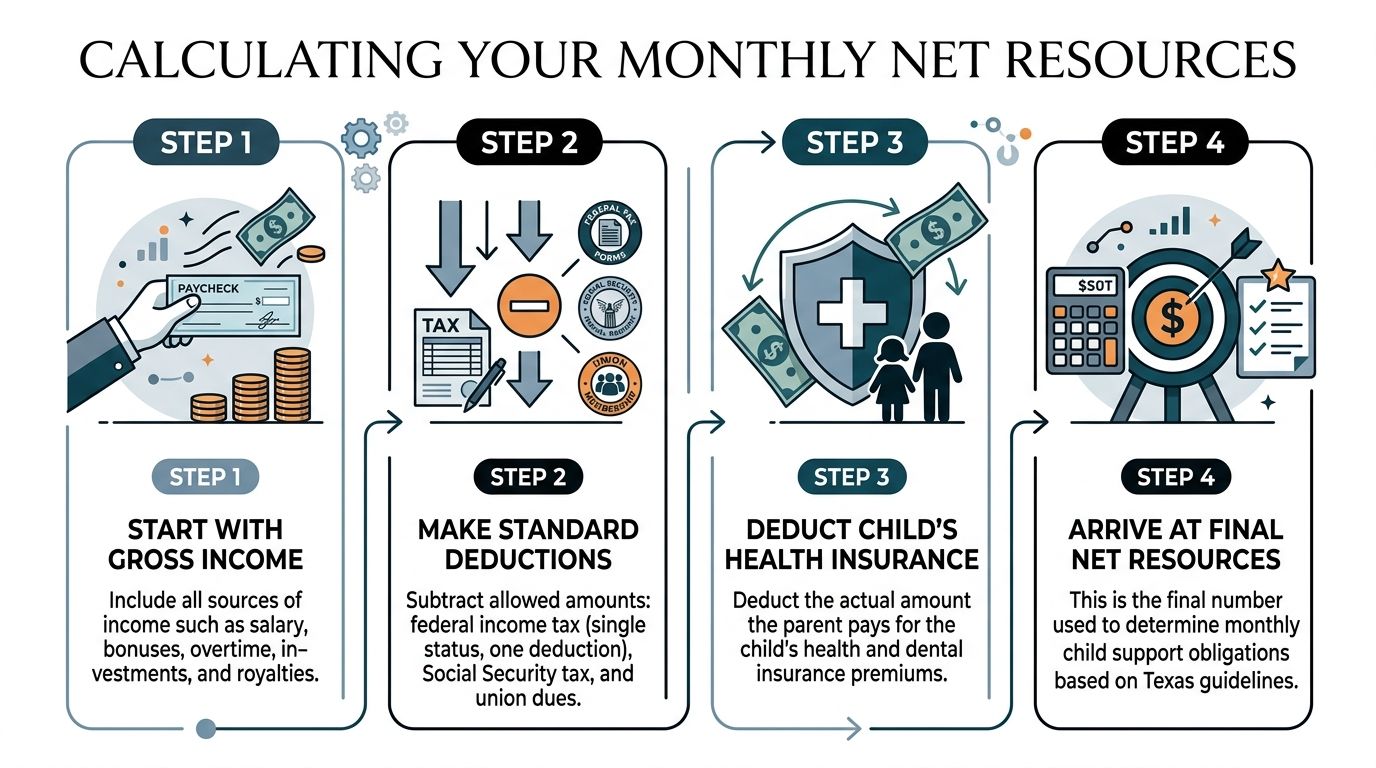
Net resources cover nearly all income—salary, commissions, overtime, rental income, and investment dividends. From this gross total, the law allows for a few specific deductions: federal income taxes (for a single person with one exemption), Social Security taxes, and the child's health insurance premium costs. The remaining amount is the monthly net resources.
Once that number is established, the court applies a percentage based on the number of children needing support. For one child, the guideline is 20% of the obligor's net resources. This calculation provides the Montgomery County judge with a baseline amount for the final court order. Managing the details of these cases can be demanding, which is why many modern law firms use tools like an AI phone answering service for family lawyers to streamline client communication.
Real-World Scenario
Imagine a parent from The Woodlands is the obligor in a case with one child. After tallying all income and taking standard deductions, the court determines their monthly net resources are $5,000. Based on Texas guidelines, the starting child support amount would be $1,000 per month (20% of $5,000). This amount is legally presumed to be in the child's best interest.
A Montgomery County judge, however, has the final say and can adjust this amount up or down if there is clear evidence that doing so is in the child’s best interest.
What to Do Next
If you are beginning a child support case in Montgomery County, getting organized is the best first step.
- Gather Financials: Collect at least two years of pay stubs, tax returns, and records of any other income.
- Track Child-Related Costs: Start a spreadsheet to document expenses for health insurance, daycare, and special needs like tutoring or medical treatments.
- Know Your Custody Schedule: The amount of time each parent has with the child can sometimes be a factor in the final support amount.
- Understand the Basics: Knowing the guideline percentages will give you a realistic expectation. A child support lawyer in The Woodlands can help you navigate this process.
Disclaimer: This article is for informational purposes only and does not constitute legal advice. You should consult with a qualified attorney for advice regarding your individual situation.
How to Calculate Monthly Net Resources
Before you can determine a child support payment, you must first calculate the paying parent's monthly net resources. This is the most important number in any Texas child support case and the foundation for the entire calculation.
It's a common mistake to think this is just your take-home pay. It is a specific figure defined by the Texas Family Code, and getting it right is critical for a fair outcome in our local Montgomery County courts.
The process begins by calculating your total gross income. The court casts a wide net to capture all sources of income to ensure the child benefits from a parent's complete financial picture.
What Counts as Gross Income?
When the court examines your income, they look at everything. You must account for:
- Wages, Salary, and Tips
- Variable Pay: Commissions, bonuses, and overtime.
- Self-Employment Income: Net profit from a business.
- Investment & Rental Income: Dividends, interest, and rental profits.
- Other Sources: Severance pay, retirement benefits, Social Security (but not SSI), gifts, or prizes.
Essentially, if it is a source of cash or an asset that can be used to support your child, a judge in Conroe will count it as gross income.
Permitted Deductions
Once you have the total gross income, the Texas Family Code allows only a few specific deductions to arrive at your "net resources." You cannot deduct personal living expenses like car payments, rent, or credit card bills.
The only deductions allowed are:
- Federal income taxes (calculated for a single person with one exemption)
- State income taxes (not applicable in Texas)
- Social Security and Medicare taxes (FICA)
- Union dues (if mandatory)
- The child’s health and dental insurance costs that you pay out-of-pocket.
After subtracting these items from your gross monthly income, you are left with your monthly net resources.
Real-World Scenario
Let's use a practical example. Sarah lives in Conroe and will pay support for one child. She earns a $6,000 per month salary and an average of $500 a month in overtime.
- Gross Monthly Income: $6,000 (salary) + $500 (overtime) = $6,500
Now, we apply the standard deductions:
- Federal Income Tax (single, 1 exemption): ~$800
- Social Security & Medicare (FICA): ~$497
- Child’s Health Insurance Premium: $200
- Total Deductions: $800 + $497 + $200 = $1,497
Net Resources Calculation: $6,500 (Gross) – $1,497 (Deductions) = $5,003
For the court, Sarah’s monthly net resources are $5,003. This is the figure used in the child support guideline percentage.
What to Do Next
Figuring out your net resources is a critical first step. Being prepared will make the process smoother and help you anticipate the final child support amount.
- Gather Proof: Collect recent pay stubs (at least six months), the last two years of tax returns, and any 1099s.
- Document Insurance Costs: Find the statement from your employer showing the exact amount deducted for the child's health coverage.
- Get an Estimate: The Texas Attorney General offers an online child support calculator for a rough idea. Remember, it's not a substitute for an attorney's analysis.
- Be Transparent: Hiding income can lead to severe penalties from a judge. It is always better to be honest.
Disclaimer: This article is for informational purposes only and does not constitute legal advice. You should consult with a qualified attorney for advice regarding your individual situation.
Applying the Standard Texas Child Support Percentages
Once the paying parent's monthly net resources are determined, the next step is applying the percentage-based formula from the Texas Family Code. Judges in Montgomery County use this formula as their starting point to create a consistent and predictable outcome. The law presumes this guideline amount is in the child's best interest.
The percentage applied depends almost entirely on the number of children involved in the lawsuit.
The Guideline Percentages
The Texas Family Code provides a standard table that links the number of children to a percentage of the obligor's net resources.
| Guideline Child Support Percentages in Texas | |
|---|---|
| Number of Children | Percentage of Net Resources |
| 1 Child | 20% |
| 2 Children | 25% |
| 3 Children | 30% |
| 4 Children | 35% |
| 5 Children | 40% |
| 6+ Children | Not less than 40% |
These percentages are the baseline and apply when the paying parent does not have a legal duty to support other children from another relationship. If they do, the percentages are adjusted downward. The amount of time a parent spends with their child under a Texas standard possession order can also sometimes influence the final support order.
The "Cap" for High-Income Earners
A critical part of the child support guidelines Montgomery County families should understand is the "cap." Texas law sets a ceiling on the amount of monthly net resources to which the standard percentages automatically apply. As of 2026, that cap is $9,200 per month.
If the paying parent's net resources are at or below $9,200, the calculation is simple. For one child and $8,000 in net resources, the guideline support would be $1,600 (20% of $8,000).
If the paying parent earns more than $9,200 per month, the calculation starts with the cap. For two children, support would begin at $2,300 (25% of $9,200). A Montgomery County judge can order additional support above this amount, but only if the receiving parent proves the child has specific needs that justify it, such as private school tuition or costly medical treatments.
Real-World Scenario
Let's imagine Mark, a parent in The Woodlands, has two kids. His monthly net resources are $12,000. Since his income is over the $9,200 cap, the court first calculates the baseline support using the capped amount.
The guideline for two children is 25%. His starting child support obligation is $2,300 per month (25% of $9,200). If his ex-spouse can show the judge that the children have proven needs costing more than that—perhaps for specialized tutoring—she could ask the court to order additional support from Mark's income above the cap.
What to Do Next
Knowing these percentages and the cap helps you set realistic expectations.
- Know the Child Count: Use the percentage that matches the number of children in your specific case.
- Account for Other Children: If the paying parent supports other children, this will change the calculation.
- Check Against the Cap: Is the parent’s income above or below the $9,200 monthly net resource cap?
- Document Extra Needs: If you are the receiving parent and believe your child’s needs exceed the guideline amount, start gathering proof like receipts and invoices.
Disclaimer: This article is for informational purposes only and does not constitute legal advice. You should consult with a qualified attorney for advice regarding your individual situation.
When a Judge Can Deviate From the Guidelines
While the Texas child support formula provides a predictable starting point, family life rarely fits into a neat box. Judges in Montgomery County have the power to order more or less than the standard guideline amount if evidence shows it’s in the child’s best interest.
A judge won’t stray from the guidelines lightly, but they must do so if a parent presents a compelling, fact-based reason. The court's decision is guided by a specific list of factors found in the Texas Family Code, Section 154.123, which allows them to consider the child’s entire situation.
Factors That Justify a Deviation
When a parent asks a Conroe court for a non-guideline amount of support, they must provide proof. Common reasons a judge might adjust the amount include:
- Age and Needs of the Child: An infant's needs are different from a teenager's. A child with a disability or chronic illness will likely require support beyond the standard calculation.
- Ability of Parents to Pay: The court can review a parent’s entire financial picture, including assets, debts, and earning potential.
- Time of Possession: If the non-primary parent has the child significantly more than a standard order dictates (like a 50/50 split), a judge might lower their support obligation.
- Child Care Expenses: Unusually high daycare costs necessary for a parent to work can be a reason to adjust the order.
- Extraordinary Expenses: This includes costs like private school tuition, competitive sports leagues, or specialized tutoring.
If sticking to the formula would be unjust or inappropriate for the child, the judge has the authority to make a change.
Real-World Scenario
Imagine a family in Spring. The paying parent has monthly net resources of $7,000. For one child, the standard guideline is $1,400 per month (20%).
However, their 10-year-old is a gifted pianist with severe asthma. The receiving parent provides proof that private music lessons cost $400 a month, and specialized medical care runs another $300 a month after insurance. That’s $700 in extra, proven needs. A Montgomery County judge would likely find it’s in the child's best interest to deviate upward and order a higher monthly payment to cover these necessary expenses.
What to Do Next
If you believe your case requires a deviation from the child support guidelines in Montgomery County, you must be prepared.
- Identify the Factors: Pinpoint which factors from the Texas Family Code apply to your child's situation.
- Gather Evidence: Collect receipts, invoices, bank statements, and medical records to document every extra expense.
- Create a Detailed Budget: Present the court with an itemized budget of the child’s actual monthly expenses.
- Be Specific: State the exact amount of support you are requesting and be ready to explain how you calculated it based on your evidence.
Disclaimer: This article is for informational purposes only and does not constitute legal advice. You should consult with a qualified attorney for advice regarding your individual situation.
Changing or Enforcing a Child Support Order in Montgomery County
A child support order is not necessarily set in stone. As life changes, the Texas Family Code provides ways to address these shifts through a modification or an enforcement.
A modification is used when you need to change the order itself, such as the monthly payment amount. An enforcement is what you file when the other parent is not following the existing order.

Modifying Your Child Support Order
To change a child support order, you must prove to a judge in Conroe that there has been a “material and substantial change in circumstances” since the last order was signed. Common reasons include:
- Involuntary Job Loss
- A Significant Change in Income
- Changes in the Child's Needs (e.g., a new medical diagnosis)
- A Change in Primary Custody
- A Significant Change in Health Insurance Costs
Additionally, if it has been at least three years since your order was signed, you can request a review. If a new calculation shows the support amount would change by 20% or $100, a judge will likely grant the modification. You can learn more about modifying a child support order in The Woodlands.
Enforcing a Child Support Order
When a parent fails to pay court-ordered support, an enforcement action asks a Montgomery County court to step in. A judge has serious power to enforce compliance, including:
- Wage Garnishment: Taking support directly from the obligor’s paycheck.
- Property Liens: Placing a claim on property like a house or land.
- License Suspension: Suspending driver's, professional, and even hunting licenses.
- Jail Time and Fines: For repeated non-payment, a judge can order jail time.
The court can also order the parent to pay all missed payments with interest. This back-owed support is called an "arrearage" and does not go away.
Real-World Scenario
David, a dad in Conroe, was laid off from his engineering job. His support was based on his old salary, and he couldn't keep up. He immediately filed a Petition to Modify Child Support, providing proof of his layoff. The court temporarily lowered his payments, saving him from accumulating massive debt.
What to Do Next
If your situation has changed or you are not receiving payments, you must go through the proper legal channels. A verbal agreement is not legally binding.
- Identify Your Goal: Are you trying to change the order (Modification) or enforce the current one (Enforcement)?
- Gather Your Proof: For a modification, you need documents like termination letters or new pay stubs. For an enforcement, you need a record of all missed payments.
- File the Right Paperwork: A formal petition must be filed with the Montgomery County court that issued your original order.
- Follow the Current Order: Until a judge signs a new order, the old one remains in full effect.
Disclaimer: This article is for informational purposes only and does not constitute legal advice. You should consult with a qualified attorney for advice regarding your individual situation.
Navigating the complexities of the child support guidelines in Montgomery County can be challenging. An experienced attorney can ensure you build the strongest possible case. To discuss your situation, schedule a consultation with our office.
