 Skip to content
A lot of parents in The Woodlands start in the same place. You're sitting at the kitchen table, looking at school expenses, health insurance, groceries, and the cost of two households instead of one. You may be in the middle of a divorce, dealing with a custody case, or trying to fix an order that stopped making sense months ago.
What individuals seek isn't a lecture on family law. They want clear answers. Who pays. How much. What happens if income changed. What to do if the other parent stopped paying. And, just as important in Montgomery County, how the local court process usually unfolds in real life.
When you need a child support lawyer in The Woodlands, TX, you're probably not looking for theory. You're looking for a plan that protects your child and keeps a difficult situation from getting worse.
Navigating Child Support in The Woodlands
A parent in The Woodlands might be trying to hold it together in public and falling apart in private. You may be dropping the kids off near Alden Bridge, heading to work, and wondering how you're supposed to cover everyday expenses while a divorce or custody case moves through Montgomery County. That stress is real, and it gets heavier when nobody gives you a straight answer.
Child support isn't just a line item in a court order. It's tied to housing, school routines, medical care, activities, and stability. When support is set too low, delayed, or never enforced, children feel it first. When support is set inaccurately against the paying parent, that can create a different kind of instability and a higher risk of future litigation.

What local families usually need most
In Montgomery County cases, parents usually need three things right away:
- A realistic support number: Not a guess, and not what the other parent says sounds fair.
- A workable court process: Filing the right case, serving the other side, gathering records, and preparing for hearings or mediation.
- A plan for the child: Support and parenting issues often affect each other, even when they are technically separate questions under the Texas Family Code.
Children also need support outside the courtroom. During separation, many parents find practical value in Children Psych's divorce coping guide, especially when they're trying to keep routines steady while legal issues are still unresolved.
Child support cases go better when parents stay organized early. The families who struggle most are often the ones who wait too long to collect records or assume informal promises will hold.
The sooner you understand the process, the more control you have.
Do You Really Need a Lawyer for Child Support
You file what looks like a simple child support case in Montgomery County. Then the other parent's pay changes from week to week, someone gets paid partly in cash, or a hearing gets set before the records are ready. That is usually the point where parents realize child support is not only about a monthly number. It is also about procedure, proof, and getting an order the court can enforce.
Some cases can be handled without a lawyer. Agreed cases with clear pay records and no dispute over past payments are the usual example. If both parents are cooperative and the paperwork is done correctly, self-representation may be a reasonable choice.
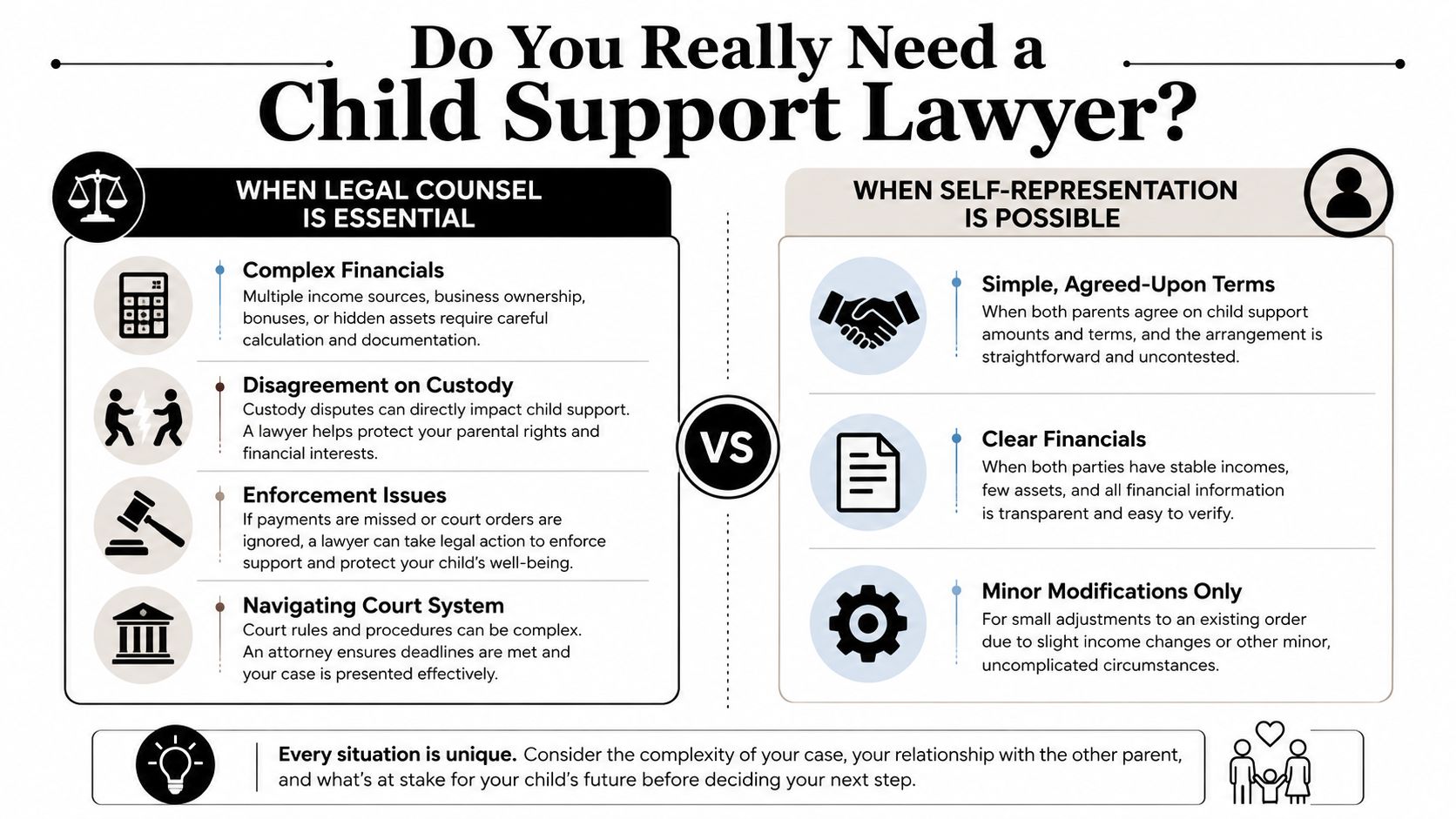
Many Woodlands cases do not stay that simple for long.
When legal counsel usually matters
A lawyer tends to matter most when the dispute is less about the guideline formula and more about building a record the judge can rely on in Montgomery County.
If you're establishing an order during divorce or custody litigation
Early orders have staying power. A temporary support amount often shapes settlement talks, budgeting, and each side's expectations for months. If income documents are incomplete or the number is rushed into an agreed order, fixing it later usually costs more than getting it right the first time.
In local courts, timing also matters. Parents sometimes assume they can explain missing documents at the hearing. Judges usually want organized records before then, not promises that they will show up later.
If income isn't straightforward
Cases involving self-employment, contract work, bonuses, commissions, rental income, or a family business are rarely good do-it-yourself cases. The problem is proof.
A parent may be convinced the other side earns more than reported. That does not carry a hearing. Tax returns, bank statements, payroll records, profit and loss statements, and testimony that matches the documents carry a hearing. If you want a better sense of how courts start analyzing income, review these Montgomery County child support guideline factors.
If support needs to be changed
Modification cases trip people up because the legal standard and the evidence have to line up. A job loss, promotion, remarriage, new baby, or changed custody schedule may matter, but the court still needs current financial records and a clean explanation of what changed and when.
Another common mistake is waiting too long. In practice, delay can mean months of paying under an order that no longer fits the facts, because the court cannot retroactively fix every problem.
Practical rule: If the key records are in the other parent's hands, assume you may need formal discovery and a hearing plan.
If payments stopped
Enforcement cases are technical. The order has to be clear. The payment history has to be accurate. The request for relief has to match what the court can grant.
In Montgomery County, self-represented parents often lose ground. They show the judge that money is owed, but the motion does not plead the missed payments with enough detail, or the exhibits are incomplete, or the arrears calculation does not match the order language.
When self-representation may be realistic
Handling it yourself may be realistic in a narrower group of cases:
- Fully agreed cases: Both parents agree on support, exchange income records voluntarily, and are ready to sign clear paperwork.
- Simple wage income: One employer, steady pay, no side business, and no dispute about health insurance or prior support obligations.
- Limited cleanup work: Correcting a clerical issue or finishing an uncontested matter that is already largely resolved.
Even then, many parents benefit from paying for a short review before filing. A one-hour consult often costs far less than redoing defective papers or returning to court because an order was too vague to enforce.
What a lawyer actually helps with
Good child support representation is practical. It means confirming the income picture, choosing the right procedural path, preparing the evidence, and drafting orders that hold up later.
In Montgomery County, that often includes checking whether your case belongs in an existing SAPCR, whether service has been handled correctly, whether mediation is likely before a final setting, and whether the proposed order says enough to avoid future enforcement fights. Those are local process issues generic Texas articles often skip, and they are often where avoidable mistakes happen.
The cost-benefit question is usually straightforward. If the amount at issue is modest, the case is agreed, and the documents are clean, limited legal help may be enough. If the case involves disputed income, arrears, contempt risk, or a modification fight, hiring counsel is often the cheaper decision in the long run.
How Texas Calculates Child Support Payments
Texas child support starts with a guideline framework in Texas Family Code Chapter 154. In plain English, the court looks at the paying parent's net resources and then applies a guideline percentage based on the number of children before the court.
The part that surprises many parents is this: small differences in how income is counted can change the monthly result in a meaningful way. That's why arguments over pay stubs, bonuses, business income, and allowable deductions can matter so much in Montgomery County cases.
The guideline percentages
Under the Texas guideline framework, the baseline amount is 20% of the obligor's net resources for one child, 25% for two children, 30% for three, 35% for four, and 40% for five. For six or more children, support is "not less than" the five-child amount, as described in this overview of Texas child support guidelines.
Here is the quick-reference chart most parents want.
| Number of Children | Percentage of Net Resources |
|---|---|
| One | 20% |
| Two | 25% |
| Three | 30% |
| Four | 35% |
| Five | 40% |
| Six or more | Not less than the five-child amount |
For a closer local discussion, many parents also review Montgomery County child support guidelines.
What "net resources" means in practice
Often, confusion begins. People often focus on gross income because that's the easiest number to spot. The court focuses on net resources, which is not always the same thing.
In a routine wage-earner case, the analysis may be fairly direct. In a more complicated case, it may involve questions about commissions, inconsistent pay, business income, or whether reported income reflects actual earning ability.
That doesn't mean every hearing becomes a fight. It means accuracy matters.
Why parents get this wrong
Parents usually make one of three mistakes:
- They rely on rough online estimates. Those tools can be useful for orientation, but they don't replace a case-specific review.
- They assume equal time means no support. That's not automatically true.
- They treat informal agreements like court orders. Courts enforce signed orders, not side conversations.
If the number was built on incomplete income information, the problem doesn't stay small. It follows the family into temporary orders, settlement talks, and enforcement later.
When the court may depart from the baseline
The guideline percentages are the starting point, not the end of every discussion. Under the Texas Family Code, courts can look at case-specific facts when deciding whether a different amount is appropriate. That usually turns on evidence, not frustration.
The practical takeaway is simple. Child support isn't just a percentage problem. It's a documentation problem.
The Child Support Process in Montgomery County Courts
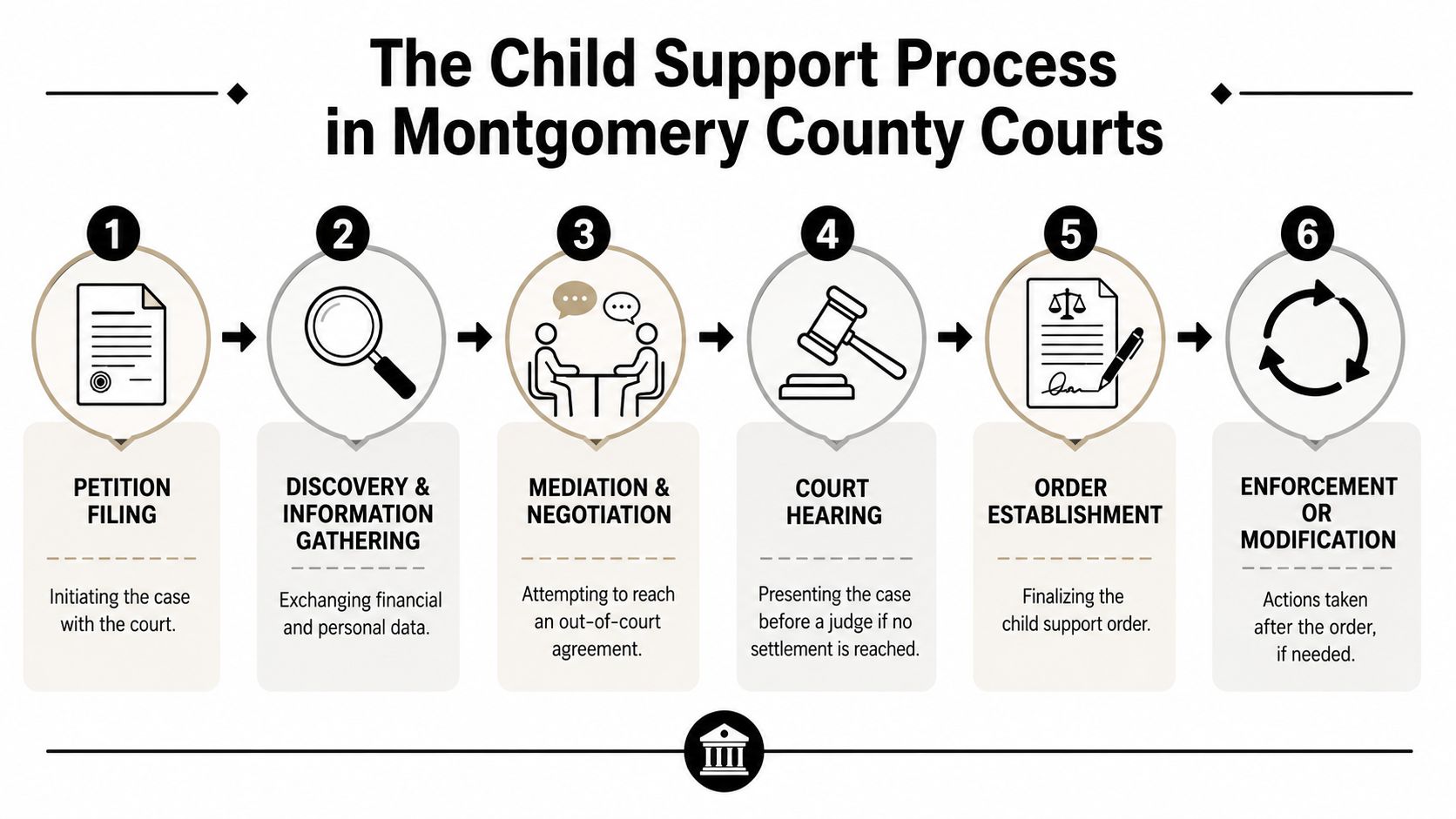
Most parents feel better once they know the sequence. A child support case in Montgomery County has a rhythm. The paperwork starts the case, service brings the other parent in, financial records drive the negotiations, and many disputes narrow before any final hearing happens.
When people don't know that rhythm, they overreact to the wrong things and miss the important ones.
Where the case starts
If you're filing in Montgomery County, the case is typically opened through the district clerk in Conroe. The exact filing depends on whether child support is part of a divorce, a custody case, or a modification or enforcement action under the Texas Family Code.
After filing, the other parent usually must be formally served unless they waive service. That step sounds routine, but it often causes early delay. If service isn't done correctly, the rest of the case can stall.
What happens after filing
Once both sides are in the case, the focus shifts quickly to information.
- Financial records: Pay information, tax records, insurance details, and other proof of income or expenses.
- Parenting facts: Who has the child when, what the child needs, and whether related custody issues are affecting support.
- Temporary requests: In some cases, a parent needs temporary support before the entire case is finished.
This is also where many parents learn that a calm, organized presentation matters. Judges and coordinators in Montgomery County see family conflict every day. The parent who shows up with complete records usually has a major practical advantage over the parent who shows up angry but unprepared.
To get a feel for the process, this short video gives a useful overview:
A local example from Alden Bridge
Sarah lives in Alden Bridge and needed an initial child support order after separating from the child's father. At first, she thought the case would be simple because he agreed he should pay support. The problem started when the financial documents didn't line up with what he had told her informally.
She filed, got the case moving, and then had to wait on complete income information. Mediation became the turning point. Once both sides had the documents in front of them, the conversation changed from argument to numbers.
That scenario is common. Agreement in principle doesn't always mean agreement on facts.
Mediation and hearing practice
In many Montgomery County family cases, mediation is a serious checkpoint. It gives both sides a chance to settle before asking the court to decide the dispute. Good mediation preparation is not just showing up with a number in mind. It's arriving with records, a payment position, and a practical sense of what you can prove.
If settlement doesn't happen, the case moves toward a hearing or trial setting.
Local reality: The parent who prepares for mediation as if a hearing will happen usually negotiates from a stronger position.
Common pitfalls in this courthouse process
Several mistakes come up again and again:
- Waiting too long to file: Delay can worsen arrears or lock in an unrealistic status quo.
- Bringing incomplete documents: Missing records weaken otherwise valid arguments.
- Confusing custody and support: They affect each other, but one problem doesn't excuse ignoring the other.
- Relying on verbal promises: If it isn't in an enforceable order, it may not protect you.
The process isn't mysterious once you see the moving parts. It is procedural, document-heavy, and easier to manage when you stay ahead of deadlines.
Enforcing and Modifying Support Orders in The Woodlands
Once a support order is signed, many parents think the hard part is over. Sometimes it is. Sometimes the true dispute begins after the order, when life changes or payments stop.
In The Woodlands, post-order cases usually fall into two tracks. Modification asks the court to change an existing order. Enforcement asks the court to make someone follow it.
Modification after circumstances change
Texas courts don't modify child support just because one parent thinks the number feels unfair. Under the Texas Family Code, the request has to fit the legal standard.
A common ground is a material and substantial change in circumstances. That may involve a job loss, a meaningful change in earnings, or a shift in the child's needs. The court needs evidence that the old order no longer matches current reality.
What works in modification cases:
- Current income proof: Recent pay information, tax records, and employment changes.
- A clear timeline: When the change happened and how it affected the household.
- Filing promptly: Waiting can make the problem worse because the existing order remains in place until a new order is signed.
What doesn't work:
- General complaints: "I can't afford it" is not enough by itself.
- Assumptions about the other parent's income: The court wants proof.
- Informal side deals: Parents often agree temporarily, then discover the old order is still controlling.
Enforcement when payments stop
Enforcement is often more technical than parents expect. The court may have tools available, but you still need the right pleadings, the right payment history, and the right remedy request.
A major problem in Texas enforcement is job change disruption. As explained in this discussion of The Woodlands child support enforcement issues, wage withholding can stop when the obligor changes employers. That creates a predictable breakdown point if no one moves quickly to verify the new employer, update income information, and pursue other enforcement tools when needed.
Why arrears grow faster than people expect
Parents often assume that once wage withholding is in place, support will continue automatically. That's not always true. If the paying parent changes jobs and no one tracks the interruption, missed payments can pile up even though there is already a valid order.
That is why enforcement work often requires fast action:
- Verify the employer quickly
- Confirm whether withholding is still active
- Update income information
- Use alternate remedies when payroll withholding is interrupted
For a more detailed look at available remedies, parents in this area often review enforcing child support in Montgomery County.
A signed order is only part of the solution. Collection usually depends on follow-through.
Choosing the right post-order strategy
Some cases need modification first. Others need enforcement first. A few need both.
For example, if the paying parent lost a job and the order is no longer realistic, modification may be the priority. If the parent is working and stopped paying, enforcement may need to happen immediately. The facts matter, and timing matters just as much.
Parents get into trouble when they freeze. They assume missed payments will sort themselves out, or they wait for the other parent to "do the right thing." In family court, delay usually helps the less cooperative side.
What to Ask and How Much to Budget for a Lawyer
Many individuals don't hire family lawyers often enough to know what a normal fee conversation sounds like. That's fine. You don't need to know everything walking in. You just need to ask good questions.
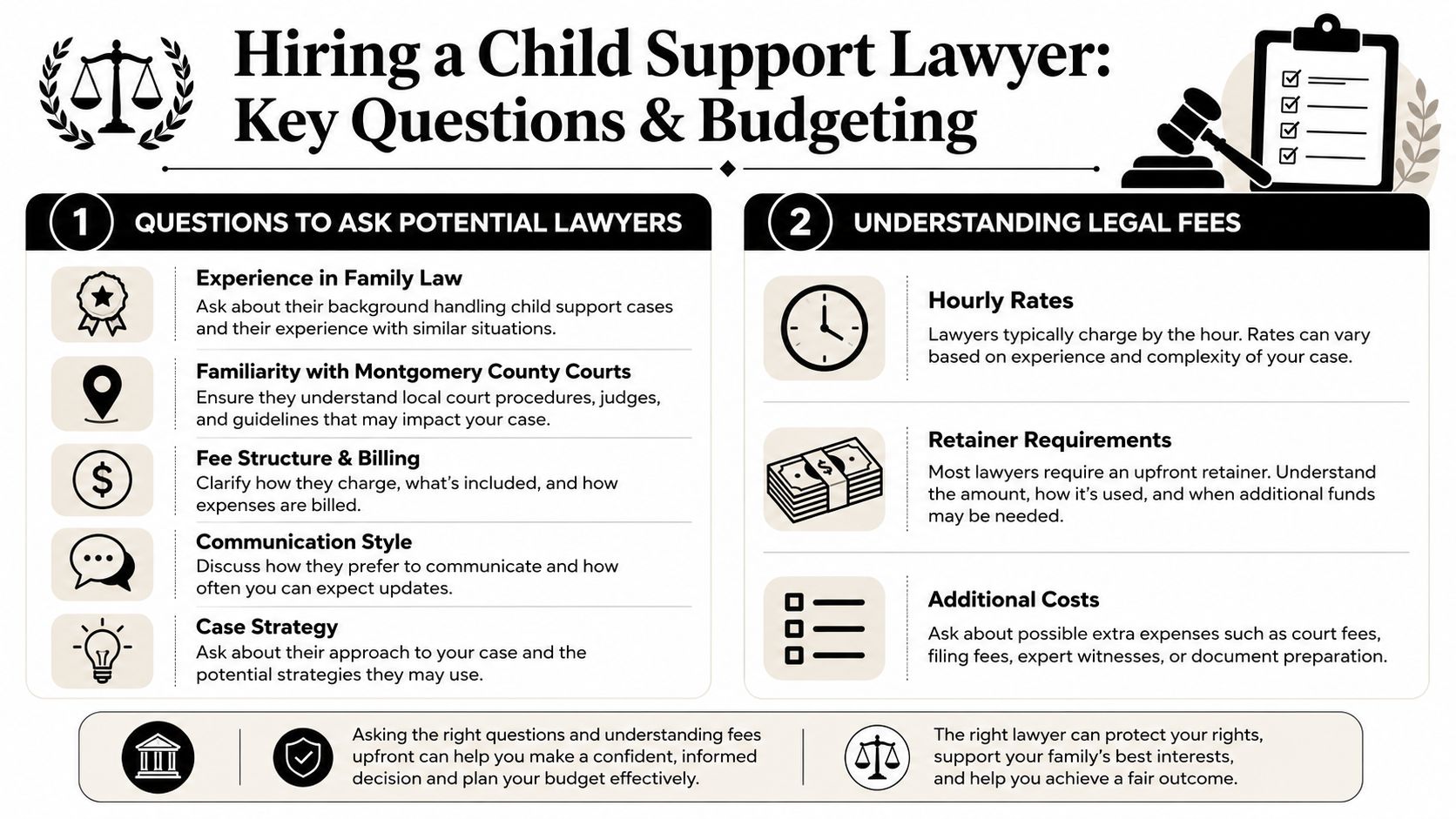
Child support cases are commonly billed in one of a few ways. Some firms use hourly billing, where you pay for the attorney's time and case work as it happens. Some require a retainer, which is an advance deposit against future work. In limited matters, a firm may offer a flat fee for a clearly defined task.
What matters most isn't finding the cheapest label. It's understanding what the fee covers and what it doesn't.
Questions worth asking in a consultation
Use the first meeting to test clarity, not just chemistry.
How often do you handle child support cases in Montgomery County?
You want someone who understands the local court process, not just Texas family law in the abstract.What is your initial read on my main risk?
A useful lawyer should be able to identify the pressure point quickly.Do you expect this case to settle, mediate, or need a hearing?
No honest lawyer can promise an outcome, but they should explain the likely path.What documents do you want from me first?
This question tells you how organized the office is.How does your office handle communication?
Ask who returns calls, how updates are given, and what response times generally look like.What fee structure fits a case like mine?
Get clarity on billing, retainer use, and added costs such as filing fees or service expenses.How do child support and custody issues overlap in my situation?
In many cases, they don't sit neatly in separate boxes. If you need context on related parenting disputes, this overview of child custody lawyer costs in The Woodlands may help frame the bigger picture.
What a healthy fee conversation sounds like
A solid consultation should leave you with:
- A scope of work: What the lawyer will do and what remains uncertain.
- A realistic process view: Not false comfort.
- A document list: So you can start immediately.
- A budgeting framework: Enough to plan, even if the exact total depends on conflict level and court activity.
If a lawyer avoids specifics, speaks only in generalities, or seems irritated by practical cost questions, keep looking.
Your Child Support Next Steps Checklist
If you're dealing with child support in The Woodlands or anywhere in Montgomery County, the best next step is usually not a dramatic one. It's organization.
Start with the documents. Build a timeline. Preserve communication. Most child support problems become easier to evaluate once the paper trail is in one place.
What to do next
- Gather income records: Collect pay stubs, tax returns, benefit information, and any proof of irregular income.
- Pull prior orders: Find the most recent signed court orders, including any temporary orders.
- Track payments or missed payments: Use bank records, state disbursement records, receipts, and written communication.
- Write a short timeline: Note job changes, moves, major child-related expenses, and key dates in the case.
- Save messages carefully: Keep texts, emails, and app communications with the other parent.
- List your questions before a consultation: That keeps the meeting focused and useful.
- Act before the problem grows: Delay usually creates more expense and more conflict.
A final practical note
Don't rely on assumptions. Don't assume the other parent's paycheck stayed the same. Don't assume a missed payment will be fixed next month. And don't assume a verbal agreement changes a court order.
Bring order to the facts first. Legal strategy gets much easier once the documents are under control.
Disclaimer: This article is for informational purposes only and is not legal advice. Reading it does not create an attorney-client relationship. Child support outcomes depend on the facts of your case, the evidence available, and the orders already in place.
If you need case-specific guidance, schedule a consultation and get advice based on your actual documents, your actual court posture, and your child's actual needs.
If you'd like to talk through your child support situation with a local family law team, you can schedule a consultation with The Law Office of Bryan Fagan. For parents in The Woodlands and Montgomery County, a focused conversation early often helps prevent bigger problems later.
