 Skip to content
A lot of parents in The Woodlands don't start by saying, “I need a modification.” They say something more immediate.
“I lost my job and I can't keep paying this.”
“My commissions dropped and the numbers on paper don't match real life.”
“Our child now has medical needs that weren't part of the order.”
“We changed the schedule, but support never changed with it.”
Those are real pressure points, especially in Montgomery County where many parents have income that isn't a simple salary. A child support order can be changed, but not because life feels harder. It has to fit Texas law, and the strength of the case often comes down to timing, records, and whether the requested change is worth filing in the first place.
That's where a Child Support Modification Lawyer in The Woodlands becomes useful. The issue usually isn't whether something changed. The issue is whether you can prove a legally meaningful change in a way a judge will accept, and whether filing now helps or hurts your position.
Your Life Changed Is It Time to Change Your Child Support
A parent in Sterling Ridge loses a steady job and moves into contract work. Another in Alden Bridge gets promoted and now pays much more for the child's health coverage. A child in Panther Creek starts therapy or needs ongoing treatment that didn't exist when the order was signed. Those situations don't fit neatly into the old numbers.
That's often when people realize child support orders aren't self-updating. Even if both parents know the current order no longer makes sense, the court order stays in place until a judge signs a new one.

A modification case is the formal process for bringing the order back in line with current circumstances. Sometimes that means asking for lower support after a serious drop in income. Sometimes it means requesting more support because the child's needs changed. Sometimes it means correcting an order that no longer matches the actual custody schedule.
Practical rule: If the order and your actual life have been out of sync for a while, waiting usually makes the legal problem harder, not easier.
The biggest mistake I see is assuming common sense is enough. It isn't. Courts don't modify support because a parent is frustrated, stretched thin, or verbally promised a different arrangement. They modify support when the facts, documents, and legal standard line up.
A short local scenario
Take a parent in The Woodlands with mostly commission income. One slow month doesn't usually persuade anyone. But a sustained downturn supported by statements, deposits, and tax records may tell a very different story. The same is true on the receiving side. If a child's expenses have increased, the parent asking for more support needs organized proof, not estimates.
That's why the first question usually isn't “Can I file?” It's “Is this case strong enough to be worth filing now?”
When You Can Legally Modify Child Support in Texas
A parent loses a commission-based job in The Woodlands, picks up contract work, and sees income swing from month to month. Another parent has the opposite problem. The child is older, uninsured expenses are climbing, and the current order no longer comes close to covering ordinary needs. Both situations can justify a modification, but only if they fit the legal standard and the proof is there.
Texas courts usually modify child support under Texas Family Code § 156.401 through two paths. In Montgomery County, the key question is not just whether life changed. The question is whether the change is serious enough, documented well enough, and timed well enough to justify filing now.
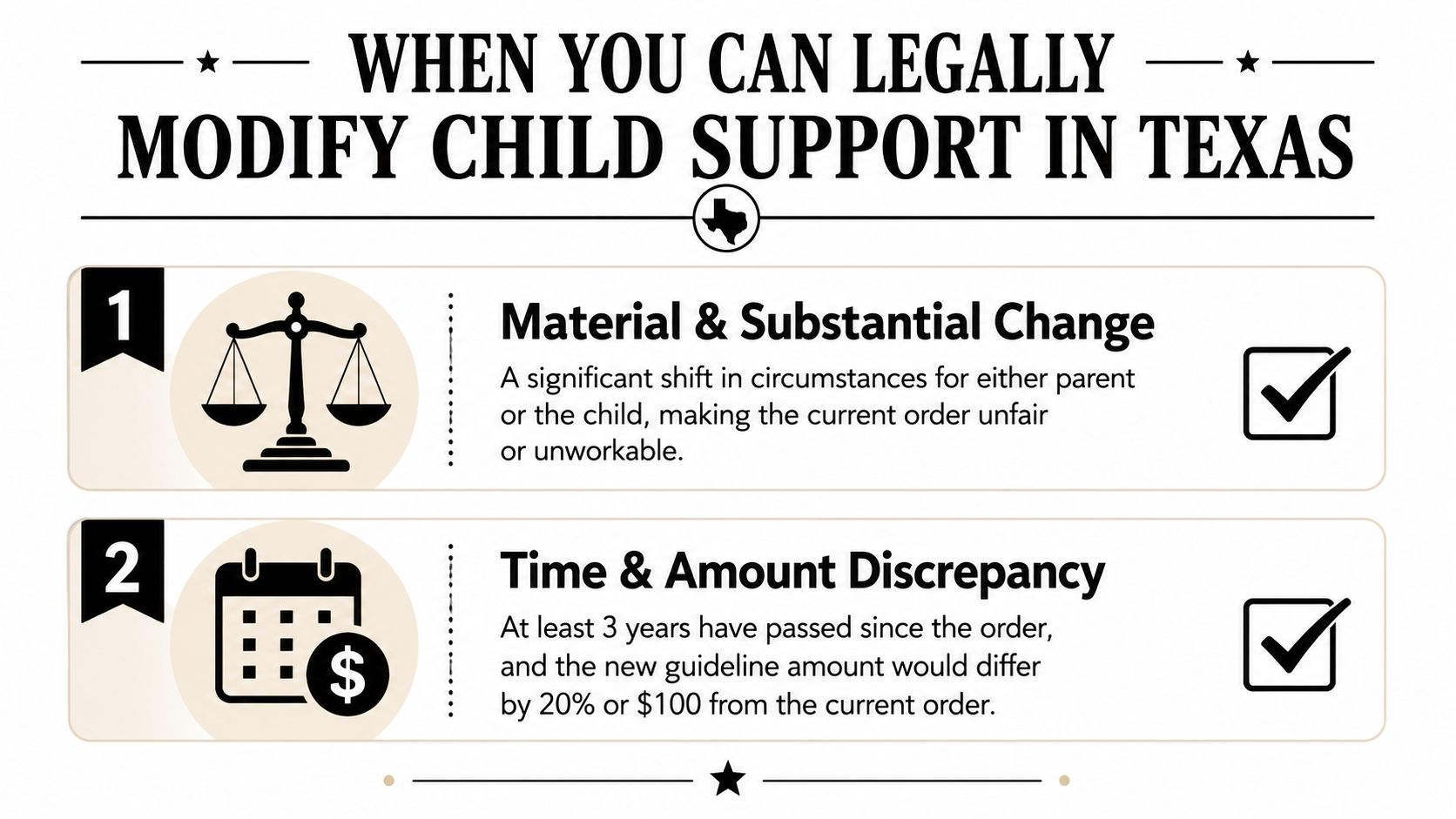
Material and substantial change
The first path is a material and substantial change in circumstances. That usually means a meaningful shift in income, medical insurance costs, the child's needs, or the amount of time the child spends with each parent.
Judges do not treat every change the same way. A short dip in overtime, one bad month in a sales role, or a voluntary reduction in work hours often leads to a weak case. A longer pattern usually matters more. For parents with salary income, that may be straightforward. For self-employed parents, business owners, commission earners, real estate agents, or people paid through irregular contracts, the court will look past a single pay period and ask what earnings look like over time.
That is where many cases are won or lost. In a non-standard income case, a judge is more likely to be persuaded by tax returns, profit and loss statements, 1099s, bank deposits, client payment history, and business records that show a sustained change, rather than a spreadsheet prepared for court the week before the hearing.
The three-year guideline trigger
Texas law also allows modification when enough time has passed and the current order is out of line with the guideline amount. If at least 3 years have passed since the order was signed or last modified, and a guideline calculation would change support by either 20% or $100, the court may modify the order.
That rule helps, but it is often misunderstood. Three years alone is not enough. The recalculated amount must differ enough to meet the statute. Before filing, it makes sense to compare the existing order against the current guideline framework. This overview of understanding child support guidelines in Montgomery County explains how those calculations are generally approached.
What actually persuades the court
In practice, judges want specifics.
If income dropped, show when it dropped, why it dropped, and whether the change is likely to continue. If you were laid off, records from the employer help. If your commission income fell, monthly statements and deposits over a meaningful period usually carry more weight than testimony alone. If you own a business, expect scrutiny about whether expenses are legitimate business costs or personal spending running through the company.
If support should increase, the same rule applies. General statements that "everything costs more now" rarely do much. Records of health insurance premiums, therapy bills, tutoring, daycare, prescription costs, or a documented change in the child's daily needs are more persuasive.
A change in possession can also support modification, but informal swaps and occasional extra weekends usually are not enough by themselves. The court will want to see that the actual schedule changed in a real, continuing way.
| Issue | Stronger filing position | Weaker filing position |
|---|---|---|
| Irregular income | Several months of records show a sustained change | You are relying on one unusually low month |
| Child-related expenses | Bills, insurance records, and recurring costs are organized | You only have estimates or memory |
| Possession schedule | The child has been living under a different routine for a substantial period | The schedule changed informally and inconsistently |
| Timing | You file as soon as the legal basis and proof are in place | You wait while arrears or underpayments continue to grow |
Timing matters more than many parents realize
Filing date matters because retroactive relief is limited. In many cases, the court's power to change support ties back to the date the modification request was filed, not the date your circumstances first changed.
That creates a real trade-off. File too early, and the evidence may be thin. Wait too long, and you may leave months of potential relief on the table. For a parent paying support after a genuine income drop, delay can mean owing under an order that no longer matches reality. For a parent seeking an increase, delay can mean absorbing child-related costs without a realistic way to recover them later.
The practical threshold is higher than many parents expect. A workable case usually has three parts at the same time. A legal basis to modify, records that hold up under scrutiny, and a filing date that protects your position.
The Modification Process in Montgomery County Step by Step
A child support modification case usually feels less overwhelming once you know the sequence. In Montgomery County, the case moves through a series of predictable stages, even though the pace and conflict level can vary from one family to another.
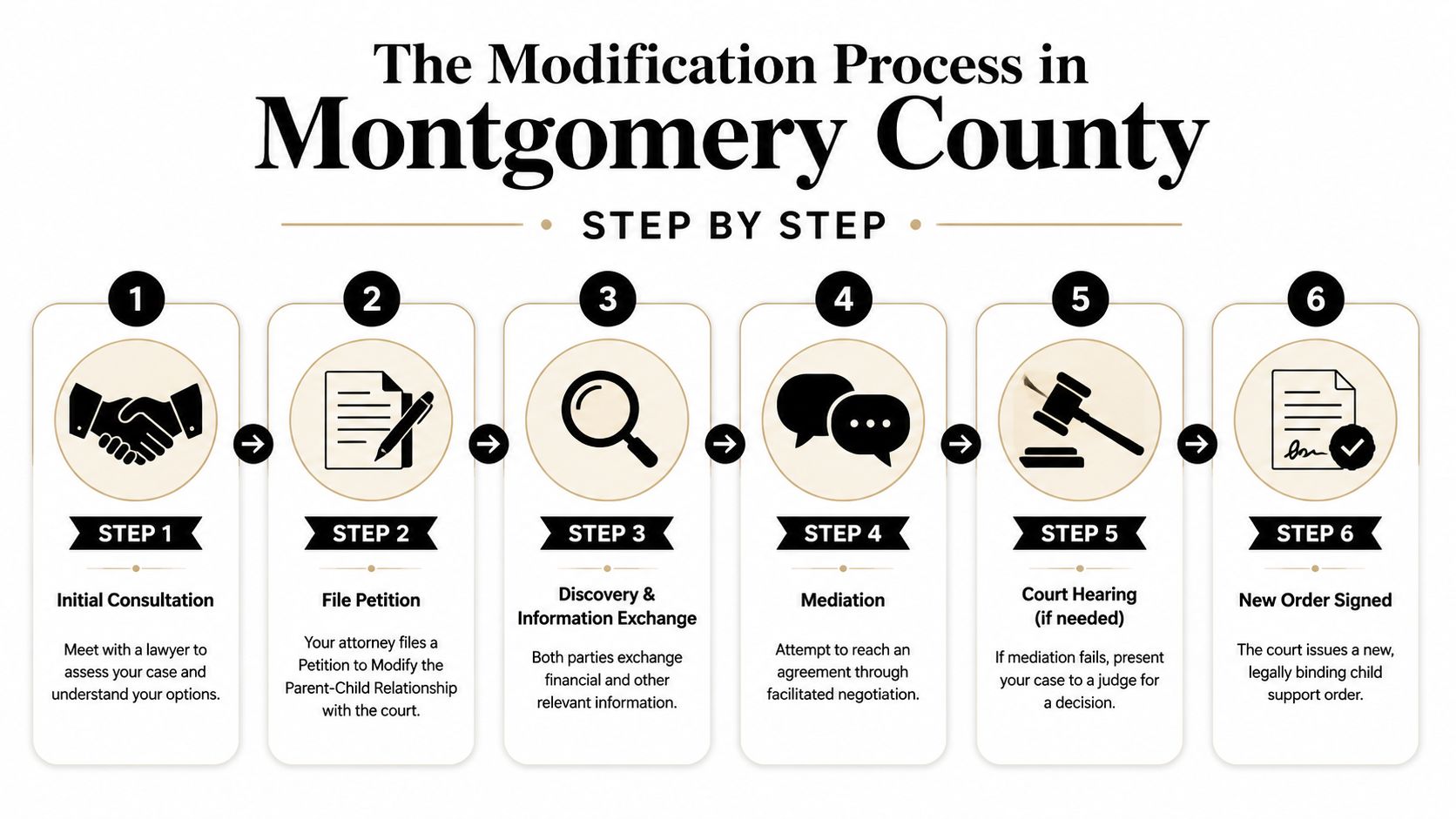
Filing starts the case
The process typically begins with a review of the existing order, current finances, and the reason for the requested change. If the facts support moving forward, the next step is filing a Petition to Modify the Parent-Child Relationship in the proper court.
That filing matters because it turns a private problem into a court case with deadlines, procedures, and a path toward a new order.
The other parent must be notified
After filing, the other parent must be formally served or otherwise brought into the case through proper procedure. This is not a technicality. Without proper notice, the case can stall or become vulnerable to challenge.
At that point, many parents realize this is no longer just a discussion between ex-partners. It's now a legal proceeding.
Here is a short overview of how the process works in visual form.
Financial exchange shapes the case
The next phase often involves exchanging financial information. That can include pay records, tax returns, business records, insurance information, and evidence tied to the child's needs. In many cases, this stage determines whether the matter settles or turns into a fight.
Parents with straightforward payroll income usually move through this stage faster. Self-employed parents, business owners, and commission earners often need more work because the court needs a reliable picture of actual net resources.
Mediation often decides the result
Many family courts in Montgomery County expect parties to attempt mediation before asking a judge to decide the dispute. Mediation is not just a box to check. It's often where practical outcomes are negotiated, especially when both sides understand the strengths and weaknesses of the evidence.
A mediated agreement can reduce uncertainty. But it still has to be turned into a signed court order.
If no agreement is reached, the judge decides
If mediation fails, the case goes to a hearing or trial. The judge reviews the evidence, applies the Family Code, and decides whether modification is warranted and what the new support order should say.
A simple roadmap looks like this:
- Initial review. Compare the old order to current facts.
- Petition filed. Start the legal process in the correct court.
- Service and response. Give the other parent formal notice.
- Financial disclosure. Exchange records and test the numbers.
- Mediation. Try to resolve the dispute before a hearing.
- Court order. Present the case if needed and obtain a signed modification.
Most anxiety comes from not knowing what happens next. Once the case is filed, the work becomes organized: prove the change, support the numbers, and move the court toward a written order.
Why a Child Support Modification Lawyer Is a Necessity Not a Luxury
Some parents think a modification is just a math problem. Fill out forms, tell the judge income changed, and get a new number. That approach can work in a narrow set of clean, agreed cases. It often breaks down when income is irregular, the records are incomplete, or the other parent disputes the story.

The real job is proof and strategy
A lawyer doesn't just file paperwork. A lawyer helps decide whether the case is worth filing now, what theory fits the facts, and how to present financial information in a way the court can use.
That matters most when the income picture is messy. Business owners may run personal and business expenses through the same accounts. Sales professionals may have seasonal earnings. Parents paid with bonuses or commissions may focus on their latest downturn, while the court looks for a broader earnings pattern.
Local knowledge changes the outcome
A Child Support Modification Lawyer in The Woodlands also brings local procedural knowledge. Montgomery County practice has its own rhythms, expectations, and negotiation realities. Knowing how to prepare for mediation, what records opposing counsel is likely to demand, and where a judge will focus can save time and reduce avoidable mistakes.
That's also why responsive intake matters at the front end. Many parents call only after arrears have built up or after the other side has filed first. If your schedule makes it hard to reach a firm during business hours, tools like SkipCalls legal intake can help families connect with counsel faster so a time-sensitive issue doesn't sit unattended.
DIY usually fails in predictable ways
The most common problems in self-filed modification cases include:
- Weak financial backup. A parent says income changed but brings only a few recent stubs or screenshots.
- Bad timing. They wait, hoping things improve, while the old order remains active.
- Informal side deals. Parents agree by text to lower support, but never get a court order.
- Unclear calculation issues. They don't understand what counts toward support or how to frame nonstandard income.
If you're comparing options, one local resource is the child support lawyer page for The Woodlands, which outlines the kind of family-law representation available for support disputes.
The point isn't that every case has to be a courtroom battle. The point is that even a cooperative case needs to be built correctly.
Building Your Case Evidence and Documents You Will Need
In modification cases, the facts matter. The documents usually matter more.
The practical filing question is often not whether your income changed, but whether the court will see enough reliable proof to justify a new order. That is especially true for self-employed parents, commission earners, and anyone whose monthly earnings move around. Guidance focused on child support modifications in Texas notes that this threshold question is often overlooked, and that Texas guideline support is based primarily on net monthly resources, capped at the first $11,700 of monthly net resources unless proven needs justify more, which means a small income change may not significantly affect support without strong documentation. See the discussion on when a child support modification is actually worth filing.
What judges usually want to see
A judge is looking for a clean, believable financial picture. That doesn't mean perfect records, but it does mean records that tell a consistent story.
Useful documents often include:
- Recent income records. Pay stubs, commission statements, or regular earnings summaries.
- Tax records. Returns and supporting schedules can help show the longer pattern behind a temporary spike or decline.
- Bank statements. Deposits often reveal whether reported income matches actual cash flow.
- Business records. Profit and loss statements, invoices, payroll records, and expense summaries can matter for owners and contractors.
- Health insurance proof. Premium changes and child coverage costs can directly affect the support analysis.
- Child-related expense records. Medical bills, therapy invoices, school-related costs, or other ongoing needs should be documented, not estimated.
Nonstandard earners need a different approach
A salaried employee can often show a change with a handful of payroll records. A self-employed parent usually can't. If your income comes from a business, commissions, bonuses, or uneven contract work, the court may look past one bad month and ask whether the downturn is real, sustained, and accurately documented.
That's where cases are often won or lost.
Bring records that show a pattern, not just a moment.
A parent with irregular income should think in layers. Start with the obvious records, then back them up. If the business is slower, show invoicing volume. If commissions dropped, show the statements over time. If deposits changed, show the bank records. If expenses are being questioned, separate personal spending from legitimate business costs as clearly as possible.
A short scenario from Panther Creek
A parent in Panther Creek works in sales and wants lower support after a drop in commissions. If that parent walks into court with only the latest statement, the case may look thin. If the same parent brings a series of commission reports, bank deposits, tax returns, and an employer summary confirming a sustained decline, the argument becomes much more credible.
The same logic applies to the receiving parent. If the child now needs recurring therapy or more expensive medical care, bring the invoices, coverage details, and records showing the expenses are ongoing.
Evidence that often hurts a case
Some records don't help as much as people expect. Others actively damage credibility.
| Evidence problem | Why it creates trouble |
|---|---|
| Texts saying “money is tight” | They show stress, not legal proof |
| One unusual month of low income | It may look temporary or selective |
| Handwritten expense estimates | Courts prefer records tied to actual payments |
| Mixed personal and business spending | It becomes harder to identify true net resources |
Keep your records organized before filing
Before a modification is filed, it helps to organize documents into a simple timeline:
- What the old order assumed
- What changed
- When it changed
- How the records prove it
- What new support amount you are asking the court to consider
That structure helps in negotiations, mediation, and court. It also helps answer the most important practical question in these cases: is the proof strong enough to justify filing now, or do you need better documentation first?
Understanding Timelines Costs and Retroactive Support
Parents usually ask two questions early. How long will this take, and when does the new amount start?
The second question is the more urgent one. A support reduction does not automatically begin when you lose a job or when your income drops. Guidance discussing child support practice in The Woodlands emphasizes that modifications are generally effective from the filing date forward, which means delay can allow the old amount to continue accruing as arrears. See the discussion on timing and child support changes after job loss.
Why delay is expensive
If you wait because you hope to recover financially next month, the court usually doesn't treat that wait as harmless. The old order remains enforceable until a new one is signed. For many parents, that creates a gap between what they can pay and what they legally owe.
That is why timing and records work together. File too early with poor proof, and the case may be weaker than it should be. File too late, and the old obligation may keep building.
What to expect
A modification can resolve relatively quickly if both parents agree and the paperwork is handled properly. A contested case can take much longer, especially when records are disputed, business income is involved, or mediation fails.
Costs vary with conflict, complexity, and how organized the financial information is at the start. In practice, clear documentation often lowers the overall cost because it narrows the issues and improves settlement prospects.
For readers trying to separate future changes from past-due amounts, this overview of retroactive child support issues in The Woodlands can help frame the difference.
Frequently Asked Questions About Modifying Child Support
A common Montgomery County scenario looks like this. Parents have been following a different payment amount for months because one parent lost contract work, the child started spending more overnights with the other parent, or insurance costs changed. Then a missed payment, enforcement threat, or tax refund intercept brings everyone back to the same hard truth. The old order still controls until the court signs a new one.
If both parents agree, do we still need court approval
Yes.
Parents can agree on a different amount privately, but that agreement does not replace the existing order. If you want the change enforced by the court, it has to be written up and signed by the judge. Until then, the prior support amount remains in effect, even if both parents have been doing something different in real life.
What counts as a change serious enough to justify modification
Texas law allows modification when there has been a material and substantial change in circumstances under Texas Family Code § 156.401. In practice, judges in Montgomery County want specifics. General statements about things being harder financially usually do not carry much weight.
The stronger cases show a measurable change. Examples include a real drop in income, a clear increase in the child's uninsured medical needs, a shift in who is paying for health insurance, or a parenting schedule that changed in a sustained way rather than for a few isolated weekends.
For parents with non-standard income, proof matters even more. That includes sales professionals, business owners, contractors, oil and gas workers, parents paid in bonuses or commissions, and anyone whose deposits do not match a simple salary stub. In those cases, judges are often looking for bank statements, profit and loss records, 1099s, recent tax returns, and evidence showing whether the income change is temporary, seasonal, or likely to continue.
What if a parent quits working to avoid child support
That issue usually turns on credibility, work history, and earning ability.
If a parent was laid off, had hours cut, or lost a contract through no fault of their own, the case looks very different from one where a parent voluntarily leaves a job or starts reporting far less income without a convincing reason. Courts can look at prior earnings, education, job opportunities, and whether the parent is intentionally underemployed.
I often tell clients that weak records can become costly. If the court believes a parent can earn more than they claim, support may be based on earning capacity rather than current reported income.
Does remarriage change child support
Usually, no.
A new spouse's income is generally not substituted into the guideline child support calculation. But remarriage can still affect the surrounding facts. For example, it may change who pays for insurance, how household expenses are shared, or whether a parent's claimed financial hardship is as persuasive as they say.
That does not mean the court treats a new spouse as legally responsible for the child support obligation. It means the full financial picture can still matter when one parent asks the judge to believe a claimed change in circumstances.
Can support be changed if the schedule changed but nobody updated the order
Sometimes, yes, but the parent asking for the change needs proof that the schedule really changed in a lasting way.
Judges usually want more than text messages saying the child has been with one parent more often lately. School pickup records, calendars, daycare records, medical appointment logs, and a consistent timeline tend to be far more persuasive. If the actual possession schedule has been different for a substantial period, that can support modification. If the change has been informal, inconsistent, or temporary, the request is harder to prove.
Can the court lower support back to the date my income dropped
Usually, no. The practical date is often the filing date, not the date life first changed.
That is why timing matters so much in these cases. A parent who waits three or four months after a job loss may still owe support under the old order for that period. If you are close to the filing threshold, the right question is often not just whether circumstances changed. It is whether you can prove the change well enough to file now instead of waiting while arrears continue to build.
Your Next Steps for a Fair Child Support Order
Child support modification cases are rarely about one dramatic event. They're usually about whether the records, timing, and legal standard line up well enough to justify a new order in Montgomery County.
What to do next
- Gather recent financial records so the change can be measured, not just described.
- Write out the timeline of what changed and when it changed.
- Avoid informal agreements that never make it into a court order.
- Talk with a family law attorney before delay creates avoidable arrears or weakens the case.
This article is for informational purposes only. It is not legal advice, and reading it does not create an attorney-client relationship.
If your income, custody schedule, or your child's needs have changed in The Woodlands or elsewhere in Montgomery County, a consultation can help you decide whether it makes sense to file now and what proof you'll need.
If you need help evaluating a possible child support modification in The Woodlands, you can schedule a consultation with The Law Office of Bryan Fagan to review your current order, the recent changes in your circumstances, and the practical next step for your case.
