
A parent in Alden Bridge may still be living independently, but early-stage dementia has started to affect bills, medical decisions, and communication with banks. The adult children are splitting caregiving around work, while a physician or financial institution refuses to discuss important information because nobody has legal authority to act. That's often the point when a family starts asking how to file for guardianship in Montgomery County Probate Court.
Guardianship can give someone authority over an incapacitated person's physical needs, finances, property, or both. It's also a serious court-supervised remedy that can limit important rights. Texas courts therefore expect families to consider less-restrictive options first and to follow detailed filing, notice, hearing, and reporting requirements.
When Guardianship Becomes the Right Path for Montgomery County Families
Guardianship isn't a routine estate-planning document. Under the Texas Estates Code, it's generally considered only when a person can't care for their person, estate, or both, and available alternatives won't adequately protect them. A guardian of the person may make decisions about physical needs, while a conservator, often called a guardian of the estate in Texas practice, handles financial matters and property. Montgomery County Probate Court's guardianship materials describe this division of responsibility and identify probate court as the local filing path.
Before filing, check whether a durable power of attorney, medical power of attorney, joint financial arrangement, or supported decision-making agreement can solve the problem. These tools may preserve more of the person's independence and can be less expensive and less restrictive than a guardianship. They won't work, however, if the person never signed them or no longer had the capacity to understand what they were signing.
Practical rule: Don't ask only whether your relative needs help. Ask what authority is needed, whether that authority already exists, and whether a narrower solution would protect the person.
For a proposed ward who lives in The Woodlands, Conroe, Magnolia, Shenandoah, or another Montgomery County community, the filing belongs in the county's probate system, not a general civil court. Montgomery County probate resources identify Probate Court No. 1 as a local court handling probate and guardianship matters, with the courthouse in Conroe. Confirm the current courtroom, filing location, and local procedures before delivering documents because court assignments and administrative details can change.
Families often benefit from reviewing guardianship alternatives for The Woodlands families before committing to a petition. The rest of the process turns on the type of guardianship, the proposed ward's residence, medical evidence, notice, fees, and the duties that continue after the judge signs an order.
Who Can File and What the Court Needs to See First
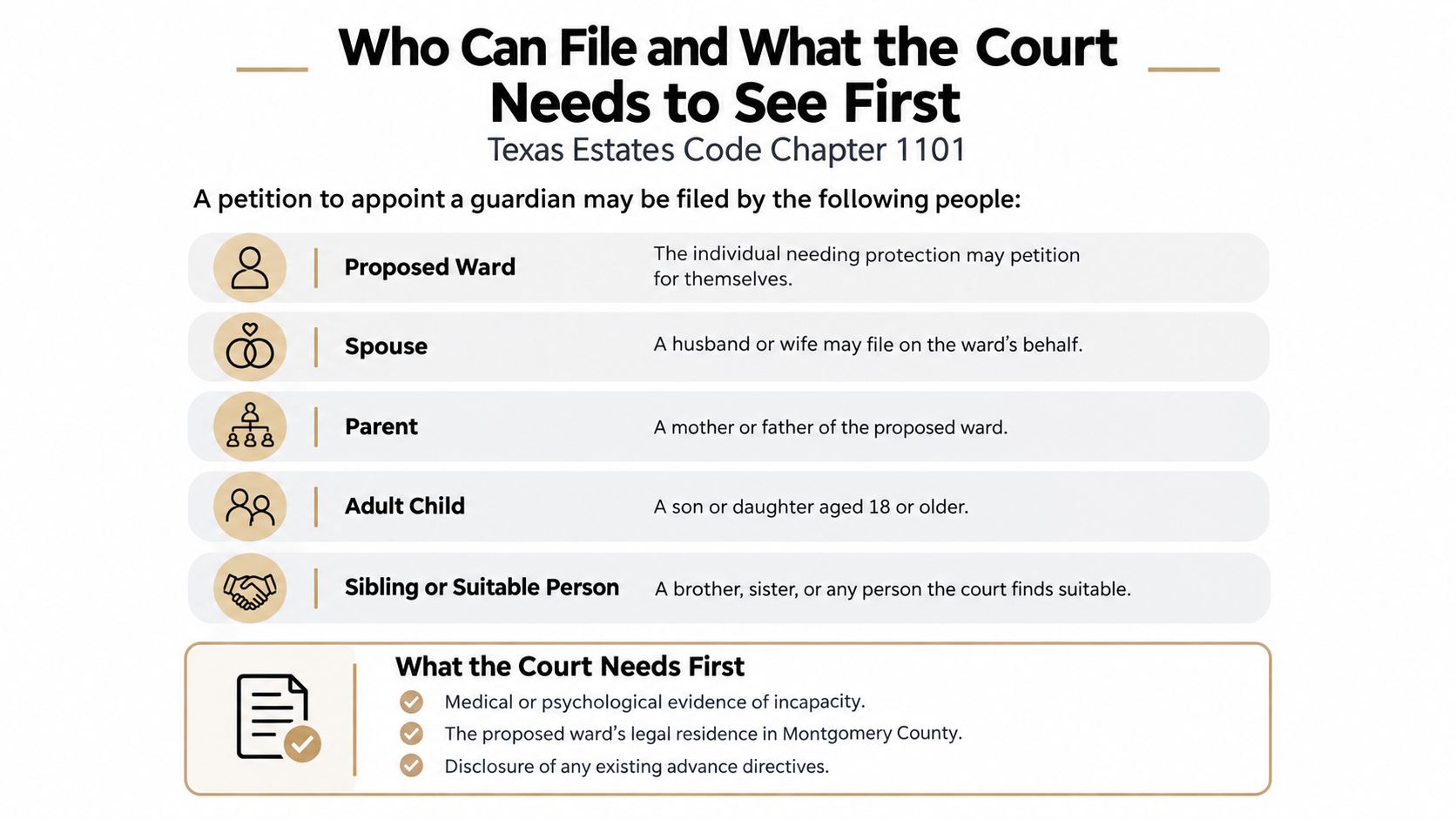
Texas Estates Code Chapter 1101 identifies people who may seek appointment, including the proposed ward, a spouse, parent, adult child, sibling, or another person the court finds suitable. The person asking to serve must still show that appointment is appropriate and that they can carry out the responsibilities diligently and reliably.
For an adult case, the application should explain the specific incapacity and how it affects daily care, medical decisions, finances, property, or a combination of those areas. For a minor, the legal analysis is different and commonly focuses on the child's circumstances, parental residence, custody, and the authority requested. Families considering minor guardianship in The Woodlands should avoid treating an adult guardianship form as a complete answer.
Address alternatives directly
Texas law requires the application to address alternatives to guardianship and available supports and services. The applicant should explain what was considered, why it won't adequately protect the proposed ward, and why the requested powers are no broader than necessary. The Texas Governor's disability guidance on guardianship describes the court's obligation to consider those alternatives before granting guardianship.
A weak petition says only that a parent is “confused” or “unable to manage.” A stronger petition connects the condition to specific limitations, such as missed medical treatment, unsafe living arrangements, unpaid bills, or vulnerability to financial exploitation. It also explains why family assistance, powers of attorney, or paid support won't solve the problem.
Check JBCC registration early
Texas requires guardianship registration information to be completed with the Judicial Branch Certification Commission at least 10 days before the hearing. The rule became effective June 1, 2018, according to the local probate materials cited above. It can affect whether a case is ready for court consideration.
The registration issue is especially important for a proposed or existing guardian who has been paid to provide guardianship services. Don't assume the clerk will fix a registration problem after filing. Verify the applicable JBCC status and registration requirements early, and keep confirmation records with the case documents.
Building the Filing Package for Montgomery County Probate Court
A guardianship application is a sworn pleading, not a one-page request for general control. Texas law requires identifying the proposed ward and stating whether the application seeks guardianship of the person, the estate, or both. The Texas Estates Code application requirements include identifying information, the applicant's information, relevant family and custody details, prior guardianship information, and an approximate description of property.
Core documents and supporting proof
The filing package commonly includes:
- Application for appointment: State the legal basis under Chapter 1101 for an adult matter. Minor cases may also involve Chapter 1102 requirements.
- Medical evidence: A physician must evaluate the proposed ward and certify incapacity when required. Montgomery County probate materials identify a Physician's Certificate Form and a Cash Bond Form among the documents used locally.
- Information about the proposed ward: Include the person's full identifying details, address, limitations, and the authority requested.
- Family and heir information: Give the court accurate names and addresses for people entitled to notice. Missing relatives can create service problems later.
- Proposed guardian's oath and bond materials: The court may require a cash or surety bond, depending on the appointment and the estate.
- Court-specific forms: Use the current Montgomery County forms and fee schedule rather than relying on an old online packet.
Medical paperwork deserves special attention. The certificate should describe the nature and degree of incapacity and the particular areas where protection or assistance is needed. A generalized diagnosis without functional detail may not answer the court's question.
The attorney ad litem is appointed to represent the proposed ward's interests. That lawyer may meet with the proposed ward, investigate the allegations, review alternatives, and present concerns to the judge. The appointment isn't a formality that guarantees agreement with the applicant.
Why otherwise good filings get delayed
Clerks commonly flag unsigned documents, missing medical certificates, incomplete family information, and requests that fail to define the powers sought. An outdated medical examination can also force the family to obtain new proof before the judge can act.
Use the current Montgomery County Probate Court filing information to confirm where and how documents should be submitted. If a separate dispute later involves enforcing divorce decree or custody order provisions in Montgomery County, that is a different matter from the guardianship filing and should be handled under the applicable family-court procedure. The Enforcement of Court Orders in The Woodlands resource addresses that separate subject.
Filing Fees, Service Costs, and the Real Budget Picture
The published filing fee is only one part of the budget. Montgomery County's 2026 fee sheet lists a local consolidated filing fee of $223 and a state consolidated fee of $137 for new guardianship cases, as shown in the Montgomery County 2026 probate and guardianship fee schedule. The same schedule identifies additional charges connected to posting, citations, and later filings.
| Cost Item | Estimated Amount | Notes |
|---|---|---|
| Local consolidated filing fee | $223 | Montgomery County 2026 fee sheet |
| State consolidated fee | $137 | State component listed for new guardianship cases |
| Posting and citation costs | Varies | Depends on the notices and service required |
| Personal service | Varies | May involve separate service costs |
| Attorney ad litem | Varies | Court-appointed representation is a separate case cost |
| Medical certificate | Varies | Physician or evaluator charges are outside the filing fee |
| Bond premium | Varies | Depends on the bond required and estate circumstances |
The total therefore depends on the case posture and service choices. A simple uncontested filing with limited property may have a different cost profile from a contested case involving personal service, a substantial estate, hearings about authority, or repeated filings. The fee schedule does not provide a reliable single all-in total for every family, so avoid budgeting from the base fee alone.
Families should also ask the clerk or their attorney how fees are collected and which items must be paid before particular steps occur. Some petitioners may qualify for a waiver or other relief based on indigence, but eligibility and procedure must be confirmed with the court.
For comparison, The Divorce Process in The Woodlands concerns a separate step-by-step process for divorce filings in The Woodlands and Montgomery County. Guardianship costs and court duties follow probate rules instead.
Notice, Service, the Hearing, and Emergency Options
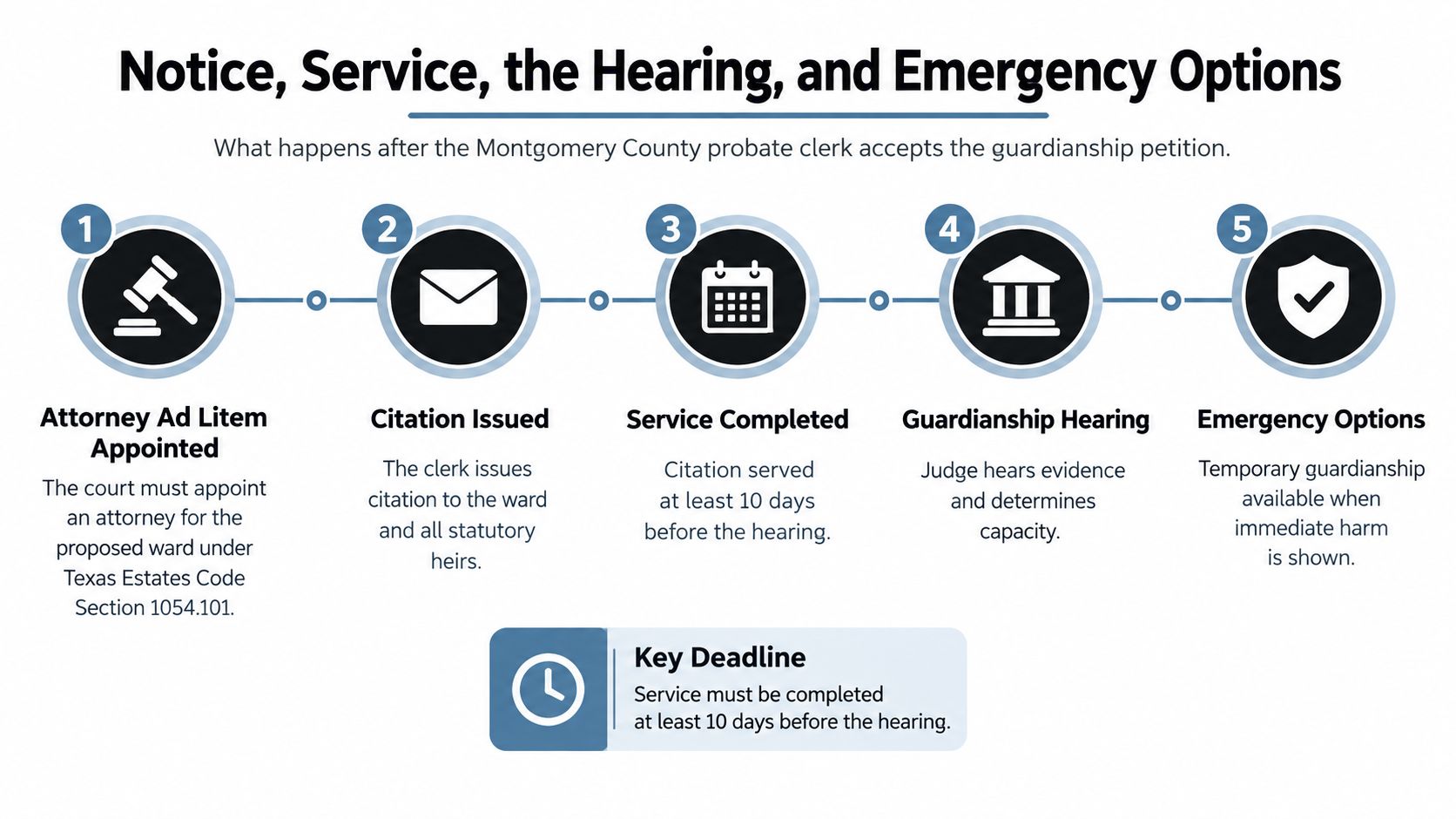
Acceptance of the application doesn't mean the judge can immediately appoint a guardian. The court must protect the proposed ward's procedural rights, including notice, service, and legal representation. Texas Estates Code Section 1054.101 addresses appointment of an attorney ad litem, and that lawyer represents the proposed ward's interests rather than acting as the petitioner's counsel.
The clerk issues citation for the proposed ward and notice for other people entitled to participate. The proposed ward must be personally served, and the application should include the required affidavit identifying notice recipients. If personal service can't be completed, ask the court about an authorized alternative such as publication. Don't substitute ordinary mail or informal family communication when the statute requires formal service.
Preparing for the hearing
Texas guidance requires service on the proposed ward and notice to interested people before the hearing can proceed. The supplied court-process visual identifies a 10-day service window, while other service rules can apply to particular documents or circumstances. Because timing depends on the type of service, the court's order, and the applicable Estates Code provision, confirm the exact deadline with the Montgomery County clerk or counsel rather than relying on a general internet checklist.
At an uncontested hearing, the judge may review the application, medical certificate, testimony from the applicant, and the attorney ad litem's position. Be prepared to explain:
- What decisions the proposed ward can't safely make.
- Why guardianship is necessary now.
- Why less-restrictive alternatives aren't sufficient.
- Whether the request concerns the person, estate, or both.
- What powers and duration should appear in the order.
A court investigator or other court-appointed professional may also gather information relevant to the proposed ward's circumstances. The hearing date depends on docket availability, completed service, appointment of counsel, and whether anyone contests the application. No responsible attorney should promise a fixed timeline without reviewing those factors.
Temporary and emergency relief
Texas Estates Code Section 1051.051 addresses temporary guardianship procedures. A temporary appointment can last up to 60 days, according to the verified Texas guardianship information provided for this guide, and emergency relief requires evidence of imminent harm to the proposed ward or the estate. That's a higher-urgency path, not a shortcut for incomplete ordinary filings.
Lead with the specific danger, such as an immediate medical crisis or active dissipation of assets. General concern, family disagreement, or a diagnosis alone may not establish the emergency basis the court needs.
The following video offers general background on the guardianship process. It isn't a substitute for reviewing the current Montgomery County docket and service requirements.
After the Order Is Signed, Ongoing Duties and Reporting
Suppose the Alden Bridge family obtains an order appointing an adult child as guardian. The appointment isn't complete merely because the judge signed the order. The guardian generally must complete the oath, satisfy bond requirements, and obtain Letters of Guardianship from the Montgomery County clerk before relying on the authority in dealings with banks, physicians, insurers, or care facilities.
Those letters expire after 16 months, according to Texas guidance cited for this process. The guardian must track the expiration date and seek renewal rather than waiting until an institution rejects stale letters. A change in the ward's condition, assets, or needed authority may also justify asking the court to modify the appointment or order.
The records begin immediately
A guardian of the estate must identify and report the ward's property through the required inventory process. The supplied Montgomery County filing guidance identifies an initial inventory as due within 30 days for non-minor wards. Keep bank statements, receipts, investment records, benefit information, and major correspondence organized from the first day.
Annual reporting continues after the initial inventory. Texas guardianship reporting requires annual reports within 60 days of the anniversary of the guardian's qualification date, as described in the Texas Judicial Branch annual reporting information. A guardian of the person reports on the ward's condition and care, while estate reporting accounts for financial activity under the applicable Texas Estates Code provisions, including Chapter 1163.
Statewide compliance data illustrate why these duties deserve a calendar system: a Texas review found 12% of cases missing annual reports, 19% missing annual accounts, 10% missing inventories, and 13% out of compliance overall, with 12% involving waived bonds. These figures come from the Texas guardianship compliance review. They don't predict what will happen in a particular Montgomery County case, but they show that post-appointment paperwork is a central part of guardianship.
After appointment: Keep the court order, Letters of Guardianship, bond documents, medical records, and accounting records in one controlled file. Calendar every court deadline before using the authority.
Review beneficiary designations, account ownership, and the care plan carefully. A guardianship order doesn't automatically rewrite every financial or estate-planning document. If the ward's capacity changes or the original authority becomes too broad or too narrow, ask a guardianship attorney whether modification is appropriate.
Your Next Steps and a Local Checklist for Woodlands Families
Start by confirming the proposed ward's residence and the correct Montgomery County venue. Then schedule the medical examination, gather identification and residence records, assemble family information, review the cash bond requirements, and verify any applicable JBCC registration before asking the clerk to accept the petition.
What to do next
- Confirm venue: Verify where the proposed ward lives, is located, or maintains the principal estate. For a minor, check the applicable parental-residence rule.
- Choose the authority: Decide whether you're seeking guardianship of the person, estate, or both.
- Address alternatives: Document why powers of attorney, family support, or supported decision-making won't provide adequate protection.
- Obtain medical proof: Arrange the required physician's evaluation and use the current court or JBCC form.
- Complete the packet: Prepare the sworn application, ward information, family details, oath, bond materials, and required affidavits.
- File and budget: Confirm the current fees, citation costs, service method, and potential ad litem or medical expenses.
- Track notice: Confirm that service and notices are completed within the deadlines before the hearing.
- Prepare for court: Bring organized evidence and be ready to explain the requested powers and the alternatives considered.
- After appointment: Complete the oath and bond, obtain Letters of Guardianship, calendar the letter expiration, and track inventory and annual reporting deadlines.
Common questions
How long does an emergency guardianship take? There's no universal Montgomery County time estimate. The court must evaluate the claimed imminent harm, the evidence, notice requirements, and available docket procedures.
Can the proposed ward attend the hearing? Often, the proposed ward's participation and rights are central to the proceeding. Whether attendance is practical or medically appropriate depends on the person's condition and the judge's procedures.
Can relatives living outside Texas petition? An out-of-state relative may be able to petition, but eligibility, venue, notice, conflicts, and suitability still matter. The proposed ward's Texas residence and Montgomery County connection should be reviewed first.
This article is general information, not legal advice, and it doesn't create an attorney-client relationship. Guardianship decisions can affect medical authority, finances, property, and civil rights, so a Montgomery County probate attorney should review the facts and current court requirements before you file.
The Law Office of Bryan Fagan helps families in The Woodlands and surrounding Montgomery County communities evaluate guardianship, prepare for probate-court filings, and understand ongoing duties after appointment. Visit The Law Office of Bryan Fagan to schedule a consultation about your family's specific circumstances.