 Skip to content
You're probably here because a parent, spouse, or adult child in The Woodlands is slipping into a situation where bills are piling up, medical decisions are getting harder, and somebody in the family is saying, “We need to get guardianship.” Slow down. In Texas, guardianship is a last resort, because it strips away legal rights and independence, and the law gives families narrower tools first when those tools solve the problem. If you're looking for a guardianship alternatives attorney The Woodlands families can rely on, the right question is not “How do we get to court?” It's “What decision problem are we really trying to solve, medical, financial, or both?”
That distinction matters. Texas law defines alternatives to guardianship broadly enough to include a medical power of attorney, durable power of attorney, representative payee, joint bank account, management trust, special needs trust, and supported decision-making (Texas Estates Code). That's not a random list. It's the roadmap Texas gives families before they ask a judge to take away decision-making authority. If one of those tools fits, you've just solved the core problem without inviting full court supervision into the family's life.
Why Woodlands Families Look Beyond Guardianship
A lot of families in The Woodlands hit the same wall. Mom is falling behind on bills. Dad is missing doctor's appointments. An adult child has a disability, needs support to understand choices, and still wants a say in the outcome. The first instinct is to reach for guardianship because it sounds like the cleanest fix.
It is usually the broadest fix, and that is the problem. Once a court appoints a guardian, the court stays involved, and the ward loses rights the court does not leave intact. Families should start by asking a narrower question, because Texas and federal guidance push less restrictive tools first, including supported decision-making, advance directives, powers of attorney, trusts, representative payees, and specific court orders.
A Woodlands family does not need a legal sledgehammer if a wrench will do the job. If the problem is paying bills, a financial tool may solve it. If the problem is healthcare decisions, a medical document may be enough. If the person still understands choices with support, Texas recognizes an informal option that keeps the person in charge while adding help.
Practical rule: if the person can still participate meaningfully, start with the least restrictive tool that matches the exact decision problem.
For families in Montgomery County, that means sitting down before any court filing and asking one hard question. What exactly is failing, healthcare, money, both, or just the paperwork? If you need broader estate planning support around that same question, an Estate Planning Attorney in The Woodlands handles wills, trusts, and estate plans for The Woodlands families.
How Texas Law Treats Guardianship as a Last Resort
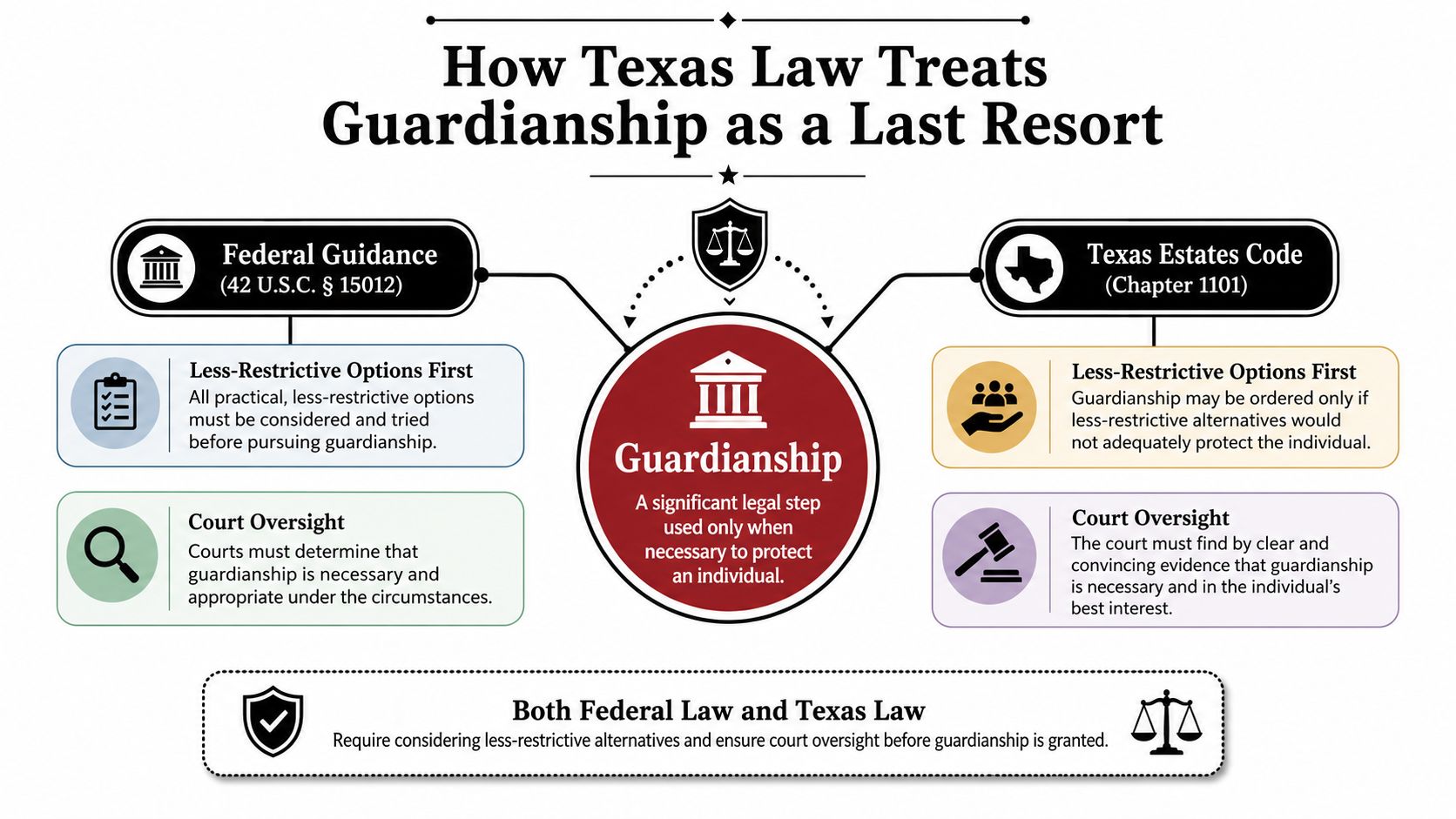
A Texas court should not be the first move. Families should first ask which decision domain is failing, medical, financial, or both, then match the tool to that problem before anyone files a guardianship case. Texas guidance pushes the court to consider the narrowest scope necessary, and federal elder justice guidance takes the same position, which tells you how the law expects these cases to be handled.
Start with the decision domain
Start with the actual problem. If the issue is consent to treatment, the family should focus on medical authority. If the issue is bill paying, access to accounts, or property management, the answer belongs on the financial side. If both areas are breaking down, you need a plan that covers both, but you still start by sorting the duties instead of asking for a full guardianship by default.
That distinction matters because one blanket filing often solves too much and too little at the same time. A parent who can still understand choices with support may not need a guardian at all, while a parent who can no longer sign new documents may have lost the chance to create a fresh power of attorney. In that situation, the family may already be headed toward a court-supervised path, because the planning window has closed.
Check the documents before you file anything
Look for the documents first. A valid durable power of attorney can keep working after incapacity, and Texas CLE materials explain that court-created management trusts under Chapter 1301 can fit some estates that need a corporate trustee and tighter asset control (UT CLE materials). That means the right answer may already be in the paperwork, not in a guardianship petition.
A good family law and probate lawyer will ask a simple question before anything else. Does an existing document already give someone the authority to handle the exact job that is failing? If the answer is yes, use that document and avoid asking a court to strip away more rights than necessary.
The practical point is plain. Texas treats guardianship as the backstop, not the first tool. Families that start with the wrong filing waste time, spend more money, and risk taking away decision-making power that could have stayed in place with a narrower solution.
The Main Texas Alternatives at a Glance
The right alternative depends on the exact job. Start with the decision domain, financial, medical, or both, then match the least restrictive tool that solves the problem. Families waste time when they ask which option sounds strongest. The better question is what authority is missing, and whether a court needs to get involved at all.
| Alternative | Decision Domain | Court Involvement |
|---|---|---|
| Durable power of attorney | Financial, legal, property matters | Usually none if validly executed |
| Medical power of attorney | Healthcare decisions | Usually none if validly executed |
| Supported decision-making | Understanding and choosing across daily decisions | None, it's informal |
| Representative payee | Social Security or similar benefits | Federal agency process, not guardianship court |
| Joint bank account | Simple bill-paying and access to funds | Usually low, but it's not a full planning tool |
| Management trust | Larger estates, asset management | Court-created or court-supervised in some cases |
| Special needs trust | Benefit preservation and support planning | Can be structured without guardianship |
That table is the decision tree. A durable power of attorney solves financial and property problems. A medical power of attorney solves healthcare decisions. Supported decision-making fits when the person still wants to choose for himself or herself, but needs help understanding the options. Representative payee is narrow on purpose, which is exactly what you want when the issue is only federal benefits.
Trusts belong in a different category. They matter when the family is dealing with more than day-to-day help, especially where asset control and long-term management are part of the plan. A management trust can fit a larger estate that needs tighter oversight, while a special needs trust is the better lane when the goal is to preserve benefits and still provide support.
A joint bank account can solve a limited bill-paying problem, but it is not a full planning tool. It gives access to funds, not a complete answer for medical decisions, property management, or long-range incapacity planning. In the same way, a power of attorney lawyer in The Woodlands can help a family sort out whether the problem is financial authority, healthcare authority, or both before anyone files a guardianship case.
Texas families should read the tools in that order. Start with the narrowest option that addresses the actual problem, then move up only if the document is missing, invalid, or too limited for what the person needs.
Durable and Medical Powers of Attorney Explained
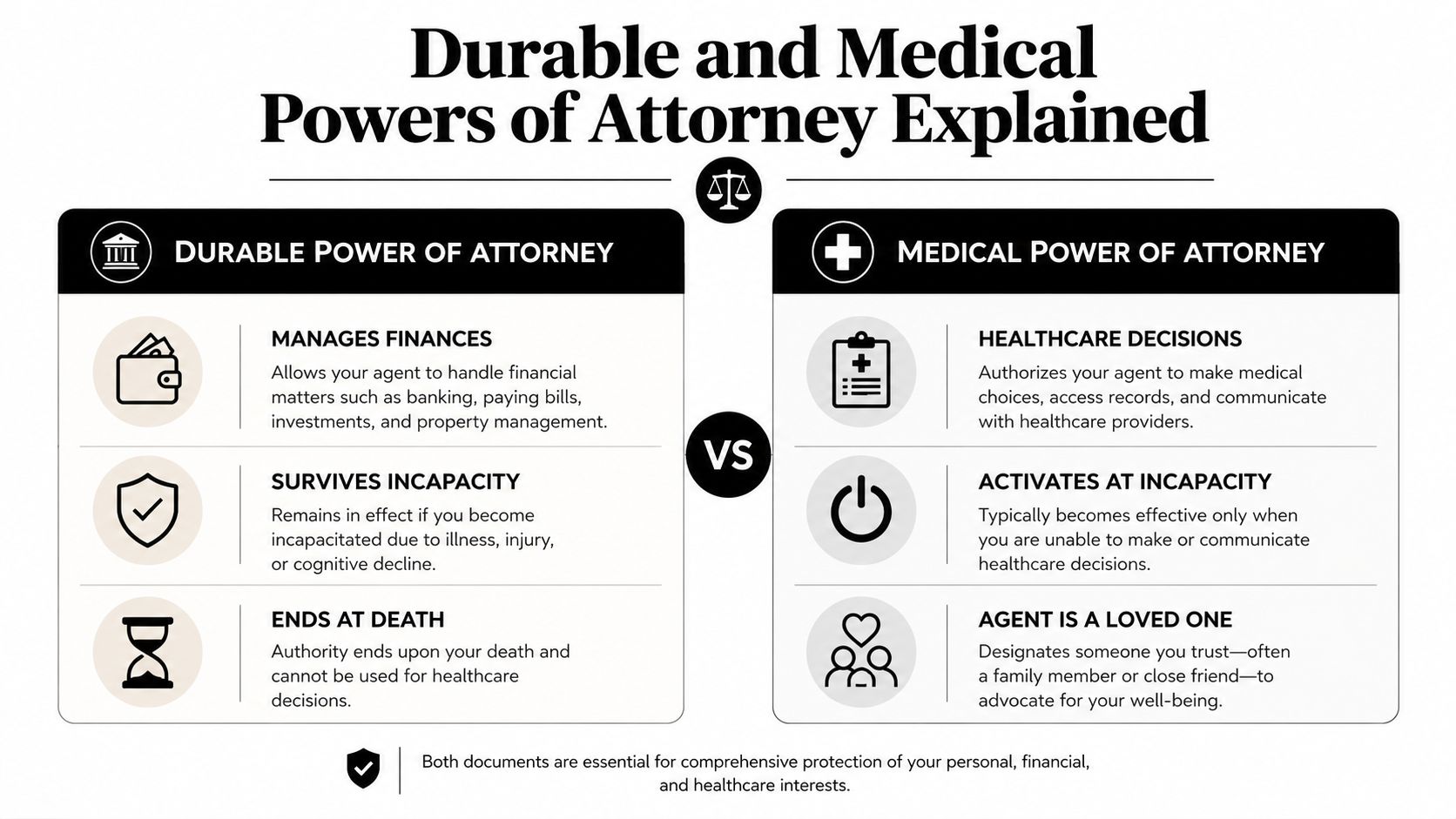
A durable power of attorney is the document families should look at first for money and property problems. It gives an agent authority over accounts, bills, real estate, and related legal matters, and Texas treats it as durable when it stays effective after the signer later loses capacity. That is the point of using a durable form instead of a standard one. If the issue is paying bills, signing for property, or dealing with accounts, start here, then have a power of attorney lawyer in The Woodlands review whether the form actually matches the problem.
The limits are just as important. A financial POA does not authorize medical choices. It does not fix a missing or invalid document, and it does not cure a form signed after incapacity already started. Timing comes first. If the person signed while still able to understand the document, a durable POA may solve the problem. If not, the family may still be looking at guardianship.
A medical power of attorney solves a different problem. It covers healthcare decisions, not money. Texas advance directive planning lets the signer name someone to make medical choices when the signer cannot communicate for himself or herself, and that authority sits in a separate lane from financial control. Families that use both documents the right way cover both medical and financial decision-making without asking a court to take over everything.
Use the right form for the right problem
Families mix these documents up because both name an agent. That mistake causes trouble. The authority is different, the purpose is different, and the backup plan is different if one document is missing.
A child support dispute shows the same point in a different setting. A parent may want one catch-all paper for every problem, but Texas does not work that way. If the issue is support enforcement or payment logistics, a Child Support Attorney in The Woodlands handles establishing, modifying, and enforcing child support in Montgomery County, which is a separate legal lane from incapacity planning.
Bottom line: if the problem is money, use a financial document. If the problem is treatment decisions, use a medical document. If it is both, you usually need both.
A power of attorney only helps if it is valid and available when needed. Keep the original in a safe place, give copies to the people who will need them, and make sure the named agent knows where to find the document. A paper locked in a drawer no one can reach is close to useless when a crisis hits.
Supported Decision-Making, Representative Payee, and Trusts
Some cases do not call for a POA, and they do not justify handing control to a guardian either. Start with the decision that needs help. If the problem is understanding and communicating a choice, use supported decision-making. If the problem is benefits administration only, use a representative payee. If the problem is asset management or benefit preservation, look at a trust.
Texas recognizes supported decision-making agreements as an alternative to guardianship, and the person can end the support arrangement whenever they want. That makes it far less restrictive than a court appointment, which is exactly why the Texas HHS guardianship guide treats it as a real option, not a formality (Texas HHS guardianship guide).
Supported decision-making keeps the person in charge
Use this tool when the person still makes the decision, but needs help getting there. The supporter does not replace the adult. The supporter helps gather information, explains it, and helps communicate the choice. That is a different job from guardianship, where a judge hands decision-making authority to someone else.
For adults with disabilities who can decide with support, this is often the cleanest answer. The family gets structure without stripping rights. If the goal is help, not control, a guardianship filing is the wrong first move.
Representative payee solves benefit-only problems
If the only problem is federal benefits, a representative payee is usually the right tool. You do not need full guardianship just to make sure Social Security money goes toward rent, food, medicine, or other needs. The authority stays narrow because the problem is narrow.
That is the point. Texas families should match the tool to the decision domain, not ask a court for more power than the issue requires.
Trusts fit larger or more complex estates
A management trust or special needs trust belongs in a different lane. These tools make sense when someone has assets to manage, needs ongoing oversight, or needs to preserve benefits while still getting support. Texas CLE materials discuss management trusts under Chapter 1301 and note that they may be used for estates that can support a corporate trustee (UT CLE materials).
For families trying to protect eligibility for means-tested benefits, a special needs trust can be the right answer because it supports the person without putting benefits at risk. If that is the issue, the Special Needs Trust Lawyer in The Woodlands page is the local resource for that exact planning problem.
A short real-world scenario
A Montgomery County family calls because their adult son understands choices when someone explains them, but paperwork and mail overwhelm him. He does not need a court-appointed decision-maker. He needs support, a way to handle benefits, and maybe a trust if assets are involved. That is a decision-tree case, not a guardianship-first case. Pick the lane that matches the problem.
Steps to Put an Alternative in Place Locally
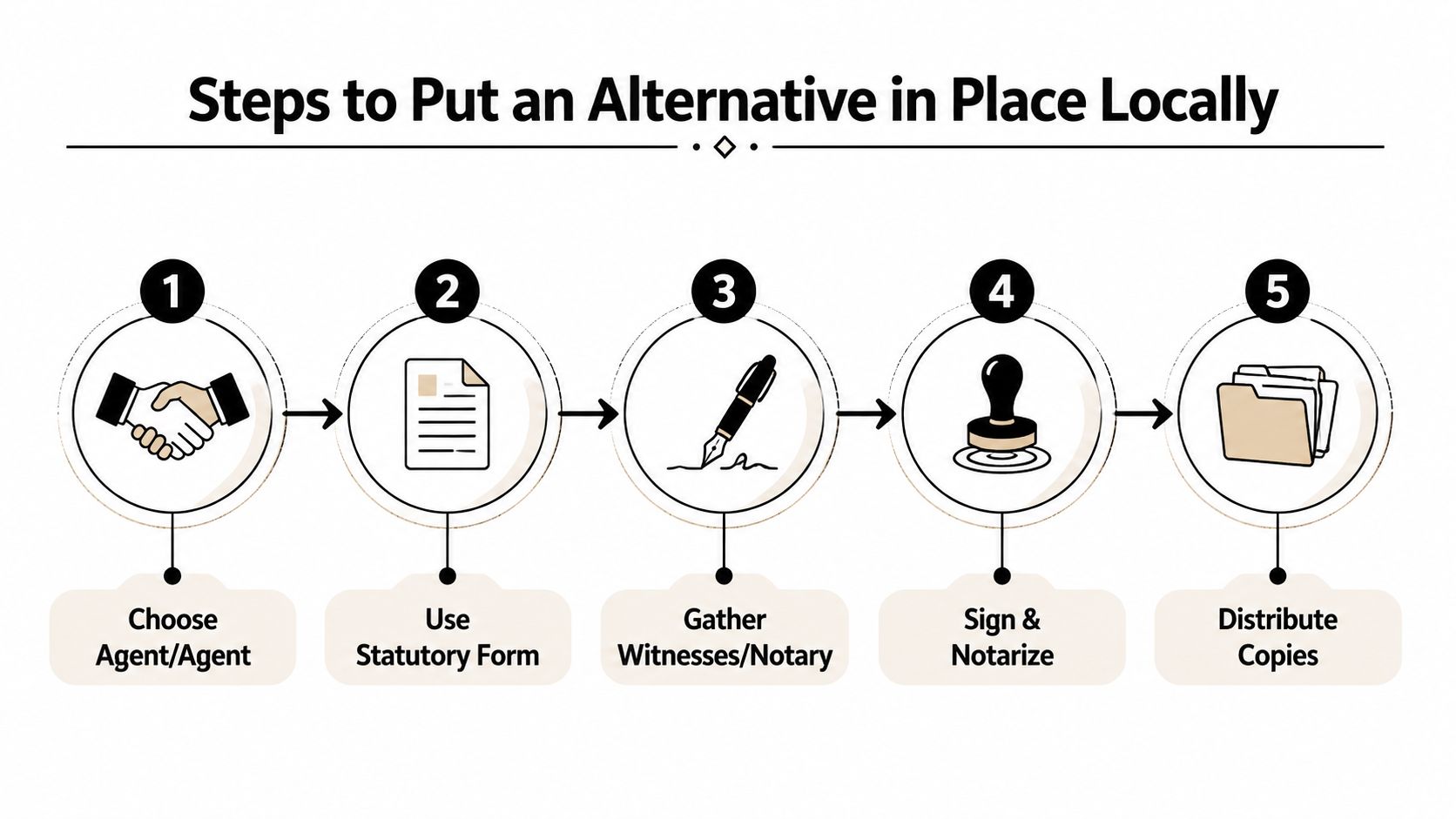
A family that waits for a crisis usually loses options. In The Woodlands and the rest of Montgomery County, the right move is to match the tool to the decision domain first, medical, financial, or both, then get the paperwork signed before capacity becomes a fight. Once the person can no longer sign valid documents, the family is often stuck with a narrower path.
Start with the document that matches the problem
Use the right form for the right job. A durable power of attorney handles financial authority, a medical power of attorney handles healthcare choices, and a supported decision-making agreement helps the person keep control while getting help understanding and communicating decisions. A representative payee is different again, because it deals with benefits administration through the federal system, not a probate filing.
Trusts belong in a separate category. If the family needs long-term asset management, oversight, or benefit protection, the drafting has to fit the exact purpose. That is the point where a generic form is a bad idea, and precise trust drafting matters.
For those close-call cases, use a local estate planning attorney in The Woodlands like The Woodlands estate planning attorney to get the structure right and make sure the documents are executed properly under Texas law.
Keep the execution and storage clean
A durable power of attorney only helps if it is signed correctly and easy to find when banks, doctors, or caregivers need it. A medical power of attorney needs the same care. Families should keep clear copies with the agent, the doctor, and in the place where other decision-makers can reach them quickly.
Store the original documents where they will not get lost, but do not hide them so well that nobody can use them. If the parent later loses capacity, a fresh signature may no longer be possible. That makes the original signing and notarization process matter far more than families usually realize.
Use local counsel for the close call cases
Get help early if the parent already looks impaired, if siblings disagree, or if medical and financial issues are happening at the same time. A lawyer can tell you whether the existing POA still works, whether supported decision-making is enough, or whether the family has already moved into guardianship territory.
Local practice in Montgomery County also matters. A bad filing wastes time and hardens family conflict. A good attorney starts with the decision problem, then checks which document or court process fits.
When Guardianship Is Still the Right Answer
Some families reach the point where guardianship is the only clean answer. If there is no valid power of attorney and the person is already incapacitated, the family may have no real alternative. If an agent is abusing authority or using it against the principal's interests, the court may need to step in and replace that decision-maker. If the person rejects every informal arrangement and cannot stay safe without supervision, guardianship may be the only protection that works.
Texas still treats guardianship as a last resort. The court has to look for the narrowest scope necessary. A Woodlands lawyer should press for the least restrictive order that still protects the person, because that is the standard families should expect when the facts support only limited control. The question is always what decision problem needs fixing, and nothing more.
When limited guardianship beats full guardianship
Full guardianship is a broad tool. Limited guardianship is the better fit when the person can still handle some decisions but not others. If the problem is only finances, the court should not hand over medical authority too. If the problem is only healthcare, financial control should stay intact as much as possible.
That approach matches the Texas Estates Code's narrow-scope rule. It also matches what careful families usually want once they stop talking in generalities and focus on the actual deficit. They want protection, but they do not want to strip away rights that the person can still use.
Adult children also run into this in disability cases. When a young adult needs a court-appointed decision-maker and no less restrictive tool covers the need, guardianship may be appropriate. The key is to match the order to the problem. If the need is medical, keep the order medical. If the need is financial, keep it financial.
FAQs and Your Next Steps in The Woodlands
Common questions families ask
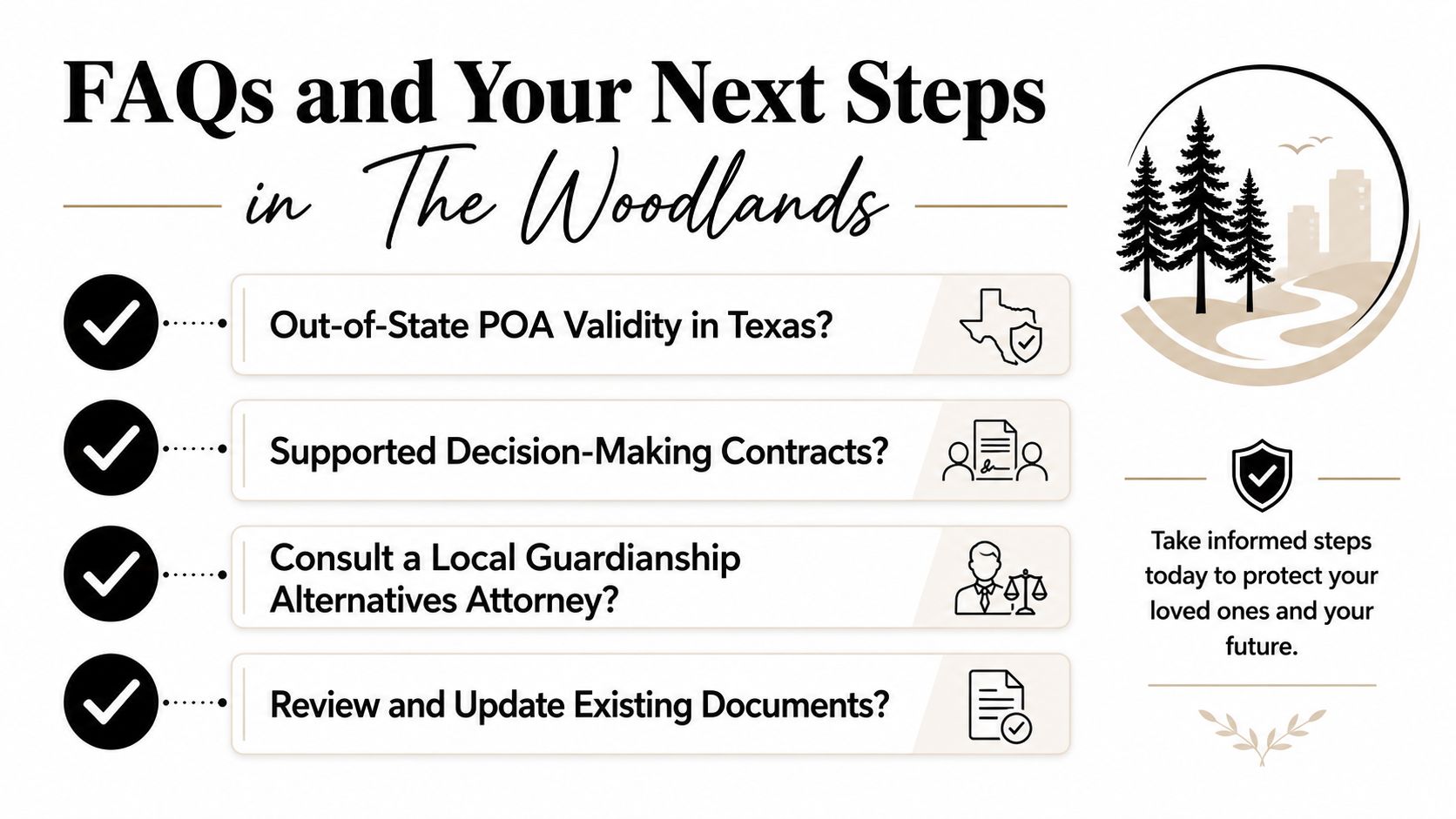
A family in The Woodlands usually comes to this point with one urgent question, what tool solves the actual problem without going straight to guardianship? The right answer depends on the decision domain. Medical decisions call for a different document than financial control, and benefit issues often call for something else entirely.
Does a power of attorney from another state work in Texas? Sometimes it does, but never assume a bank, hospital, or title company will accept it without review. Texas institutions can be strict about form and execution, so a local lawyer should check the document before your family relies on it.
How does supported decision-making work in practice? The person keeps the decision. The supporter helps gather records, explain options, and communicate the choice, but does not take over the decision itself. That makes it a fit for some medical and daily-living issues, not for situations where the person cannot make or express a choice at all.
Can a family member serve as a representative payee? Often, yes, if the federal agency approves the person and finds the person suitable. That tool fits a benefits problem, not a broad medical or property problem, so it can solve the immediate issue without a guardianship case.
What if the proposed ward refuses the alternative? If the person still has capacity, that refusal matters and the court will care about it. If capacity is gone and no less restrictive tool can protect the person, guardianship may be the right answer.
What to do next
- Gather existing documents. Pull together any power of attorney, medical directive, trust, or prior court order.
- Identify the decision domain. Decide whether the problem is medical, financial, benefit-related, or a mix.
- Check whether the person can still sign. Capacity controls the legal path, and it can change everything.
- Talk to a local lawyer. A guardianship alternatives attorney can tell you whether a narrower tool still fits.
Disclaimer: This is not legal advice. Every family situation is different, and Texas courts look closely at capacity, execution, and the least restrictive path.
The Law Office of Bryan Fagan serves families in The Woodlands and surrounding Montgomery County communities in family law and probate matters, including guardianship and guardianship-alternative planning. If you want a direct answer about which tool fits your situation, schedule a consultation and get the documents reviewed before anyone files a guardianship case.
If you're trying to decide between a power of attorney, supported decision-making, a trust, or guardianship, The Law Office of Bryan Fagan can help you sort out the right path for your family. Visit the firm to talk through your options and get a local plan that matches the actual problem, not just the family's fear.
