 Skip to content
Texas has a 60-day minimum waiting period after a divorce is filed, but a contested divorce in Texas usually takes 6 to 18 months to finish. In Montgomery County, that gap matters because life doesn't pause while the case is pending, and temporary court orders often control parenting, money, and the house long before the final decree is signed.
If you're in The Woodlands and lying awake wondering whether this will be over in a few weeks or whether your family will be living in limbo for the better part of a year, that worry is normal. When contacting a family lawyer, the primary concern is rarely a lecture on procedure. The desire is to know how long this will last, what happens next, and what parts of the timeline can still be influenced.
A contested divorce usually means there is a real disagreement about children, property, support, or all three. Once that happens, the legal process becomes less about the filing date and more about what has to happen before a judge can sign a final order. In practical terms, the temporary phase often becomes the lived reality of the case.
The Uncertainty of a Contested Divorce in The Woodlands
A common situation in The Woodlands looks like this. One spouse has moved into a guest room or to a nearby apartment. The kids still need to get to school. The mortgage is still due. No one agrees on who should stay in the house, what the possession schedule should be, or how bills should be paid.
That's when the timeline starts to feel personal instead of legal.

In neighborhoods like Sterling Ridge, Alden Bridge, or Panther Creek, the stress is often less about the word “divorce” and more about the unknowns around daily life. Parents want stability for their children. Spouses want to know whether they can access accounts, stay in the home, or make school and medical decisions without triggering a bigger fight. The uncertainty is exhausting because the answer to almost every question seems to be, “It depends.”
The hardest part for many people isn't the paperwork. It's not knowing how long they'll be living under temporary rules.
That's why the question, how long does a contested divorce take in Texas, needs a practical answer, not a technical one. Yes, there is a minimum waiting period under Texas law. But in real Montgomery County cases, the more useful question is this: how long will your family be operating under interim arrangements while lawyers exchange documents, the court addresses disputes, and settlement efforts play out?
What worried clients usually mean when they ask about timing
They're usually asking several questions at once:
- How soon will the case start affecting my routine with my children, money, and housing?
- When will a judge set basic rules if my spouse and I can't agree?
- How long will I be stuck in conflict before there is either a settlement or a trial?
- What can I do now to avoid making the process slower or more expensive?
Those are the right questions. A contested divorce is not one long event. It's a series of phases, and each phase can move the case forward or drag it out.
The 60-Day Rule vs The 12-Month Reality
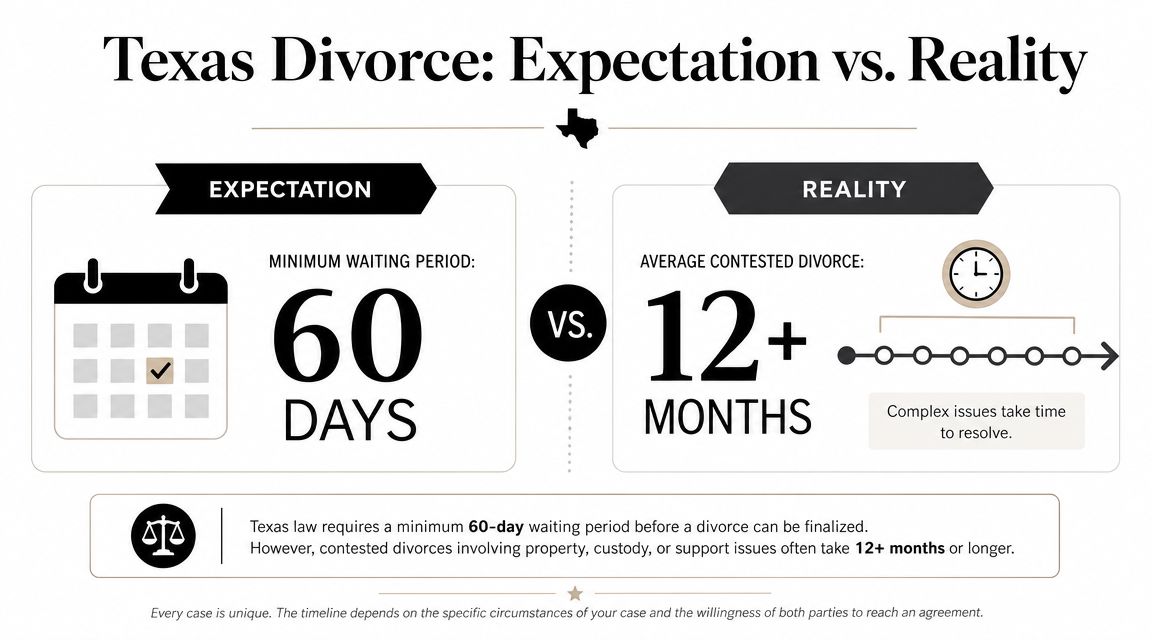
Texas law includes a waiting period, but many people misunderstand what that means. Under Texas Family Code Section 6.702, a divorce generally can't be finalized until at least 60 days after the Original Petition for Divorce is filed. That is a floor, not a forecast.
For contested cases, neutral Texas family-law sources commonly place the overall timeline at 6 to 18 months, as explained in this discussion of how long a contested divorce takes in Texas. Some Texas case-management guidance also puts many contested cases in a 4 to 12 month range, depending on service, document exchange, temporary orders, and whether children or complicated property issues are involved, as outlined in this review of Texas divorce timelines and deadlines.
Why the waiting period doesn't answer the real question
If both spouses agree on everything, the waiting period may be the main timing issue. In a contested case, it usually isn't. A disputed divorce has to move through a chain of events that the 60-day rule does not solve:
| Issue | Why it slows the case |
|---|---|
| Children | Parents may disagree over conservatorship, possession, decision-making, and support |
| Property | The parties may dispute what is community property, what is separate property, and how assets or debts should be divided |
| Money | One spouse may ask for temporary support, reimbursement, or control of accounts |
| Information | Documents have to be exchanged, reviewed, and sometimes challenged |
| Court access | Hearing dates and trial settings depend on the court's schedule |
A spouse who hears “60 days” often expects a finish line. What they have is permission for the case to exist long enough to become final. That's very different.
What the law says and what families experience
The law creates a minimum. The dispute creates the timeline.
Practical rule: If you and your spouse are fighting about children, property, or support, plan around process, not the statutory minimum.
That's especially true in a busy county. Even when both sides are motivated, lawyers still need records, temporary arrangements may need court approval, and mediation may or may not resolve the core conflict. If mediation fails, the case has to wait for a final hearing or trial setting.
For many families in Montgomery County, the emotional reality is this: the divorce is not “over” when the waiting period ends. The waiting period ends.
Navigating the Five Phases of a Contested Divorce
A contested divorce usually feels less overwhelming when you break it into phases. The order matters because each stage affects what comes next.
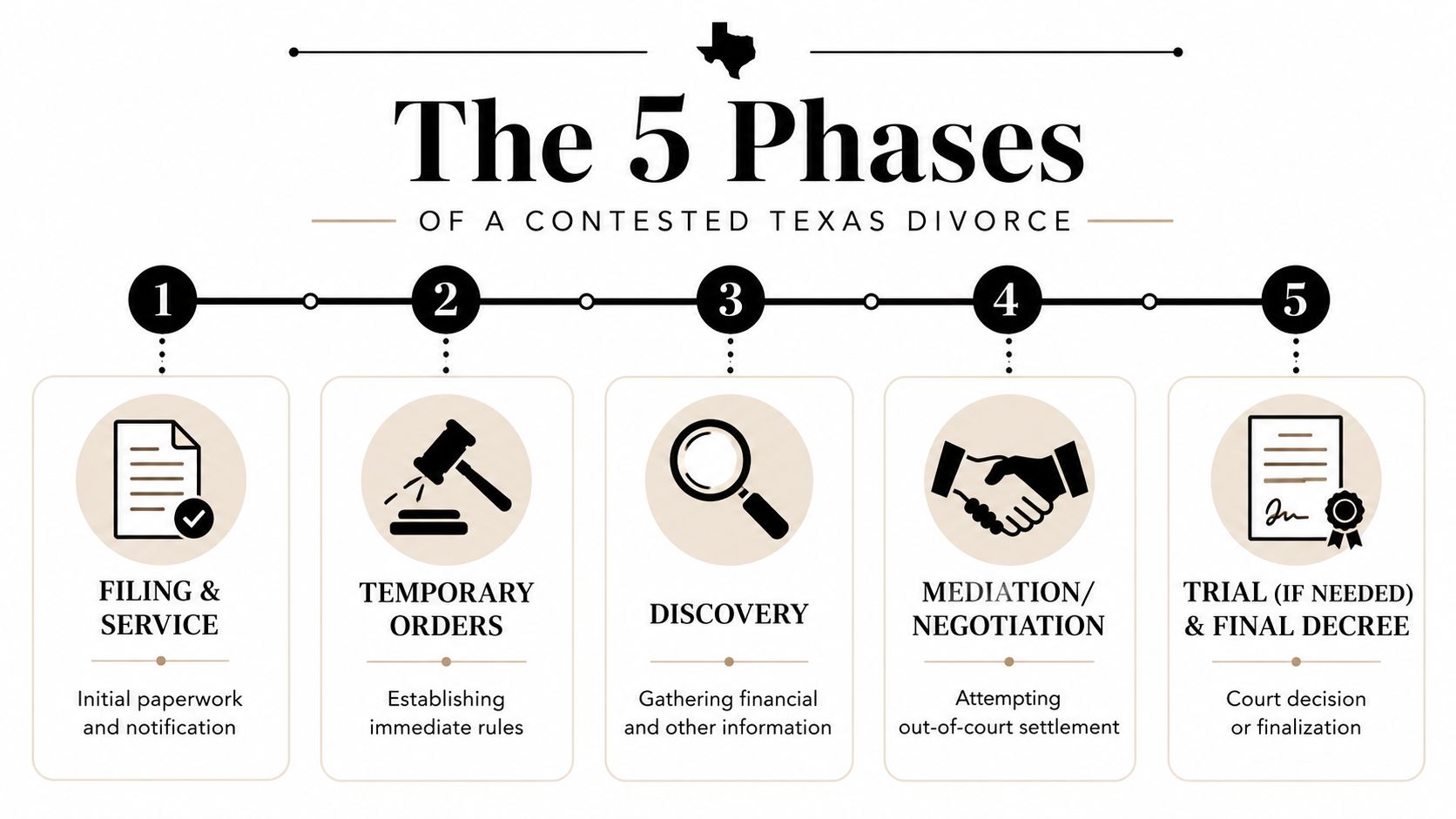
Filing and service
The case starts when one spouse files the Original Petition for Divorce. The other spouse must then be formally served unless service is waived properly. That sounds simple, but delays often start here.
If service is hard to complete, or if the responding spouse waits until late in the process to hire counsel and file an answer, the case loses momentum immediately. Early organization matters. Calendars, pleadings, notices, and records need to stay accessible from the beginning. Many firms and clients borrow contract management system insights when building a cleaner document workflow because contested cases create a lot of moving paperwork very quickly.
Temporary orders
This is the phase many articles miss, but clients feel it every day. Texas courts can enter temporary orders for child support, custody, use of property, and attorney's fees while the case is pending, as explained by Texas Law Help's overview of divorce in Texas. In real life, that means your family may spend months living under enforceable court rules before anyone signs a Final Decree of Divorce.
A temporary orders hearing can decide who stays in the house, who pays which bills, where the children sleep on school nights, and how exchanges happen. Those orders don't necessarily predict the final outcome, but they often shape bargaining power, routine, and settlement pressure.
Temporary orders are where a pending divorce becomes a daily operating system for the family.
If you want a closer look at how evidence and preparation affect that stage, this guide on a temporary orders hearing in a Montgomery County divorce is worth reviewing.
Here is a short video overview of the process many families find useful before their first major hearing:
Discovery
Discovery is the formal exchange of information. During this phase, both sides request financial records, account statements, business records, employment information, and other evidence relevant to property, support, and parenting issues.
In straightforward cases, discovery is mostly an organization problem. In difficult cases, it becomes a conflict problem. Missing records, incomplete answers, and disputes over separate versus community property can slow everything down. If you want a deeper look at the mechanics, this page on the divorce discovery process gives a useful local overview.
Mediation
Most contested divorces do not end in a full trial. They often narrow through negotiation and may settle in mediation. A neutral mediator helps the parties test proposals, reality-check risks, and work toward a written agreement.
Mediation works best when both sides already have enough information to negotiate seriously. It works poorly when one spouse is still hiding the ball, still emotionally escalating every issue, or still treating mediation like a chance to make speeches instead of decisions.
Trial and final decree
If settlement fails, the case moves toward a final hearing or trial. That requires exhibit preparation, witness planning, legal arguments, and patience with the court calendar. The judge then decides the unresolved issues, and the final decree must be drafted carefully enough to be enforceable later.
That last part matters. A rushed decree can create post-divorce conflict that should have been avoided.
Key Factors That Extend a Divorce Timeline in Montgomery County
In Montgomery County, the calendar usually expands for the same reason the stress does. The spouses need decisions on children, money, or use of property now, but they cannot agree on the terms. That gap between what needs to be decided and what can be agreed on is what turns a 60-day minimum into months of active litigation.
For many families, the main issue is not the final decree. It is how life works while the case is pending. Temporary orders decide who stays in the house, who pays which bills, what the possession schedule looks like, and how day-to-day parenting disputes get handled. If those issues are contested, early conflict often sets the pace for the rest of the case. A clear overview of a temporary orders hearing in Montgomery County divorce cases helps explain why.
Children can multiply the number of disputed issues
A case with children rarely stays limited to one disagreement.
Parents may start with a dispute about who should determine the child's primary residence. Then the conflict spreads to school enrollment, counseling, medical decisions, extracurricular activities, holiday schedules, travel, pickup times, and communication rules. Under the Texas Family Code provisions on conservatorship and possession, the court focuses on the child's best interest, but reaching a workable order still takes time when each parent distrusts the other.
Specificity helps. Parents who propose a detailed schedule, keep records, and stay focused on the child's routine usually move the case along faster than parents who turn every exchange problem into a new accusation.
Property issues often prove larger than they first appear
Many spouses tell me their case is only about the house, retirement, and a few accounts. Then we begin tracing deposits, reviewing debt, and sorting out whether an asset is community property, separate property, or mixed.
That work takes time. The questions are rarely simple in The Woodlands cases. A bonus may be partly earned before filing and partly after. A business account may include personal spending. A house may have a separate-property reimbursement claim tied to down payment funds or later improvements. Even cooperative spouses can lose weeks waiting on statements, appraisals, business records, or retirement information.
The larger point is practical. A divorce does not slow down because the issues sound important. It slows down because important issues require proof.
Delay usually comes from behavior, not only from the court
Court congestion matters, but party conduct matters more in most contested cases.
A spouse who ignores deadlines, produces incomplete records, changes positions without warning, or insists on fighting over every small issue can stretch each phase of the case. That affects more than the final trial date. It also keeps temporary arrangements in place longer, which can be hard on parents and children who are already living under strained rules.
One pattern shows up often. A party agrees informally, then refuses to sign, then asks for more documents, then raises a new complaint. Each step may look minor by itself. Together, they add months.
Preparation shortens disputes. Vagueness lengthens them.
Judges can resolve disputed issues, but they cannot do much with half-prepared presentations. Cases tend to move faster when each side has organized financial records, a concrete parenting proposal, and a realistic sense of which fights are worth the cost.
That last point matters. Some issues should be tried. Others cost more to litigate than they are worth. Clients who understand that trade-off usually make better timing decisions than clients who treat every disagreement as a matter of principle.
A Real-World Scenario A 12-Month Divorce in The Woodlands
Sarah and Mark live in Alden Bridge. They have two school-age children, a family home, retirement accounts, and a sharp disagreement about who should be primary conservator. Mark wants to keep the house until it sells. Sarah wants a structured possession schedule immediately because the informal arrangement is causing conflict every week.
Early months
In the first month, Sarah files. Mark hires counsel and answers. The case is clearly contested because the parties disagree about the children and about use of the home.
By the second month, the pressure is no longer abstract. A temporary orders hearing is necessary because no one can agree on school-week possession, bill payment, or who gets exclusive use of certain accounts. The judge puts interim rules in place. No one feels fully satisfied, but everyone now has enforceable structure.
The middle of the case
The next stretch is slower and less visible from the outside. Lawyers request documents. The parties exchange bank statements, retirement records, tax returns, and home-related information. Each side reviews what the other produced and asks follow-up questions.
This is the phase where clients often ask, “Why is nothing happening?” In reality, a lot is happening. Discovery, review, negotiation strategy, and decree planning don't create dramatic court dates every week, but they often determine whether the case settles later.
Mediation is scheduled after enough information is available to negotiate seriously. It helps narrow some issues, but not all of them. The children's schedule and the home remain sticking points.
The final stretch
As the trial setting gets closer, both sides become more realistic. Trial preparation forces decisions. Witnesses need to be identified. Exhibits have to be organized. Settlement proposals become more concrete because the cost of not settling is now obvious.
In the twelfth month, the parties reach an agreement shortly before trial begins. That result surprises clients sometimes, but it's common in spirit. Many contested divorces don't resolve quickly, and they don't necessarily end with a judge deciding every issue either. They resolve after months of pressure, information exchange, temporary orders, and serious risk assessment.
That timeline isn't a guarantee. It's a grounded example of how a year can pass in a Montgomery County divorce even when the parties are actively moving the case.
Your What to Do Next Checklist
In a Montgomery County contested divorce, the waiting period is rarely the part that disrupts daily life. Temporary orders usually do that. They can decide who stays in the house, how bills get paid, when the children are with each parent, and what each side can and cannot do while the case is pending. Good preparation at the front end puts you in a better position when those early decisions are made.
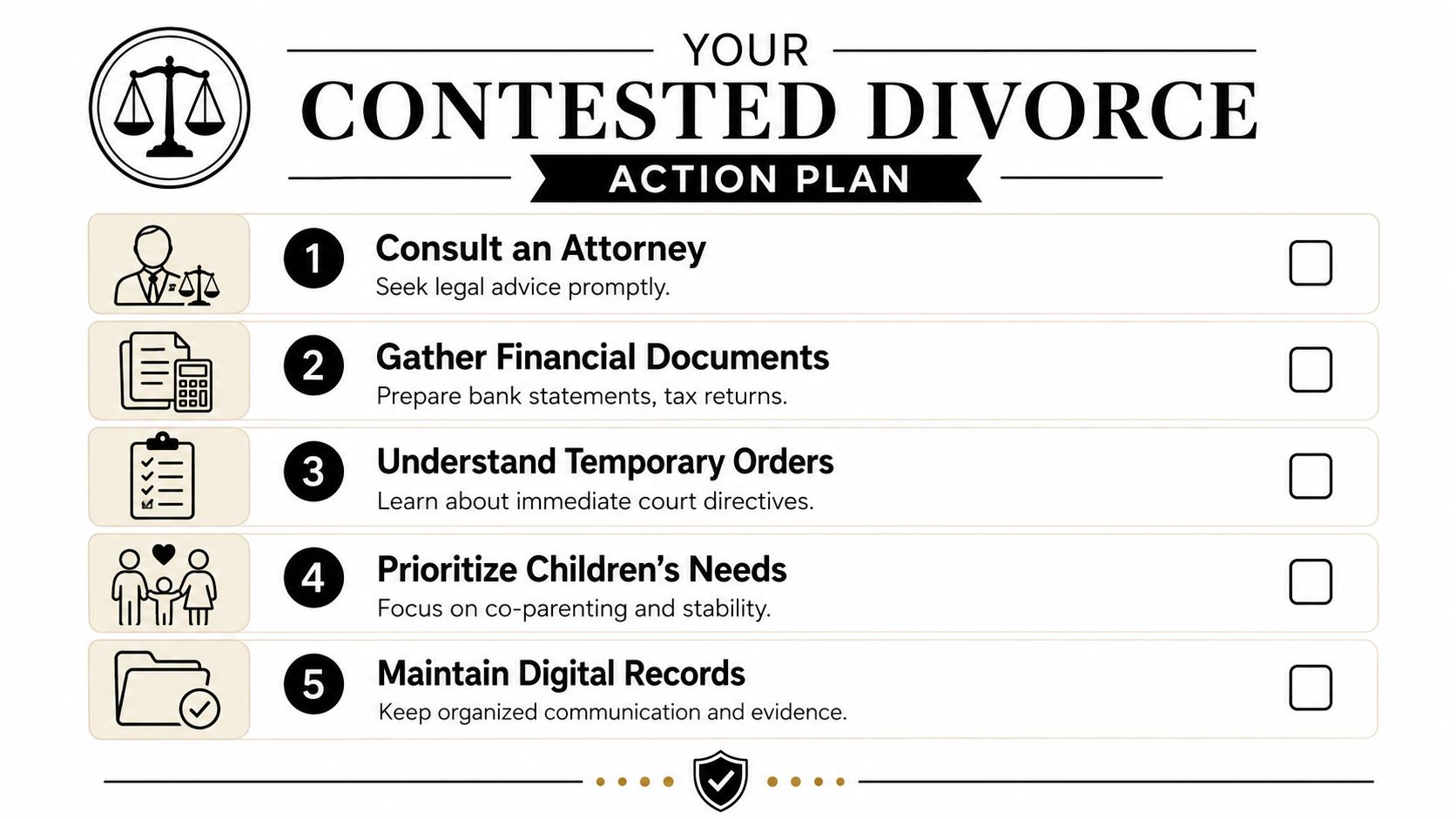
Five steps to take now
Gather core financial records. Collect tax returns, pay stubs, bank statements, retirement statements, mortgage documents, credit card records, and any business records you can lawfully access. Keep the file complete. Do not edit, delete, or selectively save only the documents that help your position.
Build a working monthly budget. Use actual numbers for housing, utilities, insurance, groceries, childcare, tuition, activities, transportation, and debt payments. Judges looking at temporary support and bill payment issues need specifics. Your lawyer does too.
Clean up your communication. Assume every text, email, and social media post could appear in a hearing. Keep messages short, civil, and focused on the children or the logistics at hand. A single angry message can complicate a temporary orders hearing more than clients expect.
Set up a document system you can use under stress. Store records in clearly labeled digital folders so you can find them quickly when your lawyer asks for them. If you need ideas for keeping family records accessible and protected, Family Folder's document storage guide is a practical place to start.
Get legal advice before deadlines start stacking up. If you have already been served, read this guide on what to do after being served divorce papers in The Woodlands and then talk to a lawyer about immediate priorities. Early advice can shape your response, your temporary orders position, and the documents you need to gather first. The Law Office of Bryan Fagan is one option for Montgomery County families who need guidance in contested divorce matters.
What you can control
You can control how prepared you are, how quickly you respond, and whether your goals are clear and realistic.
You cannot control the court's docket, your spouse's willingness to cooperate, or whether a settlement comes together early.
That difference matters. Clients often spend too much energy trying to predict every move the other side will make. A better use of time is to prepare for the part of the case that affects daily life first: temporary arrangements for the children, the house, the bills, and access to money while the divorce is still pending.
Important: This article is for informational purposes only and does not constitute legal advice. Your situation is unique, and you should consult with an attorney for guidance specific to your case.
Frequently Asked Questions About Divorce Timelines
Can my divorce finish faster if we agree on everything
Yes. If you and your spouse reach full agreement on children, property, support, and any remaining procedural issues, the case can shift from contested to uncontested after the waiting period ends. In practice, that only helps if the paperwork is complete, the decree matches the agreement, and neither side reopens an issue at the last minute.
In Montgomery County, I often tell clients to separate two different questions. One is how fast the case can legally end. The other is whether daily life is stable enough while the case is pending. Even when settlement comes together, temporary orders usually carry the family until the final decree is signed.
What is the difference between mediation and trial
Mediation is a private settlement meeting with a neutral mediator. The spouses, through their lawyers if they have them, negotiate their own resolution. Trial puts the decision in the judge's hands after testimony, documents, and legal argument.
The trade-off is straightforward. Mediation gives you more say in the outcome and usually saves time compared with trial preparation and a crowded court docket. Trial gives an answer when settlement fails, but it costs more, takes longer, and leaves important decisions with the court.
Does it matter who files first in Texas
Filing first does not guarantee a better outcome. It can still matter.
The spouse who files first starts the timetable, chooses when to put the case into court, and can ask for temporary orders early if there is a pressing problem involving the children, the house, or access to money. That can be important in a contested divorce because the first major hearing often shapes how the next several months feel.
What happens after the judge signs the Final Decree of Divorce
The decree becomes the controlling order, but the work is not over. Deeds may need to be signed. Retirement accounts may need separate division paperwork. Support payments, possession schedules, and pickup routines have to shift from temporary orders to final terms.
That implementation stage causes more trouble than many people expect. A signed decree ends the case on paper. It does not handle the transfers, deadlines, and follow-through for you.
Will temporary orders decide the entire case
No, but they carry a lot of weight.
Temporary orders often decide who stays in the house, who pays which bills, when each parent sees the children, and how expenses are handled while the case is pending. In a Montgomery County contested divorce, that period can last far longer than the 60-day minimum people hear about at the start. If a temporary schedule works tolerably well for months, it often becomes the baseline people negotiate from later, even if it is not the final result.
Is every contested divorce headed for trial
No. Many contested divorces settle before trial, sometimes after temporary orders, sometimes after financial disclosures and document review, and sometimes only after mediation late in the case.
The practical approach is to prepare for trial from the beginning while staying open to a reasonable settlement once the facts are clear. That puts you in a better position whether the case resolves in a conference room or in a courtroom.
How long does a contested divorce usually feel while it is pending
Longer than the statute suggests.
Texas law imposes a minimum waiting period, but a contested divorce in The Woodlands often feels like a months-long process because families are living under temporary arrangements while waiting for the next setting, exchanging information, and trying to resolve disputes. For many clients, the case starts to feel manageable once temporary orders are in place, even though the final decree may still be a long way off.
If you're dealing with a contested divorce in The Woodlands or elsewhere in Montgomery County, a clear timeline starts with a clear case assessment. The Law Office of Bryan Fagan works with families facing disputes over children, property, temporary orders, and final trial preparation. If you want a practical view of what your case may look like and what to do next, schedule a consultation.
