 Skip to content

A parent in The Woodlands may open a court order before a custody hearing and find that an unfamiliar lawyer or professional has been appointed to the case. The order may say amicus attorney or guardian ad litem, followed by a request for a deposit. The immediate question is usually simple: What will this cost me?
The answer depends less on a statewide fee schedule than on the appointment order, the role assigned, and the work the professional expects to perform. Texas law doesn't establish a fixed Montgomery County dollar price for either appointment in a private custody case. Under Texas Family Code Section 107.023, the court sets reasonable fees and expenses by looking to reasonable and customary fees for similar services in the county.
This guide explains the practical difference between an amicus attorney and a guardian ad litem, what a Woodlands parent should look for in the order, and why a lower initial deposit doesn't necessarily mean a lower final bill. It provides general information, not legal advice for a particular case. If your situation also involves child safety concerns, you may need advice about issues discussed in fighting CPS in Montgomery County.
When a Woodlands Parent First Hears the Words Amicus or Guardian Ad Litem
A parent from Creekside may arrive at a temporary orders hearing expecting to discuss possession, school schedules, and communication with the other parent. Instead, the judge announces that an amicus attorney or guardian ad litem will be appointed. The parent leaves with a copy of an order, a professional's name, and a financial obligation that wasn't part of the original litigation budget.
That reaction is understandable. The appointment sounds official because it is. The court has brought another professional into the case because the child's best interests require additional investigation, legal participation, or both. But the title alone doesn't tell you how much work will be performed, what the professional can access, or who ultimately pays.
Practical rule: Don't budget from the title alone. Read the appointment order before assuming the deposit is the total charge.
The first document to examine is the order itself. Identify whether it appoints an amicus attorney, attorney ad litem, guardian ad litem, or more than one professional. Then look for the scope of work, the amount of the deposit, the party ordered to pay, and any language about future replenishment or payment from a trust account.
For Montgomery County parents, the financial answer is local and case-specific. Texas Family Code Section 107.023 directs the court to use reasonable and customary fees for similar services in the county, rather than imposing one mandatory statewide amount. The appointment may involve interviews, records, home visits, court appearances, or trial preparation, and each can affect the bill.
A parent should also separate two questions that are often confused:
- Who requested or triggered the appointment?
- Who does the court order to pay?
They may be different. Texas law permits fees to be assessed against one or more parties, so the parent who requested an appointment isn't automatically the only person responsible.
The practical goal isn't to resist every appointment. It is to understand what the professional is being asked to do before the work expands. Bring the order, any invoice, and your questions to your lawyer before the next conference or hearing.
What Each Role Actually Does in a Texas Family Case
Texas law permits a court to appoint an amicus attorney, attorney ad litem, or guardian ad litem when a child's best interests are at issue, while recognizing that the roles aren't identical. Texas Family Code Section 107.021 provides the statutory starting point.
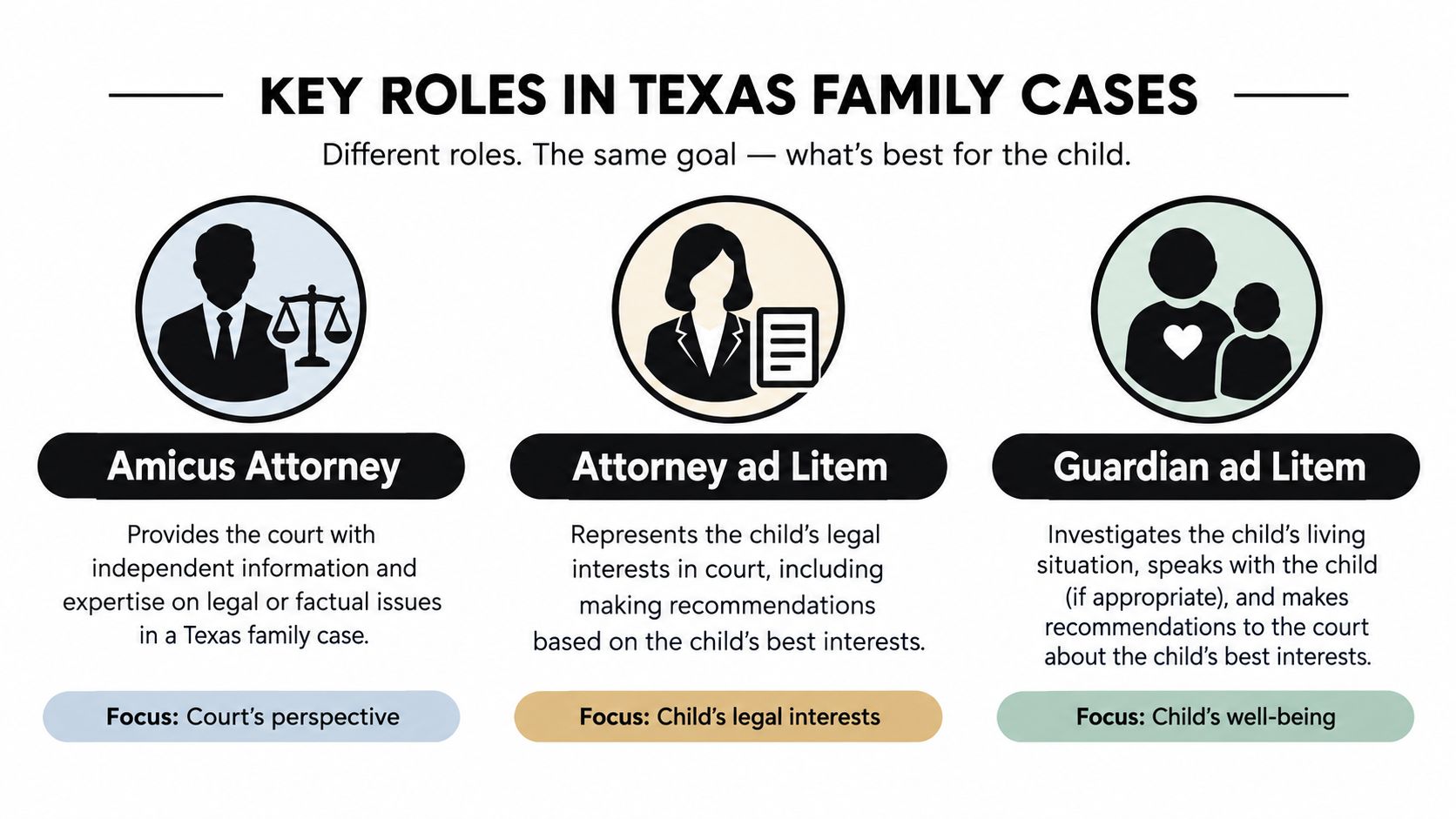
Amicus attorney
An amicus attorney participates in the legal case to help the court evaluate the child's best interests. The amicus may review pleadings and records, interview parents and children, speak with relevant professionals, attend hearings, question witnesses, and present legal positions or evidence to the judge.
That doesn't mean the amicus attorney becomes the child's personal lawyer in the same way a privately hired lawyer represents an adult client. The appointment order controls the precise authority and scope. A parent should look for language describing whether the amicus may conduct interviews, access records, participate in discovery, call witnesses, or make recommendations.
Attorney ad litem
An attorney ad litem represents a child's expressed wishes when appointed for that purpose. The role focuses on legal representation, although the attorney may need to meet with the child and gather information to provide that representation. The attorney ad litem's position may differ from what an adult believes is in the child's best interests.
Guardian ad litem
A guardian ad litem investigates the child's circumstances and provides information or recommendations to the court based on the child's best interests. The work can include interviews, home visits, review of school or medical records, contact with counselors or other professionals, and observation of family dynamics.
A GAL's investigation can therefore look different from an amicus attorney's legal advocacy. Both may attend court, but the preparation behind their work may not be the same.
Who can lead to an appointment
An appointment may arise from a request by a parent or another party, a court's own decision, or another authorized person such as a guardian. The order should tell you what happened in your case. Don't assume that the parent who asked for help controls the professional's role or bill.
Montgomery County's local procedure also matters. The Domestic Relations Court announced rules effective June 1, 2025, affecting access to guardian ad litem reports. A represented party may receive the report through the party's attorney, while disclosure to others is restricted without written court approval. That limitation can affect how a parent prepares for a hearing and discusses the report outside the case.
Side-by-Side Comparison of the Two Appointments
The terms can sound interchangeable, but they describe different work. This table gives a practical starting point for reading an appointment order.
| Criterion | Amicus Attorney | Guardian ad Litem |
|---|---|---|
| Primary function | Participates in the legal process to help the court evaluate the child's best interests | Investigates the child's circumstances and may make recommendations to the court |
| Who the professional serves | The court's need for legal advocacy and a fuller presentation of best-interest issues | The child's best interests as assessed through investigation |
| Typical work product | Pleadings, legal arguments, evidence presentation, hearing participation, and possibly a position or recommendation | Investigation findings, communications with professionals, and possibly a written or oral recommendation |
| Information gathered | Court filings, records, interviews, discovery, and evidence relevant to legal issues | Interviews, records, home visits, school or medical information, and other facts about the child |
| Who can request appointment | A party may request it, or the court may appoint one on its own authority | A party may request it, or the court may appoint one when the child's best interests require it |
| Report access | Access depends on the appointment, court orders, and applicable procedure | Local Montgomery County rules can route a report through counsel for represented parties and restrict disclosure to others |
| Main billing drivers | Legal review, interviews, discovery, hearings, briefing, and trial preparation | Investigation, interviews, records review, visits, communications, reports, and court appearances |
An amicus attorney is generally part of the legal process. The professional may develop a legal position, present evidence, and participate directly in hearings. A GAL is generally associated with fact investigation and best-interest recommendations, although the exact duties still depend on the order.
Both roles fall under the Texas Family Code fee framework. Texas Family Code Section 107.023 requires the court to set reasonable and necessary fees, costs, and expenses by reference to reasonable and customary fees for similar services in the county. The court may also require a cost deposit when making the appointment.
The role changes how you prepare evidence. It also changes what kind of work may appear on the invoice.
For example, a parent working with a Child Support Attorney in The Woodlands may be focused on establishing, modifying, or enforcing child support in Montgomery County. A GAL or amicus appointment adds a separate best-interest process that can affect the overall litigation plan, but it doesn't replace the parent's responsibility to address support issues directly.
How Montgomery County Actually Appoints and Pays These Professionals
The process usually begins with a motion, a request made during a hearing, or a court order entered on the judge's own initiative. The judge then identifies the professional and the role, sets the authority granted, and addresses payment.
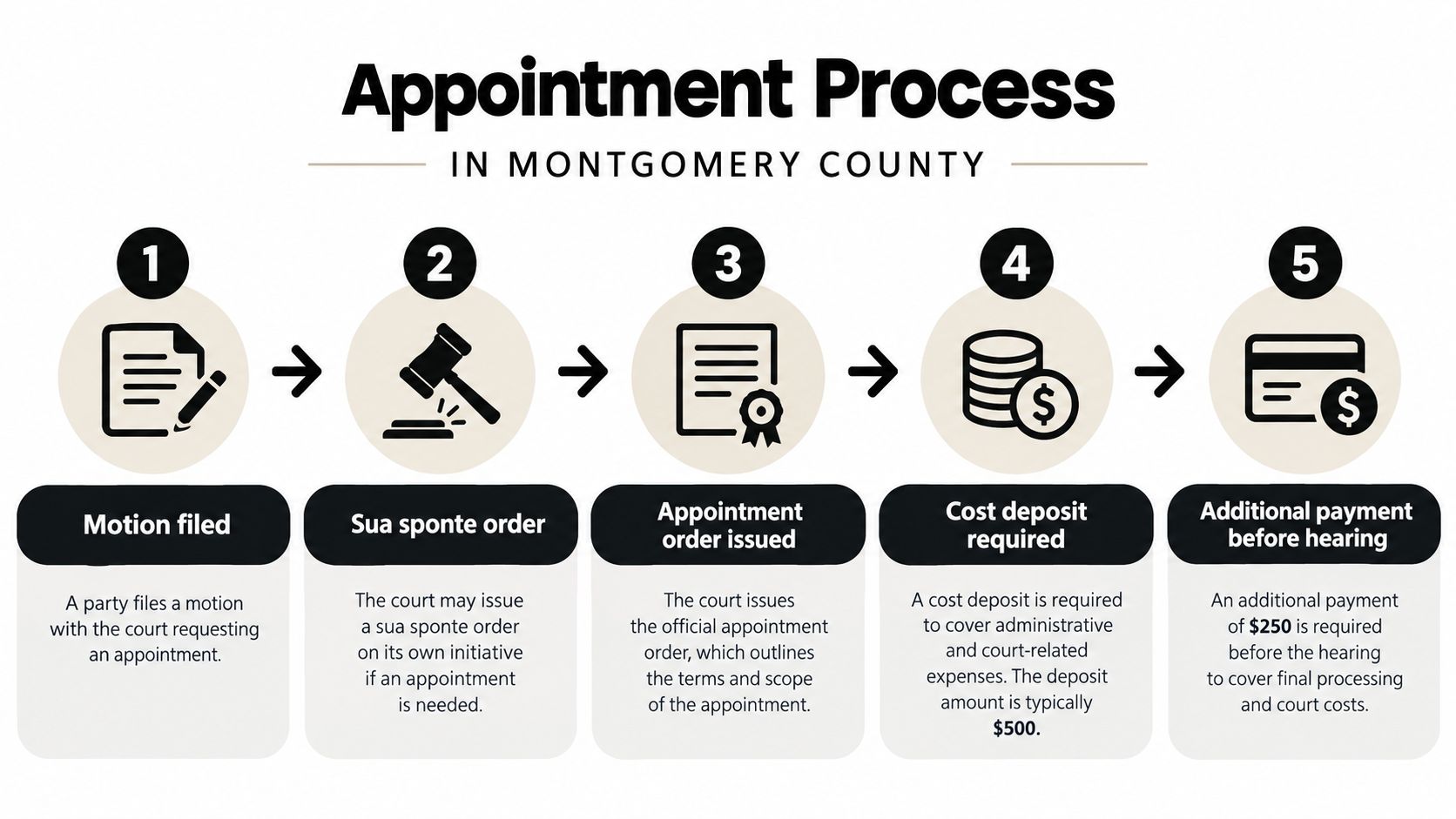
Start with the appointment order
The order is the document that creates the immediate financial obligation. It should be read from beginning to end, not just at the paragraph listing the deposit.
Look for these terms:
- Scope of work: Does the professional investigate, interview, review records, participate in discovery, attend hearings, or prepare for trial?
- Billing structure: Does the order state an hourly rate, flat fee, fee cap, or another method?
- Initial deposit: How much must be paid, to whom, and by what deadline?
- Replenishment: Can the professional request additional funds before the final hearing?
- Billing frequency: Will invoices be sent periodically, or only after a later event?
- Allocation: Does one parent pay, or does the order divide responsibility between the parents?
The court may require a cost deposit at the time of appointment and may order additional funds into a trust account before the final hearing. The initial payment is therefore a funding mechanism, not necessarily a final invoice.
Understand who pays
The court can assess fees against one party or more than one party. The parent who requested the appointment may be ordered to pay, but that isn't automatic. The court may consider the circumstances of the case, the parties' ability to pay, and the reason the professional was needed.
A local court rule can affect procedure without changing the state-law fee standard. Montgomery County's Domestic Relations Court rules sit alongside the Texas Family Code, so a parent should review both the appointment order and any applicable local procedure.
Track the appointment over time
Keep every invoice, payment confirmation, and written communication about the scope of work. If the professional asks for more funds, compare the request with the original order. Ask whether the added work falls within the original scope or reflects a new task, hearing, investigation, or records request.
Realistic Cost Drivers and How to Read Your Appointment Order
The right budgeting question isn't, “What does a GAL cost?” It is, “What work has the court authorized, and how much of that work is reasonably expected in this case?”
The statutory benchmark is local customary pricing for similar services. The final amount can still vary substantially because cases don't demand identical work.
The workload behind the bill
A professional's time may be affected by:
- Hourly rate or fee structure: The order may identify an hourly rate, flat fee, or cap.
- Anticipated scope: A limited interview assignment differs from a broad investigation involving multiple professionals and records.
- Number of children: More children can require additional interviews, observations, and review.
- Contested issues: Allegations involving safety, school decisions, mental health, relocation, or communication may require more investigation.
- Hearings: Temporary orders, status conferences, discovery disputes, and trial settings can add preparation and attendance.
- Interviews and visits: Parent, child, household, school, medical, and home-visit contacts can increase time.
- Records review: The professional may review pleadings, text messages, school records, medical information, counseling records, or other materials.
- Trial preparation: Exhibits, witness preparation, legal research, and courtroom attendance can create additional charges.
The initial deposit isn't necessarily the total cost. A lower upfront amount may be followed by a replenishment request if the professional has used the deposit and the case still requires work.

Ability to pay matters
Texas law requires courts to consider the parties' ability to pay in discretionary appointments, and an appointed professional can't be compelled to work without reasonable compensation. If paying the deposit would create a serious hardship, raise that issue promptly and provide a clear financial picture.
Before agreeing to an order or paying a deposit, ask:
- What exact role has been appointed?
- What work is included?
- Is there a cap or only an initial deposit?
- When can replenishment be requested?
- Will invoices identify time, tasks, and expenses?
- How are fees divided between the parents?
- Who receives reports and records?
- What happens if the case settles before the expected hearing?
Bring the order and any invoice to counsel. A discussion with a Woodlands child custody lawyer about appointment costs can help you identify unclear language before it creates a financial surprise.
The June 2025 Montgomery County Rule Change and Why It Matters for Your Bill
A local procedure change can affect budgeting even when it doesn't set a fee. The Montgomery County Domestic Relations Court announced new rules effective June 1, 2025, including a rule allowing represented parties to receive a guardian ad litem report through their attorney while restricting disclosure to others without written court approval. The announcement is available in the court's June 1, 2025 local-rules notice.

For a represented parent, access may run through the lawyer rather than directly from the GAL. That matters when the parent wants to understand recommendations, identify factual errors, gather a response, or decide what evidence should be presented at the next hearing.
The restriction also affects family discussions. A parent may want to send the report to relatives, discuss every detail with a support person, or provide it to another professional. Disclosure rules can limit those choices without written court approval.
Report access affects preparation
Suppose a GAL investigates a dispute about school attendance and household stability. The parent receives the report through counsel, reviews it with the attorney, and learns that the GAL relied on an incomplete record. The parent may need to locate school communications, attendance records, witnesses, or other evidence before the hearing.
That response can require legal review and additional work. It may also require the GAL to address new information, clarify a recommendation, or attend another hearing. The local report-access rule doesn't automatically create those charges, but it changes how the parent and attorney must organize the response.
An amicus attorney may spend more time on legal advocacy, pleadings, evidence, and courtroom participation. A GAL may spend more time investigating the child's circumstances. If both are appointed in one dispute, their workloads can differ substantially.
The budgeting lesson is practical: a lower initial deposit doesn't necessarily mean a lower final bill. The scope of the order, later funding requests, report access, and hearing strategy all matter.
Probate and Adult Guardianship Appointments Are a Different Conversation
A guardian ad litem appointed in an adult guardianship or probate proceeding isn't governed by the same framework as a GAL appointed in a child-custody case. A family in The Woodlands handling an adult guardianship should start with the Texas Estates Code and the probate court's appointment order.
Texas Estates Code provisions can authorize an appointment when protecting a proposed ward or interested party is advisable. Compensation is generally set by the probate court as reasonable compensation or as a cost of the proceeding. Guardianship-related expenses, including guardian ad litem services and reasonable attorney's fees in appropriate circumstances, may be paid from the guardianship estate. The relevant provisions are collected in the Texas Estates Code guardianship provisions.
That payment structure differs from a private custody dispute. The estate's available assets, the nature of the proceeding, and the probate court's order may control whether and how the professional is paid. A family shouldn't assume that a custody-case deposit, parent allocation, or billing arrangement carries over.
For help identifying the different filing framework, a Woodlands family can review information about filing for guardianship in Montgomery County Probate Court. The specific facts still matter.
A family handling divorce, child custody, or probate should identify the forum and statute first. The same title, guardian ad litem, can describe work under different legal systems with different payment mechanics.
What to Do Next and How a Woodlands Attorney Can Help
Use this checklist before the next conference or hearing:
- Read the order: Identify the exact role, scope, deposit, deadline, and payer.
- Check funding terms: Look for replenishment language, a trust account, or a fee cap.
- Ask about report access: If a GAL is appointed, ask counsel how the June 2025 local rule affects delivery and disclosure.
- Request itemized billing: Review time, tasks, expenses, and remaining funds.
- Prepare allocation questions: Ask whether the court assigned payment to one parent or divided it.
- Gather financial information: If the deposit creates hardship, discuss ability to pay promptly.
- Match evidence to the role: Prepare legal records for an amicus attorney and factual information relevant to a GAL investigation.
This article is general information, not legal advice. It doesn't create an attorney-client relationship and can't determine what a particular Montgomery County court will order in your case.
The Law Office of Bryan Fagan handles family and probate matters for people in The Woodlands and surrounding Montgomery County communities, including custody disputes, child support issues, and contested divorce matters. A consultation can help you review the appointment order, understand the role assigned, and plan for the financial and procedural decisions ahead.
The Law Office of Bryan Fagan can help a Woodlands parent evaluate an amicus attorney or guardian ad litem order, prepare for Montgomery County family-court procedure, and address related custody, child support, contested divorce, or probate concerns. Visit The Law Office of Bryan Fagan to schedule a consultation about your situation.
