 Skip to content
If you're in The Woodlands and facing divorce or a support dispute, you've probably already run into the same frustrating answer: "child support is just a formula." That’s only partly true.
For high income child support montgomery county cases, the formula matters, but it usually isn't the whole case. Once income goes above the usual guideline range, the fight shifts from simple math to proof. The court still starts with the statute, but the outcome often turns on what you can document, how clearly you present the child’s needs, and whether the judge believes the requested expenses are reasonable.
That’s where generic online articles usually fail people in Montgomery County. They stop at the cap. Real cases don’t.
Understanding High-Income Child Support in Montgomery County
A common Woodlands scenario looks like this. One parent works in energy, medicine, finance, or owns a business. Income is strong, but it isn’t always simple. There may be salary, bonus, distributions, restricted compensation, or self-employment income. The other parent assumes support will be automatic because earnings are high.
Then the calculator gives a number that looks low.
That surprise is where most high-income cases begin. Texas uses guideline child support, but in upper-income cases the court doesn't just keep applying percentages forever. After a certain point, the judge has to look at the child’s proven needs. That means a parent asking for more than the baseline amount has to come to court with evidence, not assumptions.

Parents in Panther Creek, Sterling Ridge, Alden Bridge, and Creekside often expect the child support result to mirror the family’s overall lifestyle. Sometimes it does in part. Sometimes it doesn’t. Judges usually want to see a disciplined explanation of what belongs in the child’s budget, what is really a parent’s expense, and what maintains stability for the child without turning support into disguised spousal maintenance.
Why local court practice matters
The legal rule is statewide. The way the case is built is local.
In Montgomery County, high-income support disputes often become document-heavy fast. If the case is contested, the judge will care about whether the numbers are organized, whether the requests are tied to the child, and whether the parent seeking above-guideline support can explain why each expense is appropriate.
That’s why a calculator alone won't prepare you for hearing. A parent usually needs a case strategy that fits the facts, the income structure, and the child’s routine in The Woodlands. If you want a broader overview of local support disputes, this Montgomery County child support attorney resource is a useful starting point.
Practical rule: In a high-income case, the fight usually isn't over whether support is owed. The fight is over how much of the child’s actual life the court will treat as a proven need.
What works and what doesn’t
What works is specificity. Tuition invoices. Activity statements. Medical bills. Travel costs tied to the child. A clean budget.
What doesn’t work is walking into court with a broad claim that "the child is used to a certain lifestyle" and expecting that phrase to do the job by itself.
How the Texas Guideline Cap Works for High Earners
Texas law gives you the starting point. Under Texas Family Code Section 154.125, the guideline calculation applies to monthly net resources up to $11,700, and for income above that amount the court may order additional support only if the child’s proven needs justify it.
That cap confuses people because they treat it like a hard ceiling on support. It isn’t. It’s the line where the standard formula stops doing all the work.
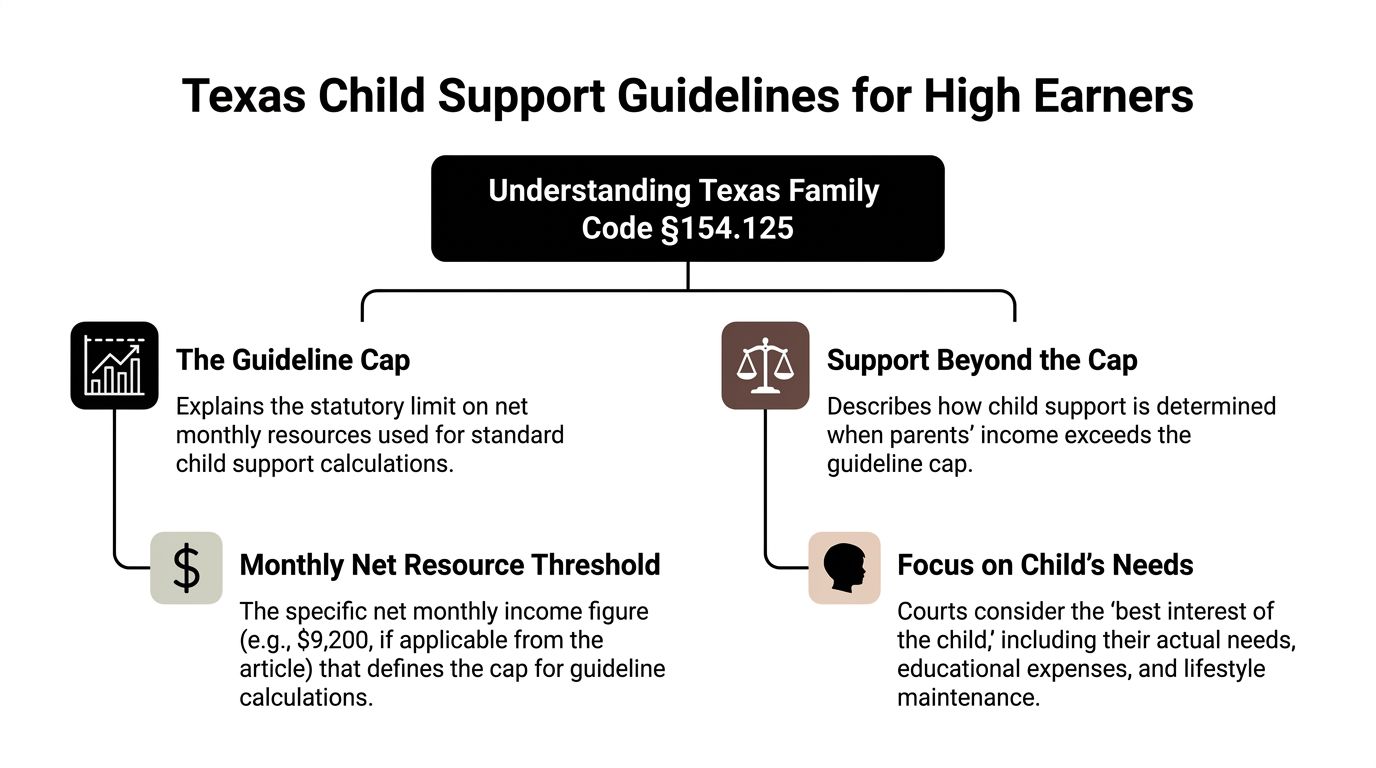
Think of the cap as a starting line
For high earners, the guideline cap is better understood as a starting line for deeper analysis, not the finish line.
If the paying parent’s net resources are at or below the cap, the court usually applies the standard percentage tied to the number of children. If net resources are above the cap, the court still uses the guideline amount on the capped portion first. After that, the parent seeking more support must prove the child needs more.
That’s why two high-income families in Montgomery County can get very different results even when the paying parents earn similar amounts. The difference is usually the evidence.
What counts as net resources
For executives, physicians, entrepreneurs, and commissioned professionals, the phrase net resources matters. In practice, this can include wages, bonuses, self-employment income, dividends, and other income streams recognized under Texas child support law. When income is layered, the cleanest presentation usually wins.
Problems show up when a parent treats support like a simple W-2 case even though the compensation structure is more complex. Business owners often under-document legitimate deductions. The other side may overstate available income by lumping personal, business, and nonrecurring funds together without context.
A high-income support case usually turns on details like these:
Salary and bonus structure
A fixed salary is easy. Annual bonuses, deferred compensation, and irregular incentive pay usually require a more careful record.Business income
If a parent owns a practice, company, or partnership interest, the court will want a clear picture of actual available income, not just top-line revenue.Investment and passive income
Dividends and similar income streams can matter. They should be documented cleanly and tied to the statutory definition of resources.Voluntary underemployment
If a parent has reduced income by choice, the court may look past the lower current number.
A local overview of how these rules fit into ordinary support disputes appears in this guide on child support guidelines in Montgomery County.
Later in the same analysis, this short video helps explain why the guideline number often isn't the end of the case.
The percentages still matter
The guideline percentages are still the base framework. The Texas Attorney General calculator reflects the standard percentages applied to net resources up to the cap: 20% for one child, 25% for two, 30% for three, 35% for four, and 40% for five or more children.
That means the court generally calculates the baseline amount first. Then the argument shifts.
The parent asking for more than the capped guideline amount has to prove more than income. That parent has to prove need.
What judges usually reject
Courts often push back on loose claims that every family expense should be shifted into child support. Mortgage payments for a large home, luxury travel for a parent, and adult lifestyle spending don't automatically become child needs just because the family could afford them during the marriage.
What tends to work better is a narrower, disciplined presentation. Show the child’s school costs. Show recurring activity fees. Show healthcare expenses. Show transportation and childcare tied directly to the child. If you're asking the court to go above the guideline amount, connect each request to the child’s day-to-day life.
Proving a Child's Needs in Montgomery County Courts
Once the paying parent’s income is above the cap, the case becomes an evidence problem. The parent asking for additional support needs to prove the child’s actual needs with records the court can trust.
In The Woodlands, that often means more than a few receipts in a folder. It usually means a clear monthly budget, backup documents, and testimony that ties the expenses to the child’s routine.
What "needs" usually looks like in a high-asset case
In high-asset Montgomery County divorces, proving a child’s needs often involves detailed evidence of expenses for private school, competitive sports leagues in communities like Creekside Park or Sterling Ridge, and specialized arts or academic tutoring, as reflected by local education and activity options in The Woodlands area.
That doesn’t mean every private expense will be approved. It means those categories are often part of the conversation when they are regular, child-focused, and documented.
The evidence judges usually want to see
In a contested hearing, broad summaries aren't enough. Judges usually respond better when the requesting parent can hand over organized backup and explain it clearly.
Consider building proof in layers:
School records
Tuition contracts, enrollment records, fee schedules, school supply invoices, transportation charges, and after-school program costs.Healthcare documents
Insurance premium allocations for the child, unreimbursed medical bills, therapy invoices, prescriptions, and specialist recommendations.Activity records
Team registration, league dues, tournament costs, uniforms, equipment, coaching fees, music lessons, dance, arts instruction, and academic tutoring.Childcare records
Nanny agreements, after-school care bills, summer program invoices, and payment histories.Travel tied to the child
Flight receipts, hotel charges related to tournaments or school travel, and transportation expenses directly connected to parenting schedules or child activities.Recurring household items attributable to the child
Clothing, food, school technology, and ordinary monthly costs, but only if they’re presented conservatively and with support.
What usually helps in Montgomery County hearings
The strongest presentations tend to have these features:
| Proof issue | What helps |
|---|---|
| Expense credibility | A spreadsheet matched to invoices and bank statements |
| Recurring costs | A history showing the expense wasn't created for litigation |
| Child connection | Clear testimony that the item benefits the child directly |
| Reasonableness | Requests that fit the family’s established routine without obvious inflation |
One practical option, when a hearing is coming up, is to work from the court-outward rather than from the file-inward. Start by asking what a judge needs to see, then organize the documents to answer that question. This local guide to a Montgomery County child support hearing gives a useful picture of how these disputes are presented.
Bring a judge a clean packet, not a shopping bag of receipts.
Common mistakes in above-cap cases
High-income parents on both sides often make avoidable mistakes.
Blending parent and child expenses
If an item mostly benefits the parent, the court may discount it.Overreaching
Asking for everything can weaken the case. A focused list often lands better than an inflated one.No historical proof
If private school, elite sports, or tutoring started long before the case, show that history. If the expense is brand new, be ready to explain why it is necessary now.Messy financial records
Unsupported estimates can damage credibility fast.
A short local example
A parent in Sterling Ridge may request above-guideline support for a child who attends private school, receives academic tutoring, and plays on a competitive team. If that parent brings contracts, invoices, payment records, and a clean monthly summary, the judge has something concrete to evaluate.
If the same parent says, "this is what families in our neighborhood spend," that usually won’t carry much weight.
Sample Calculation and Scenario for a Woodlands Family
A hypothetical helps make this easier.
Assume a parent in The Woodlands has $30,000 in monthly net resources. There is one child. Under the standard Texas guideline percentage for one child, the court starts with 20% of net resources up to the cap. Using the cap discussed earlier, that baseline amount is $2,340.
That number is not automatically the final order. In a high-income case, it is the baseline before the court considers whether the child’s proven needs justify more.
A practical scenario
Consider a family in Creekside. The parents separated after years of a high-income household. The child has been in private school, participates in a select sports program, and receives regular academic support. One parent assumes the baseline amount should cover everything. The other parent says it plainly won't.
The court won’t decide that dispute by impression. It will look at proof.
Here is a sample way the issue gets organized.
| Calculation Component | Amount |
|---|---|
| Guideline support on capped net resources for one child | $2,340 |
| Additional proven child needs above baseline | Depends on evidence presented |
| Total possible order | Baseline amount plus any additional needs the court finds proven |
Why the table stops where it does
It stops there on purpose.
A lot of online articles try to finish the example by inventing a polished monthly budget and a final award. That’s risky and often misleading. In real Montgomery County cases, the additional amount depends on the quality of the proof, the reasonableness of the expenses, and whether the judge sees those costs as the child’s actual needs rather than household overreach.
Case reality: The same income can produce different outcomes if one parent brings organized evidence and the other brings general claims.
How to think about the second half of the calculation
When the case moves above the cap, ask these questions:
Is the expense for the child?**
School tuition usually is. A parent’s upgraded vehicle usually isn’t.Is it recurring and established?
Courts often trust expenses that existed before litigation more than expenses that appeared after filing.Can you prove it with documents?
Invoices, contracts, payment records, and statements matter.Is the amount reasonable in context?
High income doesn't eliminate the need for common sense.
Many payors make a mistake. They focus only on reducing income. Many recipients make the opposite mistake. They focus only on the payor’s wealth. Neither approach is enough by itself.
The better method is balanced. First, calculate the baseline correctly. Second, build or challenge the child-needs case line by line.
Changing or Enforcing Your High-Income Support Order
A common Woodlands scenario looks like this: the support order made sense when it was signed, then compensation changed, a child’s schedule became more expensive, or payments started arriving late. In high-income cases, those shifts happen more often than statewide articles suggest, and Montgomery County judges usually focus less on the headline income number and more on whether the change is real, documented, and likely to continue.
A child support order can be modified, but not because one parent now dislikes the deal. Texas law generally requires a material and substantial change in the circumstances of the child or a parent since the earlier order, as stated in Texas Family Code Chapter 156.
That standard sounds simple. In court, it is very fact-specific.
In Montgomery County, modification requests often rise or fall on how the judge views the reason for the change. A pay package that shifted from base salary to performance compensation may justify a fresh look. A temporary dip tied to a voluntary job move may not. A child’s new tutoring, therapy, or academic support can matter. So can a serious increase in travel, training, or activity costs, if those expenses are established and tied to the child rather than the parents’ dispute.
When a modification request deserves a serious review
Several patterns come up repeatedly in higher-income cases in The Woodlands:
Compensation changed in a meaningful way
Income may now come from bonuses, commissions, deferred compensation, partnership distributions, or self-employment rather than a predictable paycheck.Income dropped, but the reason matters
Courts usually look hard at whether the reduction was involuntary, credible, and likely to last.The child’s needs increased since the prior order
Educational intervention, medical treatment, counseling, specialized programs, or structured activities may support a modification if the proof is clean.The earlier order was based on an incomplete picture
If the current facts are materially different from the facts behind the prior order, the court may revisit support.
Judges in Montgomery County often pay close attention to timing. If a claimed income change happened right before filing, expect questions. If the child’s added expenses began long before the case and were consistently paid, that usually presents better than costs that appeared only after litigation started.
What usually decides these cases
Records matter. Credibility matters more than many parents expect.
A parent asking to reduce support usually needs more than a verbal explanation. Pay records, business documents, tax returns, updated financial information, and a clear timeline all matter. In self-employment and business-owner cases, the court may look past labels and ask what money is available to the parent.
A parent asking to increase support faces a different problem. The request has to show changed circumstances and child-specific need, not a second attempt to relitigate the old order because the other parent earns a high income. That distinction carries real weight in Montgomery County courtrooms.
Enforcement in a high-income case
Enforcement can become serious quickly.
If support is not paid as ordered, the court has tools that can reach income, accounts, and property, and contempt exposure is real in the right case. In higher-asset cases, enforcement work may involve tracing irregular payments, business entities, reimbursements, or account transfers that make the arrearage issue look less straightforward than it is.
From a practical standpoint, delay usually makes the case worse. The parent owed support loses time and collection options. The parent behind on support loses credibility, and arrears keep building under an order that remains enforceable until it is changed.
One point clients often need to hear clearly: filing for modification does not erase missed payments that accrued before the order was changed. If income dropped, address it early. If the other parent stopped paying, document every missed payment and act before the record gets harder to clean up.
Your Checklist for a Montgomery County High-Income Case
A parent in The Woodlands may walk into court with a high salary on one side and a stack of private-school, therapy, and activity bills on the other, then leave frustrated because the presentation did not match what the judge needed to decide. In Montgomery County, high-income support cases usually turn on organization, credibility, and whether the claimed expenses are tied clearly to the child.
That is the part generic Texas articles often miss. The Family Code sets the framework, but local judges still have to decide what income counts, what expenses are child-specific, and whether the proof is clean enough to support an above-cap request or defend against one. In practice, the better-prepared side often has the stronger position before anyone testifies.

What to do next
Use this checklist for an original case, a modification, or an enforcement dispute:
Pull complete income records
Gather pay stubs, tax returns, bonus history, K-1s, profit and loss statements, brokerage statements, and records showing recurring deposits. In high-income cases, salary alone is often incomplete.Separate the child's needs from household spending
Judges want to see the child's expenses, not a general description of an expensive lifestyle.Match each major expense with backup
Keep tuition contracts, invoices, receipts, registration forms, medical statements, and payment confirmations in one place.Prepare a usable monthly summary
A spreadsheet usually works better than a binder full of unsorted documents. The numbers in that summary should tie back to the source records.Show what is longstanding and what is new
A continuing expense, such as the same school, tutor, or therapy provider, is usually easier to explain than a new item that appeared right before litigation.Read the current order line by line
In modification and enforcement matters, small wording differences can control reimbursement rights, payment dates, and what counts as noncompliance.Avoid side agreements that never make it into a written order
Informal payment changes create proof problems later, especially when one parent says a payment was support and the other says it was a gift or extra expense help.Get ahead of complicated income issues
Business ownership, deferred compensation, stock awards, irregular bonuses, and reimbursed personal expenses often require a more careful document strategy than parents expect.
When hiring counsel usually makes sense
Some support cases are simple enough for a parent to handle without much dispute. High-income cases in Montgomery County usually are not, especially when the numbers look good on paper but the issue is classification, tracing, or credibility.
You should strongly consider counsel if any of these are true:
| Situation | Why it matters |
|---|---|
| Income comes from a business or multiple sources | Net resources may be disputed, and labels on tax documents do not always end the argument |
| The other parent is claiming large above-cap needs | The claimed expenses need to be tested item by item |
| You suspect hidden income or manipulated deductions | Formal discovery and careful financial review may decide the case |
| The case involves modification after a major income change | The court will expect records and a timeline that make sense |
| Enforcement is on the table | Missed support can lead to serious court action and collection remedies |
The Law Office of Bryan Fagan handles Montgomery County family law matters, including child support, modification, and enforcement.
What tends to work in real courtrooms
Start narrow.
Parents often hurt their own case by claiming every expense they can name. A more persuasive approach is to focus on expenses that are consistent, documented, and clearly connected to the child. In Montgomery County courts, restraint usually helps credibility.
Consistency matters too. If the financial statement uses one set of labels, the spreadsheet uses another, and the testimony uses a third, the court has to work harder than it should. That is rarely a good sign in a high-income case.
Be ready for questions about whether an expense is really for the child or partly for the adults in the home. That issue comes up often in above-cap disputes. It is common in The Woodlands, where families may have significant spending but still need to separate true child needs from broader household choices.
Enforcement also needs prompt attention. Unpaid support can lead to income withholding, account problems, property-related collection issues, and contempt exposure in the right case. Delay usually makes the record harder to fix.
A strong high-income child support case is usually narrower than the client first expects and far more document-driven than the client first plans.
Final practical takeaway
The biggest mistake in high income child support montgomery county cases is assuming the result will follow the income level. It will not.
The statute gives the court a starting point. The outcome in Montgomery County often depends on how the local judge views the proof, the history of the child's expenses, and whether the numbers hold up under scrutiny. If you are asking for more than the guideline amount, prove specific needs with records that are easy to follow. If you are defending against that request, challenge weak categories and unsupported assumptions with the same level of detail.
This article is for informational purposes only. It is not legal advice and does not create an attorney-client relationship.
