
If you're searching for hidden assets divorce Montgomery County, you're probably already seeing the pattern.
The paycheck that used to hit the joint account now lands somewhere else. Mail disappears before you see it. A spouse who never cared about bookkeeping suddenly becomes protective of passwords, tax returns, and business records. In The Woodlands, I often see this start subtly. One spouse handles the money, the other feels something is off, and by the time divorce is discussed, the paper trail is already getting harder to follow.
That instinct matters. Hidden assets aren't rare. A 2018 NEFE study discussed here found that 41% of U.S. adults with combined assets admitted to hiding money from their spouse during divorce proceedings. That doesn't mean every missing statement proves fraud. It does mean suspicion should be tested with facts, not brushed aside.
Texas courts expect full financial disclosure in divorce. Under Texas Family Code §7.001, the court divides community property in a manner the judge considers just and right. That only works when both sides tell the truth. If one spouse hides accounts, income, business value, or property, the entire division process gets distorted.
In Montgomery County, that problem shows up in ordinary cases and high-asset cases alike. It can involve a family business in Sterling Ridge, sales commissions delayed until after filing, cash-heavy work, retirement funds left off an inventory, or property titled in someone else's name. The legal tools to deal with it are strong, but timing matters. Waiting too long can make tracing money harder and protecting property more expensive.
Uncovering the Truth in a Montgomery County Divorce
A common story starts like this. A husband or wife in The Woodlands notices the family lifestyle hasn't changed, but the disclosed income suddenly looks smaller. The mortgage is paid. Travel continues. The business still seems busy. But the joint account is tighter than ever, and every question about money turns into an argument.
That disconnect is often where hidden asset cases begin.
Texas is a community property state. In plain English, that means property acquired during the marriage is generally presumed to be part of the marital estate unless a party proves otherwise. If one spouse controls the books, the login credentials, or the business records, the other spouse can feel outmatched very quickly. That feeling is understandable, but it isn't a reason to guess. It is a reason to act carefully and use the court process the right way.
Why this issue hits hard in The Woodlands
In Montgomery County, many families have assets that don't fit neatly on a single pay stub. They may include business interests, bonuses, deferred compensation, stock, rental property, separate property claims, trusts, or cash flow from closely held companies. When one spouse has better access to those records, concealment becomes easier.
Practical rule: Suspicion alone won't win in court. Organized records, targeted discovery, and a clear timeline often will.
The emotional side matters too. Hidden assets change more than property division. They affect trust, temporary support negotiations, and sometimes custody dynamics when one parent is using financial pressure to control the process. A spouse who hides money may also be the spouse who delays documents, stalls mediation, or claims poverty while still spending freely.
What honesty means under Texas law
In a Texas divorce, each side is expected to disclose assets and debts accurately. That usually includes inventories, appraisements, account records, tax returns, business records, and other financial materials depending on the case. If a party lies, omits, transfers, or dissipates property, the judge can respond in ways that meaningfully affect the outcome.
That is why a hidden assets divorce Montgomery County case should be handled with discipline from the start. We look for what can be proven, what can be preserved, and what a Montgomery County judge will consider important when the evidence is presented.
Common Warning Signs Your Spouse May Be Hiding Assets
Hidden assets are rarely discovered due to a single dramatic clue. Instead, their discovery often results from several smaller issues aligning.

A forensic analysis summarized here found a high correlation between concealment and certain red flags, including unexplained bank withdrawals exceeding 10% of income and major lifestyle mismatches. That matters because many spouses in Montgomery County first notice the lifestyle mismatch before they can identify the exact account or transfer.
Behavioral signs that deserve attention
These signs don't prove concealment by themselves. They do tell us where to look.
- New secrecy around devices and mail. A spouse who used to leave statements on the kitchen counter now reroutes mail, changes passwords, and keeps a second phone close at hand.
- Sudden hostility about basic financial questions. If asking about taxes, payroll, or credit cards now triggers anger or deflection, that change matters.
- Pressure to sign quickly. A spouse pushing for a fast settlement before full disclosure often has a reason for the rush.
- Gaslighting about money. Some people insist you're confused, forgetful, or overreacting when you ask about a transfer or missing account.
Financial irregularities that often show up first
This is usually where clients start bringing us useful details.
- Large cash withdrawals. Cash is harder to trace than bank transfers, especially when it leaves in repeated smaller amounts.
- Unfamiliar statements or recurring charges. A small payment can lead to a brokerage account, storage unit, private mailbox, or digital wallet.
- Income that no longer reaches the household. Direct deposits may be redirected to a new account, or commissions may be held back.
- Tax returns that stop making sense. Wages, business losses, refunds, or deductions may conflict with the way the family is living.
Spending patterns often tell the story before the balance sheet does.
Business owner tactics we see in high-asset divorces
The Woodlands has many families tied to closely held businesses, medical practices, professional firms, sales organizations, and service companies. Those cases require closer review because records can be manipulated in ways a normal employee paycheck cannot.
Here are common patterns:
- Underreporting cash sales. This is especially important in cash-intensive businesses.
- Ghost payroll entries. Payments are run through payroll to people who do not work there.
- Personal expenses booked as business costs. Travel, vehicles, meals, or luxury purchases get buried inside company accounts.
- Delayed contracts or bonuses. A spouse may postpone income recognition until after temporary orders or final division.
- Fake debts to friends or relatives. A business suddenly "owes" money to someone close to the owner, reducing apparent value on paper.
The pattern matters more than any single clue
One missing bank statement isn't enough. One vague answer at dinner isn't enough either. But when secrecy, cash movement, business irregularities, and an unrealistic financial story start appearing together, the case changes.
That's when we stop debating motives and start collecting evidence.
Using Legal Discovery to Find Hidden Money and Property
Once divorce is filed, suspicion has to become proof. In Texas, that usually happens through discovery. This is the formal process for obtaining information, documents, and sworn answers from the other side and from third parties.
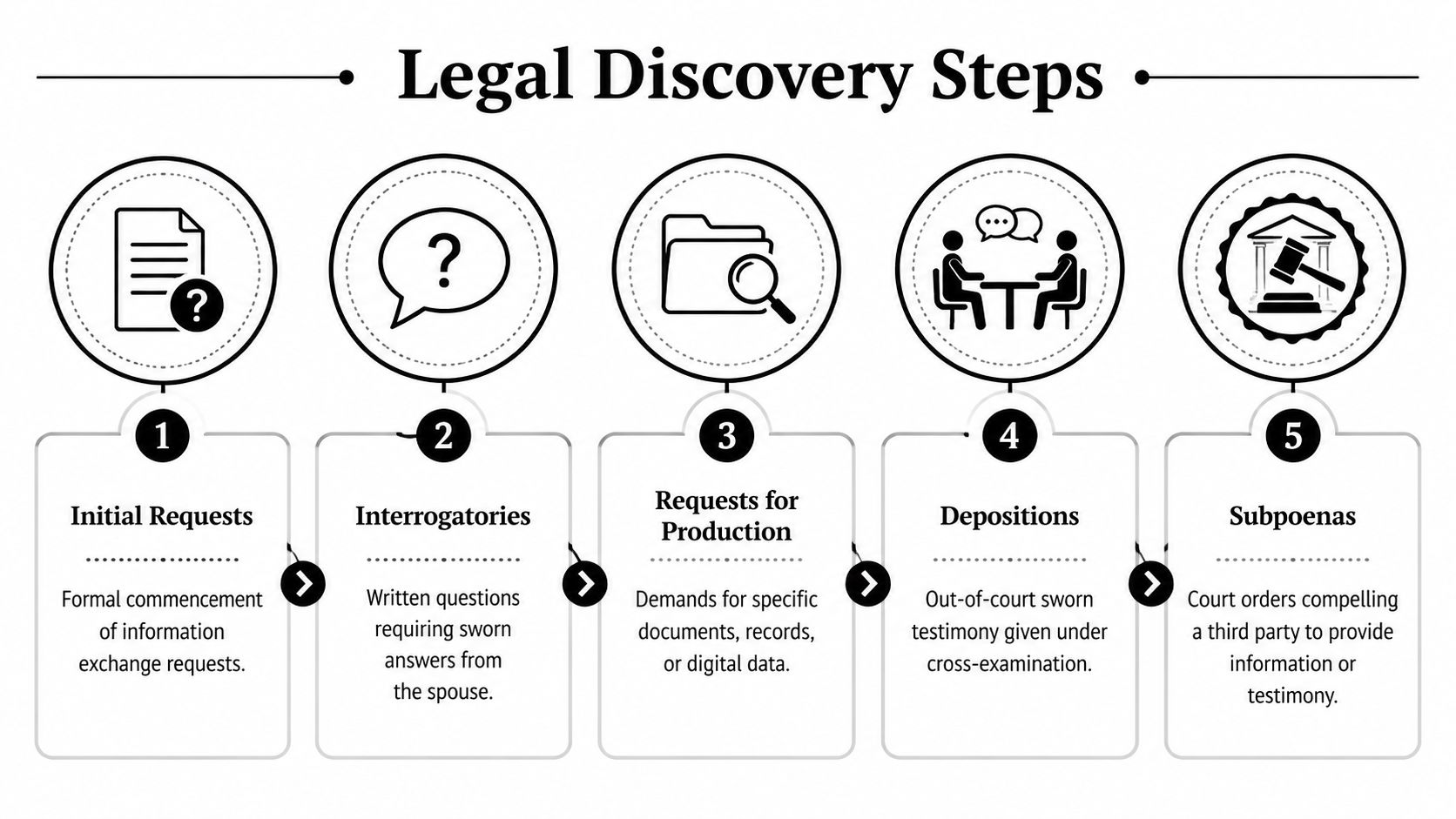
If you've read online about Montgomery County hidden asset cases, you've probably seen articles aimed at Pennsylvania. That causes confusion. Texas doesn't use the same domestic-relations-specific framework. In a Montgomery County, Texas divorce, we rely on Texas procedure, local court expectations, and practical case management. That local approach matters in places like the 410th District Court.
Start with the inventory and the paper trail
In Texas divorce practice, the Inventory and Appraisement is foundational. Each spouse identifies assets, debts, and claimed values. It isn't enough by itself, but it gives the court a map of what each side says exists.
Then we test that map against the documents.
The first wave usually includes:
- bank statements
- credit card statements
- tax returns
- loan applications
- payroll records
- retirement account statements
- business bookkeeping records
- deeds, titles, and closing documents
When clients have boxes of statements or messy PDFs, it helps to organize the information before we start tracing transfers. A practical resource on how to handle bank statement data can make that first review much more useful, especially when we're looking for repeating transfers, unexplained cash movement, or hidden account numbers.
The main discovery tools we use
Below is the plain-English version of the tools that matter most.
| Tool | What It Is | Best Used For |
|---|---|---|
| Inventory and Appraisement | A formal listing of assets, debts, and values | Establishing each spouse's claimed financial picture |
| Interrogatories | Written questions that must be answered under oath | Pinning down explanations for transfers, accounts, and income |
| Requests for Production | Formal requests for documents and electronically stored information | Obtaining statements, tax returns, bookkeeping records, emails, and contracts |
| Depositions | Sworn testimony taken outside the courtroom | Testing credibility and forcing detailed explanations |
| Subpoenas | Court-backed demands to third parties for records or testimony | Getting records directly from banks, employers, brokers, or business partners |
Interrogatories narrow the story
Interrogatories are written questions answered under oath. Used well, they force specifics.
Instead of asking broad questions like "What assets do you have," we ask targeted ones. Identify every bank account used in the last several years. Identify every person or entity holding money for your benefit. Identify all bonuses earned but not yet paid. Identify all cryptocurrency exchanges used. Identify every safe deposit box. The answers matter because they can later be compared against produced documents.
A weak interrogatory set produces vague answers. A focused one creates contradictions we can use.
Requests for Production get the records behind the story
If interrogatories tell us what a spouse says, Requests for Production tell us whether the documents support it.
We often request:
- complete bank and credit card statements
- QuickBooks files or similar accounting exports
- K-1s, W-2s, 1099s, and business tax returns
- employment contracts and bonus plans
- email communications about compensation
- appraisals, purchase records, and insurance schedules for valuables
- records tied to trusts, partnerships, and LLC interests
In a business-owner case, general ledgers and expense reports can be more revealing than a polished profit-and-loss statement. A spouse may present a neat summary. The detailed ledgers often tell a very different story.
Subpoenas are often where the truth gets clearer
A subpoena is how we go around an uncooperative spouse and obtain records directly from the source. Banks, employers, brokers, accountants, and business partners may all have relevant records.
This matters when the spouse has altered a statement set, "forgotten" an account, or delayed disclosure. Third-party records often provide cleaner evidence than records produced by the person accused of hiding assets.
For local property division issues involving homes, retirement, business interests, and tracing claims, see this overview of property division in a The Woodlands divorce.
Case tactic: If the account statements don't line up with deposits, withdrawals, or transfers mentioned elsewhere, subpoenaing the bank can resolve the dispute quickly.
Depositions expose the weak points
A deposition is sworn testimony, usually taken in a lawyer's office. The witness answers questions under oath, and the testimony can be used later in court.
Depositions work well after we have documents in hand. That sequence matters. If you depose too early, the witness can stay vague. If you depose after reviewing statements, tax returns, emails, and bookkeeping, you can ask pointed questions about exact dates, transfers, and missing disclosures.
Many hidden asset cases often pivot on these details. A spouse who looked confident in pleadings may struggle to explain why a payroll expense went to a relative, why funds moved into a newly opened account, or why a business loss appeared right before divorce.
What works and what usually doesn't
What works in hidden assets divorce Montgomery County litigation is disciplined sequencing. We gather what the client can legally access, compare that against sworn disclosures, then use focused written discovery, subpoenas, and testimony to close the gaps.
What usually doesn't work is random accusation. Judges hear emotional claims every day. They respond to clean timelines, bank records, metadata, accounting records, and testimony that doesn't match the documents.
Another common mistake is confronting the spouse too early. Once a person knows exactly what you're looking at, records can disappear, accounts can move, and witnesses can be coached. Quiet preparation is usually the better path.
How to Freeze Assets and Protect Marital Property Now
Finding hidden assets is one problem. Stopping further damage is another.

If you believe your spouse may sell property, drain accounts, run up debt, or move money once divorce becomes real, waiting is risky. Texas law gives courts tools to preserve the marital estate while the case is pending. In practice, that often means asking for temporary restraints, temporary injunctions, and specific orders about spending, transfers, records, and notice requirements.
A key local point gets missed in a lot of online content. Texas lacks specific domestic relations discovery rules, and local court practice matters, especially in Montgomery County courts where lawyers often use Rule 11 agreements and targeted temporary orders to maintain the status quo.
What these orders actually do
A Temporary Restraining Order, often called a TRO, is designed for immediate protection. It can stop a spouse from:
- selling real estate
- emptying accounts
- destroying records
- canceling insurance
- transferring business interests
- hiding or dissipating community property
A temporary injunction can continue those protections after a hearing.
Under the Texas Family Code, temporary orders are meant to protect property and the parties while the divorce is pending. Judges use them to keep one side from changing the financial picture before the court can sort out what belongs where.
Real trade-offs clients should understand
Freezing assets isn't always as simple as shutting everything down. Families still need to pay mortgages, payroll, utilities, insurance, and children's expenses. If one spouse owns a business, an overly broad freeze can create new problems by disrupting ordinary operations.
That is why the order has to be specific.
A smart request usually distinguishes between ordinary living expenses and unusual transfers. It may require notice before large withdrawals. It may block sale or encumbrance of property. It may limit spending outside the ordinary course of business. It may require documents to be preserved and shared on a set schedule.
The best order is the one a judge can enforce and a party can't easily evade.
Why speed matters in Montgomery County
Once money leaves a known account, recovery becomes harder. If a spouse retitles a vehicle, pulls cash, shifts inventory, manipulates receivables, or liquidates an investment, tracing takes more time and costs more. In some cases, you can still recover value later. But prevention is usually cheaper than reconstruction.
That is especially true where:
- one spouse controls all online account access
- there is a family business
- there are pending commissions or bonuses
- there are non-cash assets such as art, jewelry, or collectibles
- a spouse has threatened to "leave you with nothing"
Montgomery County judges expect adults to act reasonably during a pending divorce. A party who starts moving property after notice of divorce can create serious credibility problems. If we have evidence of immediate risk, we move quickly and ask for focused relief that preserves the estate without paralyzing normal life.
A practical first move
Sometimes the right answer is a court order. Sometimes it is a narrowly drafted agreement between counsel under Texas Rule of Civil Procedure 11 that freezes certain conduct, preserves records, and avoids a rushed hearing. The right choice depends on the spouse, the assets, and the level of urgency.
If there is genuine risk, hesitation helps the wrong person.
The Role of Forensic Accountants in Your Divorce
Not every divorce needs a forensic accountant. Some absolutely do.

When the money trail runs through a business, multiple entities, cash-heavy operations, or inconsistent tax reporting, a forensic accountant acts like a financial investigator. The job is not just to total accounts. The job is to test whether the reported numbers fit the actual lifestyle, records, and business activity.
In hidden asset cases, these experts often review bank records, tax returns, bookkeeping files, payroll, credit card activity, and loan applications together. That last part matters. People often tell different stories to banks, the IRS, and the divorce court.
What a forensic accountant actually adds
A good forensic accountant can help with several issues at once:
- Tracing funds through personal and business accounts
- Identifying personal expenses buried in company books
- Testing income claims against spending patterns
- Reviewing payroll irregularities and related-party payments
- Evaluating whether a business has been undervalued
- Preparing exhibits and testimony that a judge can follow
This work is especially important in The Woodlands cases involving business owners, physicians, consultants, contractors, and sales professionals with variable compensation. A clean monthly salary is easier to evaluate. A mix of draws, distributions, reimbursements, and perks is not.
A real-world Texas example
One Texas case shows why these experts matter. In a high-net-worth divorce described here, a husband who owned three restaurants reported $400,000 in annual income on tax returns, but lifestyle analysis showed $800,000 in annual spending. A forensic investigation uncovered $400,000 per year skimmed through underreported cash sales, ghost employees, and personal expenses disguised as business costs. The court found he concealed $5.2 million in assets and sanctioned him by awarding the concealed assets to the wife, along with $150,000 in attorney's fees and a $50,000 contempt fine.
That kind of result doesn't come from suspicion alone. It comes from matching financial records to behavior, then proving the mismatch in a form the court can trust.
For business-owner divorces, valuation work is often part of the same effort. This overview of business valuation in a The Woodlands divorce explains why value and concealment issues often overlap.
A short video can help frame how these cases develop in practice.
How lawyers and accountants work together
The expert should not operate in a vacuum. The lawyer decides what legal questions must be answered, what records need to be compelled, when to use subpoenas, and how to present the findings so they matter under Texas property law and local court procedure.
That coordination is where many cases are won or lost.
For example, the accountant may identify suspicious transfers or business deductions. The lawyer then uses written discovery, deposition questions, and courtroom presentation to connect those findings to community property, reimbursement claims, fraud on the community, or credibility. In appropriate cases, firms including The Law Office of Bryan Fagan may work with forensic accountants and related financial experts to review records and develop testimony for court.
A forensic accountant doesn't replace legal strategy. The expert gives the numbers meaning, and the lawyer gives them consequences.
What to Do Next If You Suspect Hidden Assets
If you think your spouse is hiding money or property, your next steps matter more than your suspicions.
Panic causes mistakes. So does confrontation.
What to do next
Use this checklist as a starting point.
Gather records you can lawfully access
Save bank statements, tax returns, pay stubs, credit card statements, loan applications, business records, retirement statements, deeds, and insurance schedules. Keep them in a secure place.Write down what changed and when
Create a timeline. Note new accounts, unusual withdrawals, missing mail, changed passwords, business slowdowns that don't make sense, or comments about bonuses being delayed.Don't alert your spouse to your full concerns
If someone is already moving money, a direct confrontation can make the trail colder.Preserve digital evidence carefully
Screenshot account names, transaction histories, or online balances you are authorized to see. Don't guess passwords. Don't access accounts you have no right to enter.Review household spending against claimed income
If the family is living better than the reported income suggests, that gap may become an important part of the case.Avoid signing a quick property agreement
Once a settlement is signed and approved, fixing a bad deal becomes much harder.Talk to a divorce attorney before filing if possible
The order of operations matters. Filing, freezing assets, serving requests, and preparing for temporary orders should be coordinated.
A short local scenario
A wife in Alden Bridge noticed that her husband's business had supposedly "slowed down," but the family still took trips, paid club expenses, and never missed a major bill. She didn't confront him. She gathered tax returns, account statements she could access, and copies of a few business expense reports that looked personal. After filing, targeted discovery and third-party records showed the financial picture was not what had been represented. Because she documented the timeline early, the case moved from suspicion to evidence much faster.
That scenario is common for one reason. The spouse who is less involved in daily finances often knows more than they think. They have seen spending, habits, and inconsistencies. Those observations become valuable once they are matched with records.
Important limits you should respect
Don't remove original business books, intercept privileged communications, or access accounts unlawfully. Bad evidence collection can create a new problem inside an already difficult divorce.
This article is for informational purposes only and is not legal advice. Every divorce is fact-specific, and the right strategy depends on the type of assets, how they are titled, the stage of the case, and the judge handling the matter in Montgomery County.
If you're concerned about hidden assets in The Woodlands or anywhere in Montgomery County, a confidential consultation can help you decide whether you need immediate protective orders, formal discovery, a forensic review, or a more measured approach.
Frequently Asked Questions About Hidden Assets in Texas
What if I discover hidden assets after the divorce is final
Texas law may still provide a remedy. In general, a party has two years from the date the divorce decree is signed to file a suit to set aside the property division based on fraud under Texas Family Code §9.201 as discussed here. That deadline matters. If you uncover an undisclosed retirement account, business interest, or other concealed property after divorce, don't sit on it.
If retirement assets are part of the issue, this overview of divorce with retirement accounts in The Woodlands may help frame the next questions.
Can a Texas judge award more than half to the honest spouse
Yes. Texas uses a just-and-right division standard, not an automatic equal split. When one spouse commits fraud on the community or lies about assets, a judge can award a disproportionate share to the other spouse. The exact result depends on the evidence and the scope of the concealment.
Is hiring a forensic accountant worth the cost
Sometimes yes, sometimes no. If the estate is simple and the records are straightforward, the expense may not be justified. If the case involves a business, unexplained cash movement, disputed income, or signs of manipulated books, the expert may be the difference between a fair division and a paper result that misses major value.
Can hidden assets affect support issues too
Yes. Undisclosed income can affect property division, temporary support discussions, and child support calculations. A false financial picture doesn't stay confined to one issue.
If you believe a spouse is concealing money, income, or property, a focused legal strategy can make the difference between suspicion and proof. The Law Office of Bryan Fagan works with clients in The Woodlands and across Montgomery County on divorce, property division, and high-conflict financial disputes. If you want to discuss your situation privately, you can schedule a consultation and review the facts of your case.