 Skip to content
If you own a business in The Woodlands and divorce papers have just landed in your hands, the first question is often immediate and personal. What happens to the company I built?
That concern is understandable. Business owners in Montgomery County are usually not worrying only about a line item on a balance sheet. They are worrying about payroll next Friday, client relationships, buy-sell restrictions, pending contracts, and whether a valuation fight will spill into the day-to-day operation of the company. In many cases, the business is the largest moving piece in the entire marital estate.
Texas courts do not divide stress, effort, or personal attachment. They divide property. To do that fairly, the court needs a usable number for what the business is worth. That is why valuation becomes such a central issue in a divorce involving a company, partnership interest, professional practice, or other closely held business.
A business valuation works much like a disciplined inspection before a major sale. The goal is not to guess what the owner hopes the company is worth or what the other spouse fears it may be worth. The goal is to reach a defensible opinion that can stand up in negotiation, mediation, or a Montgomery County courtroom.
Many clients often feel overwhelmed. Terms such as EBITDA, goodwill, discounted cash flow, and normalization adjustments can sound like a foreign language. They are not as mysterious as they seem. Each serves as a tool for answering a practical question. What would a reasonable buyer pay, under the facts of this case, for this business interest at the relevant time?
Local procedure matters here. In Montgomery County, valuation disputes often turn less on abstract definitions and more on records, timing, credibility, and the quality of the expert work. An oilfield service company, medical practice, construction firm, or startup based in The Woodlands may have revenue patterns, owner perks, or growth expectations that need careful explanation. A judge can only work with what is properly documented and presented.
That is why it helps to understand the business as part of the larger property division process in a The Woodlands divorce, not as a separate financial puzzle floating on its own.
If your case involves a newer company, outside investors, or aggressive growth projections, it also helps to compare divorce valuation concepts with broader discussions of unlocking your startup's true worth. The legal standard in divorce is different from pitching investors, but the contrast helps business owners see why one number used in the market may not be the number a court accepts.
You do not need to become a valuation expert overnight. You need a clear process, clean records, and a strategy that fits how these disputes are handled in Montgomery County.
Introduction
A business valuation in a Texas divorce is the process of determining what the business is worth for property division purposes.
That sounds simple. It rarely feels simple.
Under the Texas Family Code, courts divide community property in a manner the court considers just and right. That doesn't automatically mean a strict half-and-half split. It does mean the judge needs reliable numbers before making decisions about who keeps what.
In many divorces involving entrepreneurs and executives, the company is frequently the most valuable asset in the marital estate, particularly in places like The Woodlands where closely held businesses, energy-adjacent companies, and service firms are common, as noted in this discussion of business valuation in divorce. If the court doesn't know the business's value, it can't divide the estate fairly.
Think of it like a house appraisal
A business valuation works a lot like a home appraisal.
If you and your spouse were dividing a house in Creekside or Sterling Ridge, you wouldn't settle the value by asking, "What does this home mean to us?" You'd ask what a buyer would likely pay in the market. A business valuation does the same thing for a company.
Texas courts use fair market value as the standard in business valuation disputes. That means the price a hypothetical willing buyer would pay a hypothetical willing seller in an arm's length transaction without duress, as explained in this Texas divorce valuation overview. That's different from what the business feels worth to you personally.
A company can be priceless to its founder and still have a lower fair market value in court.
That distinction is where many owners get frustrated. You may know your relationships, reputation, and long-term plans make the business powerful. The court still needs an objective framework, not instinct.

Community property is why valuation matters
Texas follows community property principles. In plain English, assets acquired during marriage are generally presumed to be part of the marital estate unless someone proves a separate property claim. That matters even when only one spouse's name is on the business documents.
A business started during the marriage may be community property. A business started before marriage may still create disputes if it grew during marriage or if community time, labor, or money contributed to that growth. That is why tracing and timing matter so much.
If you own an early-stage company, the issue gets even trickier. Some startups have little revenue and heavy expenses, which can produce very different conclusions depending on the company stage. Founders who want a plain-English overview of unlocking your startup's true worth often find that helpful before speaking with counsel and a valuation professional.
For a broader look at how valuation fits into property division in a The Woodlands divorce, it helps to see the business as one part of a much larger property puzzle.
Comparing the Three Main Valuation Methods
Not every business gets valued the same way. A consulting firm, a machine shop, a medical practice, and an energy services company don't produce value in the same way, so appraisers don't use a one-size-fits-all formula.
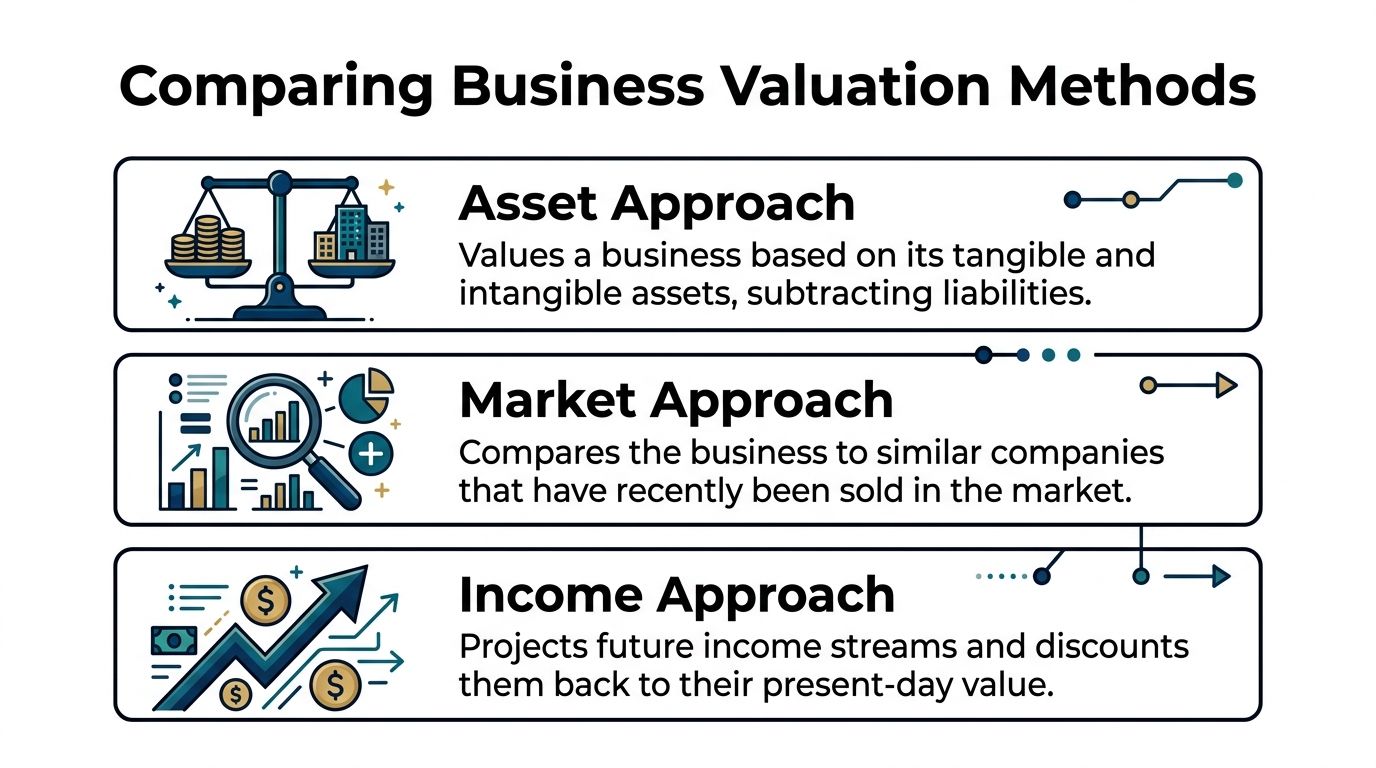
Professionals handling business valuation divorce the woodlands tx matters generally use three primary methods: the asset approach, the market approach, and the income approach, as described in this overview focused on The Woodlands business valuations.
The asset approach
The asset approach asks a direct question. What does the company own, and what does it owe?
An appraiser looks at tangible assets like equipment, vehicles, inventory, and real estate, then intangible assets where appropriate, and subtracts liabilities. This method often makes sense when the company is asset-heavy or when its value is tied more to what it holds than to recurring earnings.
A useful analogy is a storage room inventory. If you had to list everything on the shelves and then subtract the bills attached to those items, you'd be thinking like the asset approach.
This approach often fits:
- Equipment-heavy businesses with significant physical assets
- Companies with substantial receivables or inventory
- Businesses under financial stress where earnings don't tell the full story
The market approach
The market approach compares the business to similar companies that have sold.
Think of it as the business version of checking neighborhood comparables before pricing a home. The challenge is that closely held companies in The Woodlands are often unique. Finding comparable sales can be difficult, especially for niche local firms or owner-driven operations.
This approach tends to work best when there is dependable data from similar businesses and the appraiser can make reasonable adjustments for differences in size, market position, and risk.
Practical rule: If the comparison businesses aren't truly comparable, the market approach can mislead more than it helps.
The income approach
The income approach focuses on the company's expected future earnings and brings those expected cash flows back to present value.
This is often the method that causes the most confusion because it involves forecasts, normalization, and judgment. But the basic idea is familiar. People pay for future earning power. If a business is expected to generate income over time, that expected income has present value today.
Appraisers using this method often normalize earnings. That means they adjust the books to remove unusual, one-time, or owner-specific items so the numbers better reflect the company's true earning capacity.
This method often fits:
- Service businesses where value comes from cash flow more than hard assets
- Professional practices with stable income patterns
- Growing companies where future performance matters more than current balance sheet value
Comparison of Business Valuation Methods
| Method | What It Measures | Best For | Example in The Woodlands |
|---|---|---|---|
| Asset Approach | Assets minus liabilities | Asset-heavy businesses or companies where hard assets drive value | A company with vehicles, equipment, and inventory |
| Market Approach | Value based on comparable business sales | Businesses with usable market comparison data | A local company with peers that have recently sold |
| Income Approach | Future cash flow brought into present value | Service firms, professional practices, and companies with strong earnings history | A consulting or energy-services firm with recurring revenue |
Real-world scenario
A spouse in The Woodlands owns a closely held energy services company. The business has equipment, long-term customer relationships, and strong recurring work. One side wants the asset approach because the physical equipment is easy to count. The other side prefers the income approach because the company earns steady cash flow and has contract-driven value beyond the trucks and tools.
A careful appraiser may review all three methods and decide that one deserves the most weight, or that a blended analysis makes more sense. That doesn't happen because anyone is manipulating numbers. It happens because good valuation work follows the nature of the business, not the preference of the spouse.
Many people get tripped up. They assume a valuation method is "right" or "wrong." The better question is whether the method fits how that specific company creates value.
The Valuation Process Step-by-Step in Montgomery County
A common scene in The Woodlands goes like this. One spouse built or helped grow a business over many years. The other spouse may not have worked there day to day, but knows the company paid the mortgage, funded the lifestyle, and may be the largest asset in the marriage. Then divorce starts, and both sides ask the same question in different ways: what is this business worth, and how will a Montgomery County judge look at it?
The answer usually does not come from one spreadsheet or one meeting. It comes from a sequence of steps, each one affecting the next. If you understand that sequence early, you can avoid the mistakes that create expensive fights later.
Because a business interest often carries so much of the marital estate, the court will expect careful proof. Timing can also shape the dispute. In some cases, lawyers and experts must sort out value at marriage for a separate property claim, value during the marriage for growth issues, and value closer to trial for division. In Montgomery County, those timing arguments often matter more than clients expect, especially when a local company has been affected by swings in energy, construction, health care, or professional services.

Step one is defining the real dispute
Before anyone can value a company, your legal team has to pin down what is being contested. Is the issue the value of the entire company, only one spouse's ownership interest, or the increase in value during the marriage? Is there a claim that part of the business is separate property? Is the fight really about cash flow, owner perks, goodwill, reimbursements, or all of those at once?
This first step works like marking the edges of a map before a trip. If the boundaries are wrong, every later calculation can drift off course.
At this point, complete records matter more than polished records. If your books need attention, a plain-English explanation of the bookkeeping cleanup process can help you see why an appraiser asks for certain reports before giving an opinion.
Step two is gathering the documents that support the story
This is usually done through formal discovery, informal exchanges, or both. In Montgomery County cases, document fights often start here, especially with closely held businesses where the owner has broad control over records.
A valuation expert will usually need documents such as:
- Business tax returns and sometimes personal returns
- Profit and loss statements and balance sheets
- General ledgers, bank records, and credit card statements
- Payroll records and details about owner compensation
- Loan agreements, leases, and major customer contracts
- Entity documents such as operating agreements, bylaws, shareholder records, or partnership agreements
These papers do more than show revenue and expenses. They show patterns. They can reveal whether the company paid personal expenses, whether compensation was above or below market, whether debt is genuine, and whether a drop in earnings is temporary or suspiciously timed.
Missing records rarely help the person withholding them. In court, gaps tend to invite skepticism.
Step three is testing the numbers against real-world operations
Once the documents are assembled, the appraiser usually studies how the business operates. That may include interviewing the owner, reviewing contracts, examining compensation practices, and comparing reported income to what the company appears able to produce.
This stage matters because two businesses with the same gross revenue can have very different value. One may depend almost entirely on the owner's personal relationships. Another may have systems, managers, recurring contracts, and a customer base that would survive a change in ownership. To a valuation expert, that difference is not academic. It can change the result in a meaningful way.
In The Woodlands, this issue comes up often with professional practices, energy-related service companies, medical businesses, engineering firms, and family-owned companies that mix business spending with personal benefits. A clean ledger helps. So does a candid explanation of unusual transactions.
The valuation report is only as strong as the story the records can support.
After that review, the appraiser applies the method or methods that fit the business and prepares a written report. That report may guide settlement discussions, mediation, or trial preparation.
A short video can help you visualize how these issues play out in practice.
Step four is dealing with the pressure points that often trigger disputes
By the time the report is issued, the disagreement is usually no longer about broad labels. It is about assumptions. Was the owner's salary normalized correctly? Were personal expenses added back fairly? Does the company have enterprise goodwill, personal goodwill, or both? Was a recent downturn temporary, or a sign of lasting decline?
This is also where Montgomery County procedure matters in a practical way. If your side waits too long to gather records, disclose the expert, or challenge the other side's assumptions, you can lose ground quickly. Judges want a valuation they can follow. They are less interested in vague complaints than in a clear explanation supported by records, testimony, and a reasonable methodology.
Step five is turning a number into a workable property division
A business valuation is not the finish line. It is one piece of the property case.
Once there is an opinion of value, the next question is how to divide the estate in a just and right manner under Texas law. Sometimes one spouse keeps the company and the other receives different assets of similar value. Sometimes the division includes a payout over time. Sometimes separate property tracing or reimbursement claims change what looked simple at first.
That final step is where legal strategy and financial analysis have to line up. A strong valuation helps, but it only solves part of the problem. The goal is a division plan a court can accept and a client can realistically carry out.
Choosing and Working With Your Valuation Expert
The wrong expert can cost you advantage. The right expert can clarify the case, narrow the dispute, and give the court something solid to rely on.
Many business owners assume their longtime CPA should handle the valuation because that person already knows the company. Sometimes that familiarity helps. Sometimes it's the very reason the expert gets challenged.
Your regular accountant may be a fact witness, not the right valuation witness. They may also be too close to the business to look neutral, especially if they've helped with tax planning, compensation decisions, or classification choices that the other side wants to attack.

What to look for
You want someone who can do more than run numbers through software. You want someone who can explain their reasoning clearly under pressure.
Good questions to ask include:
- What credentials do you hold such as CPA, ABV, or CVA?
- How often do you value closely held businesses in divorce cases?
- Have you testified in Montgomery County family court before?
- How do you handle owner perks, nonrecurring expenses, and disputed goodwill?
- Which valuation methods do you usually consider for companies like mine?
- What documents do you need first?
A calm, direct answer matters. If an expert hides behind jargon in the interview, they may do the same on the stand.
Why neutrality matters
Judges tend to trust experts who appear disciplined, independent, and careful with assumptions.
That doesn't mean your expert has to agree with the other side. It means the analysis should look like professional work, not advocacy dressed up as accounting.
One option some clients consider is a neutral evaluator jointly selected by both sides. In other cases, each spouse hires their own expert. The right choice depends on whether the business records are clean, whether trust is low, and whether major disputes already exist.
If you're working with counsel who regularly handles these cases, that attorney can often help identify valuators who understand local practice. The The Law Office of Bryan Fagan handles family law matters in The Woodlands and Montgomery County, including disputes involving business interests and property division.
How to make your expert more effective
Clients sometimes hurt their own case by treating the expert like a magician. No expert can fix bad records, hidden transactions, or vague answers.
You help your case when you:
- Provide complete records early instead of in waves.
- Answer questions directly even when the answer feels uncomfortable.
- Flag unusual events like one-time losses, unusual bonuses, or owner withdrawals.
- Keep business and personal spending separate going forward.
Hire the expert who can defend the valuation, not just deliver a number you like.
Cost is a real concern. Valuation work can be expensive, especially when the company is complex or the other side is aggressive. But if the business is central to your estate, cutting corners on the valuation is often the more expensive mistake.
Common Disputes and How to Defend Your Position
Business valuation fights usually don't start with the headline number. They start with the assumptions underneath it.
The most common disputes in Montgomery County cases involve goodwill, income normalization, valuation date, and whether a business is separate property, community property, or some combination of both in value and growth.
Personal goodwill versus enterprise goodwill
This issue asks a simple but powerful question. Is the business valuable because of the business itself, or because of you?
If customers would stay because the company has systems, staff, reputation, and transferable relationships, the company may have enterprise value. If revenue would vanish when the owner leaves, the other side may be overstating what can be sold or transferred.
A common example is the owner-driven professional practice. If the practice depends almost entirely on the owner's skill and personal relationships, that becomes a major point of dispute.
Your defense usually comes from evidence, not argument alone:
- Show dependence on the owner with client patterns and operational realities.
- Show transferable systems if the company can run without you.
- Use contracts and staffing records to prove whether value is personal or enterprise based.
Normalizing income and hidden perks
Normalization means adjusting financial statements to reflect the company's actual economic performance.
Spouses frequently accuse each other of hiding income in plain sight. Vehicle expenses, family payroll, travel, meals, home office costs, and nonbusiness purchases all get attention. Sometimes those accusations are fair. Sometimes ordinary business decisions get framed unfairly in divorce.
If you want to defend against a claim that your income is artificially low or your business is carrying personal expenses, records are your best protection.
Keep:
- Clear bookkeeping entries that describe expenses accurately
- Supporting receipts and invoices
- Payroll records showing who worked and what they were paid
- Board, member, or owner notes if compensation changed for a business reason
Date fights and method fights
Two smart experts can disagree, not because one is dishonest, but because they selected different assumptions.
One may favor the income approach. Another may lean on assets. One may treat a certain date as the proper valuation point. Another may argue a later date better reflects the business's fair market value in current conditions.
Your response should be structured:
- Pin down the legal issue first. Is the fight about classification, reimbursement, division, or current value?
- Challenge weak assumptions with documents, not just testimony.
- Consider a rebuttal expert report if the other side's valuation overreaches.
For spouses dealing with larger estates, high-asset divorce issues in The Woodlands often overlap with these valuation disputes because one wrong assumption can ripple through the entire property division.
Local court experience matters here. A lawyer who knows Montgomery County procedure and how judges tend to evaluate expert testimony can help you decide when to settle, when to challenge, and when to bring in a rebuttal witness.
Frequently Asked Questions About Business Valuations
A common moment in these cases goes like this. One spouse says, "We will never agree on what the company is worth," and the other says, "Then we may have to sell it." In Montgomery County, the answer is usually more measured than that. The court is trying to reach a fair division, not create unnecessary damage to a business that may be feeding both households.
Can my spouse force me to sell the business?
Usually, no automatic sale is required.
In many Woodlands-area divorce cases, a key question is how to account for the business in the overall property division. A court may consider a buyout, a larger share of other assets to the non-owner spouse, or payments made over time. That approach often makes more sense for closely held companies, medical practices, contractors, and family-run businesses where a forced sale can reduce value for everyone.
A business valuation works like an appraisal on a house, but with more judgment involved. The court wants a defensible number it can use in a just and right division.
What if my business is new and losing money?
A new business can still become a major issue in the divorce.
Low revenue or current losses do not end the analysis. An expert may look at whether the company has valuable contracts, proprietary systems, customer relationships, equipment, or strong growth potential. In The Woodlands, this comes up often with newer professional ventures, service businesses, and companies built around future expansion rather than current profit.
That said, a young business is often where valuation fights get sharper. One expert may treat the company like a promising engine that has not reached speed yet. Another may view it as a risky project with limited present value. The difference usually comes from assumptions, not simple math.
How can we reduce tax damage and keep the business operating?
Start by treating the division plan and the tax plan as related issues.
A paper result can look fair and still create a cash-flow problem. For example, if one spouse keeps the company but must make a large equalization payment too quickly, the business may struggle to cover payroll, inventory, or debt service. A structured payout can sometimes reduce that pressure and keep operations stable.
This is one of the places where local practical judgment matters. In Montgomery County cases, lawyers and valuation professionals often need to test whether a proposed settlement works in real life, not just on a spreadsheet. Your attorney should review the settlement terms with a CPA before anything is signed so you understand tax treatment, liquidity concerns, and whether the company can still function the next morning.
My business was a gift from my parents. Is it still community property?
It may be separate property, but proof decides that issue.
Texas law generally treats property received by gift or inheritance as separate property. The hard part is showing the court a clean chain from the original transfer to the business interest that exists today. If ownership changed over time, if marital money went into the company, or if the business was restructured, the separate-property claim may face close scrutiny.
A good way to view tracing is to picture a title history for land. The court wants to see where the asset came from, how it changed, and whether community property became mixed into it. Gift letters, transfer records, ownership ledgers, tax documents, and old organizational papers often matter more than broad testimony that "my parents gave it to me."
What if my spouse and I both disagree with the valuation report?
That is common, especially in higher-asset divorces and owner-operated businesses.
The first step is to identify the point of disagreement. Is the fight about the valuation date, the method used, compensation adjustments, personal goodwill, discounts, or future earning assumptions? Once that is clear, your lawyer can decide whether the best response is cross-examination, a supplemental report, or a rebuttal expert.
In Montgomery County, judges usually want the dispute narrowed to the points that affect value. That means a productive challenge is rarely, "This whole report is wrong." A stronger position is, "These three assumptions overstate income, ignore local market conditions, and treat personal effort as transferable business value." That kind of focused response is easier for a court to evaluate and easier to defend.
Do both spouses need their own valuation expert?
Not always.
Some couples use one neutral expert, especially when they are working toward settlement and both trust the expert's process. In more contested cases, each side may retain its own expert. That is more expensive, but it can be appropriate when the company is a large part of the marital estate or when one spouse believes the other has provided incomplete information.
If you are hiring your own expert, ask a practical question early. Can this person explain the numbers clearly to a judge in Montgomery County, not just prepare a polished report? A report matters. Testimony matters too.
How long does a business valuation take in a divorce?
It depends on the quality of the records, the size of the company, and how much information has to be chased down.
A small business with organized books may move much faster than a company with multiple entities, inconsistent payroll practices, or disputed owner perks. Delays often come from missing records, late document production, or the need for follow-up questions from the expert.
That is one reason early preparation matters so much in The Woodlands business-owner cases. The more complete and orderly the records are, the easier it is to reach a value that can be defended in settlement talks or in court.
Conclusion Your Next Steps
If you're facing a business valuation divorce the woodlands tx issue, the key point is simple. This process is technical, but it isn't random.
The court needs a defensible value. The value depends on records, timing, method, and expert judgment. The outcome often depends on how early you prepare and how well your legal and financial professionals work together.
What to do next
- Gather your records including tax returns, profit and loss statements, balance sheets, contracts, and ownership documents.
- Be careful what you say about the business's value to your spouse, employees, or business partners before getting legal advice.
- Make a shortlist of valuation experts with divorce-related experience involving closely held companies.
- Review separate property evidence if the business existed before marriage or came by gift or inheritance.
- Schedule a consultation with a family law attorney who understands Montgomery County practice and business-owner divorce issues.
Disclaimer: This article is for informational purposes only. It is not legal advice and does not create an attorney-client relationship.
When the business is tied to your livelihood and your future, waiting usually makes the problem harder. A confidential consultation can help you understand the likely pressure points before they become expensive surprises.
If you're dealing with a divorce involving a company, partnership interest, or professional practice in The Woodlands or elsewhere in Montgomery County, you can schedule a confidential consultation with The Law Office of Bryan Fagan to discuss your specific circumstances and your options.
