 Skip to content
Your child used to run to the door when you arrived. Now the child hangs back, refuses calls, and repeats phrases that sound too adult to be coming from a child. You may be in The Woodlands, juggling exchanges between school, sports, and two homes, and wondering whether this is a rough phase or something more serious.
That question matters. In Montgomery County family court, judges don’t decide these cases based on labels alone. They look for conduct, patterns, and proof. If you want to know how to prove parental alienation in court, you need more than frustration and a gut feeling. You need evidence that connects behavior to harm and ties that harm to the child’s best interest under the Texas Family Code.
Is It Parental Alienation or Something Else
A lot of parents come in with the same fear. They say their child came back from the other parent’s house cold, angry, or strangely rehearsed. The child may refuse to speak, insist on calling a stepparent instead, or accuse the rejected parent of things that don’t match the child’s own experience.
Sometimes that is parental alienation. Sometimes it isn’t.
A child can pull away for many reasons. Divorce stress, loyalty conflicts, developmental changes, a busy school schedule, or a parent’s own past mistakes can all affect the relationship. In other cases, the child’s distance may reflect estrangement, meaning the child is reacting to conduct by the rejected parent that occurred. Courts care a lot about that distinction.
Important disclaimer: This article provides general information, not legal advice. Reading it does not create an attorney-client relationship. An attorney-client relationship is formed only after a signed agreement.
What courts usually care about
The court’s focus is practical. It asks whether one parent is engaging in behavior that damages the child’s relationship with the other parent. That can include interference with contact, repeated negative messaging, guilt pressure, or conduct that trains the child to reject a parent without a sound reason.
That’s why I usually tell parents to slow down before using the word alienation. Start with facts. What changed. When it changed. What was said. Who saw it.
A better starting point for worried parents
If your child is struggling with the split itself, emotional support matters just as much as legal strategy. A thoughtful guide for parents on divorce can help you separate normal adjustment problems from conduct that may need court attention.
The right question isn’t, “Do I feel alienated?” The right question is, “Can I show the court a pattern of behavior that is harming my child’s relationship with me?”
Recognizing Actionable Signs of Alienation
Montgomery County judges usually respond to observable behavior, not broad accusations. That point comes through clearly in Judge Jon Van Allsburg’s discussion of a behavioral framework for proving alienation. He emphasizes that courts look at what was said, what was done, and whether that conduct undermines the child’s relationship with a parent under the same best-interest analysis used in custody cases, as discussed in Judge Jon Van Allsburg’s explanation of parental alienation proof.

Conduct that gets a judge’s attention
In practice, judges tend to focus on patterns like these:
- Blocked communication: Calls go unanswered, FaceTime is discouraged, texts from the child stop during the other parent’s possession periods, or messages are screened.
- Visit interference: A parent cancels visits, shortens weekends, or schedules competing activities during the other parent’s time, then blames the targeted parent.
- Adult issues pushed onto the child: The child is told details about the divorce, money disputes, infidelity claims, or litigation strategy that the child should never carry.
- Campaigning behavior: One parent repeats insults, recruits relatives or friends to criticize the other parent, or tells the child the other parent “has no rights.”
- Unexplained rejection: The child suddenly refuses contact and offers weak, borrowed, or exaggerated reasons that don’t fit the child’s own history.
What is not enough by itself
One missed call isn’t alienation. One difficult exchange isn’t alienation. A teenager preferring friends over a weekend dinner usually isn’t alienation.
Courts want to see a pattern. They also want to know whether there is a valid explanation. If the rejected parent has been absent, harsh, inconsistent, or frightening, the case may be about estrangement instead. That’s why a careful review of your own conduct matters before you file anything.
A strong case usually sounds calm and specific. A weak case usually sounds global, emotional, and unsupported.
A short local example
A parent in Panther Creek may notice this sequence. After several months of smooth exchanges, the child begins refusing midweek dinners. The child says, “You abandoned us,” even though the parent has exercised regular possession the whole time. Then the other parent starts canceling make-up time and says the child is “old enough to decide.”
That pattern is more useful in court than saying, “My ex is turning my child against me.”
Why local strategy matters
In The Woodlands, high-conflict custody cases often rise or fall on details the other side didn’t expect you to preserve. If your case already involves chronic conflict, this overview of high-conflict custody issues in The Woodlands gives a practical sense of how these disputes are framed.
Building Your Case with Strong Evidence
If you think alienation is happening, your first job is to build a record. Courts don’t reward the parent who is most upset. They respond to the parent who is most organized.
Documentation protocols in alienation cases call for meticulous, date-stamped records, including communication logs, parenting time violation logs, social media evidence with visible timestamps, and physical proof such as photos or receipts, as outlined in this discussion of how to document parental alienation evidence.
Start with a timeline
Create one master chronology. Use a notebook, spreadsheet, or secure notes app, but keep the format consistent.
Include:
- Dates and times: Exact exchange times, missed calls, late pickups, and canceled visits.
- Who said what: Short, factual summaries. Avoid speeches.
- What the child did: Refused to get in the car, cried at handoff, repeated adult accusations, refused to answer a call.
- Who else was present: Teachers, grandparents, coaches, babysitters, neighbors.
A good entry is short and testable. “April 14, 6:05 p.m., arrived for scheduled pickup at Alden Bridge home. Child did not come out. Other parent texted at 6:12 p.m. saying child did not want to go. No make-up offered.” That helps a judge.
Preserve digital proof the right way
Screenshots help, but random screenshots dumped into your phone gallery don’t. Save them in folders by month or issue. Keep the full thread when possible so context isn’t lost.
Useful digital evidence often includes:
- Text messages and emails: Especially repeated interference, guilt messages, or false claims.
- Co-parenting platform messages: OurFamilyWizard and similar systems can be useful because they preserve timing and content.
- Voicemails: Save them in more than one place.
- Social media posts: Capture the visible timestamp and surrounding context.
If you’re thinking about recording conversations, check legality before you do it. This plain-language is it legal to record calls guide is a good starting point, but get Texas-specific legal advice before relying on a recording in a custody case.
Practical rule: Don’t edit, crop, annotate, or “clean up” evidence before your lawyer sees it.
Don’t overlook third-party witnesses
Some of the best witnesses are people with no stake in your lawsuit. A teacher in Sterling Ridge may notice a sudden change in the child’s attitude before Monday drop-off. A soccer coach in Creekside may hear the child repeat hostile talking points. A counselor may observe a sharp shift in the child’s language about one parent.
You don’t need to coach these witnesses. In fact, don’t. Just note who observed what and when.
Evidence checklist for parental alienation claims
| Evidence Type | What It Proves | How to Preserve |
|---|---|---|
| Communication logs | Repeated interference, blocking, or manipulation in co-parenting communications | Export texts or emails, save full threads, keep dates and times visible |
| Parenting time violation log | Missed exchanges, denied possession, chronic lateness, canceled visits | Maintain a dated chronology with brief factual entries |
| Social media evidence | Public disparagement, pressure campaigns, or child coaching | Screenshot full post with timestamp and account information visible |
| Physical evidence | Your actual involvement with the child and completed visits | Save receipts, tickets, school records, photos, and calendars in organized folders |
| Third-party observations | Independent confirmation of behavior changes or interference | Record witness names, dates, and what they personally observed |
What usually backfires
Parents often hurt their own cases by doing too much in the wrong direction.
Common mistakes include:
- Confronting the other parent in anger: Those texts often become exhibits.
- Asking the child leading questions: That can make the child sound coached by both sides.
- Over-documenting irrelevant drama: Judges don’t need every insult. They need the events tied to possession, communication, and the child’s condition.
- Ignoring order violations while arguing theory: Courts often respond better when alienation evidence also shows concrete violations of the current order.
If the damage is ongoing, the next legal question is whether the case calls for enforcement, a modification, or both. This overview of custody modification in The Woodlands, Texas helps frame that decision.
The Role of Experts in Proving Your Claim
A parent’s records can start the case. An expert often gives it shape.
That matters because alienation allegations are easy to make and hard to prove. Judges know that. They also know that a child’s rejection of a parent may come from fear, unresolved conflict, poor parenting, or normal developmental pushback. An expert helps the court sort those possibilities.
Why evaluators matter
The most useful expert is often a qualified mental health professional who can assess parent-child dynamics in a way the court trusts. In the stronger cases, that professional does more than repeat what one parent said. The evaluator tests competing explanations.
One framework often discussed for that work is the Five-Factor Model, developed by Dr. Amy Baker and Dr. William Bernet. It requires all five factors to be present before concluding alienation rather than estrangement, helping evaluators and courts distinguish deliberate alienation from a child’s justified response to a parent’s own conduct, as explained in this overview of the Five-Factor Model for parental alienation.
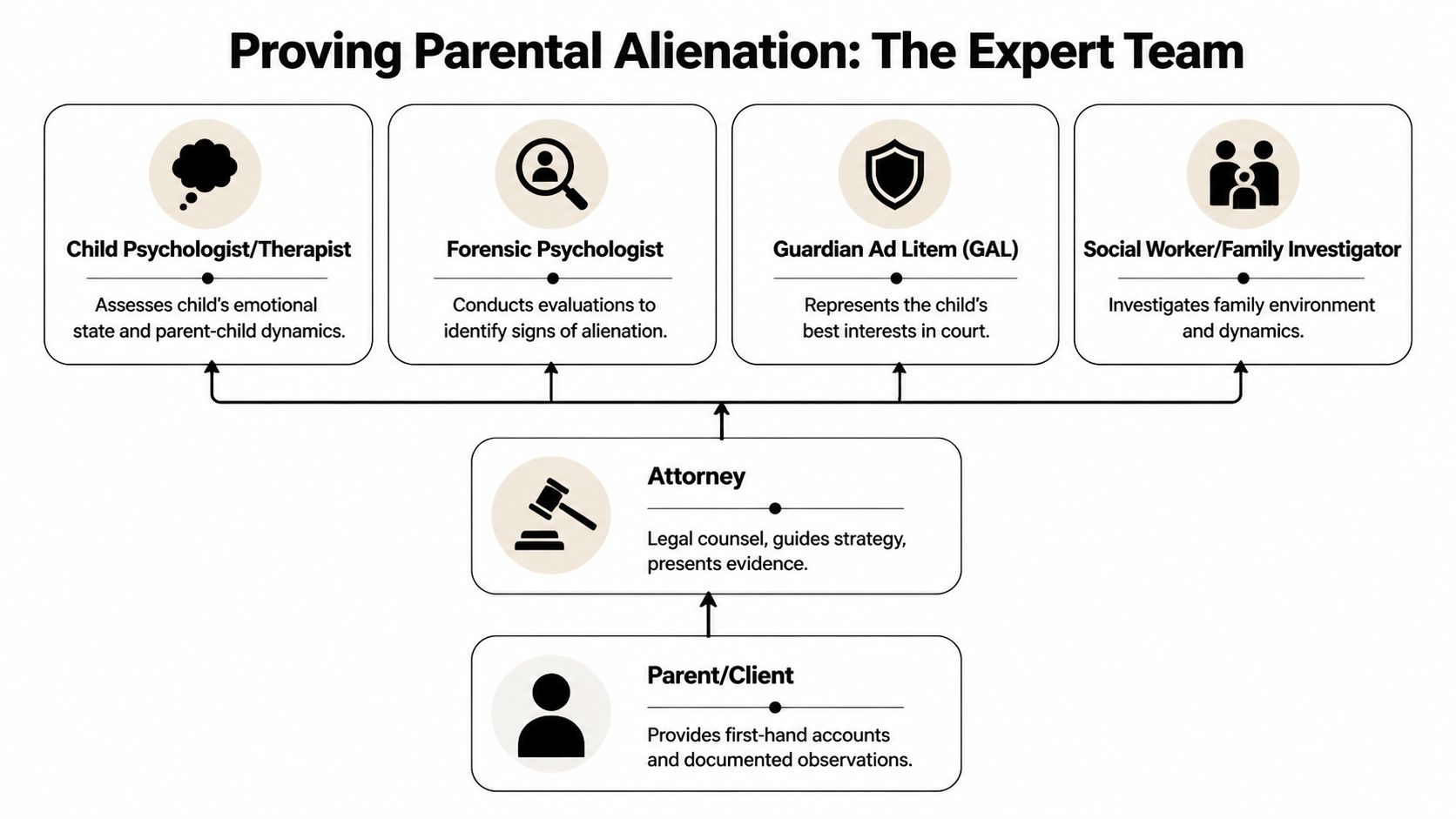
The different professionals you may encounter
Not every professional does the same job.
- Forensic psychologist: Evaluates the family system and offers opinions the court may rely on.
- Treating therapist or child psychologist: Helps with the child’s emotional needs, but may not be the right person to make ultimate forensic conclusions.
- Amicus attorney or attorney ad litem: In some cases, the court appoints someone to represent the child’s interests or assist the court in understanding the child’s situation.
- Your lawyer: Organizes the record, prepares testimony, and makes sure the expert’s work fits the legal standard under Texas law.
The real trade-off
Experts can help, but they also create cost, delay, and scrutiny. A weak case can fall apart faster once a neutral evaluator starts asking hard questions. That is not a reason to avoid experts. It’s a reason to prepare carefully before asking the court for one.
The best expert opinions are grounded in records, timelines, witness observations, and the child’s actual behavior. They are not built on one parent’s narrative alone.
If you’re deciding whether your case needs an evaluator, an amicus appointment, or a more targeted litigation plan, a local child custody lawyer in The Woodlands can help you match the right professional to the right problem.
Strategic Steps in a Montgomery County Court
Once the evidence is strong enough, the case shifts from documentation to procedure. In Montgomery County, that usually means asking what relief fits the facts. Do you need enforcement of the current order, a modification of conservatorship or possession, temporary orders, or a combination of those tools under the Texas Family Code, especially the best-interest standard in Chapter 153?

What usually gets filed
In many cases, the core pleading is a petition to modify the parent-child relationship. The theory is straightforward. Circumstances have materially and substantially changed, and the current order no longer protects the child’s relationship with both parents.
Depending on the facts, a lawyer may also consider:
- Temporary orders: To stabilize communication, exchanges, or counseling during the case.
- Enforcement claims: If the other parent has violated possession or communication terms already in the order.
- Requests involving therapy or family intervention: If the court needs a structured path to repair the relationship.
- Emergency relief: Only when the facts justify immediate intervention.
Why careful presentation matters
Parental alienation allegations can strongly affect custody litigation. A ProPublica report on parental alienation in family court discusses a 2020 national study funded by the U.S. Justice Department finding that when mothers alleged abuse and fathers responded with parental alienation claims, mothers were twice as likely to lose custody. The same report discusses research finding courts were 3.9 times more likely to disbelieve mothers’ abuse claims when fathers cross-claimed alienation.
Those findings should make any parent more careful, not more dramatic. Alienation is not a buzzword to throw into a pleading because the other parent is difficult. It is a serious claim that can redirect the case.
What local judges often want to see
In courts such as the 418th or 386th District Court, the most effective presentation is usually the simplest one. Judges want a record they can follow.
That often means:
- A clear chronology tied to the current order.
- Specific examples of interference, not character attacks.
- Neutral corroboration from records or third parties.
- A practical remedy that matches the problem.
Here is a helpful overview that explains the broader custody framework before you step into court:
What works better than a courtroom speech
Parents often think the hearing will turn on a dramatic moment. Usually it doesn’t. It turns on whether your exhibits are organized, whether your testimony is disciplined, and whether your requested relief sounds child-focused instead of parent-focused.
A strong request might be limited and concrete. Enforce communication. Clarify exchanges. Order an evaluation. Adjust possession if the evidence supports it. Require steps that rebuild the relationship.
A weak request usually sounds punitive. It asks the judge to “see through” the other parent without giving the judge a reliable path to do that.
Your Path Forward and Final Checklist
A short example shows how this often plays out. A parent in Sterling Ridge came in convinced the case was hopeless because the child had begun refusing visits and using harsh, adult language. The parent had not retaliated. Instead, the parent kept a dated log, preserved message threads, saved proof of attempted contact, and worked through counsel to present a focused request for court intervention and professional evaluation. That approach gave the court something usable.
If this sounds like your situation, keep your next steps simple.
What to do next
- Start a private journal today: Record dates, times, missed calls, denied visits, and the child’s exact words when relevant.
- Organize your existing records: Put emails, texts, voicemails, school messages, and photos into secure folders by date.
- Follow the current order closely: Show the court that you are the parent acting steadily and in good faith.
- Don’t confront the other parent recklessly: Angry accusations usually create bad exhibits.
- Identify neutral witnesses: Teachers, relatives, counselors, and coaches may have useful observations.
- Review the Texas Family Code with your lawyer: Chapter 153 is often central in custody and possession disputes.
- Get case-specific legal advice early: Timing matters in modification and enforcement cases.
If you think alienation is happening, act early, document carefully, and stay child-focused.
This article is general information only and is not legal advice. Every family’s facts are different, and the right legal step depends on your current orders, your evidence, and the judge hearing your case.
If you’re dealing with a custody dispute in The Woodlands or anywhere in Montgomery County, a consultation can help you sort out whether you’re seeing alienation, estrangement, or a solvable communication problem. The attorneys at The Law Office of Bryan Fagan help parents evaluate evidence, prepare for modification or enforcement, and build a practical strategy for local family courts.
