 Skip to content
You may be running a successful company in The Woodlands right now and still be one phone call away from a crisis.
A founder sits down for lunch near Hughes Landing, answers emails between meetings, and realizes something uncomfortable. If he got sick, retired sooner than expected, or hit a rough divorce, nobody has clear authority, the ownership documents don't line up, and the family assumes things will somehow work out. That is how profitable businesses end up in expensive disputes.
That is why business succession planning in The Woodlands, TX isn't just an exit project. It's a continuity project. It protects operations, relationships, and the value you've spent years building across The Woodlands, Spring, Magnolia, and the rest of Montgomery County.
Some owners want a child to take over. Others want key employees to buy in. Others know a third-party sale is more realistic and spend time studying resources like this guide to selling your logistics business to understand what buyers look for before they ever go to market. The common thread is simple. The businesses that transition well usually plan while the owner still has negotiating power, clarity, and time.
Your Business Legacy Starts Today Not Tomorrow
Legacy planning isn't only about retirement
Many owners treat succession planning like a task for later. Later usually means after a tax issue, after a health scare, after a child joins the company, or after a spouse files for divorce. By then, your options are narrower.
In The Woodlands, a business often sits at the center of everything else. It funds the home, college plans, investments, and family expectations. It may also employ relatives, longtime managers, or trusted friends. If ownership changes without a plan, the fallout rarely stays inside the company.
Practical rule: Start succession planning while you're still fully in control of the business, not when circumstances force a decision.
A good plan answers practical questions in plain English:
- Who leads next: Is the successor a family member, a management team, or a buyer?
- Who owns what: Are equity interests clearly defined and transferable?
- What triggers the plan: Retirement, disability, death, divorce, deadlock, or a voluntary sale?
- How is value handled: Will there be a formula, appraisal process, or staged buyout?
- What happens to family members not in the business: Will they inherit cash, voting rights, nonvoting interests, or something else?
Local businesses need local planning
Montgomery County business owners don't live in a vacuum. They deal with Texas community property rules, probate exposure, partner disputes, and family dynamics that generic online checklists skip over.
That matters because the legal documents have to match the actual situation. If your operating agreement says one thing, your estate plan says another, and your spouse believes something else entirely, conflict isn't a possibility. It's a setup.
The strongest succession plans I've seen are practical, not theatrical. They don't rely on vague promises like "the kids will work it out." They create structure before emotions get involved.
Why Succession Planning Is Critical for Woodlands Businesses
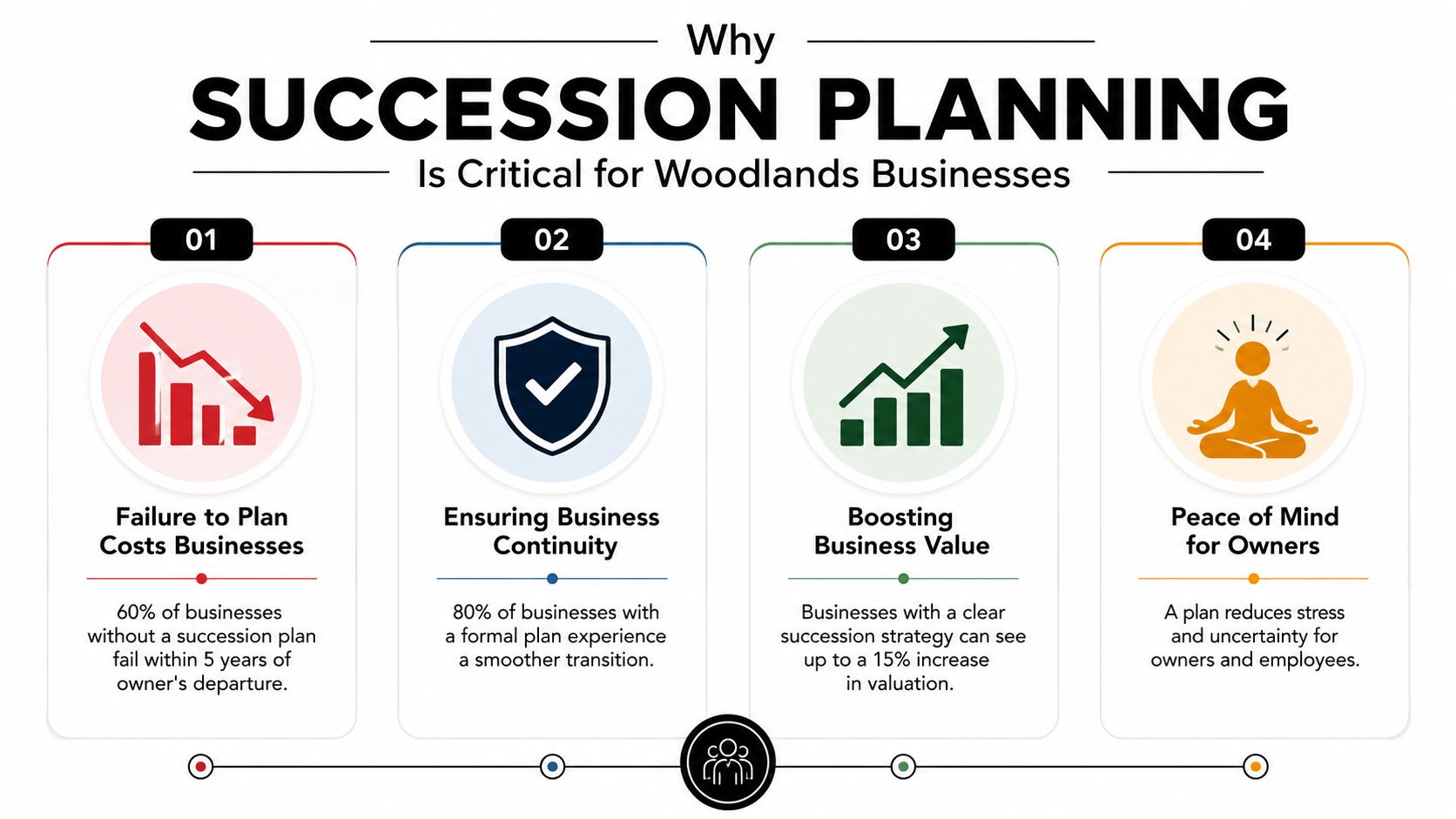
The planning gap is wide. Nearly two-thirds, approximately 66%, of family-owned businesses in the United States lack a documented and communicated succession plan. Also, 3 in 5, or 60%, of all small businesses do not have a succession plan, and 47% of owners without one believe it is “not necessary” according to succession planning statistics compiled here.
Why waiting is expensive
Owners often think no plan preserves flexibility. In practice, no plan usually creates confusion.
If there is no written transition process, several problems show up fast:
- Management uncertainty: Employees don't know who is making final decisions.
- Family conflict: Relatives may disagree about ownership, control, or fairness.
- Valuation pressure: A business sold under stress usually negotiates from weakness.
- Probate exposure: If the owner dies with no coordinated plan, business interests may end up tied to estate administration.
That risk is sharper in a place like The Woodlands, where many businesses are closely held and family wealth is concentrated in the company itself.
A plan protects more than ownership
Succession planning isn't only about who signs the closing documents. It also supports day-to-day continuity. Vendors want stability. Key employees want clarity. Customers want to know the company won't stall if the founder steps back.
For some families, that planning naturally overlaps with broader estate work. An Estate Planning Attorney in The Woodlands handles wills, trusts, and estate plans for The Woodlands families, which often need to coordinate with business ownership terms rather than operate separately.
A business transition fails when the documents are technically complete but practically disconnected from how the company and family actually function.
The real issue is avoidable vulnerability
A succession plan does not guarantee a conflict-free transition. It does something more important. It gives everyone a framework when emotions are high and decisions need to be made quickly.
Without that framework, people improvise. In business families, improvisation gets expensive fast.
The Legal Toolkit for Your Succession Plan
The legal side of succession planning doesn't need to feel mysterious. Most strong plans are built from a handful of documents doing different jobs at the same time.
In Texas, legally transferring ownership of a family business requires a Buy-Sell Agreement that complies with the Texas Business Organizations Code and the Texas Estates Code so the transfer is valid and enforceable, as explained in this discussion of Texas business succession planning requirements.
The core documents
A Buy-Sell Agreement is the backbone. Think of it as a prenup for the business. It says what happens if an owner dies, becomes disabled, wants out, divorces, or ends up in a dispute with the other owners. If it's well drafted, it can stop an ex-spouse, heir, or outsider from unexpectedly stepping into ownership.
Trusts can also play a major role. Depending on the family and tax picture, they may help hold business interests, control how ownership passes, and separate management authority from economic benefit. For owners comparing structures, this page on a trust attorney in The Woodlands, Texas is one example of the type of trust-focused guidance that becomes relevant when business interests and family wealth overlap.
A transfer plan also needs to address company-specific documents. That may include corporate bylaws, LLC company agreements, shareholder restrictions, voting rights, and successor management authority.
Essential Succession Planning Documents
| Document | Primary Purpose | Key Consideration for Woodlands Businesses |
|---|---|---|
| Buy-Sell Agreement | Controls when and how ownership interests can be transferred | It should address death, disability, retirement, divorce, default, and valuation mechanics |
| Will | Directs probate assets at death | It must not conflict with transfer restrictions in company documents |
| Trust | Holds or transfers business interests under chosen terms | Useful when families want control, privacy, or staggered inheritance |
| Durable Power of Attorney | Authorizes someone to act during incapacity | It should be coordinated with business governance documents |
| Company Agreement or Bylaws Amendment | Aligns governance with succession terms | Voting rights, manager authority, and transfer limits need to match the plan |
| Marital Property Agreement | Defines treatment of ownership interests between spouses | This can be critical where community property issues may affect control |
The family law piece owners miss
Many generic succession plans ignore marriage entirely. In Texas, that's a mistake.
If the business was started or grown during marriage, or if separate and community property claims have become blurred, a divorce can disrupt the transfer plan in ways owners didn't expect. That is why marital agreements sometimes belong in the succession toolkit, not off to the side. Prenuptial & Postnuptial Agreements in The Woodlands involve drafting and review of marital property agreements for Woodlands clients, and those agreements can be relevant when an owner wants to limit future ownership disputes.
The best legal document is the one that solves the exact problem your business is most likely to face, before that problem reaches court.
What works and what doesn't
What works:
- Clear trigger events: death, incapacity, retirement, divorce, deadlock
- Defined valuation method: not vague promises to "work it out later"
- Aligned documents: estate plan, company documents, and ownership records all say the same thing
- Real communication: the successor, spouse, and key managers understand the structure
What doesn't work:
- Handshake arrangements
- Outdated agreements after growth or remarriage
- Giving children equal ownership without deciding who manages
- Assuming probate and family law won't affect the company
Texas owners should also remember that the Texas Estates Code can affect what happens at death, especially if planning is incomplete or inconsistent. The legal paperwork has to function together, not as isolated files in different binders.
Choosing Your Path Family Heir or Outside Buyer
Succession planning gets personal here. Legal structure matters, but so does the harder question. Who should take over?
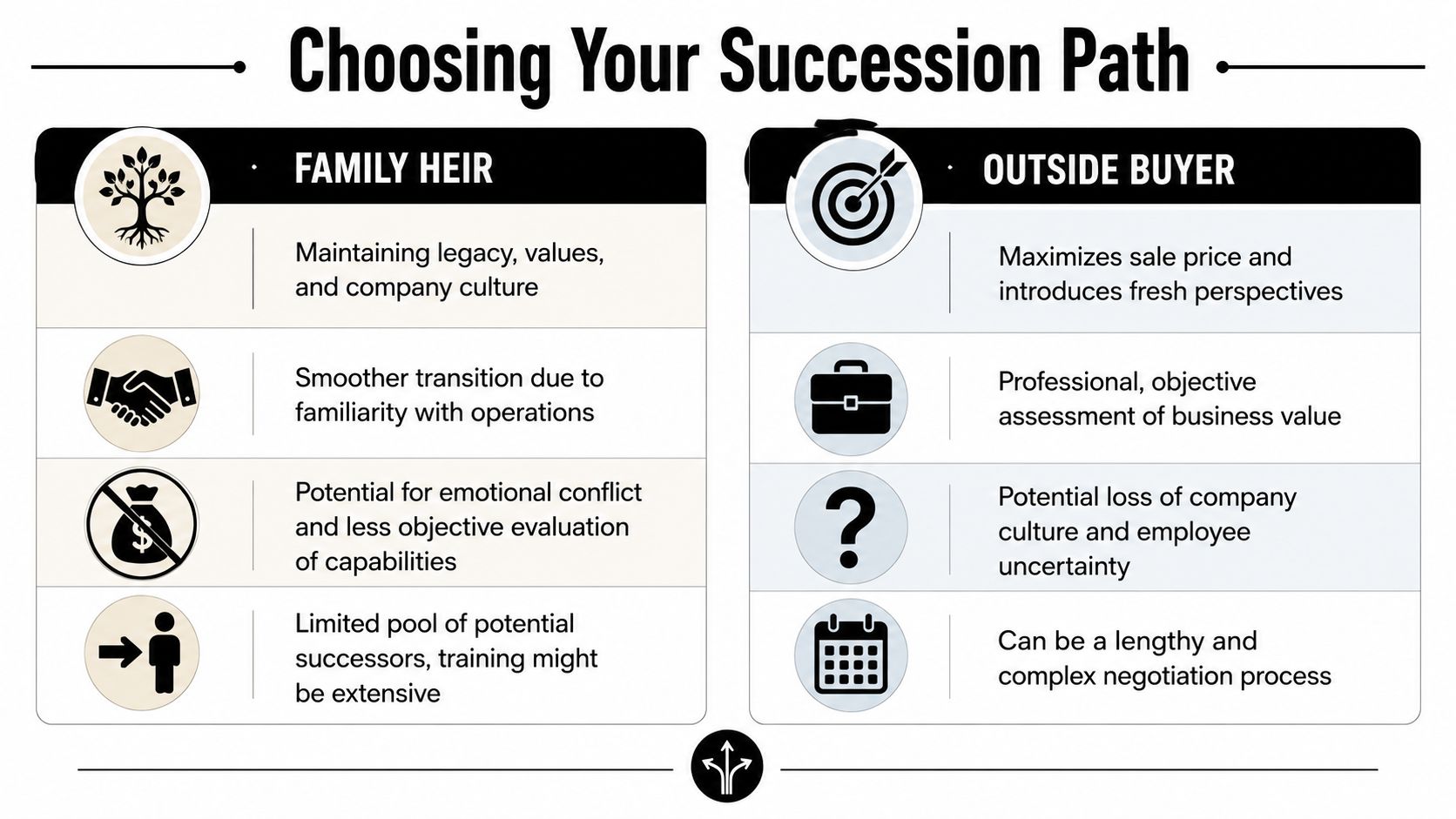
According to Gallup's reporting on small business succession, 74% of employer-business owners plan to transfer ownership as they approach retirement, but only 26% intend to give it to a family member, while 23% plan to sell it to an outside party. That leaves a large group still sorting out the right path.
Family succession
Keeping the business in the family can preserve identity, relationships, and long-term legacy. It often works best when the successor has already earned trust inside the company and everyone understands the difference between ownership and management.
In Texas, a successor handling family business interests should understand fiduciary responsibilities. The commonly described pillars are the duty of loyalty, duty of prudence, and duty of impartiality, discussed in this overview of family business succession planning duties in Texas. Those duties matter when one child runs the business but several family members benefit from it.
Family succession often fails for familiar reasons:
- The wrong child is chosen for emotional reasons
- Siblings are given equal shares without equal ability
- The founder won't let go of control
- No one addresses fairness for children who don't work in the business
Outside buyer or internal management sale
An outside sale may produce cleaner economics and a more objective transition. In some cases, a management buyout or sale to a long-term employee group is the better middle ground. If financing is part of the conversation, owners and buyers often review how deals are structured through resources on smart money business acquisition financing.
A sale path usually demands stronger records, cleaner books, tighter contracts, and a defensible valuation. If divorce risk is in the background, owners should also understand how business value may be analyzed in family court. That makes pages like this one on business valuation in divorce in The Woodlands relevant even before any case is filed.
A short real-world scenario
A Spring manufacturing owner has two adult children. One has worked in operations for years and knows the plant, vendors, and staff. The other is successful in another field and wants equal ownership but no management role.
If the parent says, "You'll split it evenly," conflict is almost guaranteed. The operating child may feel trapped running a company with a passive co-owner. The non-operating child may feel excluded from information or distributions. A better plan might separate voting control from economic benefit, set compensation rules, and create a buyout structure if one sibling wants out later.
Families don't need identical outcomes. They need outcomes that are understandable, enforceable, and fair in context.
The Woodlands Reality Divorce Probate and Your Business
Many succession plans break down because they deal with retirement and death, but ignore divorce.
In Montgomery County, that omission can become a direct threat to the company. A recurring issue in business succession planning in The Woodlands, TX is the overlap with high-conflict family law. When divorce happens in the middle of a transition, a non-operating spouse may claim an ownership interest, which can trigger asset freezes or force a buyout, as discussed in this look at succession planning concerns for Woodlands business owners.

Divorce can interrupt a transition overnight
Texas is a community property state. That doesn't mean every business is automatically community property, but it does mean characterization, reimbursement claims, and growth during marriage can become serious litigation issues. The Texas Family Code drives property division analysis in divorce, and owners ignore that at their peril.
A pending divorce can affect:
- Control: who can vote or exercise authority over the business interest
- Liquidity: whether one spouse must buy out the other
- Timing: whether a sale or transfer should pause
- Records: whether valuation and forensic review become necessary
For owners in Panther Creek, Sterling Ridge, Alden Bridge, or Creekside, the business may be the most valuable asset in the marital estate. That's why planning often needs to account for the possibility of a case involving divorce involving business owners in The Woodlands.
Probate can be just as disruptive
If an owner dies without coordinated business and estate documents, the Texas Estates Code may determine how interests pass, who has authority, and whether probate proceedings become necessary. That can create delay, public filings, and disputes among surviving spouses, children, co-owners, and managers.
Another common mistake is assuming a will alone solves the business issue. It usually doesn't. If the company agreement restricts transfers, or if the ownership records are incomplete, the estate may inherit a conflict rather than a clean asset.
For high-asset families, this often overlaps with concerns handled in High-Net-Worth Divorce in The Woodlands, which involves complex asset division for high-net-worth divorces in The Woodlands. The point isn't that every owner needs a divorce case. It's that every owner with substantial business value should plan as if family conflict could affect the transition.
Probate and divorce don't stay in their own lanes. For business owners, they often hit ownership, control, and valuation at the same time.
What a stronger plan looks like
A stronger plan usually includes transfer restrictions, marital property planning where appropriate, coordinated estate documents, and realistic instructions for what happens if incapacity, death, or divorce arrives in the middle of a transition.
That kind of planning isn't pessimistic. It's disciplined.
Your Succession Planning Checklist and Next Steps
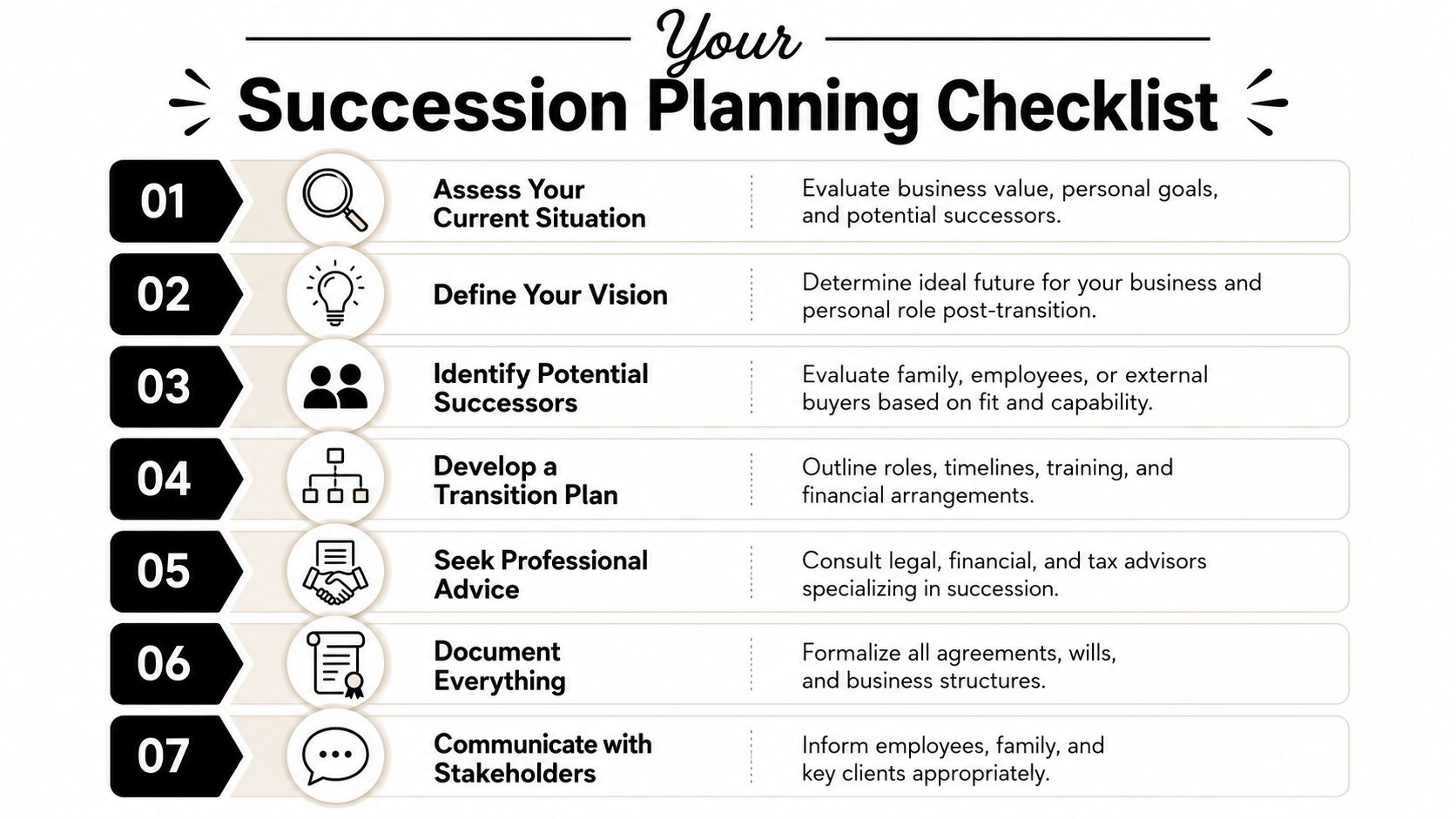
Texas succession planning usually takes time. A robust plan often needs a 5 to 10 year execution timeline to support a gradual, tax-efficient transfer and align the necessary legal agreements, according to this guide on succession planning for Texas business owners.
That doesn't mean you need to finish everything this month. It does mean you should start.
What to do next
- Clarify your outcome: Decide whether you want a family transfer, management transition, or outside sale.
- Identify pressure points: Look at divorce risk, blended family issues, partner conflicts, health concerns, and probate exposure.
- Gather your documents: Pull your company agreement, bylaws, shareholder records, will, trust, powers of attorney, and any prior buy-sell terms.
- Get a current valuation approach: Even if you don't order a full valuation today, know how value would be determined.
- Choose your advisory team: A business attorney, CPA, financial advisor, and when needed, estate planning or family law counsel.
- Name successors: Choose based on judgment, skill, and commitment, not just family expectations.
- Document the plan: Verbal promises won't protect your company in probate court or divorce court.
- Communicate carefully: Tell the people who need to know. That usually includes co-owners, key managers, and affected family members.
A helpful operational overview can also come from practical business resources on succession planning for small businesses, especially for owners trying to organize internal transition steps before formal legal drafting begins.
This video gives a useful overview before you sit down to map your own plan.
A few final cautions
Don't assume your oldest child should inherit control.
Don't assume your spouse has no claim because the business started with you.
Don't assume your will overrides your business agreements.
And don't assume you have plenty of time.
If you're weighing legal guidance, the The Law Office of Bryan Fagan is one local option serving families in The Woodlands and Montgomery County in probate and family law matters that often intersect with business ownership issues.
Disclaimer: This article is for informational purposes only and is not legal advice. Reading it doesn't create an attorney-client relationship. Business succession, probate, and divorce issues depend on your specific facts, documents, and timing under Texas law, including the Texas Family Code and Texas Estates Code.
If you're a business owner in The Woodlands, Spring, Magnolia, or elsewhere in Montgomery County, a confidential consultation can help you spot the gaps before a family event, probate issue, or ownership dispute forces decisions on bad terms. If you'd like to talk through your situation, you can schedule a consultation with The Law Office of Bryan Fagan.
