
You may be staring at a draft decree, a pension estimate, and a stack of questions you never expected to have. In a Woodlands divorce, the military pension is often the hardest asset to sort out because it sits at the intersection of federal law, Texas community property rules, and the practical reality of what DFAS will pay.
That uncertainty hits hard in neighborhoods like Alden Bridge, Sterling Ridge, and Creekside. One spouse wants to know what's fair, the other wants to know what can be enforced, and both are trying to avoid a mistake that turns a negotiated settlement into a collection problem. If you're in that spot, you're not alone, and you're right to slow down before signing anything.
Facing Military Pension Division in a Woodlands Divorce
A common call starts the same way, the spouse in The Woodlands knows the retirement account exists, but the pension details are fuzzy. Maybe one spouse served for years, maybe the marriage overlapped with part of that service, and maybe the couple has already heard three different versions of what the court can divide. That confusion is normal, because military divorce is not just a Texas divorce with a different job title attached.
The Department of Defense reported that 2.8% of married active-duty members divorced in 2020, with branch rates of 3.0% for the Air Force and 2.6% for the Navy in that report, and other summaries using DoD data have reported 19,689 active-duty divorces in 2022 and 7,951 reservist divorces. Broader compiled military statistics also put military divorce above civilian divorce, which is why pension division keeps showing up in family courts across Montgomery County and the greater Houston area (DoD demographics report).
In practice, the hard part isn't just deciding who gets what. It's making sure the decree uses the right language, tracks the right dates, and lines up with what federal agencies will honor later. That's why a Woodlands case can look simple on paper and still go wrong at the payment stage.
For readers who want a local starting point, Military Divorce in The Woodlands is a useful way to frame the basic issues before the settlement talks get serious.
Practical rule: In a military divorce, the first question is rarely “how much.” It's “what part is divisible, and who can actually pay it?”
The Two Sets of Rules Governing Your Pension
A military pension does not get divided under Texas law alone. Federal law sets the outer limit, and Texas law decides how community property is split within that limit. Missing that separation can leave you with a decree that looks fair on paper but fails when payment starts.
The main federal statute is the Uniformed Services Former Spouses' Protection Act, or USFSPA, enacted in 1982. It lets state courts, including courts in Montgomery County, treat military retired pay as divisible property, but it does not give a former spouse an automatic share by itself (Soldier for Life on former spouse rights). Texas then applies community property principles under the Texas Family Code to decide what part was earned during the marriage.
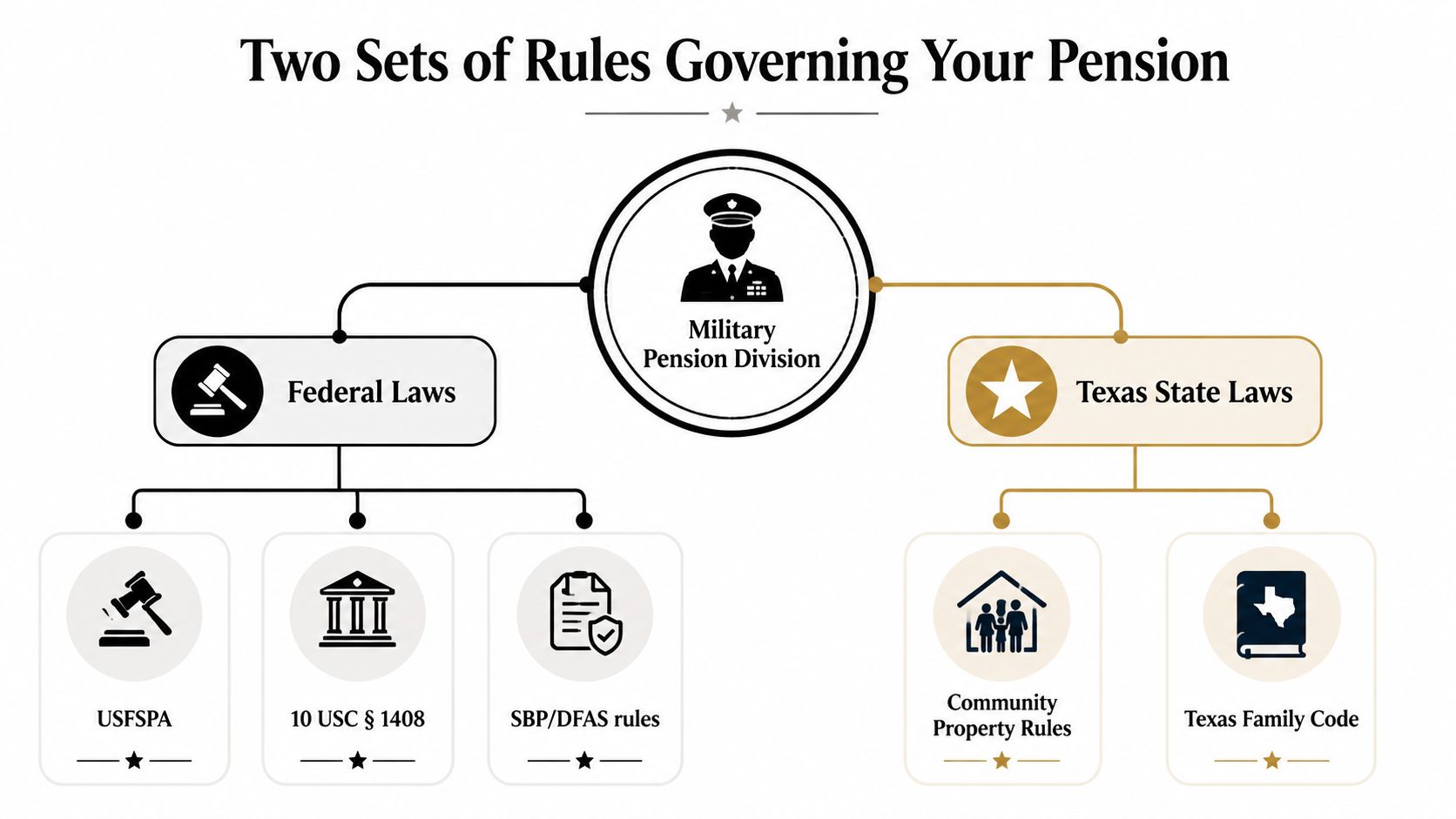
Disposable retired pay is the target
The word that matters most is disposable retired pay. That is the amount federal law allows a court to divide, not gross retired pay. Under the federal framework, Texas courts may divide only that disposable portion, and DFAS direct payment to a former spouse is capped at 50% of disposable retired pay (Texas military applications guidance).
That cap matters because a court order and a payment order serve different functions. The judge's characterization and DFAS's processing requirements often diverge, so the decree has to be written with both in mind. That is one reason attorneys separate the legal division from the mechanics of collection.
The Texas side still matters a lot. Retirement earned during marriage is generally treated as community property, while pre-marriage and post-separation accruals remain separate property. That is why the service dates, marriage dates, and decree language all need to work together, not just the broad settlement terms. A Woodlands divorce lawyer who understands the federal overlay can draft for enforceability, not just for theory, and Divorce Lawyer in The Woodlands, TX is the kind of local representation people usually seek when the paperwork has to be exact.
For clients comparing military retirement division with other retirement assets, divorce with retirement accounts in The Woodlands shows how timing, valuation, and decree language can affect the final result.
A clean agreement on paper can still fail if it does not match the federal definition of disposable retired pay.
For many couples, the practical issue is how Texas Family Code community property rules fit inside the federal ceiling. The answer is simple in concept and harder in execution. The court can divide the marital portion, but the pay stream has to stay within the federal lane.
How to Calculate the Community Property Share
The basic math usually starts with the coverture fraction. That formula measures the overlap between marriage and creditable military service, then applies Texas community property rules to the result. If you understand the fraction, the rest of the calculation becomes much less intimidating.
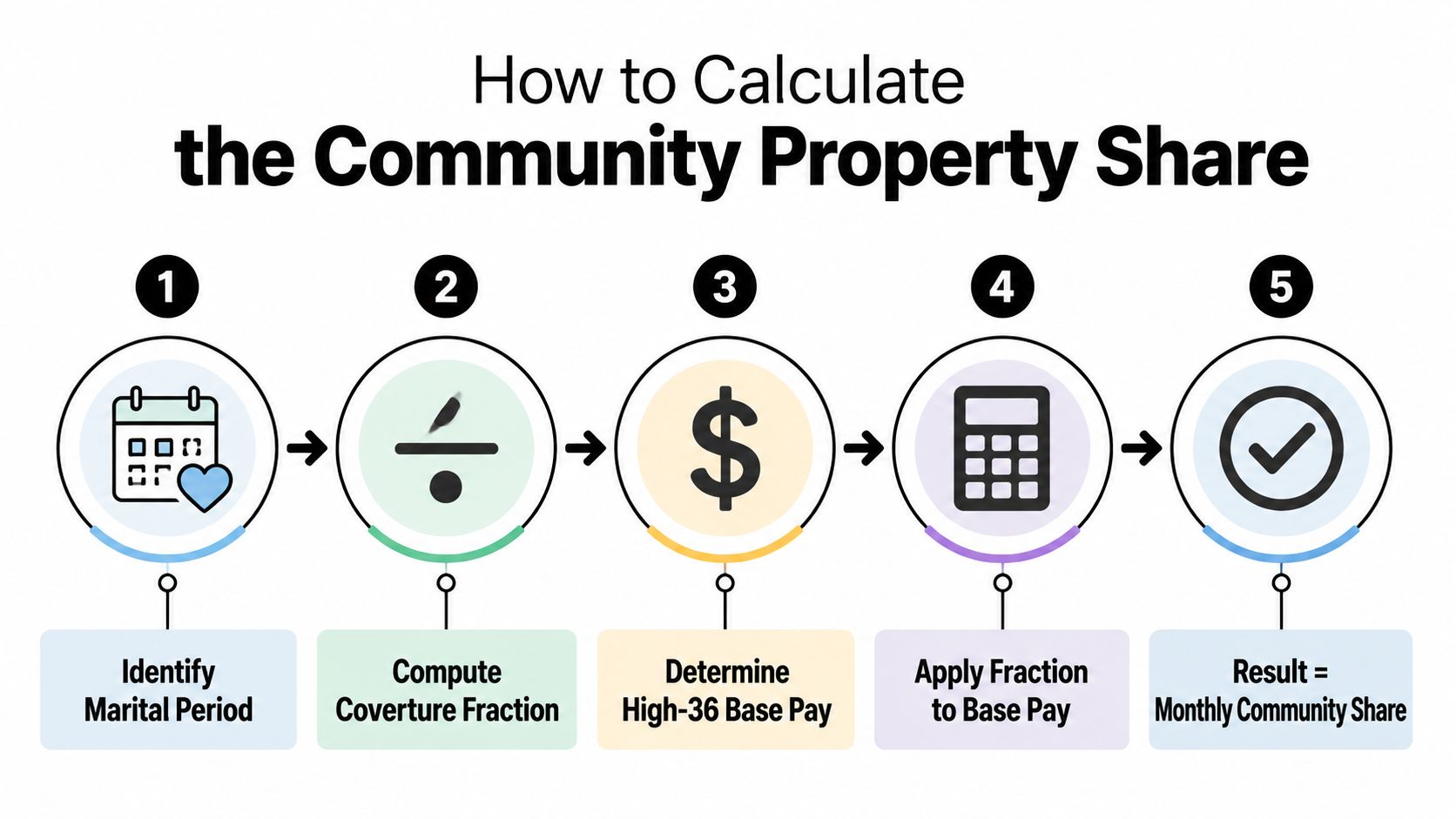
The formula in plain English
Start with the years of marriage that overlapped military service. Divide that by the total years of creditable service. That gives you the marital portion of the pension, which Texas treats as community property. A Texas military-divorce guide describes the formula the same way, and uses a 15-of-20-year example to show that 75% of the pension is marital property (Texas military divorce guide).
The legal logic is straightforward. Texas treats the retirement earned during marriage as belonging to both spouses, while the service member's separate property portion stays outside the marital estate. The coverture fraction is just the tool that separates those pieces.
Here's a simple way to understand it:
- Step 1, identify the overlap: Count the years the marriage and service overlapped.
- Step 2, divide by total service: That produces the marital fraction.
- Step 3, apply the divorce division: If the court awards a 50/50 community split, the non-military spouse's share is half of that marital fraction.
Why small date errors create big problems
This math only works if the dates are accurate. A few months can change the marital share, and a missing or sloppy service record can trigger later disputes over what the decree was meant to do. That's why Montgomery County lawyers often ask for the retirement record early, before anyone starts negotiating percentages.
If the example is a 20-year career and the marriage covered 12 of those years, the overlap is 12/20. That type of calculation is the backbone of the pension discussion in many Texas divorces, including those in The Woodlands. The coverture fraction doesn't answer every issue, but it gives both sides a common starting point.
For property division work in The Woodlands, the key is getting the fraction right before settlement language gets locked in. Property Division in The Woodlands Divorce is the kind of local issue that often depends on this exact math.
A Real-World Scenario in Montgomery County
Sarah and Tom lived in The Woodlands and expected their divorce to be mostly about the house and retirement accounts. Tom had served 22 years in the Navy, and they'd been married for 16 of those years, so the pension came up quickly in settlement talks. Their lawyers used the coverture fraction, 16 divided by 22, to identify the marital portion of Tom's pension as about 72.7%.
That number didn't mean Sarah automatically received that much. It meant that roughly 72.7% of the pension was marital property, and then the community split had to be applied on top of that. In plain terms, Sarah and Tom negotiated from the same framework, instead of arguing over a made-up percentage that ignored Texas property law.
The settlement only mattered if DFAS could read it and process it later.
What made their decree work
Their lawyers didn't just write “pension divided equally.” They included the service dates, the marriage dates, and language that tied Sarah's award to disposable retired pay. That mattered because a vague decree can leave a former spouse with a paper win and a collection headache.
They also discussed the Survivor Benefit Plan, because a pension share can disappear if the retiree dies first and no survivor protection is in place. Sarah wanted long-term security, not just a monthly number that stops at an unexpected time. The decree language had to reflect that reality.
Tom's case is the kind of example that comes up all the time in Montgomery County. The legal concept is the same, but the result turns on drafting and timing. A good agreement doesn't just state the division, it tells DFAS and the parties exactly how the division is supposed to work.
For families in The Woodlands, the lesson is simple. A pension settlement can look generous and still fail later if the decree doesn't match the federal rules. That's why the local details and the federal paperwork need to be handled together, not separately.
Getting Paid Directly The 10/10 Rule and DFAS Orders
The 10/10 Rule is one of the most misunderstood parts of a military pension case. People hear the phrase and assume it decides whether a former spouse gets anything at all. It doesn't. It decides whether DFAS can send the money directly.
Under the rule, the marriage must have overlapped with at least 10 years of creditable military service for a former spouse to be eligible for direct payment from DFAS (10/10 rule overview). If the overlap is shorter, the court can still award a share, but the retiree usually has to make the payments personally.
What DFAS needs
DFAS is not reading the decree the same way a family law judge does. It wants exact dates, clear identification of the retiree, and language that tracks the divisible retired pay. If the order is vague, missing a date, or uses the wrong pay category, the direct-pay process can stall.
That's why a technically correct decree matters so much in Montgomery County. The entitlement can exist even if the direct-payment mechanism doesn't. Those are separate questions, and they need separate attention.
A few practical points tend to matter most:
- Confirm the overlap dates: The marriage and service dates need to be consistent across every document.
- Use the right pay language: The order must refer to disposable retired pay, not a broader category.
- Submit certified paperwork: DFAS needs the decree and any supporting order in a form it can process.
The federal cap also matters here. Under the USFSPA framework, no more than 50% of disposable retired pay can generally be paid directly to a former spouse. Even when a court awards a larger share on paper, that direct-payment ceiling still applies. Texas cases often require that distinction to be explained carefully, because the court's property allocation and DFAS's payment mechanics are not the same thing.
If the rule isn't met, the award doesn't vanish. It just changes how it gets collected. That's the difference between a good settlement and an enforceable one.
Protecting Your Future SBP and VA Disability Waivers
A lot of divorce agreements fix the present and ignore the future. That's risky in a military case, because the loss often shows up later, after the decree is signed and the payment structure is already in motion. Two issues deserve close attention, Survivor Benefit Plan coverage and VA disability waivers.
The Survivor Benefit Plan, or SBP, can keep a former spouse's share from disappearing when the retiree dies first. It's an annuity-based protection, and in a divorce it should be addressed directly in the decree and the settlement discussions. If the paperwork is vague or the election is missed, the benefit the parties thought they secured can be lost later.
The hidden risk in disability elections
The bigger trap is the post-divorce disability waiver. A retiree may later waive retired pay to receive VA disability benefits, and federal law treats disability pay as non-divisible. That can reduce or eliminate the pension payments the former spouse expected to receive, which is a recurring problem in Texas military cases (VA disability waiver issue).
That issue is especially important in high-asset divorces in The Woodlands, where the pension may be a substantial part of the marital estate. The problem isn't just legal theory. It's cash flow, retirement security, and what happens when one party's post-divorce election changes the numbers the other party was relying on. Texas courts continue to work through those disputes, but the practical lesson is already clear, don't rely on a reimbursement clause to solve a federal disability issue later.
A few negotiation points usually deserve attention:
- SBP election language: The decree should say who is to be named beneficiary.
- Deadline awareness: SBP elections are time-sensitive, so the paperwork has to be tracked.
- Disability risk planning: Don't assume a reimbursement promise will survive a future waiver.
When these issues are handled early, the settlement is more durable. When they're ignored, the later fight is usually about whether the decree can still protect the money the parties thought they divided. In a military divorce, that question is often more important than the initial percentage.
Your Action Plan for Dividing a Military Pension
The right result comes from matching federal law, Texas community property rules, and DFAS procedures in the same decree. The math matters, but so does enforceability. In Montgomery County, the cases that go best are usually the ones where the paperwork is built for practical application, not just the courtroom.
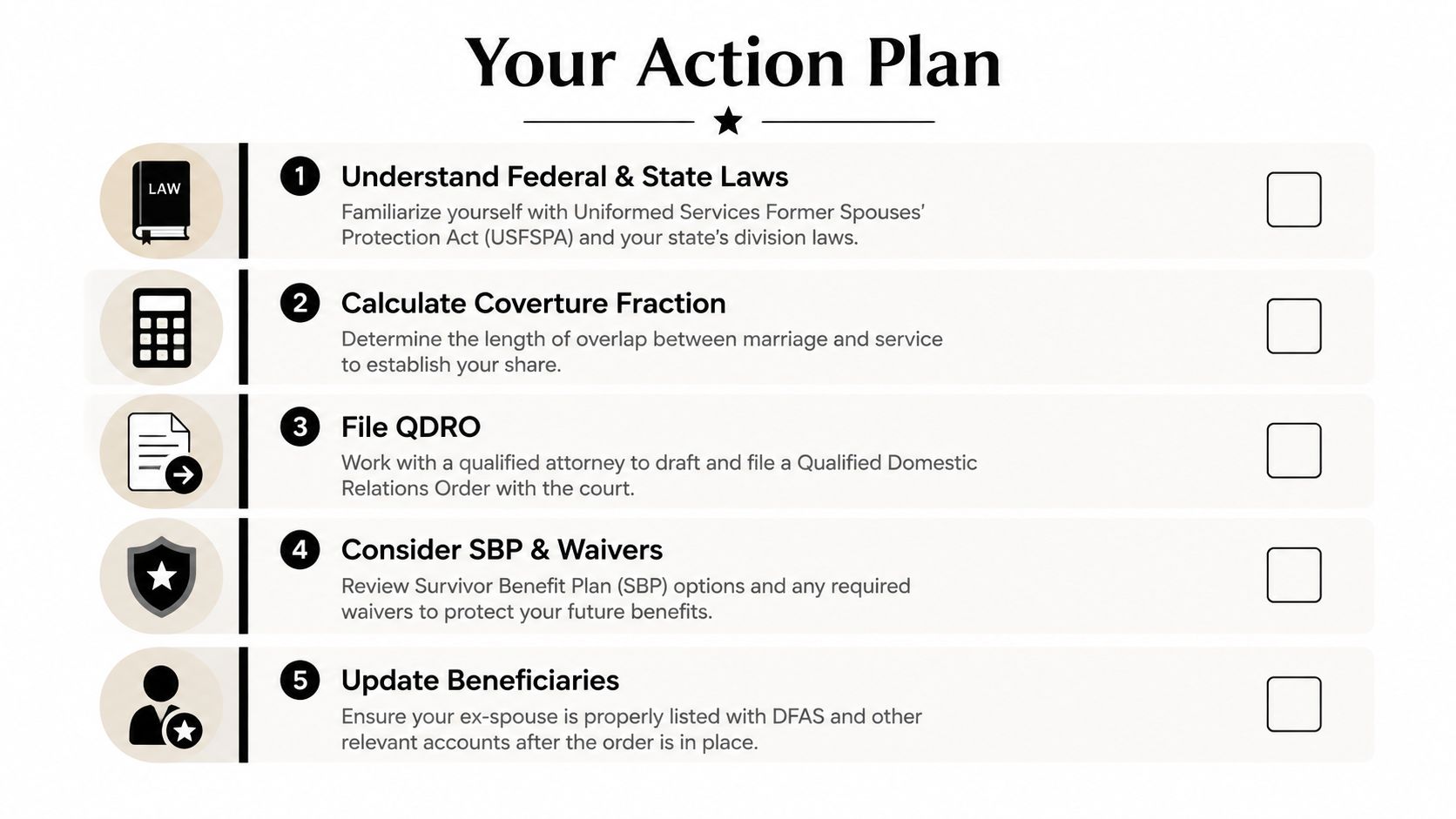
What to do next
- Gather the service records. Get the marriage date, service dates, retirement information, and any pension statements before you negotiate.
- Check the overlap. Confirm whether the marriage overlaps at least 10 years of creditable service if direct DFAS payment matters.
- Review the decree language. Make sure it identifies disposable retired pay and not a broader or vague retirement category.
- Talk through SBP. Decide whether former-spouse survivor coverage is part of the settlement.
- Plan for disability changes. Ask how a future VA disability waiver could affect the pension share.
A Texas divorce under the Texas Family Code can divide retirement earned during marriage, but a military case adds federal limits on top of that. That's why a decree that looks complete to a civilian eye may still need military-specific drafting to work after judgment.
This article is for education only, and it's not legal advice. If you're dealing with divorce and military pension issues in The Woodlands or Montgomery County, talk with a family law attorney before you sign anything that affects your retirement rights.
If you want help sorting out a military pension, survivor benefits, or DFAS-compliant decree language, The Law Office of Bryan Fagan handles divorce and property division matters for families in The Woodlands and Montgomery County. Visit The Law Office of Bryan Fagan to schedule a consultation and get a practical review of your situation before the settlement papers are finalized.