 Skip to content
A Woodlands resident who dies without a will leaves inheritance to Texas intestacy law, and the family will likely need a court proceeding in Montgomery County to transfer a house or accounts. If the person leaves a surviving spouse and children, the spouse does not automatically receive everything, the spouse takes one-third of the personal estate and a life estate in one-third of the land, while the children and descendants receive the remaining interests under Texas law.
A parent dies in a Grogan's Mill home, and the family gathers around the kitchen table to sort through bank statements, property records, and unanswered questions. There may be a joint account at Woodforest National Bank, a house in Montgomery County, vehicles, personal belongings, and debts, but no document naming an executor or explaining what the parent wanted.
That uncertainty is common in dying without a will in The Woodlands, TX. The law supplies a default inheritance system, but it doesn't create a personalized estate plan. The family still has to determine which assets are probate assets, identify the heirs, address creditor claims, and obtain the legal authority needed to retitle or sell property.
Texas Estates Code Chapter 201 establishes the intestacy hierarchy, while Chapter 202 provides the procedure for determining heirship. The Montgomery County court applies that statewide framework to residents of The Woodlands, Conroe, Magnolia, Spring, and nearby communities. The result may be a structured heirship proceeding rather than a simple transfer at the bank or county records office.
When a Woodlands Resident Dies Without a Will
The first problem isn't always figuring out who should inherit. It's determining who has authority to act.
In the Grogan's Mill example, the surviving spouse may know the family's finances, but that doesn't automatically make the spouse an executor. There is no executor unless a will names one, and an intestate estate generally requires an administrator appointed through the probate process. Until that authority exists, a bank may restrict access to accounts, and a title company may refuse to insure a transfer of the home.
A joint account can operate differently from an account held only in the deceased person's name. The account agreement and ownership records matter. A house titled only in the deceased person's name presents a separate title problem, even if everyone in the family agrees about what should happen.
The family's first questions
A Woodlands family should usually gather:
- The death certificate: Obtain certified copies and preserve the original estate records.
- Property documents: Locate the Montgomery County deed, mortgage information, vehicle titles, and insurance records.
- Financial statements: Review accounts, retirement information, investment records, and recent mail.
- Family information: List the spouse, children, grandchildren, parents, siblings, and any relatives who may have an inheritance claim.
- Debt information: Identify mortgages, credit cards, medical bills, taxes, and other obligations.
Practical rule: Don't distribute or sell estate property simply because the family agrees. First determine whether the asset belongs to the estate and who has legal authority to transfer it.
The court may need to declare the heirs and appoint an administrator before the family can settle the estate. Texas guidance explains that an administrator handles estate administration, including addressing debts and taxes, before distributing what remains under the law. That process can be more involved when no will identifies the heirs or the person responsible for administration.
The rest of the process turns on three questions: who inherits, what property is included, and which probate path fits the estate. The answers depend on family structure, property character, ownership documents, and debt.
How Texas Intestacy Decides Who Inherits
Texas intestacy law does not divide every estate in the same way. Estates Code Chapter 201 looks at the surviving family members and the type of property involved.
Consider a Woodlands resident who dies leaving a spouse and two adult children. For the separate personal property, the surviving spouse receives one-third, and the children share the remaining two-thirds. For separate real property, the spouse receives a life estate in one-third of the land, while the remainder goes to the children and their descendants. The children share their interest equally unless another rule applies to the family structure or property.
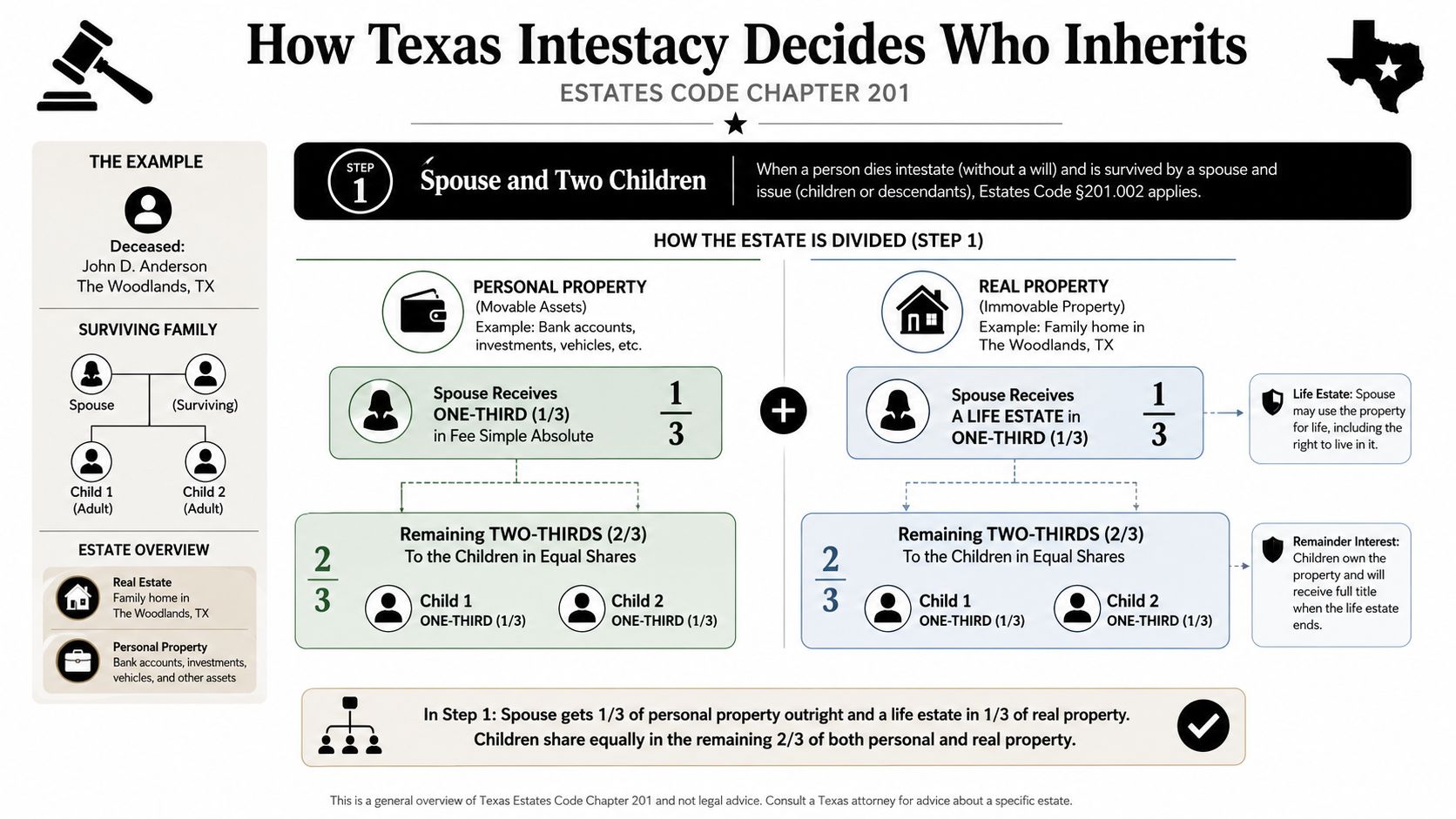
The family tree changes the result
If there's a surviving spouse but no children or descendants, the spouse may receive all personal property and, in some circumstances, the entire estate. Whether parents or siblings survive can affect the result.
If there is no surviving spouse, Texas law generally moves first to the decedent's children and descendants. If none survive, the law looks to parents, followed by siblings and their descendants. The court may need evidence about the family tree, including marriages, births, deaths, and possible unknown heirs.
A stepchild isn't automatically an heir of a stepparent under intestacy law. A blended family may include a spouse, children from a prior relationship, stepchildren, adopted children, and grandchildren, but those relationships don't all carry the same inheritance status. Adoption, legal parentage, and the identity of each child matter.
You can review the statutory framework in the Texas Estates Code heirship provisions. Families facing uncertainty about who must participate in the case may also need an heirship proceeding in Montgomery County.
The key mental model is simple: intestacy divides property according to family relationships and property categories, not according to who provided care, who lived in the home, or who the deceased may have intended to favor. A court may identify the legal heirs even when the family's practical expectations are very different.
Community Property, Separate Property, and the Homestead
The inheritance analysis changes once you classify each asset.
Property acquired during a marriage may be community property, while property owned before marriage or received by gift or inheritance may be separate property. Those labels aren't interchangeable, and bank records, deeds, inheritance documents, and marital agreements may help establish the character of an asset.
For community property, the surviving spouse generally retains the spouse's own community interest. The deceased person's interest then passes under the intestacy rules. Separate property follows the separate-property inheritance rules, which can give children from an earlier relationship an interest that surprises a surviving spouse.
A Woodlands home adds another layer. Homestead protections can affect possession, use, and transfer, and a homestead may be treated differently from other real property. The surviving spouse may have important rights to remain in the home, while children or descendants may hold interests that affect a future sale or long-term ownership.
| Property Character vs. Intestacy Treatment in Texas | Surviving Spouse | Children / Descendants |
|---|---|---|
| Community property | Retains the spouse's own community interest, with the deceased spouse's interest distributed under applicable intestacy rules | May inherit the deceased spouse's interest when the statutory family configuration provides for descendants |
| Separate personal property | May receive one-third when the decedent leaves a spouse and children | Share the remaining two-thirds under that family configuration |
| Separate real property | May receive a life estate in one-third when the decedent leaves a spouse and children | Receive the remainder in the affected real property |
| Homestead | May have protections affecting occupancy and use | May receive an interest that affects later transfer or sale |
The details can become especially difficult when the estate includes a home, business interests, inherited funds, or property acquired during different relationships. A Property Division Lawyer in The Woodlands may handle division of community property and complex assets for Woodlands divorces, while probate counsel addresses how those classifications affect an estate after death.
Don't assume the deed alone answers every question. A title record may identify ownership, but the court may still need to determine whether the property was community or separate, whether a homestead right applies, and which heirs hold the transferable interest.
Opening Probate in Montgomery County
A typical intestate estate begins with a court filing, not a family agreement.
For a Woodlands resident, the family may file an application for letters of administration and seek a determination of heirship in the Montgomery County Probate Court at 210 W. Davis in Conroe. The filing generally involves a court fee and formal notice requirements. The family should confirm current filing procedures with the clerk or counsel because local administrative requirements can change.
Suppose a spouse and two adult children need to transfer a house and access an account held only in the deceased parent's name. The court must first establish who the heirs are. It can then appoint an administrator, who receives authority to manage estate property, address creditor claims, and complete the settlement process.
What the administrator does
The administrator may need to:
- Protect estate property: Secure the home, vehicles, records, and valuables.
- Identify obligations: Review debts, taxes, mortgages, and other claims.
- Provide required notices: Follow applicable notice procedures, including notice to creditors.
- Prepare the estate inventory: File the Inventory and Appraisement within 90 days under Texas Estates Code Section 309.056, as described in the statutory framework.
- Transfer remaining assets: Distribute property only after the estate's legal and financial obligations are handled.
Texas law allows independent administration in appropriate circumstances, and it can reduce the need for repeated court involvement. In an intestate estate, the heirs generally must agree to the process and nominate an administrator, while the court still must determine heirship first. A required surety bond may also apply, especially when the administration is dependent or the court requires protection for the estate.
The Montgomery County probate court process can involve several distinct steps, from heirship findings through administration and final distribution. A Probate Lawyer in The Woodlands, TX may handle probate administration and estate settlement in Montgomery County.
The court's role isn't to rewrite the family's wishes. It applies the inheritance rules and confirms who has authority to act.
Real estate outside Texas creates a separate issue. Texas probate authority generally cannot transfer out-of-state real property by itself, so the family may need an ancillary probate proceeding in the state where that property is located.
Small Estate Affidavits and Other Shortcuts
A Woodlands resident may leave a modest bank account, a vehicle, and a homestead, while also owing medical bills or credit card debt. That combination determines whether a shortcut works. Families should screen each asset and obligation before assuming they qualify.
Texas Estates Code Section 205 allows a small-estate affidavit only when strict requirements are satisfied. The estate must have no will and non-exempt assets of $75,000 or less, as explained in a guide to probating an estate without a will from Texas Law Help. The affidavit must identify the heirs, property, debts, and other required facts. The appropriate heirs must also swear that the information is accurate.
A Woodlands family should review the estate property by property. A homestead may receive different treatment, but a house generally cannot be transferred by a small-estate affidavit alone. Real property outside the homestead usually creates additional limits, and unpaid debts may disqualify the simplified process.
| Small Estate Affidavit vs Full Administration in Texas | Small Estate Affidavit | Full Administration |
|---|---|---|
| Court involvement | Simplified filing if statutory conditions are satisfied | Formal court case with heirship and administration steps |
| Asset limit | Non-exempt assets must be $75,000 or less | No small-estate asset ceiling |
| Real estate | Limited use, with homestead and other real-property restrictions | Can address estate real property through proper court authority |
| Debts | Debts and other conditions can disqualify the route | Administrator addresses creditor claims within the administration |
| Best fit | Modest estate with qualifying assets and no will | Estate with a home, complex assets, disputes, or significant obligations |
An explanation of how to file a small estate affidavit in The Woodlands, TX can help a family identify the required filing information. An Affidavit of Heirship may establish family history and ownership for real estate when full administration is unnecessary, but it does not resolve every title or creditor issue.
Some assets may pass outside probate. Joint ownership with a valid right of survivorship or a payable-on-death designation can transfer particular accounts or property, if the documents create that result. Banks and brokerage firms may follow their own procedures, so heirs should ask each institution which documents it requires before relying on an affidavit.
Guardianship Questions for Minor Children
A will can nominate a guardian, but intestacy leaves the family without the deceased parent's written preference.
Under Texas Estates Code Section 201.002 and Chapter 1104, a surviving parent is usually the natural guardian. If that parent has also died, is unwilling, or cannot safely serve, Montgomery County may need to address a guardianship case. The court focuses on the child's best interests and the proposed guardian's ability to care for the child.
Consider a Woodlands father with two children from a first marriage and a second spouse, but no will. If the father dies and the second spouse isn't the children's legal parent, she may not automatically receive parental authority. The children's other legal parent may have priority, or the court may need to address competing requests depending on the facts.
Person and estate guardianships
A guardian of the person handles care, residence, education, and medical decisions. A guardian of the estate manages property belonging to the child. Those roles can be held by one person or divided between people when that arrangement serves the child.
The court may require a bond to protect the child's property. A guardian may also have to file an annual accounting under Texas Estates Code Section 1163.104. The accounting requirement helps the court monitor money and property managed for the child.
Guardianship of the estate is different from administering the deceased parent's estate. A child may inherit property through intestacy, but someone still needs legal authority to hold and manage that property until the child reaches the applicable legal age or the court authorizes another arrangement.
Mistakes Woodlands Families Make Without a Will
The most damaging assumptions usually sound reasonable at first.
Myth one: the surviving spouse automatically controls everything. Texas intestacy law can give the spouse significant rights, but the result changes when children, descendants, parents, or siblings survive. Children from an earlier relationship may inherit interests in certain separate property even after a long second marriage.
Myth two: every joint account bypasses probate. Some accounts may pass under a valid survivorship agreement, while others may not. The account contract controls, and a surviving co-owner's access doesn't necessarily resolve creditor, ownership, or family disputes.
Myth three: a beneficiary designation transfers a house. Beneficiary forms can affect certain financial accounts, but they don't replace a deed or create a transfer mechanism for titled real estate such as a Woodlands home.
Myth four: one family member can pay every estate bill personally. A relative who uses personal funds may create confusion about reimbursement, ownership, or responsibility. Estate debts should be evaluated and paid through the proper estate process, not handled casually from a helper's account.
Myth five: the family can skip court because everyone agrees. Agreement helps, but it doesn't create record title or authorize someone to act for the estate. If the estate doesn't qualify for a simplified procedure, heirs may remain unable to sell property or close accounts until the court process is completed.
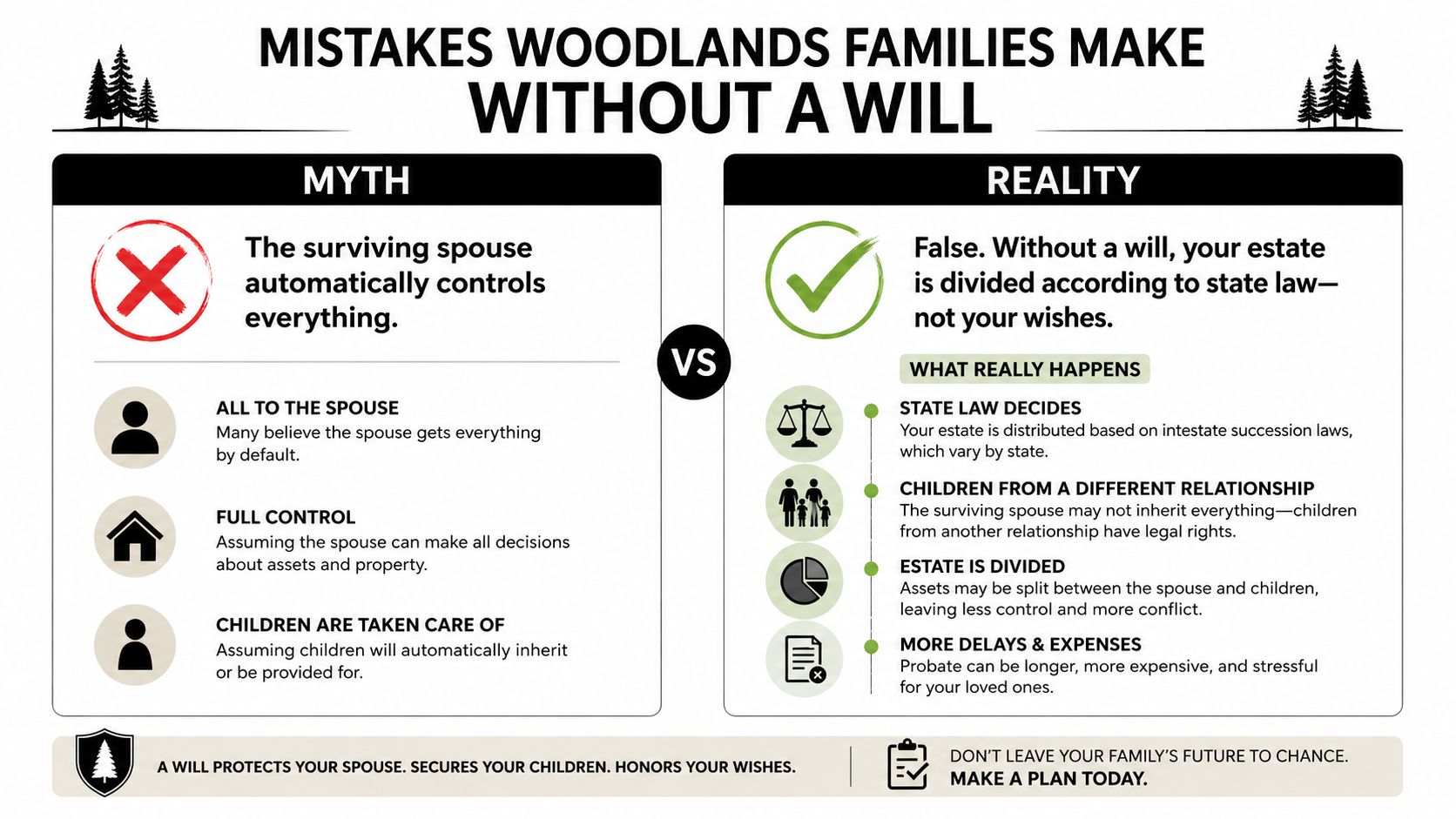
A modern estate may include jointly held accounts, retirement benefits, life insurance, beneficiary designations, and real estate titled in different ways. Each asset needs its own review. The question isn't whether the person had a will. It's which assets pass through probate and which assets transfer under a separate ownership or beneficiary arrangement.
The following video offers a visual explanation of common estate-planning misunderstandings.
Your Next Steps and When to Call a Probate Lawyer
Start with documents, not assumptions. A family can often make the first conversation with a probate professional more useful by organizing the basic facts.
What to do next
- Locate the death certificate: Request certified copies and preserve all estate records.
- Gather financial records: Collect deeds, account statements, vehicle titles, insurance policies, tax documents, and retirement information.
- Separate ownership types: Mark assets held only by the deceased, jointly held accounts, survivorship property, and assets with beneficiary designations.
- List potential creditors: Include mortgages, medical balances, credit accounts, taxes, personal loans, and claims that family members have already paid.
- Map the family tree: Identify the spouse, children, descendants, parents, siblings, stepchildren, adopted children, and any heirs who may be difficult to locate.
- Screen the probate route: If the estate consists only of qualifying personal property under the small-estate threshold and has no problematic real estate, the affidavit route may be possible. A Woodlands home, unresolved debts, blended-family concerns, or title problems usually call for a more careful analysis.
A routine matter may take months because creditor notices, court calendars in Conroe, heirship findings, administration, and title work must occur in sequence. The exact timeline depends on the estate's assets, debts, family agreement, and whether anyone contests heirship or administration.
Call a probate lawyer promptly if the estate includes real estate in The Woodlands, minor children, a blended family, missing heirs, disputed ownership, or uncertainty about community and separate property. Bring the death certificate, deed, account statements, debt records, tax information, and any documents suggesting a will or beneficiary designation.
This article provides general information about Texas intestacy and probate. It isn't legal advice, and the right procedure depends on the specific family, assets, debts, ownership documents, and court requirements.
The Law Office of Bryan Fagan helps families in The Woodlands and Montgomery County evaluate intestate estates, heirship questions, property transfers, and probate administration. To discuss the home, accounts, family structure, and debts involved in your situation, visit The Law Office of Bryan Fagan and schedule a consultation.
