
You live in The Woodlands, own a home in Montgomery County, and may have spent years building accounts, retirement savings, vehicles, and other property. The mistake I see most often is treating probate avoidance as a single form. A will alone doesn't avoid probate, and a transfer-on-death deed only addresses the real estate named in that deed.
The practical answer to how to avoid probate in The Woodlands, Texas, is to match every asset with the right transfer method, record the documents correctly, and keep beneficiary designations aligned. Texas law provides useful tools, but each one has limits.
What Probate Means for Woodlands Families
A Woodlands homeowner in Panther Creek dies with a will, a house in Montgomery County, two brokerage accounts, and a Texas ranch. The surviving spouse may assume the will means the property passes directly to the named beneficiaries. It doesn't. Assets titled solely in the deceased owner's name generally still require an estate administration before the heirs can receive clear authority over them.
Under Texas Estates Code Chapter 301, the family begins by filing an application with the appropriate probate court. For a Montgomery County estate, that may mean filing locally in Conroe, including at the Montgomery County probate facilities associated with 210 W. Davis. The court process can involve notice, a bond when required, issuance of letters testamentary, creditor procedures, and authority for the independent executor to act.
Why a will isn't a probate-avoidance document
A will tells the court how to distribute probate assets. It doesn't remove those assets from the court system. The executor may need court authority before selling or refinancing a house, accessing accounts, or transferring property, and the family may face appraisals, filing expenses, attorney fees, creditor notices, and ongoing carrying costs.
The Texas court system's annual statistical reporting reflects roughly 60,000 probate cases in one recent fiscal year, with almost 70% handled through independent administration. That data comes from the Texas courts annual statistical report. Independent administration is usually less court-intensive than dependent administration, but it remains a court process.
Local reality: A streamlined probate administration is still different from keeping an asset outside probate from the beginning.
Accounts at a Woodforest National Bank or Wells Fargo branch near Lake Woodlands Drive may be frozen or restricted while the institution confirms who has legal authority. The house, brokerage accounts, and ranch may each require different transfer work. Public filings can also reduce privacy, especially when the estate includes valuable real property.
For a local overview of the administration process, see estate administration in The Woodlands. The right avoidance plan aims to prevent the house, accounts, and other assets from reaching that process unnecessarily.
Texas Tools That Move Assets Around Probate
Texas gives Woodlands homeowners several nonprobate tools, but none covers everything. Choose based on the asset, how much control you need during life, and whether the transfer must be recorded.
Revocable living trusts
A revocable living trust can hold real estate, bank accounts, vehicles, and other property after ownership is properly transferred to the trustee. Texas trust law is addressed in Texas Property Code Chapter 113. If the trust owns a home in The Woodlands, the deed must be prepared and recorded so the trust, rather than the individual, holds title.
A trust can also address an out-of-state cabin, but the deed must be recorded in the county where that property sits. The trust itself doesn't do the work until assets are funded into it. A pour-over will remains important for property that wasn't transferred during life.
Families looking for wills, trusts, and estate plans can review an Estate Planning Attorney in The Woodlands as one local option.
Transfer-on-death deeds
A transfer-on-death deed, or TODD, applies to the specific Texas real property described in the recorded deed. Texas Estates Code Chapter 114 authorizes this mechanism, and the Texas Estates Code addresses the deed framework in Section 114.151.
The owner keeps control during life and can generally revoke the deed before death. The deed must be properly executed and recorded while the owner is alive. After death, the beneficiary typically needs supporting documents, such as a death certificate or affidavit of death, filed with the county clerk to establish the transfer in the title records.
Account designations and survivorship
Bank accounts may use payable-on-death, or POD, designations. Brokerage accounts may use TOD registrations, while retirement plans and life insurance rely on beneficiary forms supplied by the institution or carrier. Those designations transfer the particular account under the institution's rules. A will generally doesn't override a valid account beneficiary designation.
Joint ownership can avoid probate only when the required survivorship rights were expressly created. Texas guidance warns that “joint” ownership doesn't automatically mean the survivor receives the asset outside probate. Married couples may also consider tenancy by the entirety where legally appropriate for homestead property.
Small estate affidavits and vehicles
A small estate affidavit can provide a narrower path for qualifying estates. Texas Estates Code Section 205.001 addresses the procedure, but it isn't a universal substitute for a trust or deed. Vehicles may have beneficiary options through TxDMV procedures, subject to the agency's requirements.
These tools can reduce court involvement and public filings for covered assets. They don't eliminate every issue, and probate avoidance doesn't eliminate possible federal estate tax exposure for larger estates.
For a comparison of wills and trusts, see will versus trust planning in The Woodlands.
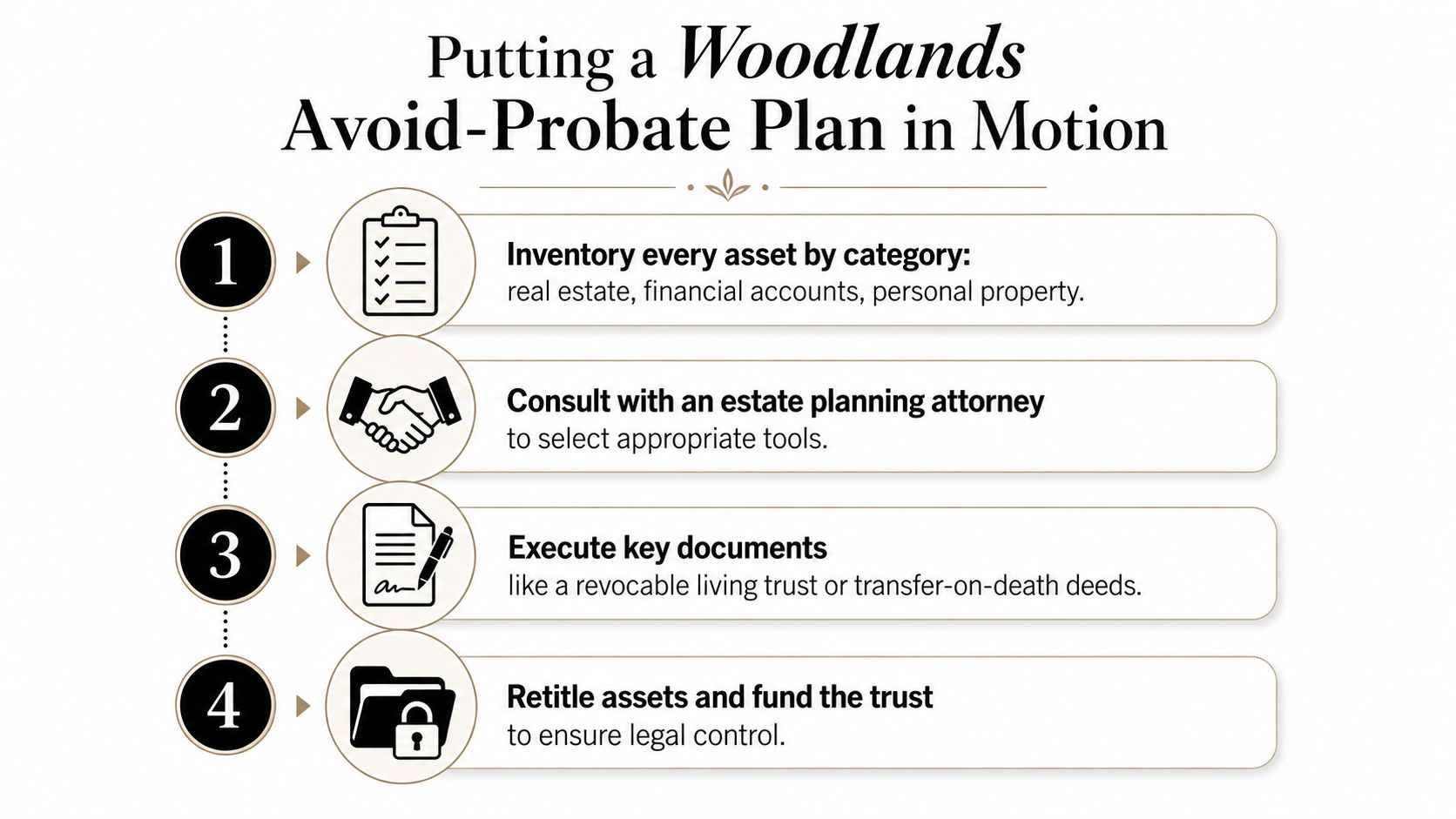
Putting a Woodlands Avoid-Probate Plan in Motion
Start with an inventory, not a document. List every asset and identify the current owner, account number, beneficiary, location, and transfer rules. Include real estate, bank and brokerage accounts, retirement plans, vehicles, business interests, valuable personal property, and digital property.
Build the documents around the inventory
A practical sequence looks like this:
- Inventory every asset. Separate real estate from financial accounts, retirement accounts, vehicles, business interests, and personal property. Note assets outside Texas because each jurisdiction may require its own recording.
- Update the will. Use a pour-over will even when a trust is the primary plan. It gives instructions for property that wasn't properly retitled.
- Execute the revocable trust. Sign the trust, certification of trust, and any memorandum governing tangible personal property. The document is only the framework. Funding creates the operative ownership.
- Prepare and record deeds. Record a deed transferring the home to the trust when appropriate, and use a TODD for specific real property that will remain individually owned.
- File with the Montgomery County Clerk. Real-property documents for a Woodlands home generally belong in the county's official records at 210 W. Davis in Conroe. Confirm the recording information appears on the recorded document.
- Update financial ownership. Retitle eligible accounts into the trust when that fits the plan. Submit new POD and TOD forms to every bank and brokerage.
- Review retirement and insurance beneficiaries. These forms control their accounts directly, so coordinate them with the trust and will.
- Address jointly owned property. Verify that a valid survivorship agreement exists. Don't rely on the word “joint” alone.
- Fund the safety net. Use the pour-over will for assets that remain outside the trust, while understanding that a will may still require probate to work.
- Document the funding trail. Keep recorded deeds, acceptance letters, account confirmations, and beneficiary acknowledgments together.
The mistake that derails most plans: Funding the trust for the house but forgetting the brokerage account or IRA beneficiary. The family then has a trust that handles one major asset while another category still requires separate administration.
Don't assume a recorded deed finishes the job. After death, someone may still need to file an affidavit of death or other title documents with the Montgomery County Clerk. Recordkeeping is part of the plan, not an administrative afterthought.
Matching Each Asset to the Right Tool
The cleanest way to evaluate probate avoidance is asset by asset. A TODD handles the described property, a beneficiary form handles the named account, and a trust handles only the assets transferred into it.
Asset-by-asset selection
| Asset Type | Best Tool | Filing Requirement | Watch Out For |
|---|---|---|---|
| The Woodlands home or other Texas real property | Revocable living trust or TODD | Trust deed or TODD must be properly recorded in the county records | A TODD covers only the real property described in it |
| Bank account | POD designation or trust ownership | Bank's own form, or account retitling documents | An outdated beneficiary form can defeat the intended plan |
| Brokerage account | TOD designation or trust ownership | Brokerage's registration or transfer documents | The designation must match the broader estate plan |
| Retirement plan | Beneficiary form, often coordinated with a trust | Plan administrator's beneficiary form | The will doesn't ordinarily control the account |
| Life insurance | Beneficiary form | Carrier's form and confirmation | Former spouses or outdated beneficiaries may remain listed |
| Vehicle | Trust ownership or applicable TxDMV beneficiary procedure | Title and agency paperwork | A vehicle procedure may not address other personal property |
| Personal property | Trust, memorandum, or pour-over will | Trust schedule, memorandum, or probate if unfunded | Unclear descriptions can create family disputes |
A trust usually beats a beneficiary form when the family needs one coordinated system for multiple assets, successor trustee management, or controlled distribution. A beneficiary form may be simpler for a single account when the designation is reviewed and maintained.
Don't use a deed as a substitute for account planning. The same principle applies to a business interest, digital property, or an out-of-state asset. Each item needs an ownership or beneficiary strategy that its custodian will recognize.
For unrelated family legal needs, a Child Custody Lawyer in The Woodlands, TX addresses custody and conservatorship representation for The Woodlands families. That work is separate from estate funding, but families often need to coordinate both areas after a major life change.
Common Assumptions That Derail Estate Plans
The most dangerous estate plans aren't always missing documents. Sometimes they contain the wrong document for the asset.
Adding a child to a deed can create more problems than it solves. The child may gain ownership rights that expose the property to creditors, divorce claims, or a partition dispute. The transfer can also affect Medicaid planning and create tax and control consequences that a homeowner didn't intend.
The myths to reject
- “Joint means automatic survivorship.” Texas law requires an express survivorship agreement for jointly owned assets. Without one, the deceased owner's interest may still enter probate.
- “My will controls every account.” A retirement plan, life insurance policy, bank account, or brokerage account generally follows its valid beneficiary or transfer designation.
- “A simple will avoids probate.” A will directs probate distribution. It doesn't transfer individually owned property by itself.
- “A TODD covers the whole estate.” A TODD applies to the specific real property described in the recorded deed. It doesn't transfer bank accounts, vehicles, or other property.
- “A small estate affidavit handles whatever we find.” Small estate procedures have statutory eligibility requirements and aren't designed for every asset or estate.
- “Signing is enough.” A deed that wasn't recorded before death may not accomplish the intended transfer. Account forms also need acceptance and confirmation from the institution.
The relevant Texas Estates Code provisions matter because they define the transfer mechanism, not just the general intention. Chapter 114 governs TODDs, Chapter 205 addresses small estate affidavits, and survivorship rules require more than informal family language.
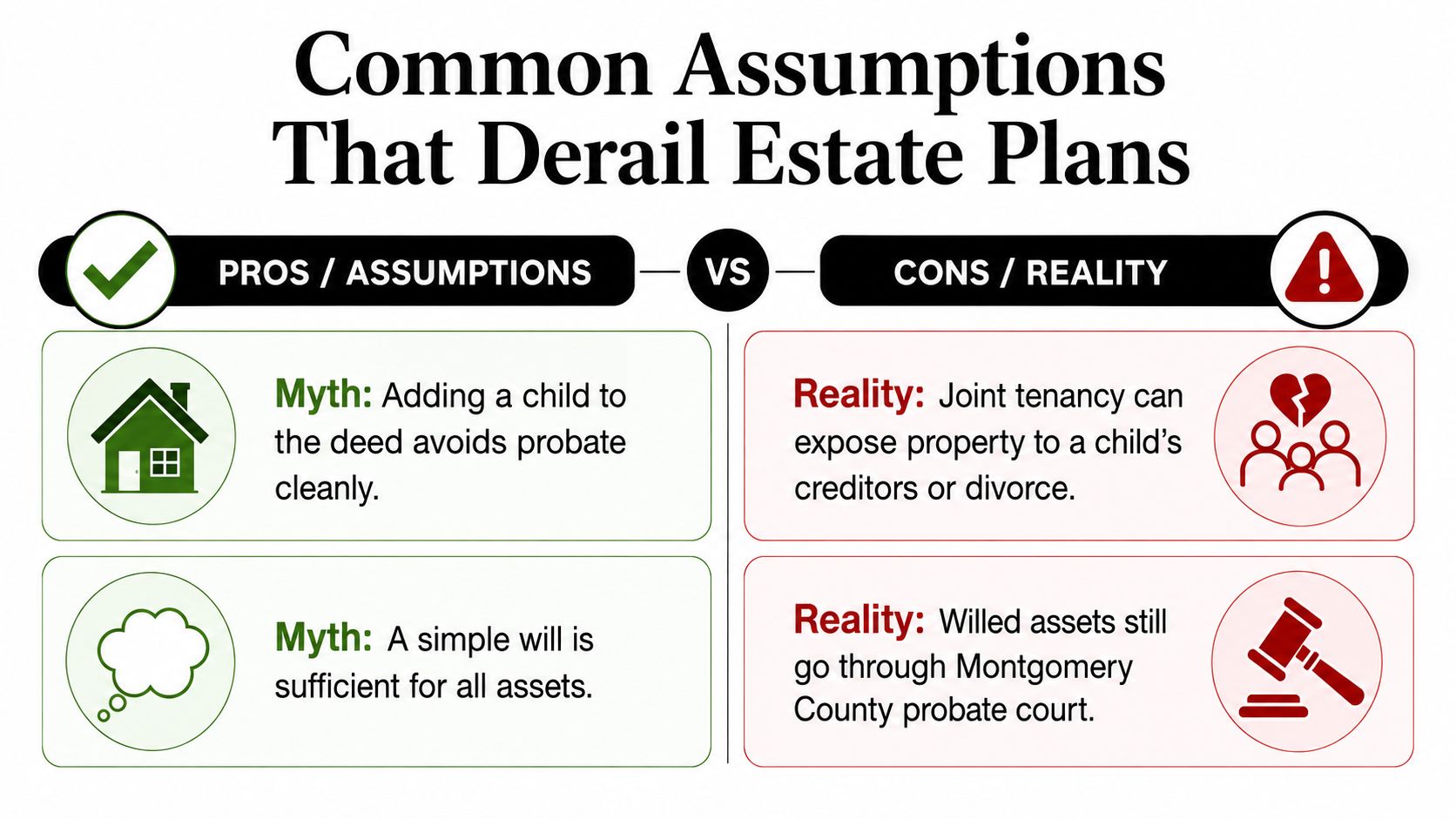
A stale beneficiary form can undermine a carefully drafted will, especially in a blended family. Review the form directly with the retirement plan administrator or financial institution. Keep confirmation records instead of assuming a conversation with a representative changed the account.
Planning rule: Don't ask only, “Do I have an estate plan?” Ask, “What happens to each asset if I die tomorrow?”
Montgomery County Filing Steps and Small Estate Paths
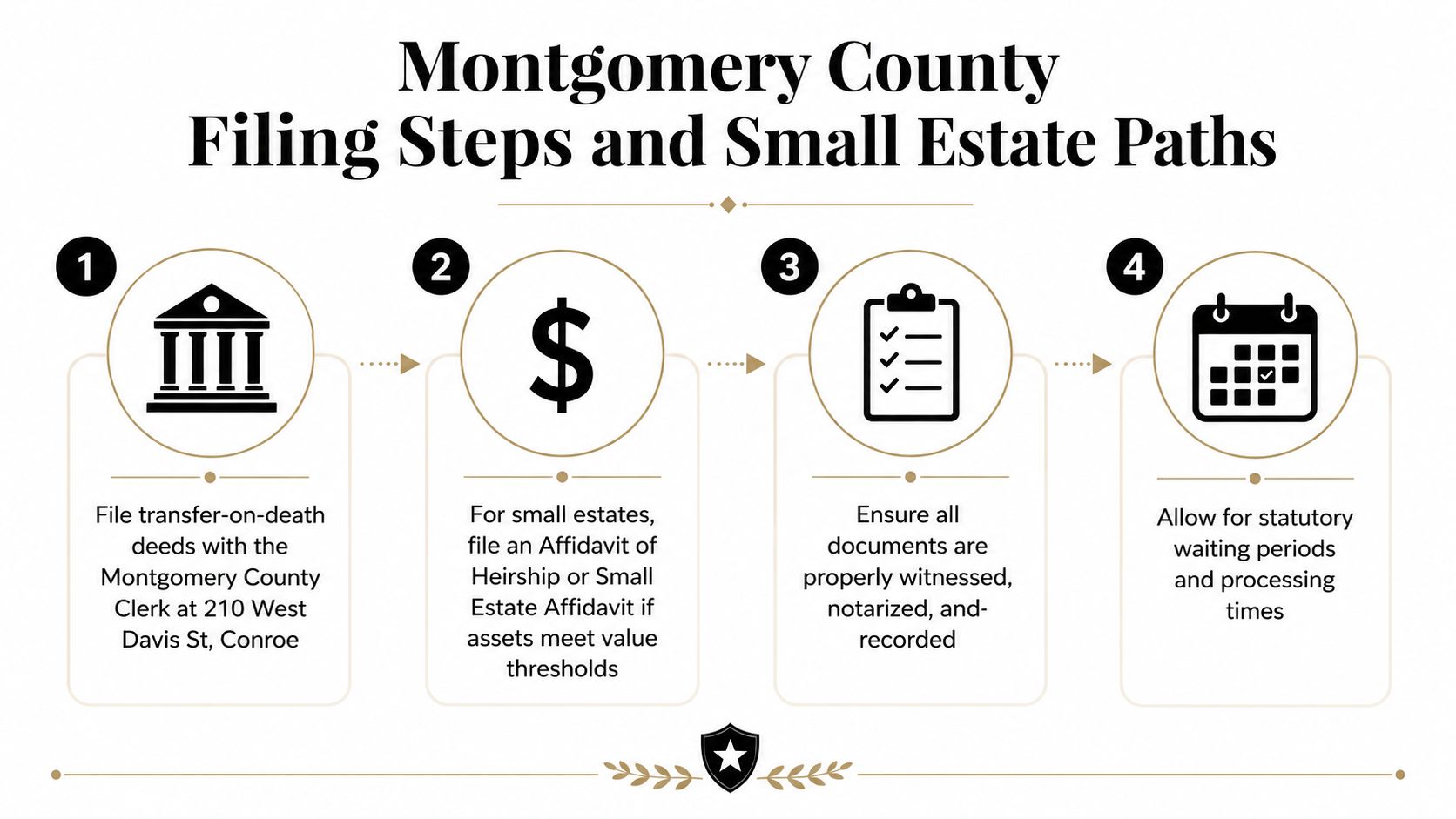
The paperwork has to reach the right record system. For real property in The Woodlands, transfer-on-death deeds, deeds to trustees, and related title documents generally belong in the Montgomery County Clerk's official records at 210 West Davis Street in Conroe. Probate pleadings follow the county's probate filing process rather than the real-property recording desk.
Record first, then confirm
For a deed-based plan, sign the document correctly, complete any required acknowledgment, and record it while the owner is alive. After recording, check that the clerk's information appears on the document and keep a certified or official copy with the estate file.
A TODD may be a strong probate-avoidance tool for a Montgomery County home, but it still requires post-death title work. The beneficiary may need to file an affidavit of death and other supporting documents so the chain of title reflects the transfer. If the deed was never recorded, the family may need a different procedure or a probate administration.
When a small estate path may apply
Texas small estate affidavits have specific conditions. The estate generally must have no will, must wait at least 30 days after death, must be solvent, and must have a probate estate of $75,000 or less, excluding homestead and exempt property. The Texas Law Help explanation of transfer-on-death deeds describes these limits and notes that small estate affidavits generally cannot transfer most real property.
Texas law also provides an alternative affidavit procedure for certain surviving spouses and children, but eligibility depends on the facts and the asset involved. A family shouldn't assume that finding modest personal property in a safe deposit box makes the estate qualify.
For a local explanation of the affidavit route, see small estate affidavits in The Woodlands. Filing fees, indexing requirements, signatures, and clerk acceptance all matter. If heirs disagree, title is unclear, a creditor issue exists, or the estate exceeds the statutory limits, a Montgomery County probate court may still be necessary.
Your Next Steps and When to Call a Probate Lawyer
A Woodlands probate-avoidance plan should end with proof, not just signed papers. Keep the recorded deed, trust documents, account confirmations, beneficiary forms, and funding correspondence in one secure location.
What to do next
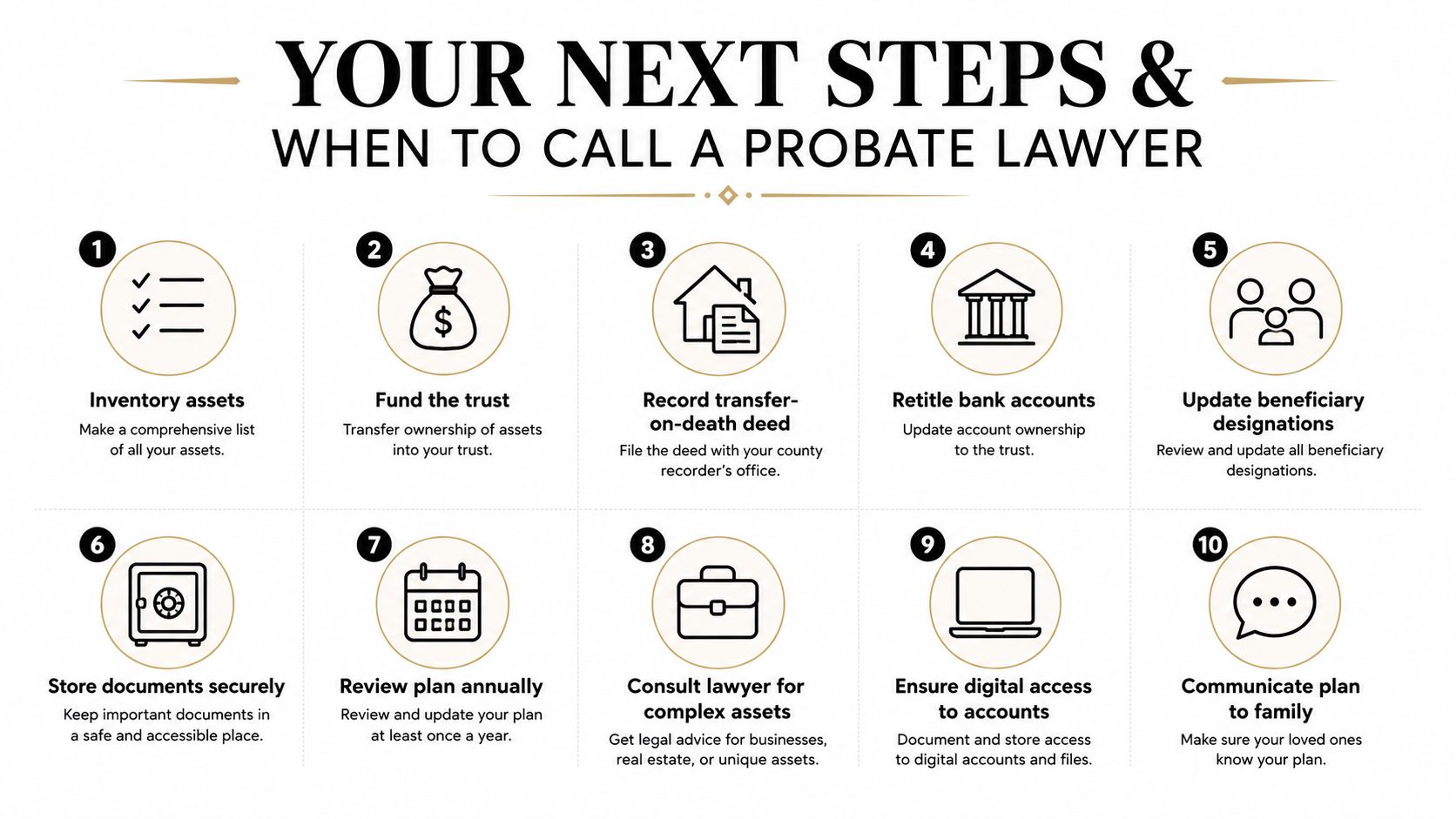
- Inventory assets by category and ownership.
- Fund the trust with the assets selected for trust ownership.
- Record the transfer-on-death deed with the Montgomery County Clerk when a TODD fits the property.
- Retitle bank accounts when trust ownership is appropriate.
- Update POD and TOD designations at every financial institution.
- Review retirement and insurance beneficiaries for consistency.
- Store original documents securely and tell the right person where they are.
- Review the plan regularly, especially after marriage, divorce, a death, a move, or a major purchase.
- Document the funding trail with recording information and institutional confirmations.
- Call a lawyer for complex assets rather than trying to repair a failed transfer after death.
A Woodlands couple used a revocable living trust for their primary assets, recorded a transfer-on-death deed for a remaining homestead, and placed POD designations on their bank accounts. One inherited brokerage account was never retitled and had no effective transfer designation, so the family still needed a small estate affidavit for that account. The plan worked for most of the estate because the couple matched tools to assets, but the unfunded account showed why a final inventory review matters.
Call a Montgomery County probate attorney promptly if the estate involves a blended family, out-of-state real property, business interests, adult children with creditor or divorce concerns, beneficiary forms that conflict with the will, or a plan drafted elsewhere and never funded. Those facts can change the correct tool and the required filing.
This guide provides general information, not legal advice. Texas estate plans depend on ownership records, family circumstances, tax considerations, and the exact language of each document.
The Law Office of Bryan Fagan helps families review wills, trusts, beneficiary designations, and probate issues in The Woodlands and Montgomery County. Visit The Law Office of Bryan Fagan to request a consultation about building your plan or repairing funding and recording gaps.