 Skip to content
A deputy is at your door in Creekside or Alden Bridge. A neighbor heard yelling. Someone called 911. You know the argument was loud, but now one person is outside talking to police, one person is inside shaking, and the next few minutes may decide where you sleep tonight, whether you can see your children this week, and whether a divorce or custody case suddenly becomes much harder.
That moment feels personal and chaotic. It also follows a pattern that Montgomery County courts see every day. In Montgomery County, where The Woodlands is located, family violence incident rates reached 803 incidents per 100,000 residents in 2024, according to Understanding Houston's domestic violence data for the Houston region. If you're dealing with this now, you're not the only family in The Woodlands facing a legal crisis that quickly spills from criminal court into family court.
People searching for a domestic violence defense lawyer in The Woodlands usually aren't only worried about a charge. They're worried about the house, the kids, the protective order, the school pickup, the divorce filing, and the text messages that suddenly look different when printed in a courtroom exhibit.
Answering the Door to a Life-Changing Accusation
A common local fact pattern is simple. Two spouses argue in a Creekside kitchen after weeks of strain. One blocks a doorway. One grabs a phone. Someone says, "Get away from me." A child hears crying. A 911 call follows. By the time deputies arrive, neither person feels heard, both are angry, and the police have to make quick decisions with incomplete information.
That doesn't mean the case is decided at the doorway.
It does mean your first job is to stop making it worse.
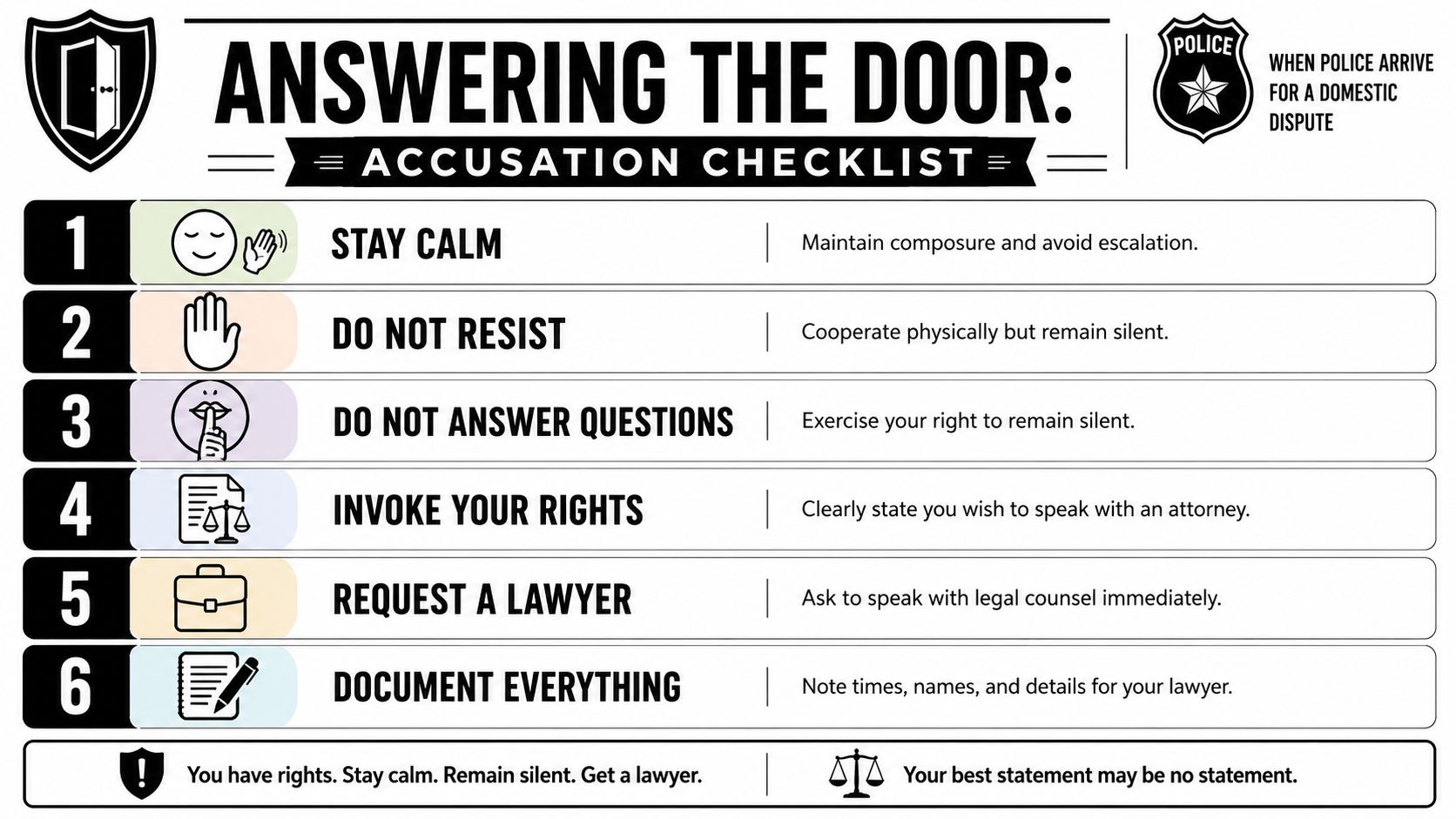
What police are looking for
Officers responding in The Woodlands usually arrive after hearing one side first. They assess visible injuries, statements, tone, damage inside the home, children present, prior calls, and whether anyone appears intoxicated or afraid. If firearms are in the home, that can change the urgency quickly. In Texas, domestic violence cases can carry penalties ranging from a Class C misdemeanor with a fine up to $500 to a first-degree felony with 5 to 99 years in prison and up to a $10,000 fine, as outlined in this Texas domestic violence penalties overview.
A lot of damage happens because a scared person talks too much.
Practical rule: Be polite. Be physically cooperative. Don't try to explain the whole relationship on the porch.
What helps and what hurts
What helps in those first minutes:
- Stay still and calm. Fast movements, stepping toward the other person, or trying to grab a phone can be described as aggressive.
- Identify yourself if asked. Basic identification is different from giving a statement.
- Ask for a lawyer if questioning starts. That is the cleanest way to stop a bad interview before it starts.
- Notice details. Which officers arrived, what time they got there, who was present, and whether neighbors or children overheard anything.
What hurts:
- Giving a “short explanation.” Individuals often believe they can talk their way out of an arrest. They usually talk their way into an exhibit.
- Trying to coach the other person. A whispered "tell them it was nothing" can become part of the narrative against you.
- Resisting handcuffs or arguing about fairness. That won't help at the scene.
- Sending texts after police leave. Even apologetic texts can be framed as admissions.
The path is narrow, but it exists
The first fear is usually, "My life is over." It isn't. But this is the point where strategy matters. The same accusation can lead to a criminal case, a protective order, emergency custody limits, exclusion from the home, and an advantage in a divorce filing.
The legal system in Montgomery County has a path. Your job is to move onto that path quickly, with discipline.
The fastest way to lose a defensible case is to treat it like a misunderstanding that just needs one more conversation.
Your First 24 Hours After a Domestic Violence Arrest
The first day after an arrest is about damage control. Not storytelling. Not fixing the relationship. Not persuading the complaining witness to "drop it." In many cases, that effort creates new evidence and new problems.
Say less than you want to say
If you're arrested, use your right to remain silent in a practical way. That means no interview in the patrol car, no venting at booking, no detailed jail calls, and no messages passed through relatives. Assume every statement can resurface.
Keep your communication limited to essentials. Name, identifying information, medical needs, and a clear request for counsel.
A short statement is enough: you want a lawyer, and you won't answer questions.
The magistrate hearing matters
Soon after arrest, you'll face an initial appearance before a magistrate. That hearing often addresses bond, release conditions, and whether an emergency order limits contact. People walk into that hearing thinking only about getting home. They should also be thinking about what conditions could affect their children, their residence, and their next family court hearing.
If divorce is already being discussed, it helps to understand how the civil timeline works in Montgomery County. A local resource like The Divorce Process in The Woodlands: What to Expect gives a step-by-step look at filing for divorce in The Woodlands and Montgomery County, which matters because domestic allegations often trigger that process faster than either spouse expected.
Mistakes families make on day one
Family members mean well. They often make the case worse.
- Calling the accuser repeatedly. That can violate release conditions or create claims of intimidation.
- Showing up at the house unannounced. If officers or the court have restricted access, this can cause a second arrest.
- Deleting messages or photos. That looks like destruction of evidence.
- Posting online. Social media turns emotion into permanent evidence.
- Using a child as a messenger. Family court judges notice this fast.
If a court has restricted contact, "but she texted me first" usually isn't the defense people think it is.
Think in two files, not one
In The Woodlands, one accusation often creates two separate battles. The criminal matter deals with the charge. The family matter deals with possession of the home, temporary orders, school routines, parenting time, and financial control.
Use the first day to gather, not argue. Make a timeline. Save photos. List witnesses. Preserve Ring footage, gate logs, call records, and receipts if they matter. Write down prior family court dates if there has already been a divorce, modification, or custody fight.
A defense lawyer needs clean facts early. Family counsel needs the same timeline for a different reason. Both courts may be looking at the same event through different legal standards.
Navigating Protective Orders and Court Hearings
For many people in Montgomery County, the protective order hearing is more disruptive than the arrest itself. The order can affect where you live, who you contact, whether you can possess firearms, and how you interact with your children before any criminal case is resolved.

What a protective order can do
Under Texas Family Code Chapter 8, a Montgomery County court can issue a protective order for family violence that can last up to two years and can prohibit contact with the alleged victim or possession of firearms, even without a criminal conviction, as described in this Montgomery County protective order overview.
That distinction matters. People often assume, "If I haven't been convicted, I can just go home." That's not how this works.
A temporary ex parte order may be entered first. That can happen quickly and with limited participation from the accused at the outset. Then comes the hearing on whether a longer final protective order should be entered.
What the hearing is really about
The hearing is not a casual conversation with the judge. It's a formal proceeding where the court hears testimony, reviews documents, and decides whether legal restrictions should continue.
Prepare for issues like these:
| Issue | Why it matters |
|---|---|
| Contact history | Calls, texts, and visits can be used to argue fear, harassment, or noncompliance |
| Living arrangements | The order may affect access to the home, clothing, medicine, and work items |
| Children | Parenting exchanges and temporary possession may need separate structure |
| Firearms | Restrictions can apply even before a criminal case is finished |
| Prior incidents | Older allegations may be raised to shape the court's view |
If you're trying to understand emergency family relief in this county, emergency family court orders in Montgomery County are part of the same practical reality.
What works before the hearing
Good preparation is boring. That's usually a good sign.
- Build a clean timeline. Dates, times, locations, and who was present.
- Preserve physical evidence. Photos, doorbell footage, damaged property, GPS records if relevant.
- Separate emotion from proof. "She's lying" is not evidence. Screenshots, videos, and third-party witnesses may be.
- Follow every temporary restriction. The court notices obedience as well as violations.
For families trying to understand the civil side of these cases, Protective Orders in The Woodlands covers protective orders in domestic violence and family safety matters.
Protective order hearings move fast. Judges often learn the case through the quality of the documents and the discipline of the testimony.
Texas family law doesn't treat these orders as symbolic. They can shape the next custody hearing, the terms of temporary orders, and the tone of the entire case.
How to Choose the Right Woodlands Defense Lawyer
Hiring the wrong lawyer in a domestic violence case usually shows up in two places. The criminal file gets a generic defense. The family file gets ignored until custody or possession of the home is already slipping away.
A strong domestic violence defense lawyer in The Woodlands needs more than courtroom confidence. The work is detail-heavy and local.

Ask what the lawyer actually does on the file
Effective domestic violence defense uses a forensic investigation methodology. That includes reviewing surveillance footage, forensic reports, and witness statements, then preparing cross-examination around intent, identity, or charge severity. The same source notes that costs average $2,500 based on hourly rates around $250, reflecting the work needed to challenge the State's case, according to Cowboy Law Group's discussion of assault defense work in The Woodlands.
That doesn't mean every case should cost the same. It does mean cheap, vague representation can be expensive later.
Ask direct questions:
- What records will you request first?
- Will you review video yourself?
- How do you handle witness inconsistencies?
- What do you do if there is also a divorce or custody case?
- Who prepares me for the first key hearing?
Local fit matters
Montgomery County practice has its own rhythm. Judges, prosecutors, probation expectations, family court schedules, and protective order practice all affect strategy. A lawyer unfamiliar with the local system may still be capable, but your case shouldn't be the place they learn county-specific habits.
One practical option for readers comparing legal services in this area is criminal defense representation in The Woodlands. The key is not branding. It's whether counsel can coordinate the criminal side with what is happening in family court.
A separate but useful clue is how a firm communicates online. Good legal websites usually make complex process easier to understand, which is why thoughtful resources on web development for legal practices can help people see what clear client communication looks like before they ever make a call.
Watch how they explain trade-offs
A good consultation should include choices, not slogans.
For example, a lawyer should be able to explain the difference between:
- fighting the accusation head-on,
- limiting statements while gathering contradictory evidence,
- contesting protective restrictions separately,
- and preparing for the family court consequences even if the criminal file moves slowly.
A serious consultation doesn't just answer, "Can you win?" It answers, "What will this affect next month if we do nothing today?"
The best fit is usually the lawyer who listens carefully, spots the hidden family-law risk, and gives you a concrete first-week plan.
The Overlap with Divorce and Child Custody Battles
Many generic defense articles stop their discussion too early. In Montgomery County, the allegation doesn't stay inside the criminal file. It moves into divorce pleadings, temporary orders, parenting disputes, exclusive use of the residence, and arguments about who should make decisions for the children.
In The Woodlands, family law attorneys often see domestic violence allegations used in divorce, and abuse can be grounds for immediate temporary custody modifications under Texas Family Code Section 153.002, as noted in this Montgomery County family law reference.
How the accusation changes a custody case
Family courts focus on the child's best interest. Under Section 153.002, that standard drives custody decisions. A domestic violence allegation, even before final resolution elsewhere, can change how a judge evaluates safety, exchanges, overnight time, and temporary conservatorship.
That can mean:
- one parent seeks temporary restrictions immediately,
- the other parent is pushed into supervised exchanges,
- school pickup becomes disputed,
- and ordinary parenting communication starts being documented like trial evidence.
If children are old enough to notice the conflict, parents also need to think about how they talk about the case at home. A neutral mental-health resource like this compassionate guide for discussing divorce can help parents avoid putting adult fear onto children while the legal process unfolds.
A short real-world scenario
A parent in Sterling Ridge gets arrested after a heated argument. No final finding has been made yet. Within days, the other spouse files for temporary orders in family court, asks for exclusive use of the residence, and argues that the children shouldn't return to the prior routine. The criminal lawyer focuses on bond conditions. The family lawyer focuses on possession and conservatorship. If those two strategies don't line up, the accused parent may comply with one court while damaging position in the other.
That's why integrated planning matters.
What integrated planning looks like
The family-law side of the case should account for:
| Family issue | Why early strategy matters |
|---|---|
| Temporary custody | A rushed hearing can set the tone for months |
| Exclusive use of the home | Moving out can become a practical custody disadvantage |
| Protective order terms | These can affect exchanges, communication, and firearms |
| Children's routines | School, activities, and medical access often become disputed fast |
For parents trying to understand how judges weigh these questions, how Texas judges decide child custody is a useful starting point.
This is the point where a family-focused firm such as The Law Office of Bryan Fagan may fit some cases. The firm handles divorce, child custody, child support, property division, and probate matters in The Woodlands and Montgomery County. In a domestic allegation that also threatens custody or temporary orders, that kind of family-court focus can matter as much as the charge itself.
The criminal case asks what can be proved. The family case asks what arrangement the judge believes is safest for the child right now. Those are different questions.
If your spouse is already talking to a divorce lawyer, assume the allegation may be used in both courtrooms.
Your Action Plan and What Comes Next
The first goal is control. The second is coordination. You don't need to solve the entire case this week, but you do need to stop avoidable damage.
What to do next
- Stay silent about the facts of the incident. Don't give police, family members, or friends a running explanation.
- Follow every release condition and court order. If a judge says no contact or stay away, treat that as absolute unless the court changes it.
- Preserve evidence early. Save texts, call logs, photos, videos, receipts, and names of witnesses.
- Map the family-law risk. Ask whether a divorce, custody modification, or emergency request is likely.
- Prepare for the first hearings, not just trial. Protective orders and temporary family orders often affect daily life sooner than the criminal case does.
- Ask about structured alternatives when appropriate. The Montgomery County Domestic Violence Court program offers a path to dismissal through a 12 to 24 month treatment plan, and since 2017 it has had a 0% recidivism rate among graduates, according to the Texas District and County Attorneys Association's report on the Montgomery County Domestic Violence Court.
Keep your focus on the practical consequences
Individuals often feel pulled toward one emotional question: "How do I make the accusation go away?" A better question is: "What do I need to do today so this doesn't cost me my parenting time, my housing, or my credibility in court?"
Write down deadlines. Keep a folder. Don't improvise contact with the other side. Don't assume family court will wait for the criminal case to sort itself out.
This article is not legal advice. Domestic violence allegations in The Woodlands and Montgomery County turn on specific facts, specific court orders, and the interaction between criminal and family law.
If you're facing a domestic violence allegation in The Woodlands and you're worried about how it could affect divorce, custody, or protective orders in Montgomery County, you can schedule a confidential consultation with The Law Office of Bryan Fagan to discuss your situation and the next practical steps.
