 Skip to content
If you're reading this after a call, letter, or visit from CPS, you're probably scared and trying to figure out what one wrong move could cost you. That reaction is normal. Parents in The Woodlands often reach out in the first hours after contact because they don't know whether they should open the door, answer questions, sign papers, or let a caseworker speak to their child.
A CPS case is not just an uncomfortable conversation. In Texas, it can become a fast-moving legal process under the Texas Family Code, and the early decisions matter. In Montgomery County, local court practice in Conroe can shape how quickly a case escalates, how temporary restrictions are handled, and how much damage gets done before a parent realizes the case is already in motion.
That Unexpected Knock What Happens When CPS Contacts You
A parent in Alden Bridge hears a knock in the late afternoon. A CPS investigator is standing at the door, says a report was made, and asks to come inside. The parent is stunned. The house is messy, dinner isn't ready, the kids are tired, and the investigator starts asking questions that sound casual but aren't.
That first contact throws people off because it feels informal. It isn't. What you say in that moment can shape the written record that follows you into court if the case moves that far.

In The Woodlands, CPS cases often intersect with custody disputes, temporary family instability, school reports, medical misunderstandings, and high-conflict separations. Sometimes the report is serious. Sometimes it's exaggerated. Sometimes it's flatly false. Your job in the first contact is not to win an argument at the front door. Your job is to avoid making the case worse.
What that first contact usually looks like
A caseworker may ask to:
- Enter your home to look around
- Interview your child or children
- Ask about discipline, supervision, or substance use
- Request records or names of relatives
- Suggest a safety plan that sounds temporary but has major consequences
Parents often think cooperation means answering everything immediately. That's not always true. Strategic cooperation is different from unguarded cooperation.
Practical rule: Be calm, be polite, and slow the interaction down.
If there is already a parallel custody emergency, local families sometimes also need to understand how emergency orders work in family court. A basic overview of emergency custody orders in The Woodlands can help you see how quickly family court issues can overlap with a CPS investigation.
What actually helps in the first hours
Three things tend to help right away.
First, get the investigator's name, agency information, and callback number.
Second, don't start explaining everything in a panic. Rambling hurts parents more than silence.
Third, talk to a lawyer before you sign anything or agree to major restrictions involving your children, your home, or where you can stay.
The CPS Investigation Timeline in Montgomery County
The first week is usually the hardest. A parent in The Woodlands gets a call or a knock, tries to answer politely, and assumes there will be time to sort things out later. In Montgomery County, later comes fast. If CPS believes the child is unsafe, the case can shift from an investigation at your home to a hearing in Conroe in a matter of days.
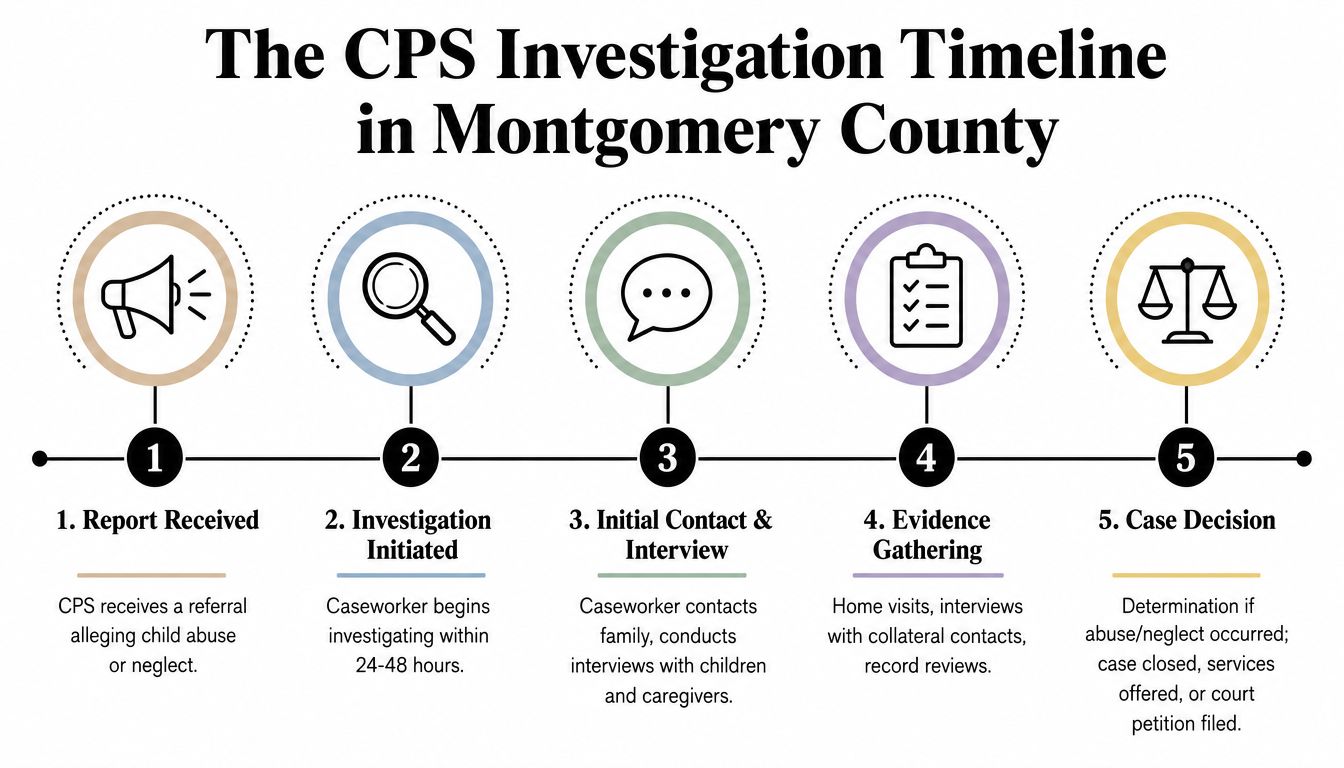
The calendar matters, but local practice matters too. Montgomery County judges usually want specifics early. They want to know where the child will sleep, who can supervise, what relatives are realistic, whether school can stay stable, and whether the parent has started addressing the stated concern. Parents who show up with a workable plan are in a better position than parents who promise to "figure it out."
How the process usually unfolds
A CPS case often starts subtly, then speeds up.
First, a report is made. That report may come from a school, hospital, neighbor, relative, or the other parent in a custody dispute.
Next, an investigator is assigned. The investigator may call first, appear unannounced, contact your child's school, or ask to speak with collateral witnesses before you understand how serious the allegation is.
Then CPS starts building its file. That can include interviews, photographs, medical records, school information, drug testing requests, and background checks on adults in the home. If there is an allegation involving drug use, assault, or another potential offense, parents should be especially careful about statements that can create both a CPS problem and a criminal one. In that situation, local families often need advice that accounts for both risks, including from a criminal defense lawyer in The Woodlands.
After that, CPS decides whether to close the case, propose a safety plan, refer the family for services, or ask the court for orders. If the agency seeks removal or court supervision, the deadline pressure changes immediately.
The deadlines that shape the case
Texas law sets the framework for child protection cases, including dismissal deadlines and permanency settings under the Texas Family Code provisions on child protection proceedings. In practice, the milestones parents feel first are the ones tied to removal and early court review.
| Phase | Typical Deadline | What It Means for Parents |
|---|---|---|
| Emergency removal review | Next business day after emergency removal | CPS must explain why immediate action was taken |
| Adversary hearing | Within 14 days | The judge decides whether the child remains in state custody |
| Permanency hearing | About 180 days into the case | The court reviews placement, services, and progress |
| Final trial setting | Around the one-year dismissal date | The case must be resolved unless the court extends it under the statute |
Those deadlines are not abstract. They control how much time you have to gather records, identify relatives, challenge bad assumptions, and present a stable alternative to foster care.
What Montgomery County parents should expect
For families in Panther Creek, Grogan's Mill, Sterling Ridge, Alden Bridge, or Creekside, the case often moves from your kitchen table to a courtroom in Conroe very quickly. That change catches parents off guard. They focus on the accusation and miss the practical questions the court will ask first.
Montgomery County courts often respond well to organized, documented proposals. A vague promise from a friend or relative usually carries less weight than a relative who is identified early, available, has a clean background, and can explain housing arrangements clearly. The same is true for counseling, substance abuse treatment, or medical follow-up. Starting late can make a parent look resistant, even when the delay came from panic or confusion.
Parents searching for a CPS Defense Attorney in The Woodlands usually need help with that early case framing as much as they need courtroom advocacy. The right first steps can affect placement, visitation, and how credible your side looks at the first serious hearing.
Bring a written timeline, names and contact information for safe relatives, school records, medical information, prescription details, and any existing custody orders to every early hearing or attorney meeting.
One more local point matters. In Montgomery County, judges often pay close attention to whether a parent can follow instructions consistently. Missed drug tests, incomplete paperwork, changing stories, or angry messages to the investigator can do real damage early. Calm, organized follow-through helps more than emotional explanations.
Know Your Rights When Facing CPS
Parents often feel like they have no rights once CPS appears. That's wrong. You do have rights, but they only protect you if you understand them and use them carefully.
One of the most important principles is that a CPS investigation does not erase constitutional protections. A specialized Texas CPS defense lawyer is often focused on exactly that issue, including whether CPS complied with rules around searches and timing.
Rights that matter at the doorstep
You generally have the right to be careful about what you say.
You generally have the right to ask to speak with an attorney before answering detailed questions.
You generally have the right to refuse consent to a home search unless CPS has lawful authority to enter. The Fourth Amendment issue matters because the legality of a search can become a major point later in the case. A discussion of the difference between a family lawyer and a CPS defense lawyer highlights that point, including warrant or consent issues and the strict statutory deadlines CPS cases involve under the Texas Family Code.
You also have the right to read before signing. Parents get into trouble when they sign "temporary" agreements they don't understand.
Emergency Protective Orders change the ground rules
In Montgomery County, courts often issue Emergency Protective Orders that can force a parent out of the home and away from the children before a full trial. Those orders are frequently tied to alleged abuse or neglect investigations involving CPS, as explained in this overview of Emergency Protective Orders in The Woodlands area cases.
That means a parent may think, "I'll explain this later," only to learn later has already been restricted by court order.
If a judge signs an order that limits contact, treat it as active and serious immediately. Violating it can make a bad case worse.
Family rights can expand beyond parents
Sometimes a grandparent becomes part of the solution. In some cases, a temporary family placement is more realistic than a direct fight over every issue in the first week. For families considering that option, Grandparents' Rights in The Woodlands addresses custody and visitation rights for grandparents in Montgomery County.
If your case has overlapping allegations outside family court, understand the boundaries and get case-specific advice. Some parents also look for information about a criminal defense lawyer in The Woodlands when allegations spill into another court system, but the CPS case still has its own deadlines, evidentiary issues, and family court consequences.
What doesn't work
These responses usually backfire:
- Arguing at length on the porch because you think you can clear it up in five minutes
- Letting embarrassment drive the conversation so you start admitting things loosely or inaccurately
- Signing a safety plan just to end the visit
- Coaching your child before an interview
The strongest position is calm, documented, and legally guided.
How a CPS Defense Lawyer Protects Your Family
By the time many parents call a lawyer, CPS has already interviewed one witness, requested records, and started building a narrative. In Montgomery County, that early narrative matters. Judges often want a clear safety plan, a realistic relative option, and proof that a parent can follow instructions without more conflict.

A CPS defense lawyer protects your family by controlling the case before CPS defines it for you. This work is different from ordinary custody litigation. Removal cases, temporary orders, family placements, service plans, and fast court settings require focused attention to procedure and proof.
What a lawyer is doing behind the scenes
First, counsel slows down harmful communication. Parents under stress often overexplain, guess at dates, argue with the investigator, or send long texts trying to fix the situation. Those statements usually become part of the file. A lawyer cuts that off and helps you answer in a way that is accurate, limited, and documented.
Counsel also gets to work on the facts quickly. That can mean collecting school attendance records, pediatric records, counseling notes, photographs, text messages, and names of adults who know what happened in the home. In many Montgomery County cases, clean records and organized timelines carry more weight than emotional denials.
Then there is court strategy.
A good CPS lawyer does not walk into a Montgomery County courtroom with general objections and broad complaints about unfair treatment. The better approach is specific. What allegation is unsupported? What safety concern can be addressed now? Which relative is appropriate for placement? What condition in the proposed service plan is unrelated to the accusation? Judges usually respond better to a parent who presents practical solutions than to a parent who insists CPS is lying about everything.
Local practice matters in Montgomery County
Local court familiarity helps because procedures may be statewide, but judges are not interchangeable. In Montgomery County, presentation matters. Relative placements usually need to be ready, not theoretical. Proposed caregivers should be identified early, understand what CPS will ask of them, and be prepared for background checks, home review, and direct questions about the child's routine.
Service plans also need careful review. Some tasks are sensible and tied to the allegation. Some are broad enough to create future compliance problems without improving your position in court. A lawyer's job is to separate the two and press for terms that match the actual risk alleged in the case.
That trade-off is real. Sometimes the fastest path to getting more possession or avoiding removal is temporary cooperation on a narrow issue. Sometimes agreeing too quickly creates admissions or expectations that are hard to undo. Good defense work means knowing when to push, when to document compliance, and when to keep the fight focused on one point the judge can rule on.
The lawyer's role is part shield, part organizer, part trial counsel
Expect your lawyer to do at least three things well:
- Protect your words: limit avoidable admissions, vague explanations, and inconsistent statements
- Build a usable record: gather records, screen witnesses, organize exhibits, and prepare you for what the court will ask
- Challenge overreach: object to weak inferences, inflated safety concerns, and service plan demands that do not fit the facts
If you are helping organize large files from schools, doctors, therapists, or prior court matters, PDF AI's legal researcher can help sort long records and locate dates, names, and treatment references faster. It does not replace legal judgment, but it can save time when a hearing is close and the paperwork is heavy.
A short video can also help some parents understand how quickly these cases move in practice.
Why this can change the outcome
In CPS court, the first workable plan often gets the court's attention. If your side presents stable housing records, a suitable relative, negative drug test results when relevant, school information, and a parent who is prepared and careful, the judge has something concrete to act on. If your side shows up angry, disorganized, and still arguing with the investigator, CPS keeps control of the story.
That is why focused defense counsel matters. The Law Office of Bryan Fagan handles family law matters in The Woodlands and Montgomery County, including cases where CPS issues affect custody, property division, and parental rights. For parents facing CPS, the practical question is not whether the situation feels unfair. It is how quickly the case can be documented, narrowed, and presented in a way the local court will trust.
What to Do Next A Step-by-Step Checklist
A teacher in The Woodlands overhears a child describe a bruise after a weekend exchange. The story is incomplete, but the report gets made. By the next day, a parent is fielding calls from CPS, texting relatives in a panic, and considering whether to send a long message "explaining everything."
That long message usually makes things worse.
The better response is controlled, documented, and boring. Boring is good in a CPS case. Boring means you aren't creating new problems while trying to solve the first one.
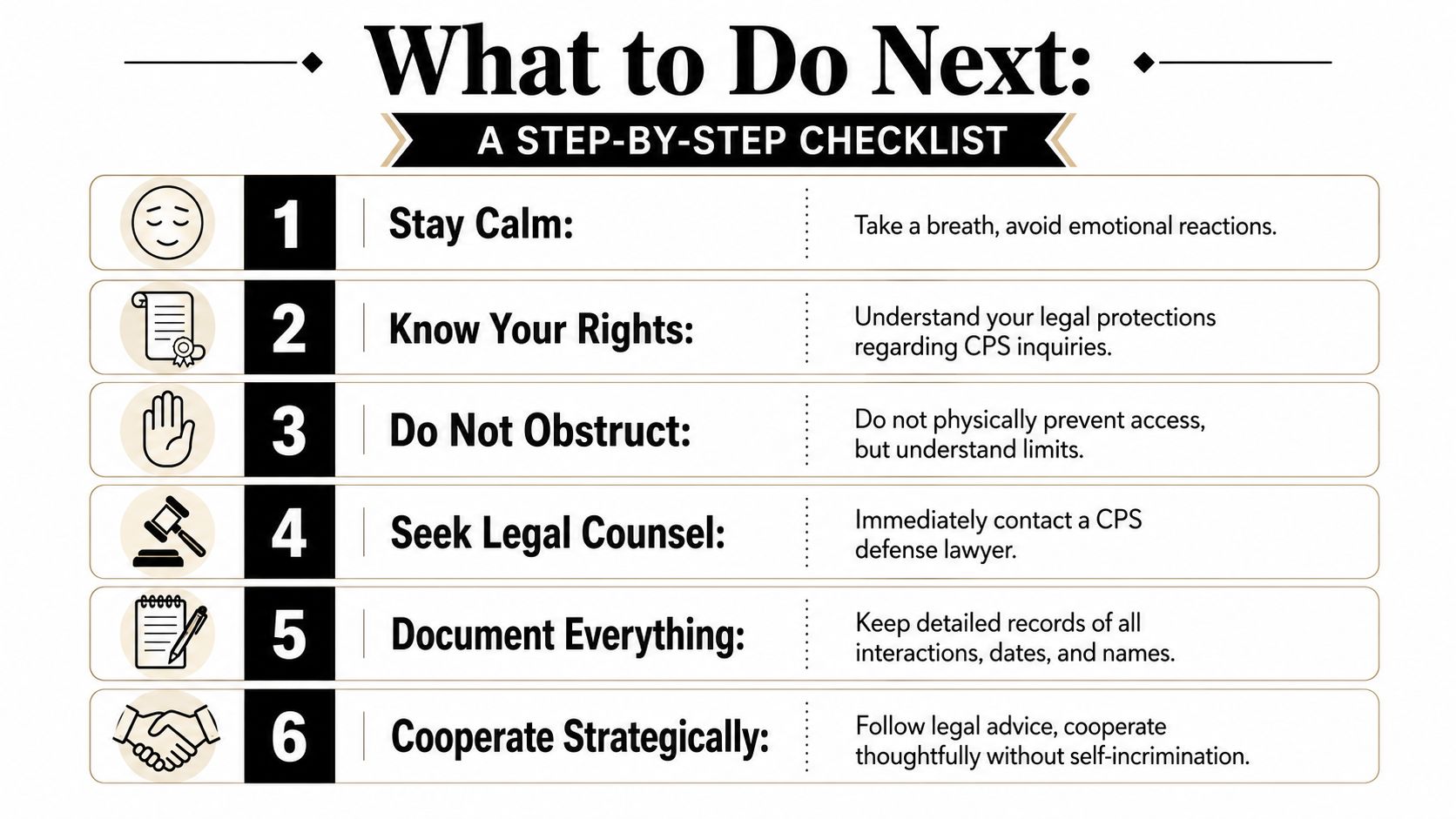
What to do next
- Stay calm first: Take a breath before you answer a question, sign a paper, or invite anyone inside. Panic produces bad statements.
- Get identifying information: Write down the caseworker's full name, office, phone number, and what they said the allegation involves.
- Don't physically obstruct: You don't want a tense scene at your home. Stay polite even when you're declining immediate questioning.
- Ask for time to speak with counsel: You don't need to perform innocence on demand.
- Start a case log: Keep dates, times, who called, what was requested, and what documents were mentioned.
- Preserve records now: Save texts, school messages, medical records, photos, and prior custody orders.
- Identify safe relatives: If temporary placement becomes an issue, judges want workable family options fast.
- Follow legal advice closely: Consistency matters more than dramatic gestures.
Write everything down the same day. Memory changes under stress, and your notes may help your lawyer correct the record early.
Medical and school records can matter quickly
If an allegation touches a child's health, injury, medication, or developmental needs, organized records can help your lawyer respond with facts instead of guesswork. Parents who already track appointments sometimes find it easier to seamlessly share data with your doctor and gather a clearer treatment history when questions about a child's condition arise.
A short checklist for the next 24 hours
- Call a CPS defense lawyer in The Woodlands, TX.
- Stop discussing the case with the reporting party, your ex, or extended family in text.
- Pull key documents into one folder.
- List every adult in the child's household and regular care circle.
- Review existing family court orders.
- Prepare for the possibility of a hearing in Montgomery County.
The Texas Family Code won't calm your nerves, but it does remind parents of something important. These cases run through legal standards, court orders, and evidence. That means there are rules, and rules create places to defend yourself.
Finding the Best CPS Lawyer in The Woodlands for Your Case
The right lawyer can change the direction of a CPS case in the first few days. In Montgomery County, that usually means someone who knows how local courts in Conroe handle emergency settings, how quickly CPS pushes for service plans, and what influences judges here. A general family lawyer may be good in a divorce or modification and still be the wrong fit for a CPS investigation.
Procedure decides a lot in these cases. Parents lose ground when no one gets records in front of CPS early, no one prepares them for interviews, or no one frames the case correctly before the first hearing. Good facts still matter, but facts presented late or badly can get ignored.
What to compare between lawyers
Use the consultation to test experience, not personality.
| What to Ask | Why It Matters |
|---|---|
| How much of your practice involves CPS defense, specifically? | CPS cases move on shorter deadlines than ordinary custody disputes |
| How often are you in Montgomery County courts in Conroe? | Local practice habits matter, especially on emergency hearings and temporary orders |
| What is your approach at the adversary hearing if removal is on the table? | That hearing often sets the tone for placement, visitation, and the court's first impression of the parent |
| How do you prepare clients for CPS interviews, home visits, and service plan negotiations? | Poor preparation creates statements and paperwork problems that follow the case for months |
| How do you use school, medical, counseling, and third-party records? | Judges and caseworkers usually respond better to organized proof than broad denials |
Ask follow-up questions if the answer sounds polished but thin. A lawyer who really handles these cases can usually explain how Montgomery County judges differ in pacing, proof, and expectations for parent progress.
Questions worth asking out loud
Some questions should be direct.
- Have you handled CPS matters involving families from The Woodlands, including Creekside, Panther Creek, Alden Bridge, or Sterling Ridge?
- What problems do you see most often in Montgomery County adversary hearings?
- How do you present a relative or family friend as a realistic placement option to this court?
- If there is already a SAPCR, divorce, or modification pending, how do you coordinate the CPS case with that file?
- What do you need from me in the first 72 hours to protect my position?
If the lawyer stays general, keep looking.
Montgomery County experience matters for a reason
Parents in The Woodlands often assume CPS practice is the same everywhere in Texas. It is not. Local judges notice whether a parent followed temporary orders, showed up prepared, and brought usable documentation instead of explanations. They also tend to focus quickly on stability. Who lives in the home, who can supervise, where the child will sleep, how school attendance will continue, and whether a proposed caregiver will answer the phone when CPS calls.
That local piece gets even more important if your CPS case overlaps with an existing custody dispute. Existing orders, standing orders, and prior filings can affect what the court sees as credible or risky. Parents dealing with both issues should understand how custody representation in Montgomery County can intersect with a CPS defense strategy.
Some families also have support issues tied to the case. Child Support Attorney in The Woodlands addresses establishing, modifying, and enforcing child support in Montgomery County, which can become relevant if a child is placed outside the home or the household changes during the investigation.
One practical screening clue
Pay attention to how the office communicates before you hire them. Do they explain the process clearly? Do they tell you what documents to gather, who will attend the hearing, and what the next deadline is? Calm, precise communication usually reflects better case handling.
A law firm's website or intake process is not proof of courtroom skill. Still, clarity matters, and some firms study effective digital marketing for law firms because clear public communication helps clients understand what to expect. In a CPS case, that same clarity can help a frightened parent make better decisions fast.
Common Questions about Texas CPS Investigations
Can CPS allegations be used against me in my divorce
Yes. In Montgomery County, a CPS report can quickly affect temporary orders, possession terms, and the judge's view of risk to the child, even before CPS finishes its investigation.
That is why parents in The Woodlands should treat the CPS case and the divorce case as one strategy problem, not two separate files. If there is already a SAPCR, divorce, or modification pending, your lawyer needs to know which court is handling it, what temporary orders are in place, and whether any prior allegations have been made. Judges in Montgomery County often focus less on who sounds more upset and more on who brought records, followed court orders, and can show a stable plan for the child.
Some families also need guidance from a Divorce Lawyer in The Woodlands, TX when the CPS issue is tied to a pending divorce.
What if the allegations are false
False allegations happen, especially during breakups and custody fights. The response still has to be careful.
Start collecting documents right away. School attendance records, pediatric records, counseling records, text messages, call logs, photographs of the home, and names of adults who have seen you parent can all matter. Keep the records organized by date. In court, a clean timeline usually helps more than a long explanation.
Do not coach your child, contact the reporting party in anger, or flood the investigator with scattered messages. In Montgomery County cases, those reactions often create new problems that distract from the weak allegation itself.
How much does a CPS defense lawyer cost
Fees depend on the stage of the case. An investigation with no court filing usually costs less than a case involving an adversary hearing, temporary orders, service plans, or repeated status hearings.
Ask how the lawyer bills. Some use an initial retainer and hourly billing. Some break work into phases. The better question is often what early representation may prevent. A missed hearing, a bad interview, or an avoidable removal can make the case much more expensive later, both financially and in terms of custody risk.
Should I just cooperate fully and hope it goes away
Cooperate with purpose. Answer required questions truthfully, show up on time, and keep your home in good condition. Do not guess, volunteer extra allegations, or sign documents you do not understand.
A practical example helps. If CPS asks for a drug test, the timing, method, and paperwork matter. If CPS asks to interview your child at school, the answer may depend on the stage of the case and whether a court order is already involved. Those are judgment calls. They should be made with local counsel who knows how Montgomery County courts usually react when a parent refuses, agrees, or asks for limits.
Is this legal advice
No. This article is for informational purposes only and is not legal advice. CPS cases are fact-specific, judge-specific, and deadline-driven. A smart move in one Montgomery County courtroom can backfire in another.
If CPS has contacted your family in The Woodlands or anywhere in Montgomery County, a calm consultation can help you understand the timeline, the local court issues, and the next protective step. You can schedule a consultation with The Law Office of Bryan Fagan to discuss your situation privately.
