 Skip to content
A normal errand in The Woodlands can turn ugly fast. You stop at Market Street or The Woodlands Mall, answer a text, juggle bags, and walk toward the exit. A store employee steps in front of you and says you took something. Minutes later, you're in a back office, shaken, embarrassed, and trying to explain yourself.
That moment feels surreal. An individual typically isn't thinking about criminal law when they leave the house. They're thinking about dinner, kids, work, or getting home before traffic picks up on I-45. Then a theft accusation lands, and suddenly you're worried about jail, fines, your job, and whether this will follow you for years.
If you're looking for a theft charge lawyer in The Woodlands, start with one rule. Take the charge seriously now. Minor theft cases in Montgomery County can move quickly, and the wrong first move can make a manageable case much harder.
A Theft Accusation in The Woodlands Can Happen to Anyone
A theft case in The Woodlands often starts in an ordinary place. The Woodlands Mall. Market Street. A grocery self-checkout line. One distracted moment, one bad assumption by store staff, or one poor decision, and you are suddenly dealing with police, store reports, and the risk of a criminal record.

A common local scenario
You leave a store in Town Center with bags in hand and your phone buzzing. A loss prevention officer stops you and says you hid merchandise or failed to scan an item. You try to explain. By the time Montgomery County deputies or local police arrive, your explanation is competing with a written statement, surveillance footage, and a store employee who already decided what happened.
That is how many theft cases begin here. Regular people get accused. Some made a mistake. Some exercised bad judgment. Some are innocent and talk too much in the first ten minutes.
Practical rule: If store staff or police accuse you of theft, stop explaining and start protecting yourself. Panicked statements often end up in the offense report.
Why local procedure matters
The charge is based on Texas law, but the outcome is shaped locally. Montgomery County prosecutors look closely at intent, prior history, store evidence, and how the first contact with police went. Local judges also have their own expectations about who is a good candidate for a first-time offender program, who needs tighter bond conditions, and who is making the case worse by talking.
That local piece is what statewide guides usually miss. A first-offense retail theft case in The Woodlands is not handled in the abstract. It is handled by specific prosecutors, in specific courts, with local practices that affect whether a case can be reduced, diverted, or pushed toward trial.
A theft accusation can also spill into the rest of your life fast.
If you are in a custody dispute, the other side may use the arrest or conviction as evidence of poor judgment under the Texas Family Code, especially if they are fighting over conservatorship, visitation, or temporary orders. If the accusation involves a family member, a caregiver, or property tied to an estate, the dispute can also affect probate proceedings under the Texas Estates Code. In Montgomery County, that means your criminal case may start influencing decisions in family or probate court long before the theft case is finished.
Treat the accusation seriously from day one. In this county, early decisions matter.
Understanding Texas Theft Charges and Penalties
In The Woodlands, a theft case often starts with one bad moment and then turns into a fight over details. The item value, what store staff say they saw, whether you allegedly passed all points of sale, and what you said afterward can all affect the charge.
Texas uses a value-based system. The State still has to prove intent to deprive the owner of the property under Texas Penal Code Chapter 31, but the dollar amount usually sets the charge level and the possible punishment. That is the starting point.
Use this statewide framework first. Then look at how Montgomery County handles real cases.
| Texas Theft Charges by Property Value | Charge Level | Potential Confinement | Maximum Fine |
|---|---|---|---|
| Less than $100 | Class C misdemeanor | Fine only | Up to $500 |
| $100 to less than $750 | Class B misdemeanor | Up to 180 days in jail | Up to $2,000 |
| $750 to less than $2,500 | Class A misdemeanor | Up to 1 year in jail | Up to $4,000 |
| $2,500 to less than $30,000 | State jail felony | 180 days to 2 years in state jail | Up to $10,000 |
| $30,000 to less than $150,000 | Third-degree felony | 2 to 10 years in prison | Up to $10,000 |
| $150,000 to less than $300,000 | Second-degree felony | 2 to 20 years in prison | Up to $10,000 |
| $300,000 or more | First-degree felony | 5 to 99 years or life in prison | Up to $10,000 |
The statewide ranges above match the general Texas theft categories summarized in this overview of theft and shoplifting penalties and this Conroe-area criminal defense page.
The number on the receipt is not always the final number in court. In Montgomery County, prosecutors regularly focus on whether the alleged value can be proven cleanly through store records, inventory data, witness testimony, or recovered property. That matters because a value dispute can mean the difference between a misdemeanor and a felony, or between a case that qualifies for a local first-offender option and one that does not.
Intent is the other fight.
A person does not become guilty of theft just because an item left a store or ended up in the wrong place. Cases often turn on mistake, lack of intent, ownership disputes, consent, bad identification, or weak proof that the accused intended to keep the property. In local courtrooms, those facts matter more than broad online summaries of Texas law.
Local reality in Montgomery County
Judges and prosecutors in Montgomery County do not treat every first-time theft arrest the same way. For lower-level cases, they look closely at criminal history, the store's evidence, restitution, and how the accused presents in court. Some first offenders are better candidates for a program that avoids a final conviction. Others are not, especially if the report claims deception, prior similar conduct, or facts that make the case look less like an isolated lapse.
That is why I tell Woodlands residents to stop guessing based on the charge label alone. A Class B or Class A case may still be very defensible. A felony filing may still have a value problem, an intent problem, or a witness problem that changes the direction of the case.
One more point. Theft charges can be enhanced or filed more seriously when the facts include aggravating conduct, prior history, or allegations tied to how the property was taken. Do not assume a retail theft arrest is automatically minor or automatically hopeless. Neither is true.
Your First 24 Hours What to Do Immediately After an Arrest
The first day's importance is often underestimated. Your job isn't to persuade police that you're a good person. Your job is to avoid making the case worse.
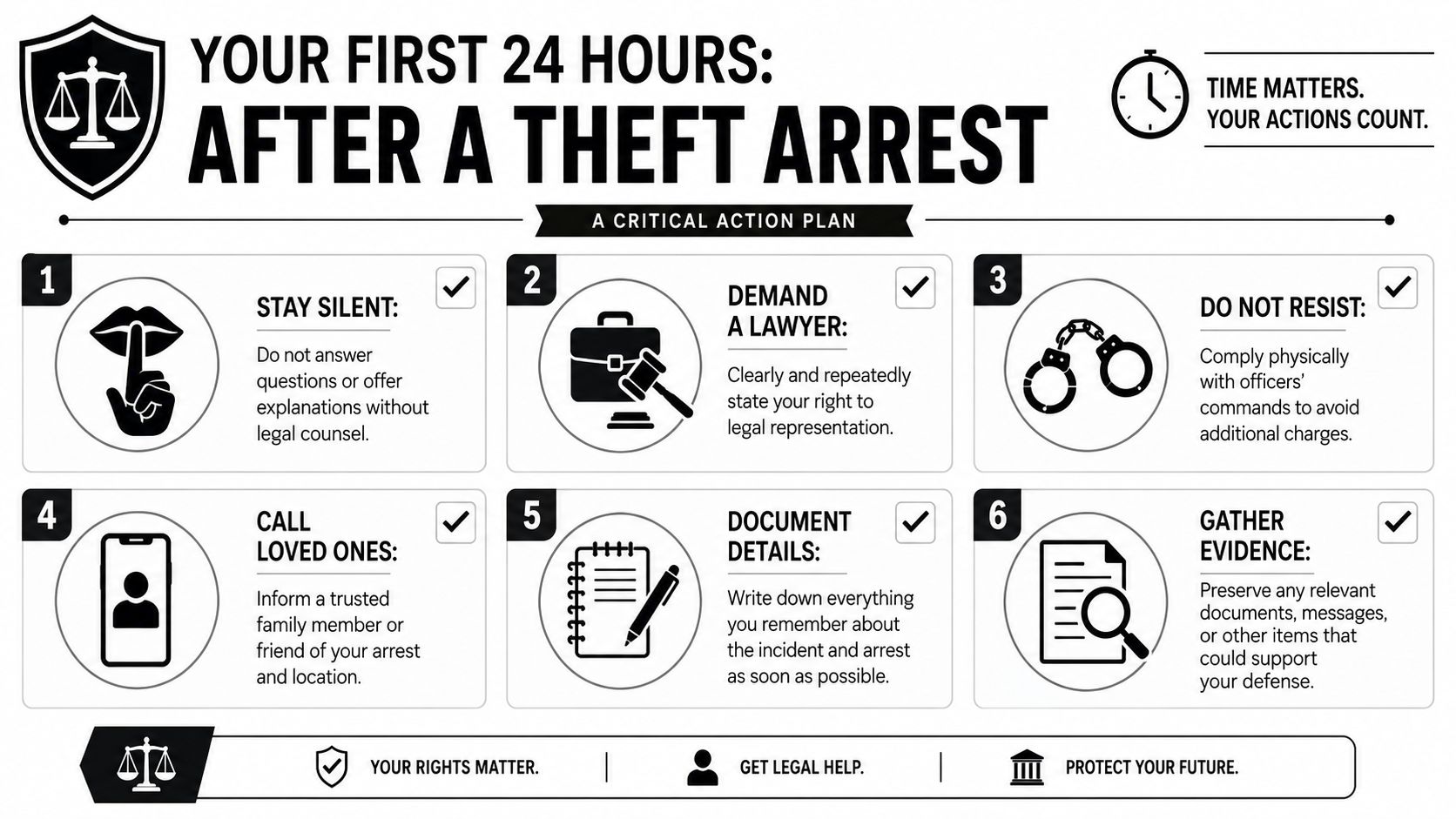
What to do next
- Stay silent: Don't answer questions about what happened. Don't explain. Don't guess. If police want a statement, say you want a lawyer.
- Ask for counsel clearly: Use simple words. “I want a lawyer.” Then stop talking.
- Don't resist: Even if the arrest feels unfair, physical resistance only creates new problems.
- Call one trusted person: Let a family member or close friend know where you are and that you need help arranging counsel.
- Write down the facts later: As soon as you're able, note what happened in order. Time, place, who said what, what you were carrying, and who was present.
- Preserve records: Save receipts, text messages, loyalty app activity, or anything else that may support your explanation.
A short visual summary can help when your head is spinning.
What not to do
People get themselves in trouble by trying to sound cooperative. They talk to store security, then repeat a slightly different version to police, then text friends about it. Now there are multiple statements to compare.
Don't post on social media. Don't call coworkers to “clear it up.” Don't contact the complaining witness. If the accusation involves a spouse, child, or inherited property dispute, remember that statements can also affect related issues under the Texas Family Code or Texas Estates Code.
Say less. The State still has to prove the case. You don't need to help them do it.
The first call should be local
A lawyer who handles Montgomery County criminal cases can start evaluating the report, the store video issue, witness credibility, and whether the allegation supports criminal intent. That's different from generic online advice written for all of Texas.
Navigating the Montgomery County Court System
Montgomery County cases have their own pace and pressure points. Most readers in The Woodlands care about one practical question. What happens after the arrest?
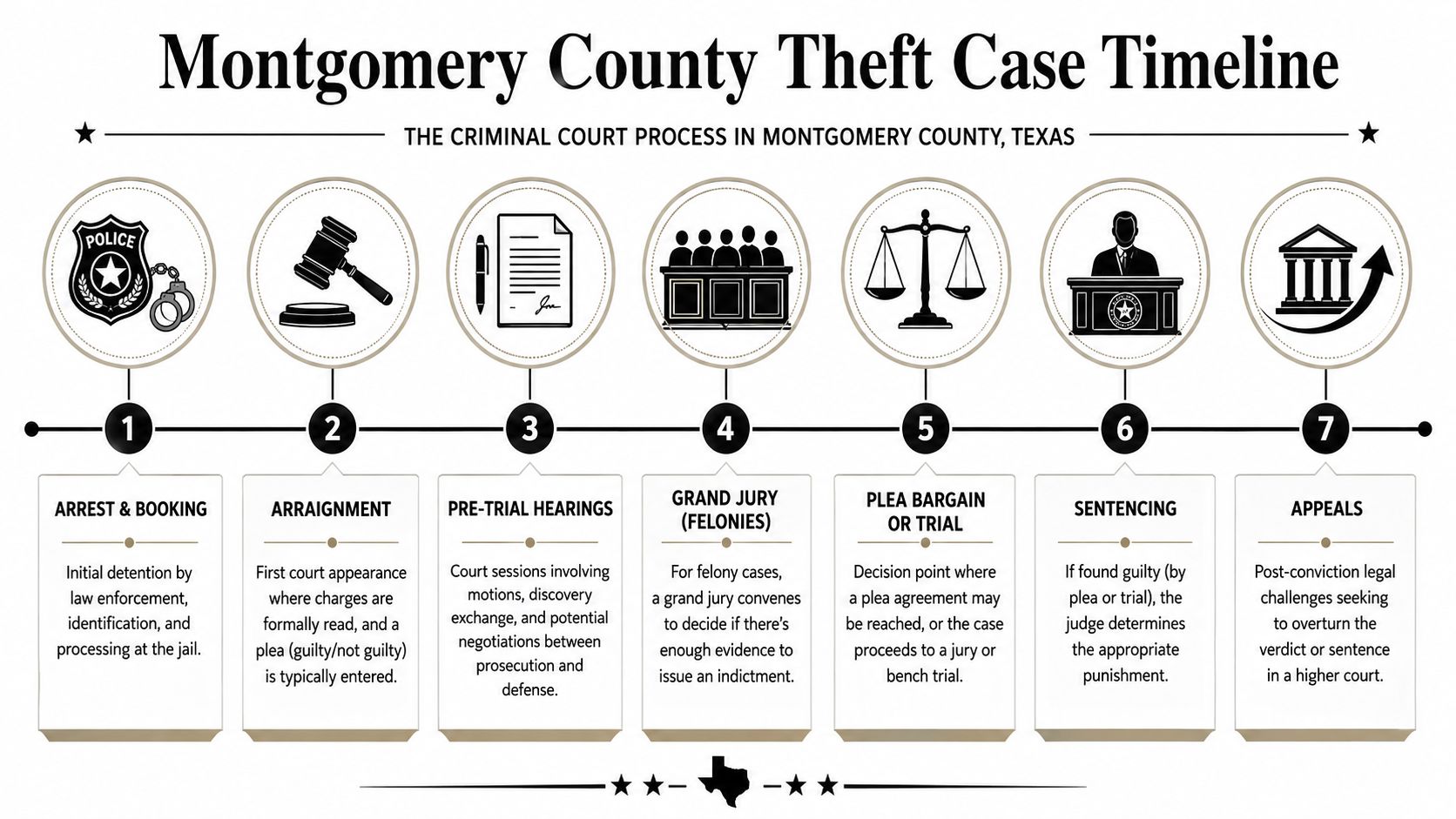
The usual path
Arrest and booking
Police process the arrest. Personal information is recorded, and you may remain in custody until release conditions are addressed.Arraignment
The court formally reads the charge. This early hearing matters more than people think.Pre-trial hearings
Lawyers address evidence, motions, scheduling, and negotiation.Grand jury for felony cases
If the allegation is a felony, the grand jury may decide whether the State has enough to indict.Plea or trial
Some cases resolve through negotiation. Others need a judge or jury.Sentencing and possible later relief
If there's a conviction, punishment follows. In some cases, later record-clearing remedies may become important.
Why arraignment is not a throwaway date
One local criminal defense source explains that the arraignment process in The Woodlands formally starts the case by reading the charges and creating the first meaningful chance for a defense lawyer to challenge the State's evidence of intent in this discussion of theft crimes and intent-based defenses.
That matches what I tell worried residents all the time. Don't treat the first court setting like a box to check. It's often the first place where a defense strategy starts taking shape.
Early hearings aren't clerical. They frame the case.
What local procedure changes
Montgomery County judges and prosecutors see repeat fact patterns all the time. They know the common excuses. They also know which defense lawyers come prepared with records, timelines, and legal arguments instead of vague pleas for sympathy.
That local familiarity is why generic statewide guides fall short. You need someone who knows how this courthouse works in practice, not just what the statute says in theory.
If you're already thinking ahead to the long-term record consequences, this is also the stage where you should ask about later cleanup options such as expunction relief in Montgomery County.
A practical courthouse point
For families in The Woodlands, a criminal court date in Conroe can disrupt work, childcare, and existing court obligations. If you also have parenting orders or estate administration issues running in parallel, your legal team needs to coordinate dates and filings carefully. That's not just convenience. It's damage control.
How a Woodlands Lawyer Defends Against Theft Charges
The State doesn't win because someone accused you. The State wins only if it can prove the required elements. In theft cases, the biggest fight is often intent.
Intent is the hinge
A local source focused on theft crimes in The Woodlands notes that successful defenses often attack the required intent to deprive the owner. That includes arguments such as honest mistake, owner's consent, mistaken identity, and abandonment. Those defenses matter because they can negate the criminal intent requirement.
In plain English, your lawyer is asking: did you mean to steal, or is the State stretching weak facts into a crime?
A short real-world scenario
A woman leaves a store in The Woodlands with a small item still under other bags in her cart. She had been on the phone with her child's school and paid for several other things at checkout. Loss prevention stops her at the exit and insists she concealed merchandise.
A careful defense doesn't just repeat “it was an accident.” It pulls the receipt, reviews the sequence of scanned items, checks store video, and compares her movements with the accusation. If the facts show distraction rather than intent, the case looks very different.
That's why a theft charge lawyer in The Woodlands should focus on details, not speeches.
Defenses that actually matter
- Honest mistake: Forgetting to scan, pay, or remove an item can matter if the surrounding facts support lack of criminal intent.
- Consent: If the owner allowed possession or transfer, the theft theory weakens.
- Mistaken identity: Bad camera angles, rushed store identifications, and assumptions by staff can produce the wrong suspect.
- Abandonment: Sometimes the ownership issue itself is disputed, though local scrutiny of this argument can be tighter than people expect.
- Value disputes: If the alleged value is wrong, the charge level can change.
Montgomery County is getting tougher on weak defenses
A frequently overlooked issue in The Woodlands is how recent legislative changes and local court attitudes affect first-time minor theft cases. One source discussing The Woodlands points to changes involving deferred adjudication eligibility for first-time offenders and a local zero-tolerance trend in Montgomery County that has reduced the success of standard accident defenses in this Woodlands theft-related overview.
That doesn't mean good defenses are dead. It means lazy defenses are.
If your lawyer's plan is just “tell the judge it was an accident,” that's not a plan.
You want someone who can test every part of the accusation, from the store's internal report to witness reliability to the timeline of events. If you're comparing firms, a broad overview of criminal defense representation in The Woodlands can help you frame the questions to ask.
Choosing Your Lawyer and Taking the Next Step
It is 9:30 p.m. You just got home after being booked or handed a court date, and now every lawyer website looks the same. Do not hire the first person who sounds reassuring. Hire the lawyer who can tell you, in plain English, what happens next in Montgomery County, who your judge may be, whether a first-offender option is realistic, and what needs to be done before the next setting.
Local experience matters here for a reason. A theft case in The Woodlands is not handled in the abstract. It is handled by specific prosecutors, in specific courtrooms, with local expectations about preparation, restitution, class requirements, and eligibility for pretrial resolutions. You want a lawyer who works in that system now, not someone giving you recycled statewide advice.
Ask direct questions in the consultation:
- Have you handled theft cases in Montgomery County recently?
- Which court will likely hear my case, and what usually happens at the first few settings there?
- Do you see a real path to dismissal, reduction, or a first-time offender program based on these facts?
- What documents, receipts, messages, or witnesses do you want from me this week?
- Will you personally appear with me, or will another lawyer cover my settings?
- How quickly will I hear from your office if the court date changes or the prosecutor makes an offer?
If the answers are vague, keep looking.
Pay attention to the office systems too. A theft case can turn on speed. If a firm takes two days to return a call, that tells you something about how your case may be handled. Some firms use tools like Voicedial.ai for law firms for after-hours intake and call routing. That does not win cases, but it does help a stressed client reach a real process quickly when timing matters.
You should also compare whether the lawyer can explain related risks outside the criminal case. A theft allegation can affect employment, professional licensing, immigration issues, family court credibility, and pending probate disputes. If you are reviewing local options, The Law Office of Bryan Fagan's criminal defense page for The Woodlands is one example of a local resource to compare. The better test is simple. Can the lawyer explain your next three steps clearly, and do those steps sound specific to Montgomery County rather than copied from a general Texas article?
This article is for general information only. It is not legal advice, and reading it does not create an attorney-client relationship.
If your case overlaps with custody, divorce, support, guardianship, or estate issues, say that early. Your defense lawyer needs the full picture before court, not halfway through the case after a bad surprise.
You do not need to solve everything tonight. You do need a case plan.
