 Skip to content
If you're sitting at your kitchen table in The Woodlands, looking at therapy schedules, school emails, and a divorce petition, you already know this case is not going to look like your neighbor's split. A divorce involving a special needs child in The Woodlands turns into a fight over daily care, long-term money, and who can keep the child stable when both homes are under strain. The courts in Montgomery County do not care about internet panic or gloomy myths. They care about proof, planning, and whether your order protects the child's real needs.
The biggest myth is the one that terrifies parents before they ever meet with a lawyer, the claim that special-needs marriages always collapse at extreme rates. That claim is overstated. A widely cited longitudinal study found divorce rates were not elevated on average, with about 22% of parents of children with developmental disabilities divorcing versus 20% in comparison families, and the authors said the difference was not statistically significant overall (PMC4624231). A related 50-year family study reached the same general conclusion, and the reported gap was only about 2 percentage points after margin of error was considered (PMC4624231).
That said, the cases that do end up in court are harder. The child may need therapy, special transportation, medical coordination, and support that lasts far beyond the usual divorce timeline. If you live in Panther Creek, Alden Bridge, Sterling Ridge, or Creekside, you need a plan that treats caregiving like a legal issue, not a vague family concern. That's the difference between a standard divorce and a case that protects a vulnerable child.
Why the numbers matter in court
When you hear wild claims that special-needs parenting leads to divorce at 80% to 90%, ignore them. The better evidence shows a more mixed reality, with outcomes that vary by family structure, stress load, and the child's needs (PMC4624231). That matters because Montgomery County judges make decisions based on the facts in front of them, not on internet fear.
The practical takeaway is blunt. A special needs child does not automatically mean divorce, and it does not automatically mean the same possession schedule, support amount, or parenting division works. The harder your child's daily care is, the more your order has to reflect real life.
Practical rule: If the child's needs affect sleep, school, transportation, medication, or therapy, the divorce paperwork has to account for that from day one.
Custody and Visitation Strategies for Complex Needs
Standard possession orders are built for children who can pack a bag, switch houses, and keep moving. That model breaks down fast when a child needs a consistent routine, equipment in both homes, or therapy appointments that can't be shuffled around to fit a weekend schedule. In a divorce involving a special needs child in The Woodlands, the schedule has to follow the child's care pattern, not the adults' convenience.
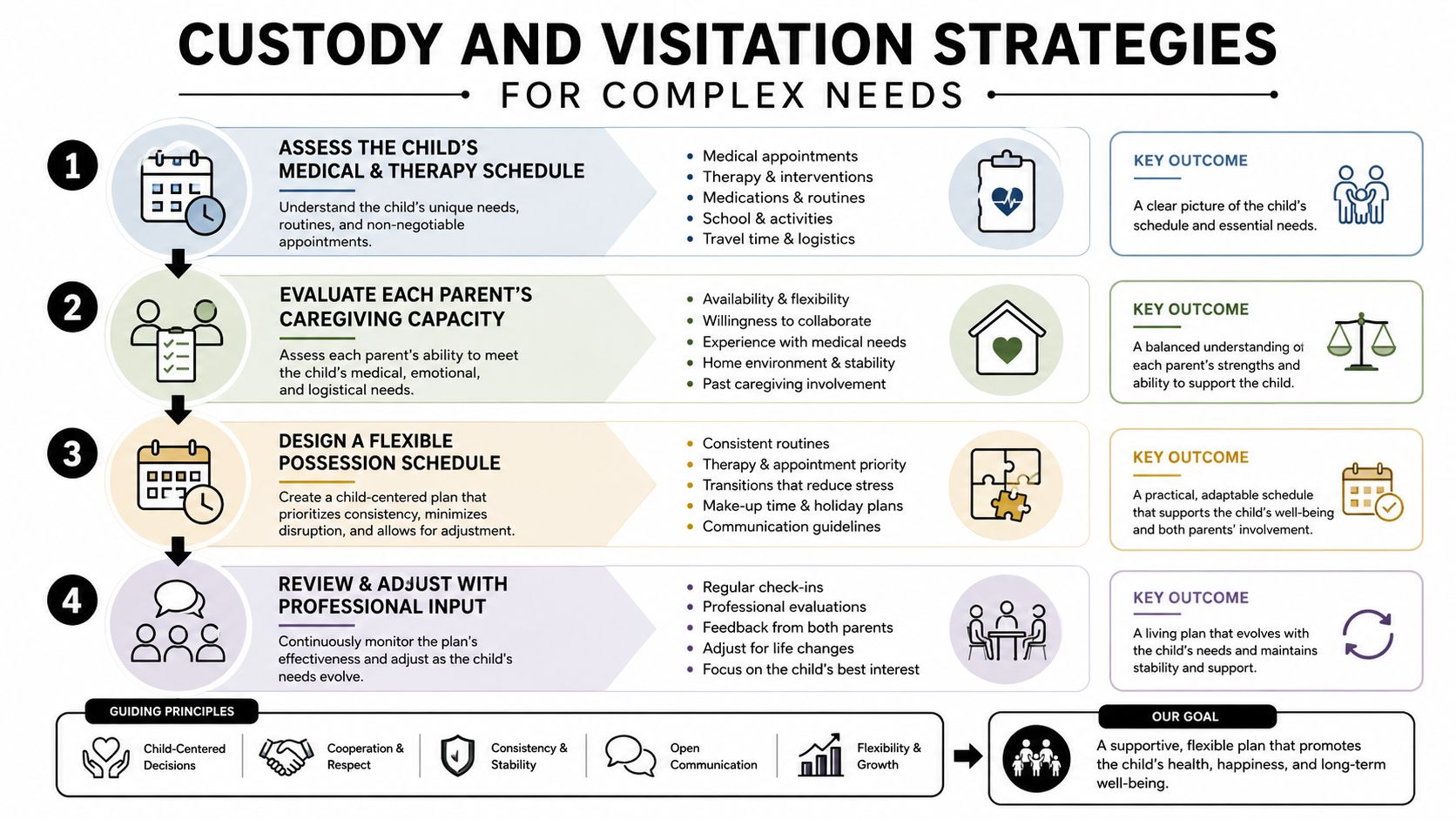
Build the schedule around the child's medical rhythm
Start with the therapy calendar. If a child has recurring appointments, one parent should not keep “forgetting” them every other Friday. The possession schedule should make room for therapy blocks, school-related meetings, and predictable recovery time after transitions. That means fewer assumptions and more written detail.
For a child in Panther Creek who does better with one main weekday routine, a split that looks fair on paper may still fail in practice. The better order is the one that reduces transitions, limits conflict, and makes it obvious who handles which appointments. If one parent manages the morning routine and the other handles evening care, spell that out.
Decide who handles decisions, not just overnights
Possession is only half the issue. Someone has to attend ARD or 504 meetings, coordinate with providers, and respond when a school asks for updated records. If parents can't make joint decisions without constant conflict, the decree needs a tighter structure for medical and educational authority.
Local families also need to think about enforcement. If one parent keeps blocking therapy or refusing to follow the order, Enforcement of Court Orders in The Woodlands is the kind of remedy Montgomery County courts use to enforce divorce decree and custody order provisions. That is not a theoretical concern, it is how parents keep the order from becoming useless on paper.
The judge is not going to micromanage your family's calendar for you. Your decree has to do that work.
Use flexibility with guardrails
A flexible schedule does not mean a vague one. It means the order allows for school events, medical appointments, and the child's tolerance for transitions without inviting a fight every week. If the child cannot handle a midweek handoff after therapy, say so. If one parent's home needs duplicate medical equipment, list it.
The Woodlands families often ask whether one parent should “just have primary custody” because life is complicated. Sometimes that is the right answer. Sometimes shared conservatorship still works, but only if the detailed routines are written tightly enough that both adults know who does what and when.
Before you agree to a possession plan, look at the child's schedule first, then the parents' work schedules, then the school calendar, then the support order. That order matters more than pride.
Use this rule: if the child's care breaks down during transitions, the schedule is wrong.
Child Support Beyond the Standard Guidelines
Texas child support guidelines are built for ordinary cases. A child with therapy, medications, assistive equipment, or ongoing care costs is not an ordinary case, and Montgomery County judges know it. That's why you need evidence of the child's actual expenses, not just a copy of the guideline chart.
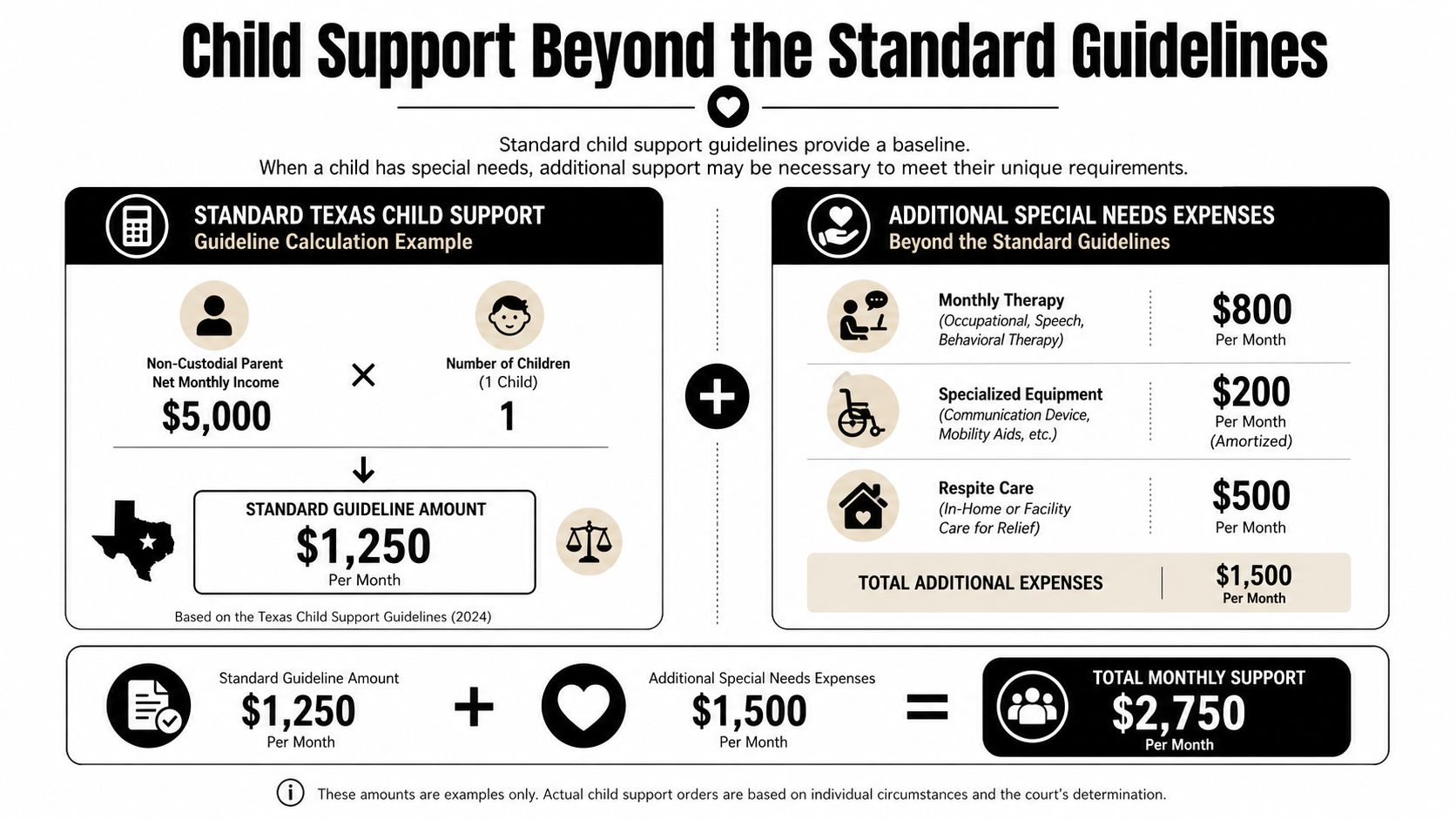
Document the real cash flow
Texas family-law guidance for divorce and special needs children specifically says to document monthly medical and related expenses, caregiving hours, and future costs so the settlement reflects the child's actual needs, not just a baseline support number (Navigate Life Texas). That advice is practical, and it lines up with what family courts want to see.
Do not show up with vague statements like “the child has expensive needs.” Show therapy invoices, medication costs, adaptive equipment, transportation expenses, and proof of what each parent is already covering. If one parent handles most of the in-home care, that time burden matters too. Texas guidance also points out that standard support rates do not cover therapy, medication, or special equipment (Bryan Fagan family-law guidance).
Know when support can last into adulthood
Special-needs cases differ the most from standard divorces. Texas law can extend child support beyond age 18 or high school graduation when the child has a disability requiring substantial care and supervision, and the disability existed or was known before the child turned 18 (Melone Hatley special-needs divorce guidance). Texas law can also allow child support for an adult child with a disability on an indefinite basis when the child is not capable of self-support because of a mental or physical disability and needs substantial care and personal supervision, with the disability existing or being known before age 18 (Barrows Firm special-needs guidance).
That changes settlement strategy. You are not negotiating a short-term order. You are building a long-duration financial structure.
Make the order work for the long haul
Bottom line: If support may continue into adulthood, think about funding before the decree is signed, not after.
A smart order should clearly identify who pays what, who handles uncovered medical bills, and how future needs are reviewed. It should also connect to life insurance and trust planning so the child is not left exposed if the paying parent dies or becomes unable to pay. If the order is vague, you will be back in court sooner than you want.
If you are trying to choose between a standard percentage and a more customized arrangement, choose the customized one when the child's care is complex. The standard model is a starting point, not a ceiling.
Protecting Benefits With Special Needs Trusts
A bad settlement can wreck benefits fast. If a child receives SSI or Medicaid, you cannot treat settlement money like a regular inheritance or hand the child cash and assume the system won't care. It will care, and the consequence can be loss of means-tested benefits that pay for critical healthcare.
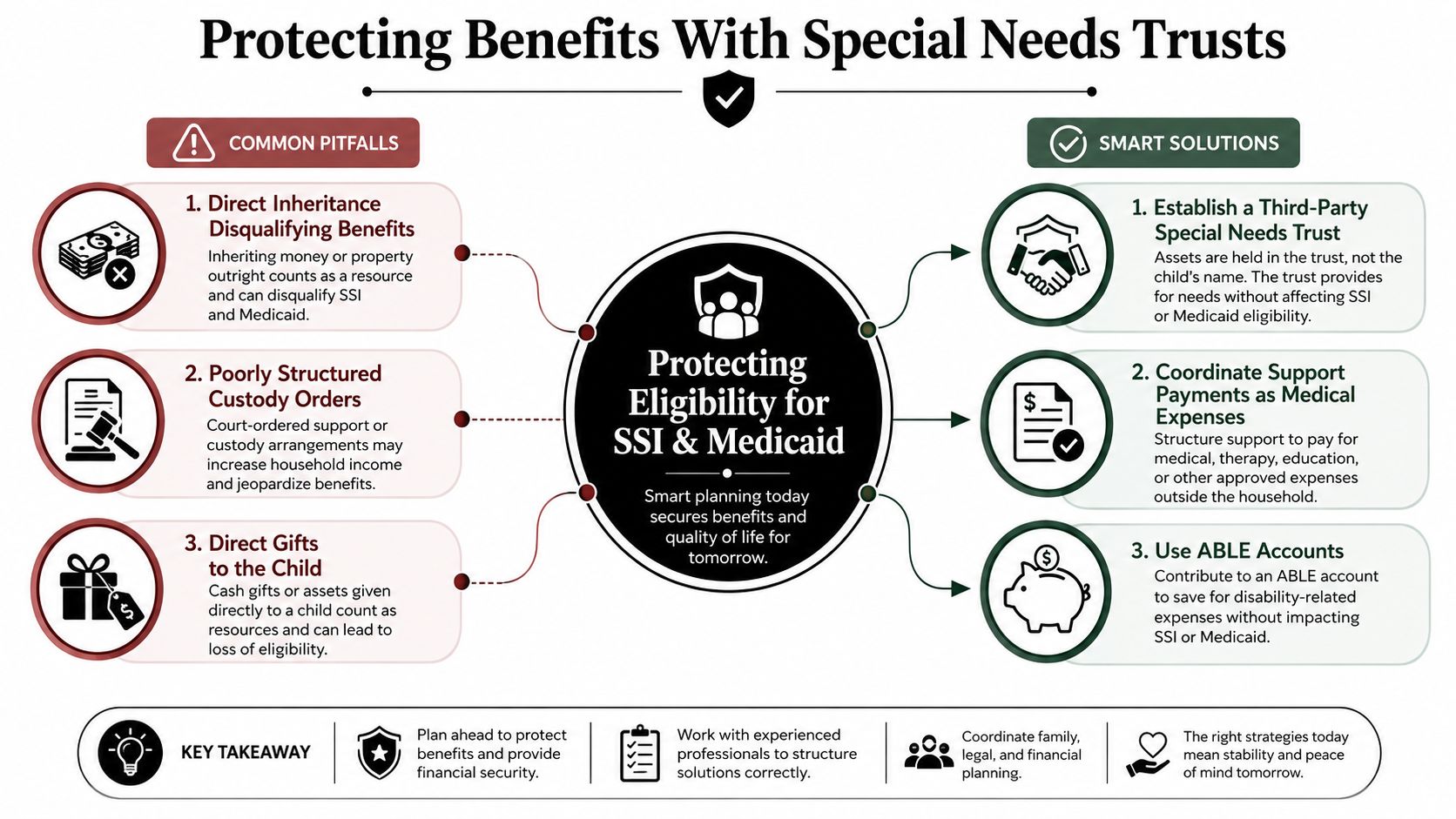
Keep settlement money away from the child's countable assets
A special needs trust is the main tool here. Under Texas estate-planning practice, the trust can hold assets for the child's benefit without blowing up benefit eligibility if it is drafted correctly and used correctly. If the divorce decree sends money straight to the child, or if a parent casually names the child as beneficiary without a plan, the result can be disastrous.
The Woodlands parents should think of the trust as part of the divorce order, not an afterthought. If one parent is trustee, both parents still need to understand what the trust can pay for and what it cannot. That includes therapy, supplemental care, equipment, and other needs that preserve quality of life without turning the child into an ineligible beneficiary.
Coordinate the decree, the trust, and the funding source
The divorce decree should not fight with the trust document. It should refer to the trust structure cleanly, identify who is responsible for funding it, and explain how child support interacts with benefit preservation. If you have a life insurance policy meant to secure support, the beneficiary designation and trust language have to match the rest of the plan.
Texas families also need to remember that trust drafting is not just a legal formality. It determines whether the child can keep SSI and Medicaid while still getting supplemental support. That is why a lawyer who handles family law and estate planning issues together is useful in these cases, especially in Montgomery County where the court will expect the order to be workable, not theoretical.
I've seen parents try to patch this together after the decree is signed. That is too late. Once money is misdirected, fixing the benefits problem can take more time and create more stress than the divorce itself.
Use the trust as the long-term safety net
A properly funded trust gives the child stability while preserving public benefits. It can receive support-related assets, structured payments, or life insurance proceeds, depending on the plan. The point is not to hide money. The point is to keep the child eligible for the programs that pay for essential care.
If the child relies on SSI or Medicaid, never sign a settlement without reviewing how every payment will be received and titled.
For families in The Woodlands, the trust question is not a luxury issue. It is a basic protection issue. If the support order is supposed to help your child for years, then the structure has to survive years.
Special Needs Trust Lawyer in The Woodlands is the kind of local resource families often need when the divorce decree and estate plan have to work together.
A Real Woodlands Family Scenario
A couple in Sterling Ridge decides to divorce after years of managing their son's autism-related care together. He has ABA therapy after school, regular school meetings, and a routine that falls apart if handoffs are chaotic. One parent wants a standard possession order and guideline support. The other wants a detailed plan with therapy blocks, school coordination, and long-term funding through a trust.
The first path looks simple at the start. They split weekends, use a generic support number, and assume they can “figure out the details later.” Within months, therapy sessions get missed, school meetings become arguments, and the parent handling more day-to-day care starts absorbing extra time and costs with no clear order to back them up. The child feels the tension, and the order becomes another source of conflict.
The second path takes more work, but it holds up better. The parents assign one adult to coordinate school communication, define who attends ARD meetings with Conroe ISD, and spell out how transportation to therapy gets handled. They also fund a trust so support doesn't interfere with benefits, and they add life insurance to protect the long-term plan.
That version is not perfect. It is just better. It gives the child more routine, gives the parents fewer fights, and gives the court a cleaner order if enforcement ever becomes necessary.
The lesson is simple. In a special-needs divorce, a vague agreement feels easier on signing day and worse every month after that. A detailed one feels harder to draft and easier to live with.
Evidence and Documentation for Montgomery County Courts
Montgomery County judges do not want speeches. They want organized proof. If you're asking for a customized custody order, above-guideline support, or trust-related protections, you need records that show exactly what the child needs and who is already doing the work.
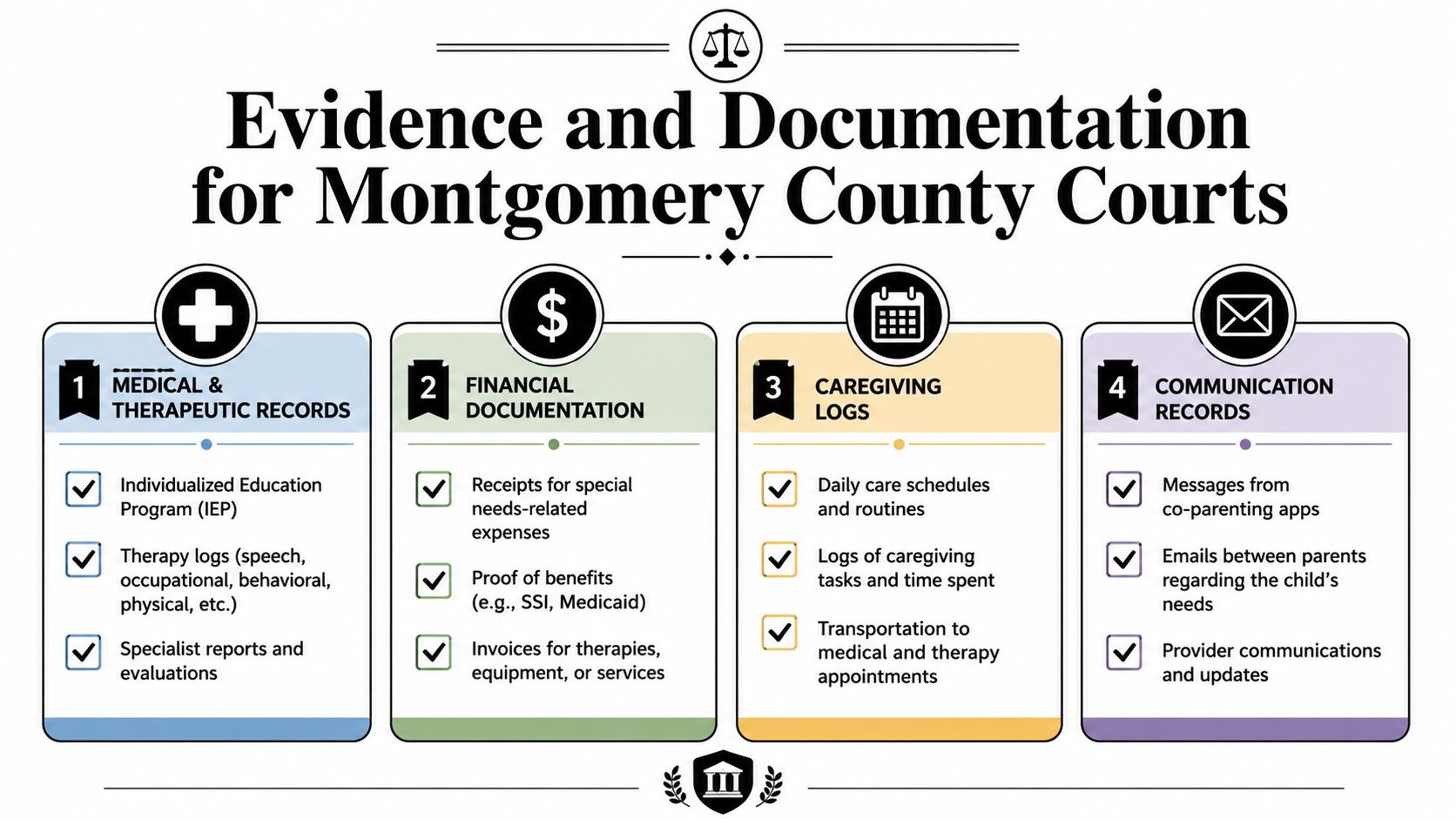
Build four file folders and keep them current
Start with medical and therapeutic records. Put the diagnosis paperwork, specialist notes, therapy logs, and any relevant school plans in one place. Add IEP or 504 records, because school accommodation issues often drive the custody schedule as much as the medical side does.
Then build a financial folder. Keep receipts for special-needs-related expenses, proof of insurance gaps, and records of any SSI or similar benefits. If the child's care creates recurring out-of-pocket costs, you need to show the pattern, not just one unlucky month.
Track who does the work
Caregiving logs matter because they show time burden. Write down who takes the child to appointments, who handles medications, who communicates with teachers, and who manages transportation. A shared digital calendar helps, but a clean written log helps more when the court wants a quick view of the pattern.
Communication records matter too. Save emails, co-parenting app messages, and school correspondence. If one parent is refusing to cooperate on appointments or school communication, the paper trail may matter more than either parent's memory.
For a broader custody evidence checklist, Montgomery County families often benefit from reviewing Evidence Needed for Child Custody in Texas. That kind of documentation becomes even more important when the child's needs are complex.
Present the evidence like a professional record
Courtroom rule: If you can't explain the child's needs in five minutes with documents in front of you, you probably don't have the record organized well enough yet.
Keep the file simple. Separate medical, financial, school, and communication records. Use a dedicated expense folder. Ask treating providers for short letters when their opinions matter. A judge should be able to see the child's needs, your response to those needs, and why the order you want is the one that works.
This is also where a local family law lawyer helps. The Law Office of Bryan Fagan represents clients in The Woodlands and Montgomery County in divorce, custody, child support, and enforcement matters. In a case like this, local process and clean documentation can make the difference between a workable order and a constant fight.
Your Next Steps and When to Call an Attorney
If you're in the middle of a divorce involving a special needs child in The Woodlands, stop trying to solve everything in your head. Start with the paperwork and the child's current care pattern.
What to do next
- Gather the core records: Pull therapy notes, school plans, medical summaries, and every support-related expense you can find.
- Map the weekly routine: Write down who handles appointments, transportation, medications, and school contact.
- Check the benefits angle: Confirm whether SSI, Medicaid, or another means-tested program is part of the picture before any settlement is drafted.
- Review support and trust options: Make sure your proposed order fits the long-term care timeline, not just the next few months.
- Talk to a lawyer early: Do this before you agree to a possession schedule or sign a decree that can't be fixed easily later.
Call a lawyer fast if the other parent is refusing therapy access, ignoring school meetings, hiding records, or pushing for an order that would disrupt benefits. Those are not small disagreements. They are the kinds of problems that can justify immediate legal action.
This is educational information, not legal advice. Every family's facts are different, and the right order depends on the child's needs, the parents' resources, and the documents you can prove in court.
The Law Office of Bryan Fagan helps families in The Woodlands and Montgomery County handle divorce, custody, child support, and enforcement matters with the local court process in mind. If you need a plan that protects your child's care, benefits, and long-term stability, visit The Law Office of Bryan Fagan and schedule a consultation to talk through your next move.
