 Skip to content
You do not have time to research this while you're panicking over a missing child. If your child was supposed to be home and now you're staring at a foreign country flight itinerary, a silent co-parent, or an empty bedroom, treat this as an emergency and move fast. In international child custody Hague The Woodlands cases, speed, documentation, and the right filing path matter more than emotions, and the wrong first move can waste precious hours.
The Hague Convention on the Civil Aspects of International Child Abduction is the civil treaty framework that matters when a child has been taken across a border in violation of custody rights. It was adopted on 25 October 1980 and entered into force on 1 December 1983. Its purpose is to secure the prompt return of wrongfully removed or retained children in Contracting States and to protect custody and access rights across borders, rather than decide the custody fight itself (Hague Convention text).
This guide is legal information, not legal advice. If your child is already gone, use the next 72 hours to preserve evidence, contact the right agencies, and get a lawyer who knows Montgomery County family court practice and Hague procedure.
When Your Child Is Taken Across Borders
A parent in The Woodlands comes home expecting a normal evening and finds the house quiet, the child's bag gone, and the other parent unreachable. Then a text arrives from another time zone, or a relative confirms what your gut already knew, your child is outside the country and the other parent may not be bringing them back. That is a terrifying moment, but it is not the time to improvise.
The legal question is not custody first
In Hague cases, the first issue is usually not “who should win custody,” it's which country gets to decide that question. The treaty is built to return the child to the country of habitual residence, then let the proper court handle the custody merits there. Congress has described the treaty as the principal mechanism for enforcing the return of abducted children to the United States since 1988, which is why left-behind parents need to think in treaty terms, not just family court terms (Hague Convention text).
Practical rule: If both countries are treaty parties and the child is under 16, move as though every hour counts. Hague cases are civil return cases, not criminal extradition proceedings, and they turn on wrongfulness, habitual residence, and fast evidence preservation.
That matters in The Woodlands and greater Montgomery County because local families travel more than they think, and a child can be moved quickly through a major airport, a border country, or a connecting jurisdiction before anyone reacts. The treaty does not solve everything, but it gives you a direct path when the other parent has crossed a border and violated custody rights.
If you're trying to figure out whether your facts fit Hague protection, start with three questions. Was the child taken to a country that is a Contracting State, was the child under 16 at the time, and did the move violate existing custody rights under the law of the child's habitual residence? If the answer to those points looks favorable, stop debating and start documenting.
How the Hague Convention Actually Works
The Hague Convention moves fast in theory and can feel painfully slow in practice. The treaty gives you a narrow path, and that path only works if the child, the countries, and the custody facts all fit the rules. Miss a threshold issue, and the Convention will not help. Meet the threshold, and the case still rises or falls on proof, timing, and disciplined follow-through.
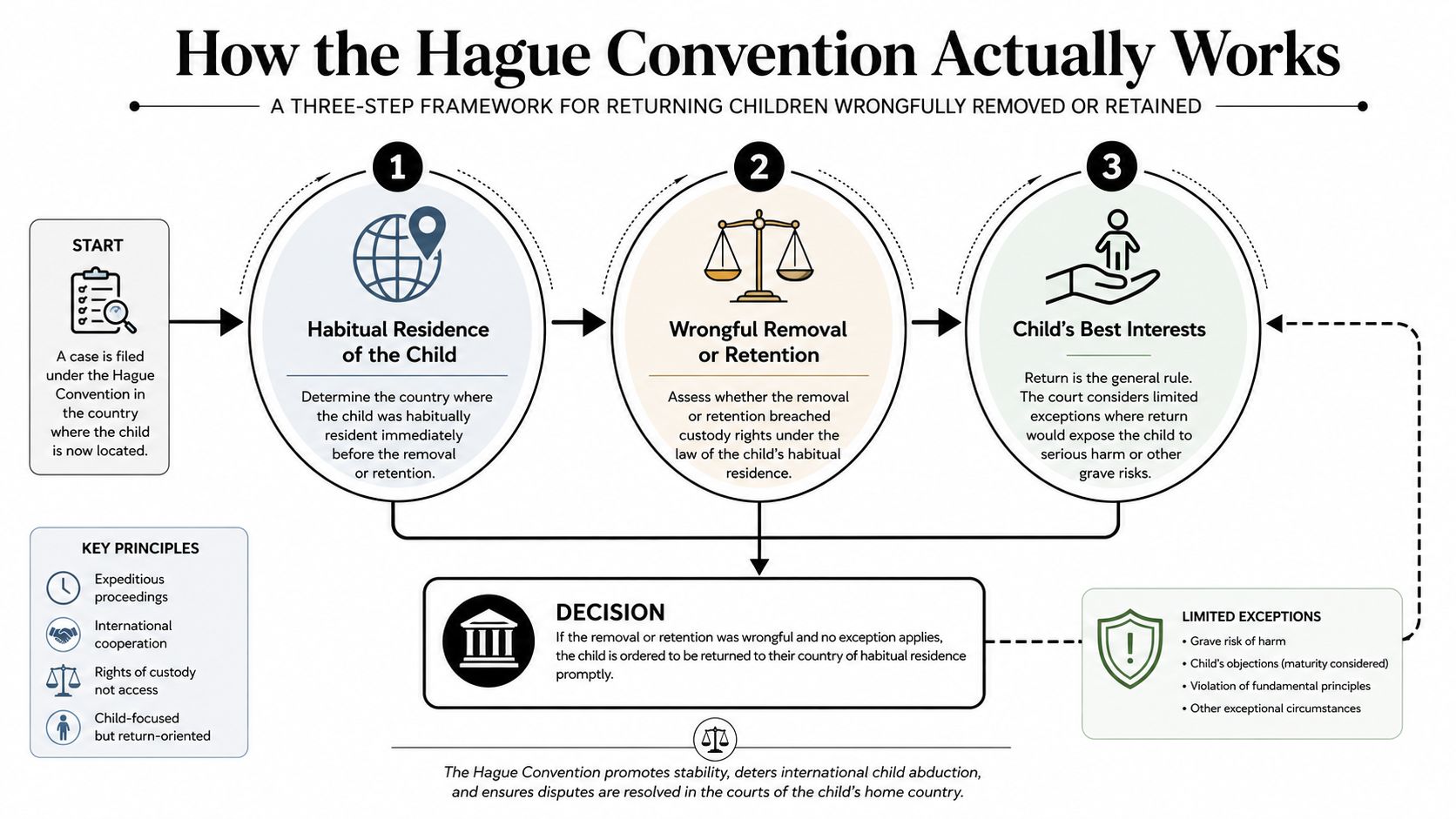
The three things that have to line up
Both countries must be treaty parties. The Convention has been adopted by many jurisdictions, which is why it is the main return tool in cross-border child abduction cases (Hague Convention overview). The child generally must be under 16. The removal or retention must also be wrongful because it violated custody rights under the law of the child's habitual residence (CRS on the Convention).
Wrongful removal is the straightforward version. Wrongful retention is the trap that catches a lot of parents. A parent may lawfully take a child abroad for a visit and then refuse to return the child on the agreed date. If that refusal breaches the other parent's custody rights under the law of the habitual residence, the Hague process can be triggered (CRS on the Convention).
Habitual residence is the anchor point
Habitual residence is not citizenship, and it is not a passport stamp. It is the child's real center of life, where the child went to school, saw doctors, slept, kept routine, and built daily ties. That is why custody records, school documents, medical records, and home records matter so much in these cases (CRS on the Convention).
The Hague judge acts as a jurisdictional referee. The job is to decide where the custody case belongs, not to decide the final custody outcome. Once that answer is clear, the merits belong in the proper country's court.
If the child's life was rooted in The Woodlands, Montgomery County, or nearby communities, that practical evidence becomes the backbone of your case. The treaty is built to send the child back to that home forum, not to reward the parent who moved first or argued loudest.
What the treaty can't do
The Convention does not decide the underlying custody dispute. It handles return, then leaves the custody merits to the proper court (Hague Convention text). A parent cannot use Hague proceedings to relitigate who should get primary custody in the foreign country.
The parent who wins a Hague return order has not won custody. They have won the right to have custody decided in the proper place.
The U.S. Central Authority Process and Timelines
Once a Hague application is filed, the case moves through official channels, not private guesswork. The U.S. Central Authority is the Office of Children's Issues within the State Department, and it coordinates the U.S. side of the treaty process (State Department guidance referenced in CRS materials). That matters because many parents assume the filing itself forces an instant return. It does not.
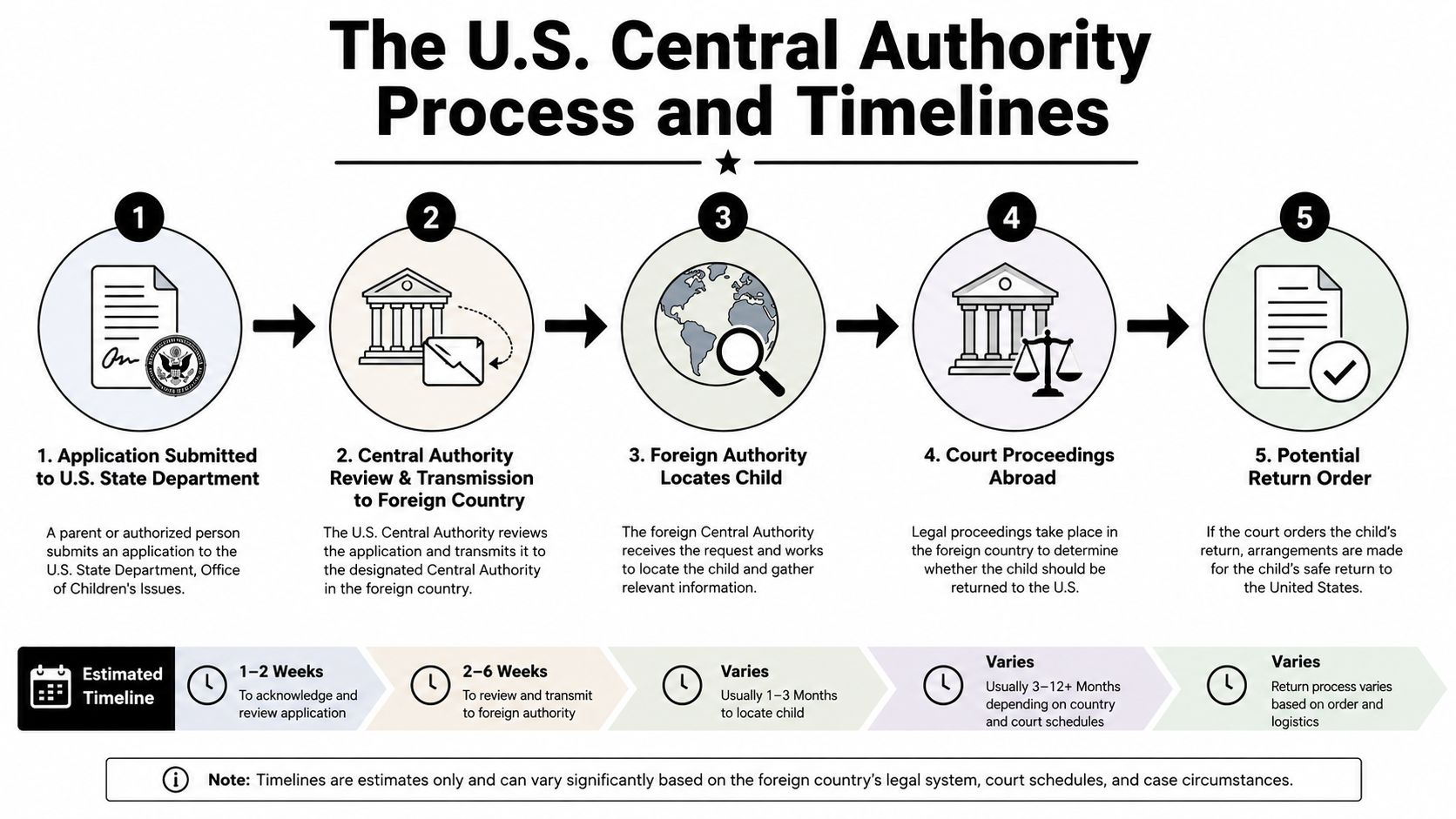
What happens after filing
The application goes to the U.S. Central Authority, which reviews it and transmits it to the foreign country's Central Authority if the case fits the treaty framework. The foreign authority then works to locate the child and move the matter into the local court system, where the return petition is litigated. None of that is automatic, and none of it should be left to hope.
The treaty's practical goal is the prompt return of abducted children and effective exercise of access rights, which is why filing fast matters in Hague cases (Hague Convention overview). “Prompt” is the goal, not a guarantee. Cases still stall on service, translation, locating the child, and local court scheduling.
What delays usually look like
The biggest bottleneck is often evidence, not law. If you do not have proof ready that the child's home was in The Woodlands or Montgomery County, the foreign court may have to sort through disorganized records while time keeps passing. Another common delay is a parent who assumes the foreign authority will do all the work. It will not.
If your family is already in or coming out of a contested divorce, The Divorce Process in The Woodlands: What to Expect gives a step-by-step look at filing for divorce in The Woodlands and Montgomery County. That does not solve a Hague case, but it shows how local family-court procedure and the international return process can overlap fast.
The six-week benchmark is not a promise
Family-law guidance commonly points to a six-week target for Hague cases, but the Convention's real-world pace is often slower. The point is not to wait for the system to catch up. You need to keep the record moving while the authorities and courts do their work.
If a return order is becoming urgent, review how to get an emergency custody order in The Woodlands and act on the local court side without delay.
Bottom line: File fast, preserve everything, and stay responsive. In Hague cases, silence gets treated like weakness.
Emergency Steps for Woodlands and Montgomery County Parents
The first 72 hours are for containment. Do not spend that time arguing with the other parent, pleading for a return, or posting emotional updates online. Build a paper trail, alert the right agencies, and use Montgomery County court tools immediately before the other side hardens its position.
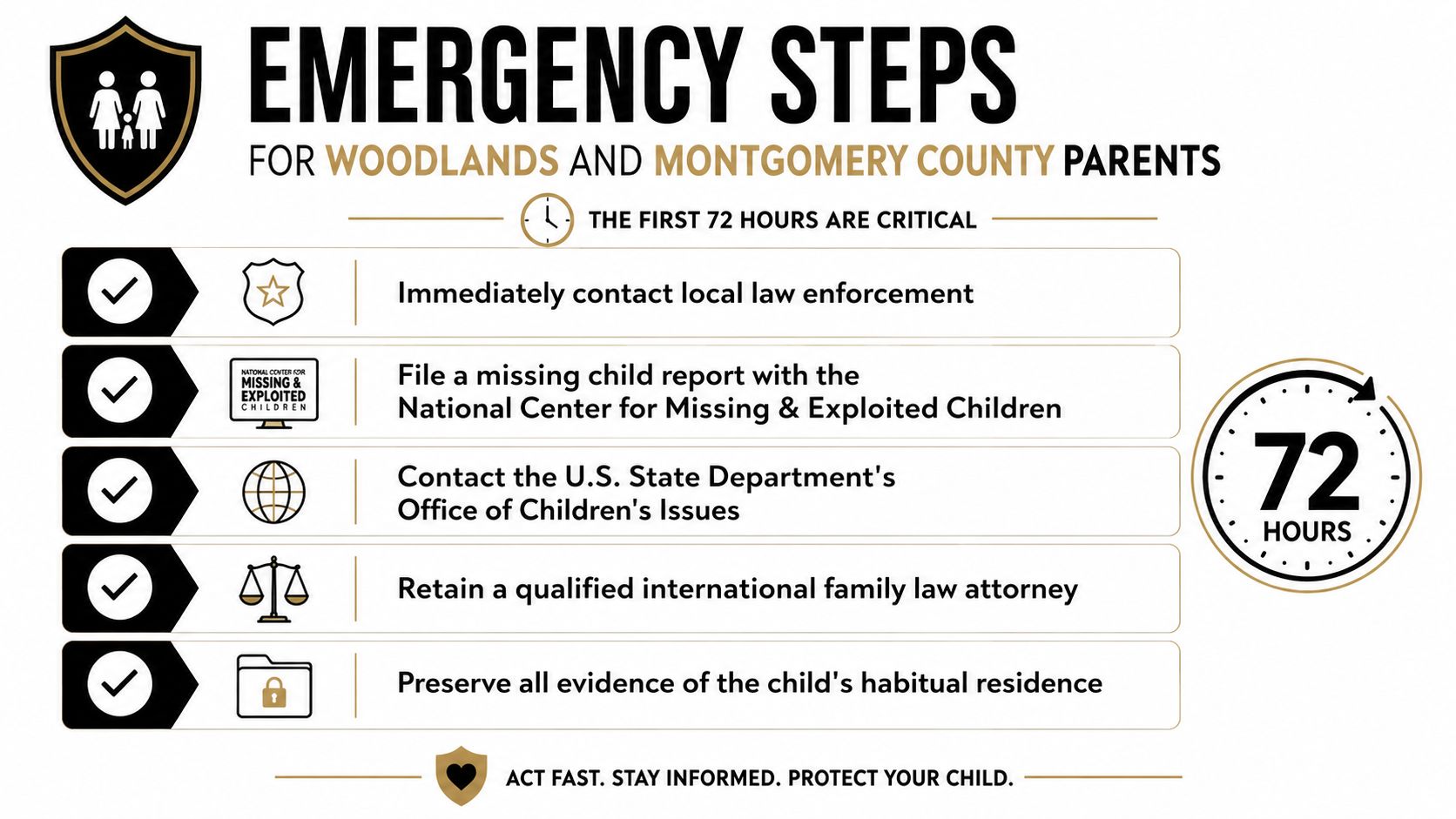
The first calls to make
Start with local law enforcement in the jurisdiction where you last had the child or where the disappearance was discovered. In The Woodlands area, that may mean the relevant local agency depending on the exact location, and in other parts of Montgomery County it may involve the proper municipal or county authority. Then contact the U.S. State Department's Office of Children's Issues so the Hague process can start moving.
Use the national child recovery reporting pathway if the facts fit a missing-child report. Get the case number, the officer's name, and the time of the report. Keep every receipt, confirmation email, and screen capture.
The documents that matter right away
Gather the existing custody order, the child's birth certificate, passport information, recent photos, school records, medical records, lease or mortgage documents, and screenshots of texts or emails showing where the child lived and where the other parent said they would go. These are the records that show habitual residence and wrongful retention under federal guidance. The same source also explains why courts focus on the child's established home base and the custody rights that were crossed, not on who seemed more sympathetic.
This is also the moment to preserve digital evidence correctly. Do not delete threads, do not “clean up” your phone, and do not rely on memory to reconstruct dates. Export messages, save email headers if possible, and back up everything in more than one place.
If you need emergency relief in Montgomery County, look at the local emergency custody route immediately, including this resource on how to get an emergency custody order in The Woodlands. Texas Family Code emergency tools matter because Hague cases and local temporary orders can move in parallel when a child is at risk.
Use local court tools without delay
Texas family courts can issue emergency orders to stop passport use, require surrender of passports, and set restraints when international removal is a credible threat. Texas Family Code provisions on international abduction risk exist for a reason, and you should use them before the child is out of reach, not after (Texas Family Code, international abduction protections). If the other parent is already ignoring a court order, Enforcement of Court Orders in The Woodlands is the kind of Montgomery County-focused action that can matter when compliance has already broken down.
Do this now: gather the order, lock down the passport issue, preserve the texts, and get a lawyer involved before the story gets rewritten by the other side.
Building Your Evidence and Countering Common Defenses
Hague cases demand disciplined, targeted evidence rather than volume. Do not flood the file with every photo, text, and old school email you can find. You need proof of the child's real home base, proof of the custody rights that were violated, and a file that is ready for the defenses the other side will raise.
The evidence that helps
School enrollment records show where the child lived day to day. Medical records show where the child received care. Lease or mortgage documents show the physical home base. Communications with teachers, coaches, and neighbors can show community ties in The Woodlands or nearby Montgomery County communities. Those are the records that help establish habitual residence under Hague analysis (CRS on the Convention).
The main question is not whether the parent was “nice” or whether the child liked both countries. The question is where the child was established before the removal or retention, and whether the move violated existing custody rights. Texas custody orders, temporary orders, and parenting agreements can all help show the legal rights that were crossed.
The evidence that wastes time
Holiday photos alone will not carry a Hague case. Social media posts are usually weak unless they directly show intent, location, or admissions. Family opinions about what “felt like home” are not a substitute for records. Courts want objective proof, not a scrapbook.
For a more detailed Texas evidence checklist, use evidence needed for child custody in Texas as a practical local reference point.
Here is a simple comparison that keeps the focus tight.
| Evidence Type | What It Proves | Examples |
|---|---|---|
| School records | Daily home base | Enrollment forms, attendance records |
| Medical records | Regular care and local residence | Pediatric visits, insurance files |
| Housing records | Actual place of living | Lease, mortgage, utility records |
| Communications | Intent and location facts | Texts about travel, return dates |
| Custody orders | Existing rights | Temporary orders, final orders, parenting plans |
Common defenses the other side will raise
The most common defenses are consent, acquiescence, grave risk of harm, and the child's objections if the child is mature enough. These defenses are real, but they are narrowly reviewed, and the burden is on the parent opposing return.
Consent usually means the left-behind parent agreed to the move. Acquiescence means the parent later accepted it. Grave risk means serious physical or psychological harm, not just a rough transition. Child objection is not the same as a child not wanting to leave a new country or a preferred parent.
Courts look hard at these defenses because almost every abductor claims one. If the evidence is thin, the defense collapses.
Working with Local Counsel and Next Steps
If your child has been taken across a border, the first move is local, not theoretical. A Hague case still runs through Montgomery County procedures, and that means emergency relief, temporary orders, and a clean custody record have to be handled immediately. If you lose time at this stage, the other parent gains control of the timeline, and that is exactly what you cannot afford.
A Montgomery County family lawyer can coordinate with the U.S. Central Authority, preserve the local record, and push for emergency relief while foreign counsel handles the return case abroad. That coordination keeps your facts consistent in both places. It also puts a Texas judge in position to protect your rights before the foreign court reaches a decision.
What to look for in counsel
Hire a lawyer who has handled custody litigation, emergency orders, and international issues, not someone learning the Hague Convention from your file. You need familiarity with Montgomery County practice, emergency temporary orders, and the Texas Family Code tools that protect a parent and child when travel turns into concealment. If enforcement may become part of the fight, you also need a lawyer who knows how local order enforcement works in practice.
You should also speak with a Montgomery County custody attorney who can work the local court side while the Hague process is underway. That kind of coordination matters because a Hague case is never only international. It is also a Texas custody case with deadlines, filings, and evidence that must hold up in front of a Montgomery County judge.
The Law Office of Bryan Fagan is one option for families in The Woodlands and Montgomery County who need custody guidance, emergency family-court action, and local court coordination. That kind of representation fits a Hague-related custody fight because the case is never just about the foreign return petition, it is also about what happens in the local court record right now.
A short scenario that shows why coordination matters
A Woodlands parent learns the child is in Mexico after a “vacation” that never ends. Local counsel files emergency Texas orders to preserve the record, the State Department process begins, and foreign counsel handles the return petition. The child comes back because every part of the case moved at once, instead of one side waiting on the other.
What to do next
- Secure the basics now: custody order, birth certificate, passport information, and recent photos.
- Preserve every message: texts, emails, travel plans, and return-date conversations.
- Report the disappearance: local law enforcement, then the federal and Hague channels.
- File for emergency relief: use Texas Family Code tools if there is any passport or travel risk.
- Build the residence record: school, medical, housing, and community documents.
- Get counsel fast: choose a lawyer who can handle local and international angles at the same time.
If your child has been taken across a border, do not wait for things to settle down. Hague cases reward immediate action, and hesitation gives the other side more room to build a defense and more time to harden the facts.
If you're in The Woodlands or anywhere in Montgomery County and need help with an international custody emergency, The Law Office of Bryan Fagan can help you move quickly on the local family-court side while you pursue the Hague process. Visit The Law Office of Bryan Fagan to schedule a consultation and get a plan in place before the other side controls the timeline.
