 Skip to content
You filed for divorce in The Woodlands, and your spouse was served. Since then, the phone has stayed quiet, messages go unanswered, and you're wondering whether the court can grant everything you requested. That situation is common enough to create confusion, but silence does not mean the divorce is automatically approved.
A default divorce can allow the case to move forward without the respondent's participation. It doesn't remove the petitioner's responsibility to prove important facts, and it doesn't erase deadlines for the spouse who was served. The difference matters in Montgomery County cases involving a home, retirement accounts, debts, conservatorship, visitation, or child support.
This guide explains the two Texas clocks that cause the most trouble, what a judge may require before signing a decree, and how both spouses can protect their rights. It also uses practical examples for residents of The Woodlands, Conroe, Shenandoah, Magnolia, Oak Ridge North, and nearby Montgomery County communities.
If you've just been served, reviewing what to do after being served with divorce papers in The Woodlands can help you identify urgent issues before the answer deadline passes.
Default procedure can affect parental rights, property, debt responsibility, and the timing of a final order. This article is educational only and is not legal advice. Texas Family Code provisions and court procedures can apply differently depending on service, the pleadings, the evidence, and the facts of your family.
Introduction to Default Divorce in The Woodlands
Consider a resident of Sterling Ridge who files for divorce after months of conflict. The spouse is served, but doesn't file anything and stops communicating. The filing spouse may think, “If my spouse won't respond, the judge will approve my petition exactly as written.”
That assumption can create serious problems. A court may proceed without the respondent, but the petitioner still has to establish that service was valid and present evidence supporting the requested decree. The judge may need information about marital property, debts, children, support, and the proposed parenting arrangements.
The term default describes the respondent's failure to participate after receiving legally sufficient notice and failing to file a timely answer. It doesn't describe an automatic victory. The court still has to follow Texas law and protect the integrity of the final order.
The practical rule: No answer may open the door to a default proceeding, but it doesn't eliminate the need for proof.
A default case can be straightforward when the marriage has limited property, there are no children, and the petitioner has organized records. It becomes more demanding when the spouses own real estate, businesses, investment accounts, retirement benefits, or substantial debts. Parenting disputes require separate attention because the court must consider the children's interests, not merely accept one parent's preferred terms.
Texas divorce rates have declined over the long term. A Texas family-law statistics summary using CDC provisional data reports a rate of 5.5 divorces per 1,000 people in 1990, 3.3 in 2010, and 2.1 in 2023, with the 2023 Texas rate below the national average of 2.4, as described in this Texas divorce statistics summary. That lower overall rate doesn't make a high-conflict case simple. Modern disputes may center on custody, support, property characterization, hidden financial information, and enforcement of the final decree.
Understanding default judgment helps you decide what to do before a hearing is scheduled. It also helps you ask better questions when looking for a default divorce lawyer in The Woodlands, TX.
What a Default Divorce Means Under Texas Law
Think of a lawsuit as a scheduled conversation with the court. The petitioner starts the conversation by filing a petition. Service gives the respondent formal notice. If the respondent doesn't answer or otherwise participate, the court may continue with only the petitioner present.
That is the basic idea behind a default judgment. The court isn't treating the respondent's silence as agreement to every requested term. Instead, it is deciding whether the case can proceed without the respondent's participation and what evidence supports the requested relief.
Texas Family Code § 6.701 is important because a divorce petition cannot be accepted as confessed solely because the respondent failed to answer. The petitioner still must present proof before the court can grant the divorce and enter related orders.
Silence can support moving forward. It doesn't prove the facts needed for a complete decree.
The proof may involve several separate subjects:
- Marriage and eligibility: The petitioner must establish the facts needed for the court to act on the divorce.
- Property and debts: The court may need evidence identifying community and separate property, determining values, and assigning liabilities.
- Children: The court must address conservatorship, possession, access, and support based on the children's best interests.
- Requested relief: A proposed decree must match the evidence and comply with Texas law.
A petitioner who asks for an unequal division of community property should be prepared to explain why the requested division is justified. A spreadsheet showing account balances may help, but the court may also need testimony or records showing when an asset was acquired, whether it was separate property, and what debts attach to it.
The same principle applies to children. If the respondent doesn't appear, the judge won't automatically adopt every requested custody provision. The court still has to evaluate the proposed arrangement under the governing standards.
The phrase Divorce Lawyer in The Woodlands, TX describes representation for clients in The Woodlands and Montgomery County. Whether a person hires counsel or proceeds without one, understanding the proof requirement is essential.
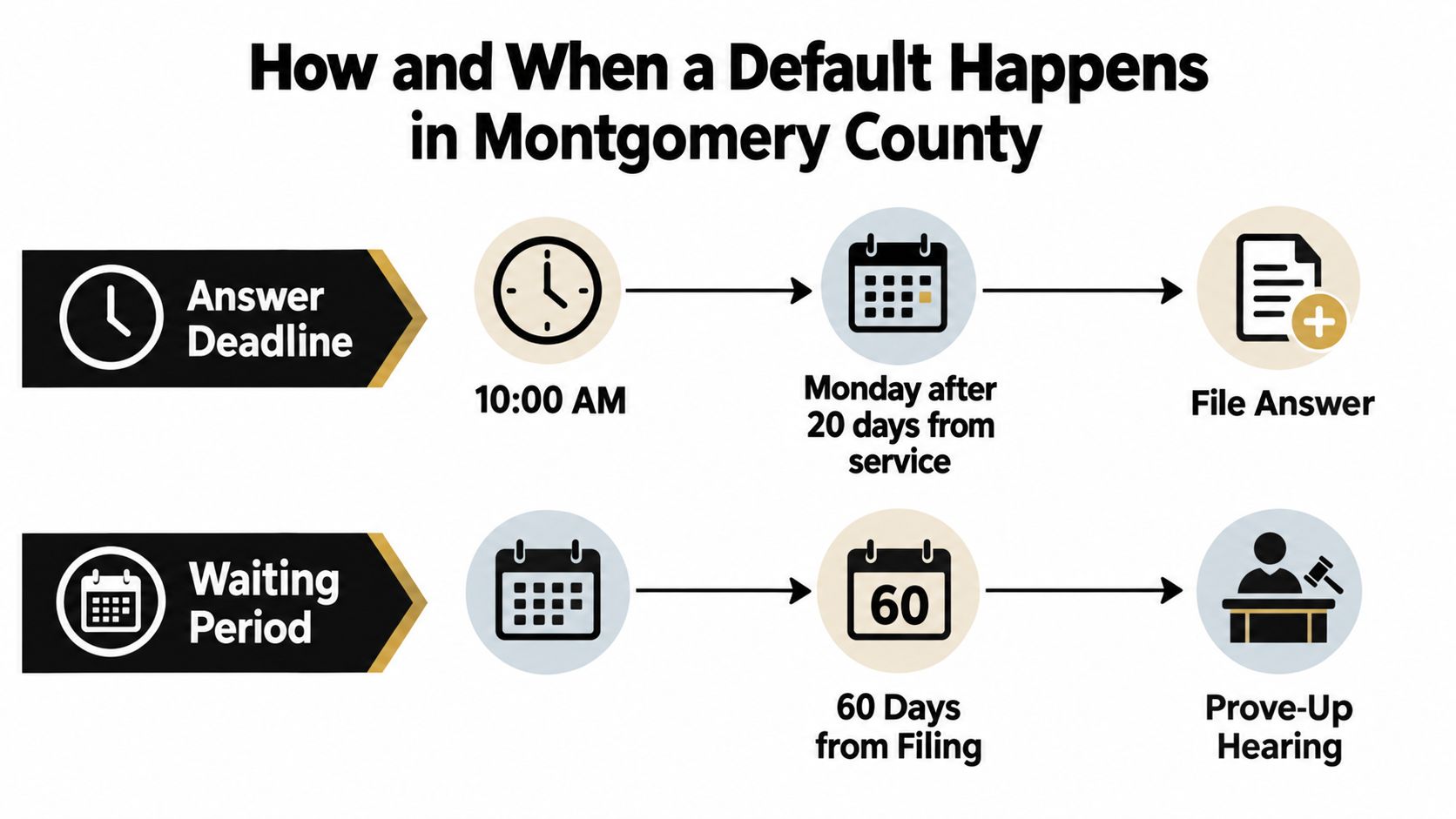
How and When a Default Happens in Montgomery County
Texas default divorce cases run on two separate clocks. The first clock concerns the respondent's answer. The second concerns when the divorce may be finalized. They start with different events, so confusing them can lead to missed rights or unrealistic expectations.
The answer clock starts with service
After a respondent is served with the divorce petition, the respondent generally must file a written answer by 10:00 a.m. on the Monday after 20 days have elapsed from service, according to the Texas State Law Library guide on answering a divorce. If the twentieth day falls on a Monday, the deadline moves to the following Monday. If the court is closed on the due date, filing is due on the next open court day.
This deadline is tied to service, not just the date the petitioner filed the case. The service return or other proof of service should be reviewed carefully. A respondent who waits until the last minute may have difficulty correcting a filing problem before the deadline.
Missing the answer deadline can make a default proceeding possible. It does not mean the petitioner can immediately obtain a final divorce.
The finalization clock starts with filing
Texas also has a waiting period before a divorce can generally be finalized. The court cannot finalize the divorce before the 61st day after filing, except for narrow family-violence situations, as reflected in Texas Family Code § 6.702 and the Texas Bar Practice divorce pleadings reference.
The exceptions are limited. The court may proceed sooner if the respondent was finally convicted of or received deferred adjudication for family violence against the petitioner or a household member. The law also recognizes an exception when the petitioner has an active protective order or magistrate's order for emergency protection based on family violence committed during the marriage.
These two clocks work side by side:
| Event | What it controls |
|---|---|
| Filing the petition | Starts the divorce waiting period |
| Service on the respondent | Starts the answer deadline |
| Failure to answer on time | May permit a default setting |
| Waiting-period completion | Establishes the earliest ordinary point for finalization |
| Prove-up hearing | Gives the petitioner an opportunity to present evidence |
If the spouse cannot be located, service may require a different process. Texas Family Code § 6.409 permits service by publication in appropriate circumstances. Texas Estates Code § 51.054 requires publication once on the state public information website and in a newspaper of general circulation in the county, with publication occurring at least 10 days before the return day, excluding the publication date, as summarized in this Texas service-by-publication discussion.
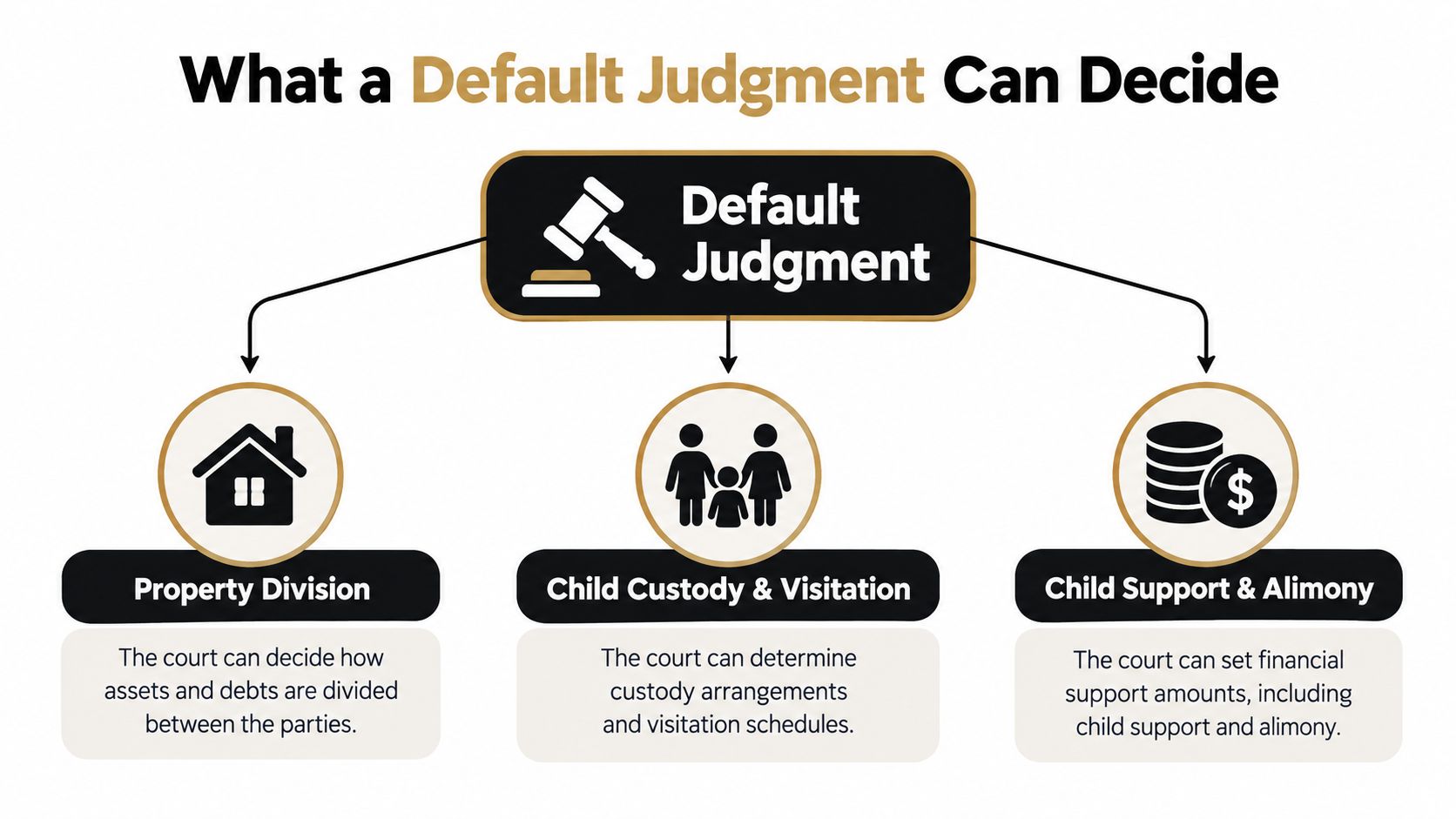
What a Default Judgment Can Decide About Property Custody and Support
A default judgment can address the major issues in a divorce, but the court needs a reliable foundation for each one. The absence of an answer doesn't give the petitioner permission to guess at values, assign debts without support, or create a parenting plan that lacks evidence.
Property division requires a usable financial record
Texas courts divide community property in a manner the court considers just and right. In a default case, the petitioner should organize evidence showing what the spouses own and owe, how each asset was acquired, and whether a claim of separate property is supported.
That may include deeds, account statements, loan records, retirement statements, vehicle titles, business records, tax documents, and an inventory and appraisement. The court may also need evidence of current values and outstanding balances.
A requested division involving a home in Panther Creek or Creekside may require more than a street address. The record may need the deed, mortgage balance, equity information, and evidence supporting the proposed allocation. If one spouse seeks an unequal division, the petitioner should be ready to explain the basis for that request.
For a more detailed discussion of these issues, see property division in a The Woodlands divorce.
Parenting orders are not rubber stamps
Texas uses conservatorship terminology rather than relying only on the word custody. A judge must focus on the best interests of the child when deciding conservatorship, possession, access, and related restrictions.
The petitioner should provide a practical parenting proposal. That may include school-week schedules, holiday periods, exchanges, transportation, communication, medical decisions, and how the parents will share information. The proposal should fit the children's ages, school arrangements, and known safety concerns.
A respondent's absence does not remove the judge's obligation to consider the children. The court may ask questions, request additional information, or modify proposed language before signing an order.
Support depends on evidence
Child support and medical support also require a factual basis. The court may need reliable information about income, employment, health insurance, childcare, and the children's needs. A petitioner shouldn't assume the judge will accept an unsupported amount just because the other parent didn't object.
The same caution applies to spousal maintenance. Eligibility and amount depend on legal requirements and evidence about the parties' financial circumstances. A prove-up should address the requested relief rather than treat silence as proof.
High-asset cases in Alden Bridge, Sterling Ridge, and other parts of The Woodlands often involve records that aren't easy to summarize from memory. A thin record can create problems later if a party challenges the decree based on inadequate proof, improper service, or unsupported asset values.
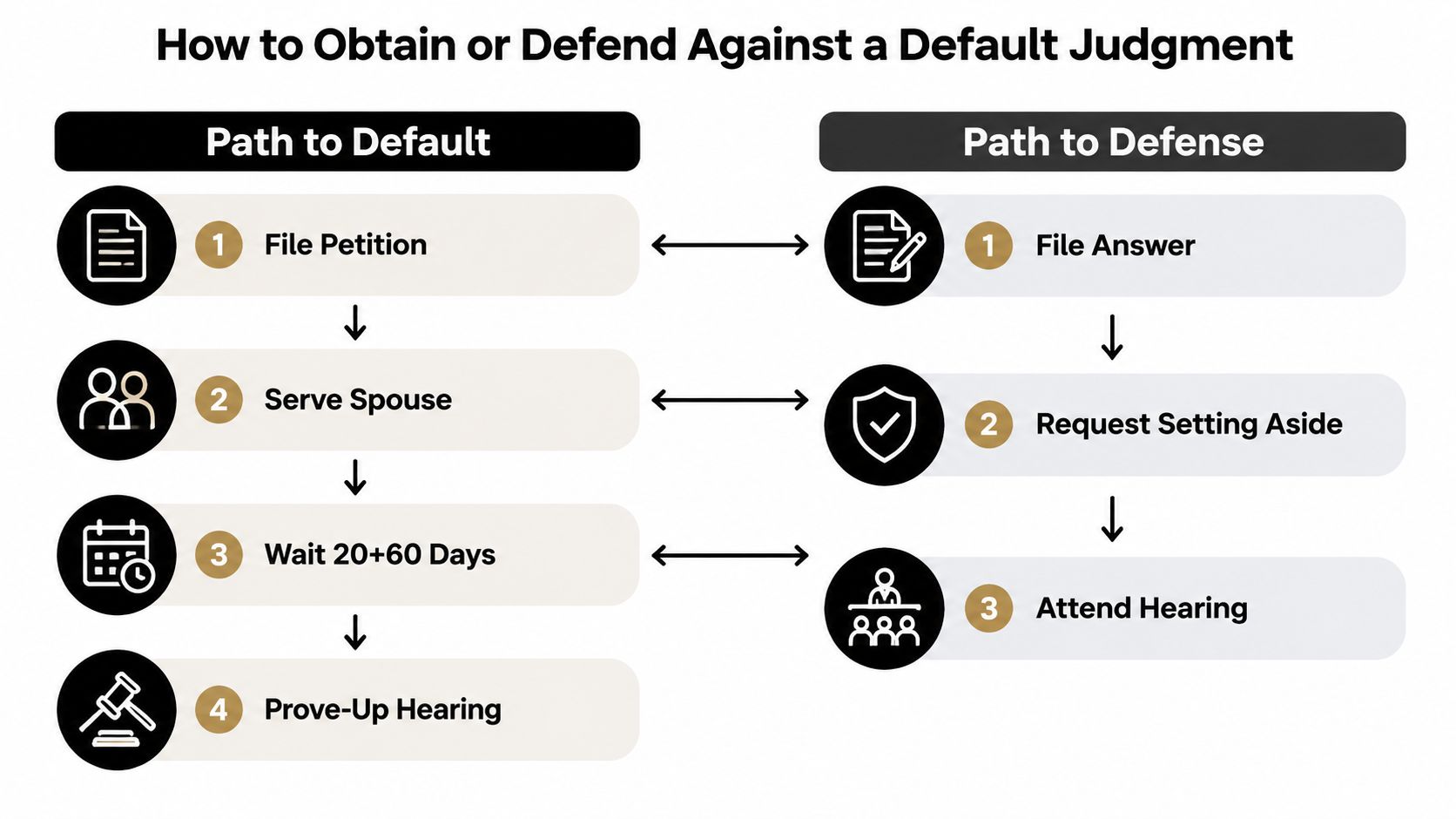
How to Obtain or Defend Against a Default Judgment
The petitioner and respondent face different urgent tasks. A petitioner must build a record that supports the requested decree. A respondent must preserve the ability to participate and challenge unsupported requests.
The petitioner's path
Start with the filed petition and the service documents. Confirm that the respondent was served in a legally valid manner and that the court record contains the appropriate proof. A default judgment based on defective service can be vulnerable.
Next, calendar both relevant dates. Track the answer deadline from the service date, and separately track the divorce waiting period from the filing date. Do not treat the passage of the answer deadline as permission to skip the waiting period or the prove-up.
Prepare the evidence before requesting a hearing. A useful file may include:
- Filed pleadings and service proof: Keep the petition, citation, return, waiver, and related filing confirmations together.
- Financial records: Gather statements, deeds, loan information, retirement records, business documents, and debt evidence.
- Children's information: Organize school, medical, schedule, and parenting details relevant to best-interest findings.
- Proposed decree: Make sure the proposed language matches the evidence and addresses every requested issue.
- Testimony outline: Prepare concise answers about the marriage, property, debts, children, support, and the requested orders.
At the prove-up hearing, answer the judge's questions directly. Don't assume a prepared decree speaks for itself. The court may need sworn testimony and supporting documents before entering judgment.
The respondent's path
Act immediately after service. File a written answer by the applicable deadline, which is 10:00 a.m. on the Monday after 20 days have elapsed from service, subject to the timing adjustments described earlier. A respondent who has missed the deadline should still seek prompt legal guidance rather than assuming the case is over.
A late appearance may be possible depending on the stage of the case and the facts. The respondent may also have options to ask the court to set aside a default judgment, but those options depend on matters such as service, notice, timing, and the reason for failing to answer.
Review the petition and proposed relief carefully. Look for requests involving the home, retirement accounts, vehicles, business interests, debt allocation, conservatorship, possession, support, and attorney's fees. Gather records that show why the proposed terms may be inaccurate or unsupported.
If a hearing is scheduled, attend it. Missing a custody hearing can create separate risks, so review what happens if you miss a custody hearing in Texas and obtain case-specific advice quickly.
Local Help Documents Fees and a Real World Scenario in The Woodlands
A first meeting becomes more productive when you bring the documents that show what happened and what is at risk. For a default divorce in Montgomery County, start with the petition, citation, service return, waiver if one exists, and every notice or setting received from the court.
Financial documents may include an inventory and appraisement, bank and investment statements, retirement records, deeds, mortgage information, vehicle titles, tax returns, business records, and debt statements. If children are involved, bring school information, medical details, existing orders, calendars, and communications that relate to parenting or safety.
A proposed final decree and a prove-up testimony outline can also help counsel identify gaps. The right documents depend on the case, so don't delay because your file isn't complete.
Bring the timeline first. The service date, filing date, answer deadline, and hearing date can determine what options remain.
Consider a short scenario. A Montgomery County spouse in Sterling Ridge was served with divorce papers and missed the answer deadline after assuming the other spouse would “work it out later.” The petition requested a property division and parenting terms that the served spouse believed were inaccurate. Counsel reviewing the file would need to examine service, determine whether a default hearing had occurred, collect financial and parenting records, and identify whether any procedure remained available to challenge the requested order.
Fees vary with the work required. A case involving only document review may require a different arrangement from one involving disputed real estate, business interests, retirement accounts, children, emergency issues, or a prove-up hearing. Ask what the engagement covers, which tasks are billed separately, and what documents the lawyer needs before giving a meaningful assessment.
The Texas judiciary's fiscal year 2023 report shows that family cases made up 43% of the total civil caseload, while about 40% of new family cases involved divorce and 30% involved child support IV-D matters. The same report states that new family-law cases were down 6% from the prior year and 21% from five years earlier, with divorce cases involving children down 6% and those without children down 5%, as reported in the Texas judiciary's Annual Statistical Report for fiscal year 2023. That workload helps explain why careful filing, deadline tracking, and familiarity with Montgomery County court practice matter.
The Law Office of Bryan Fagan handles divorce, child custody, child support, property division, and related family-law matters for clients in The Woodlands and surrounding Montgomery County communities. Its services can include strategic guidance in high-conflict cases, contested divorces, custody modifications, and enforcement matters.
What to Do Next and How The Law Office of Bryan Fagan Can Help
A default case rewards early organization. Whether you filed the petition or were served, preserve every document and write down the dates before relying on memory.
What to do next
- Calendar the answer deadline: Calculate the Monday deadline from the service date and account for the 10:00 a.m. filing time.
- Track the waiting period separately: Calculate the earliest ordinary finalization date from the filing date.
- Check service proof: Review the citation, return, waiver, or publication records for procedural problems.
- Preserve financial evidence: Collect records for real estate, accounts, retirement benefits, businesses, vehicles, and debts.
- Prepare parenting information: Gather school, medical, schedule, and communication records if children are involved.
- Contact counsel promptly: Ask a Montgomery County family lawyer to assess your options before a prove-up or final hearing.
A petitioner should not assume a missing answer proves every requested term. A respondent should not assume missing the answer deadline means no remedy exists. The result may depend on service, timing, the evidence, and whether a final judgment has already been signed.
This article is not legal advice. It provides general educational information about Texas default divorce procedure and doesn't create an attorney-client relationship. A lawyer must review your specific pleadings, service history, family circumstances, assets, debts, and court record before advising you.
For help evaluating a default divorce in The Woodlands, Montgomery County, or a nearby community, you can schedule a consultation with The Law Office of Bryan Fagan and discuss the deadlines, proof, property, and parenting issues affecting your case.
The Law Office of Bryan Fagan offers guidance on default divorce, contested divorce, child custody, child support, and property division for families in The Woodlands and surrounding Montgomery County communities. Visit The Law Office of Bryan Fagan to learn more and request a consultation focused on protecting your rights, assets, and parental interests.
