 Skip to content
You look at your phone, your stomach drops, and you realize the custody hearing was this morning.
Maybe you were in traffic on I-45. Maybe work would not let you leave. Maybe you wrote down the wrong date, or thought the hearing was by Zoom when it was in person in Conroe. However it happened, the first instinct is usually panic, then avoidance. That second part is the dangerous one.
If you're in The Woodlands, Spring, Magnolia, or anywhere in Montgomery County, what you do in the next few hours matters. A missed hearing in a Texas custody case can hurt your position fast, but the damage is not always permanent. The right response is quick, organized, and realistic.
This is the practical version of what happens if i miss a custody hearing texas. Not vague advice. Not scare tactics. A clear plan for what may have happened, what might happen next in Montgomery County family court, and what usually works better than excuses after the fact.
The Moment of Panic When You Miss a Hearing
A parent in The Woodlands misses a hearing more often than people think. It usually isn't because they stopped caring about their child. It's because life collided with a court setting, and court won.
One common version goes like this. A parent leaves Sterling Ridge early, planning to get to Conroe on time. A school call comes in, then a boss starts texting, then the calendar reminder turns out to be wrong. By the time the parent checks the case notice again, the hearing has already started or ended.
That moment feels bigger than it is. Serious, yes. Final, not always.
Practical rule: Don't spend the day arguing with yourself about whether the court will understand. Start building your response immediately.
What helps right now is shifting from panic to tasks. You need to find out what happened in court, whether an order was signed, and what deadline now controls your next move.
Three early mistakes make things worse:
- Waiting until tomorrow: Delay makes it harder to fix the record and harder to explain why you acted reasonably.
- Sending emotional messages: Angry texts to the other parent or long emails blaming everyone else can become exhibits.
- Assuming a good excuse is enough: Courts care about proof, timing, and procedure, not just whether your reason sounds sympathetic.
If your case is in Montgomery County, you need to think like someone solving a court problem, not like someone explaining a scheduling problem. Those are different things.
Immediate Legal Consequences in Texas Courts
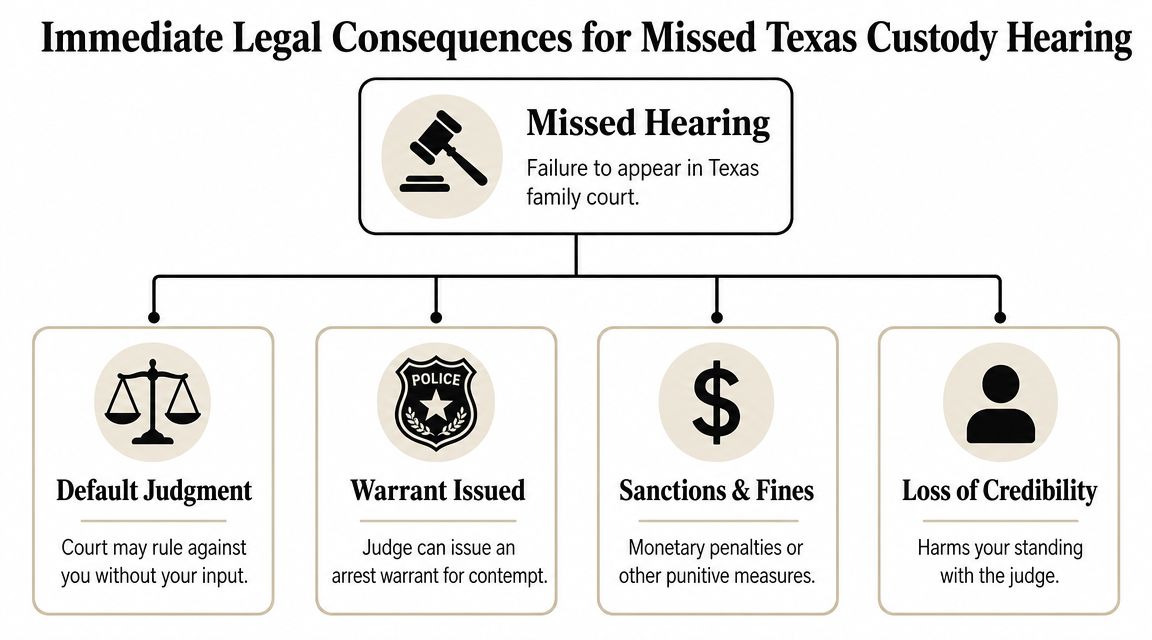
Texas family courts take nonappearance seriously. If you were properly served and did not answer or appear, the other side may be able to move forward without you. Under Texas Law Help's explanation of default in custody cases, if a respondent does not file an answer by the deadline computed as 20 days after service, plus the next Monday at 10 a.m., the other parent can ask for a default judgment, and the case may be finished without the missing party.
Default can happen faster than people expect
A default judgment means the judge may hear one side's evidence and sign orders without your participation. That can affect conservatorship, possession, support, and practical decision-making about the child.
The short version is blunt. If you were served, failed to answer, and missed the hearing, the court may proceed.
If a respondent in a Texas custody case does not file an answer and appear for a hearing after being properly served, the other parent can ask the judge for a default judgment. This means the case may be finished based on one side's evidence, leading to final orders on custody and support without the absent party's input.
Texas procedure matters here, and so does the Texas Family Code, especially the parts governing conservatorship, possession, and the best interest of the child. A judge still has to make orders that fit the law, but the judge may only have one parent in the courtroom giving facts.
Later in the case, evidence handling also matters. If your dispute expands into sworn testimony or document disputes, it helps to understand related tools like understanding the deposition process, because family cases often turn on records, statements, and credibility.
Sanctions and contempt are separate risks
A missed custody hearing is not only about default. Texas practitioner guidance also warns that courts may impose sanctions for nonappearance, including monetary fines and contempt-related consequences. The Texas Family Code provisions on enforcement and contempt are relevant when a party ignores court orders or fails to comply with court-directed obligations.
Here is the practical difference:
| Problem | What it means |
|---|---|
| Default | The judge may rule without hearing your side |
| Sanctions | The court may punish the nonappearance |
| Contempt exposure | If an order was violated, the court may treat it as disobedience |
| Credibility damage | The judge may see you as unreliable going forward |
This video gives a useful general overview of missed hearing issues in Texas family matters:
What usually does not work
Telling the court "I forgot" without documentation rarely fixes much. So does showing up days later with no motion on file and no written explanation. Judges hear scheduling excuses all the time.
What works better is immediate action, a documented reason, and a proper filing that asks the court to revisit what happened.
Real-World Scenario A Missed Hearing in The Woodlands
David lives in Sterling Ridge and works in north Houston. He had a temporary orders hearing in Montgomery County. The hearing mattered because the court was deciding the near-term schedule for his daughter, along with school-week possession and who would make certain decisions.
That morning, his employer pulled him into a problem that turned into hours. He thought he could leave in time, then realized he could not. He did not call the court. He did not call opposing counsel. He planned to "explain it later."
By the time he checked the docket, the hearing had already gone forward.
The judge signed the other side's proposed temporary order. David's possession was reduced to every other weekend, and he lost ground on decision-making authority because the only parent present was the one asking for those terms. That order then became the working reality for the child, the school, and both households.
The worst part was not just the missed date. It was the new status quo. Once a schedule is operating on paper and in real life, changing it takes effort, evidence, and a court willing to revisit what it already signed.
A missed hearing does not just create one bad day in court. It can hand the other side a clean record and a practical advantage.
That is why the first response after a missed hearing should be procedural, not emotional. You are trying to stop a one-time failure from becoming the story of your whole case.
Your Immediate What to Do Next Checklist
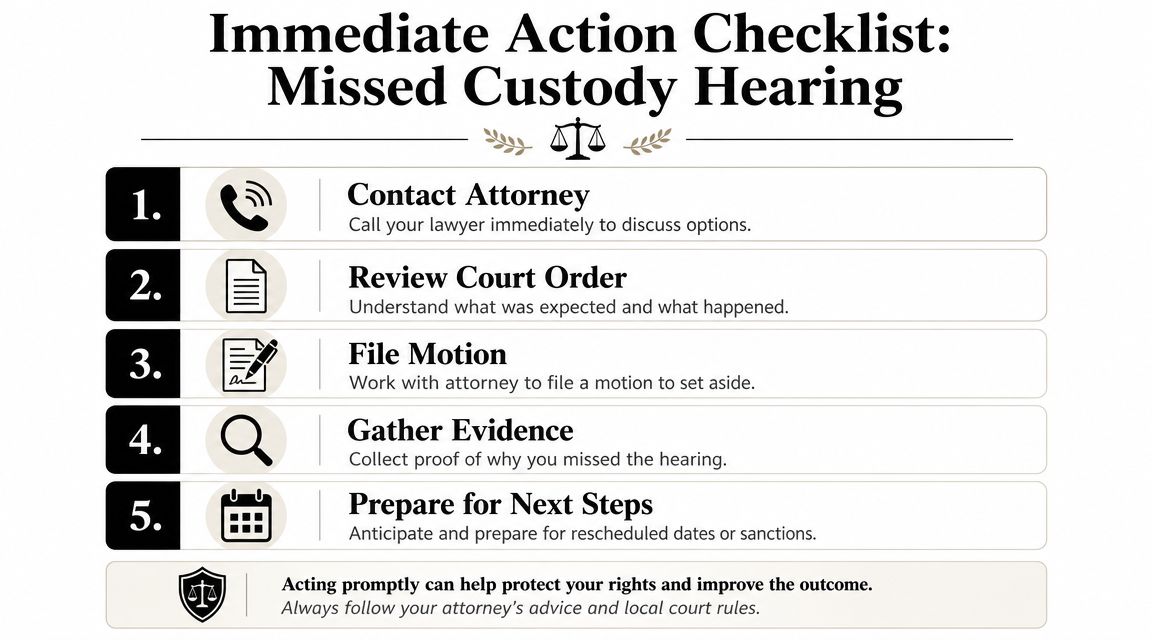
If you missed a hearing in Montgomery County, act today. Do these in order if possible, but do not let perfection slow you down.
Call the right people first
Start with the court clerk for the court where your case is pending. Ask whether the hearing was held, whether any order was signed, and how you can obtain a copy.
Then contact the opposing attorney's office, or the other parent if no attorney is involved. Keep it short and professional. You are not debating facts. You are confirming what occurred and that you are taking immediate steps.
- Ask for the result: Was the hearing reset, held, or concluded by default?
- Request paperwork: Find out whether an order was submitted or signed.
- Stay controlled: Do not accuse the other side of "tricking" you unless you have proof.
Gather proof before you tell your story
If you had a real reason, document it. Judges and lawyers sort excuses from evidence very quickly.
Useful proof may include:
- Medical documentation: A discharge sheet, urgent care note, or appointment record
- Work record: An email, supervisor message, or time entry showing an unavoidable conflict
- Transportation proof: Tow receipt, repair invoice, or roadside assistance record
- Notice problems: Screenshots or envelopes if there was confusion about date, time, or method of appearance
Save the documents exactly as they are. Don't edit screenshots or rewrite the timeline to make it sound cleaner.
File the motion that fits what happened
If the court signed orders after you missed the hearing, you may need a motion to set aside default, a motion for new trial, or a motion to reset, depending on the posture of the case. Legal advice becomes especially important at this stage, because the remedy depends on what the judge did, not what you fear happened.
A lawyer can review the docket, the notice, the proof of service, and the signed order. For local family law emergencies, some parents also review resources on emergency custody orders in The Woodlands to understand how fast temporary relief can affect possession and decision-making.
Build a short timeline
Do not write pages. Build one clean chronology.
- When you learned of the hearing
- What you believed the setting required
- Why you missed it
- When you called the court or counsel
- What order, if any, was entered
That timeline helps your attorney draft a motion and helps you stay consistent.
Get legal help quickly
Some people can file pro se. Some should not. If there is already a signed custody order, a contempt issue, or a claim that you were properly served and ignored the case, time and precision matter. One available option for Montgomery County family matters is the Law Office of Bryan Fagan, which handles custody disputes and related hearings in this area.
Long-Term Risks to Your Custody and Modification Case
The immediate problem is the hearing you missed. The longer problem is the record it creates.
Texas Access explains that enforcement penalties can include make-up parenting time and fees, and it also stresses the value of keeping a detailed journal, witness names, and records of denied access to support enforcement. In the same practical vein, Texas Access notes on enforcement and visitation explain that a missed hearing can create a paper trail that complicates future custody modifications and enforcement actions, and a defaulted order may make it harder to later modify custody while exposing a parent to consequences like make-up parenting time or attorney's fees if the court views the absence as neglect rather than an excusable mistake.

Judges remember patterns, not isolated explanations
One missed hearing does not automatically define you. Repeated missed settings, weak documentation, or delayed responses can.
In a later modification case, the opposing side may argue that you:
- Don't prioritize court orders
- Aren't dependable with exchange times or notice requirements
- Create instability for the child
- Only react when an order goes against you
Those arguments become more effective when they are tied to documents already in the court file.
A bad temporary order can harden into the normal arrangement
This is one of the most overlooked risks in Montgomery County cases. A temporary possession schedule that started because you missed one hearing can start to look "workable" after enough weeks pass.
Courts often care about stability. If the child has been living under a certain routine, the other side may argue that changing it again would create disruption. That does not mean you cannot fix it. It means delay helps the parent already benefiting from the order.
For many parents, the next legal issue becomes modification. If that is where your case is heading, it helps to understand custody modification in The Woodlands through the lens of what is already in your file.
Your absence can become evidence. Not because the hearing itself proves bad parenting, but because the record may suggest disorganization, noncompliance, or indifference unless you correct it quickly.
Support and possession are not the same issue
Parents sometimes assume a missed custody hearing changes everything at once. It doesn't work that way. Under the Texas Family Code, child support duties and possession rights are legally distinct. Falling behind on one does not erase the other, and problems with visitation do not automatically cancel support obligations.
That separation is important because parents sometimes make the mistake of "self-help." They stop paying, stop showing up, or stop following the order because they think the case is already broken. That usually makes the file worse, not better.
Navigating the Montgomery County Courthouse Procedures
If your case is in Montgomery County, local procedure matters as much as legal theory. The practical first step is confirming which court is hearing your family case and what the clerk's file shows today.

Start with the district clerk and the case file
Family cases in Montgomery County are commonly handled through the district courts in Conroe. For many readers in The Woodlands, Spring, or Magnolia, that means the courthouse process feels unfamiliar until there is a crisis.
Before you file anything, confirm:
- The court number: Your motion has to go into the correct court file.
- Whether an order was signed: This determines whether you need a reset request or a motion attacking an existing order.
- The next setting: Sometimes another hearing is already on the calendar before you realize it.
A parent looking for a local overview of setting expectations can review child custody hearings in Montgomery County alongside the actual paperwork in the case.
Local practice rewards speed and clean paperwork
Montgomery County judges and staff deal with busy dockets. If you missed a hearing, showing up later with an emotional explanation and no filing usually does not move the case forward.
A better approach is disciplined:
| Step | Why it matters locally |
|---|---|
| Check the docket | You need to know what happened, not guess |
| Pull the signed order | The exact wording controls your next move |
| Prepare a narrow motion | Judges respond better to focused requests than long narratives |
| Set a hearing promptly | Delay makes the court wonder why the issue was not urgent to you |
Know what you are asking the court to do
There is a big difference between asking to reset a hearing that never really occurred as to you and asking the court to undo an order that has already been signed. Each request should explain the missed appearance, attach supporting proof if available, and show that you are prepared to move forward.
In family cases, the relevant legal framework often includes the Texas Family Code title on the parent-child relationship. You do not need to memorize it, but you do need to understand that procedure and substance work together. A strong parenting argument can still lose if the procedural response is weak.
In Montgomery County, the parent who acts first after a mistake usually has the better chance of containing it.
If you live in Creekside, Panther Creek, Alden Bridge, or nearby communities, the geographic drive to Conroe is not the hard part. The hard part is making sure every call, filing, and court appearance after the missed hearing is deliberate.
Frequently Asked Questions About Missed Court Dates
What if I had a real emergency
A real emergency helps only if you can prove it and act quickly. Courts respond much better to a documented emergency plus a prompt motion than to a bare explanation days later.
Does missing a hearing stop child support
No. In Texas family law, support and possession are separate issues. A missed hearing or visitation dispute does not automatically cancel a support obligation.
Should I just wait for another court date
Usually not. If an order was signed, waiting can make your position worse. You need to find out what the court did and respond based on the actual docket.
Can I fix this without a lawyer
Sometimes, but not every case is a good do-it-yourself case. If default, sanctions, contempt concerns, or a major change in possession is involved, getting advice quickly is usually the safer path.
This article is for educational purposes only and is not legal advice. Family-law outcomes depend on the exact court, notice, filings, service history, and orders in your case.
If you missed a custody hearing in The Woodlands or anywhere in Montgomery County, a calm and fast response can matter more than the reason you missed it. The Law Office of Bryan Fagan works with parents facing custody disputes, enforcement issues, and urgent post-hearing problems in local family courts. If you need help figuring out what the court did and what to do next, you can schedule a consultation to review the file and discuss your options.
