 Skip to content
A minor traffic stop in The Woodlands can become a weapons case before a driver understands what happened. An officer stops a vehicle on Woodlands Parkway or Research Forest Drive, notices a firearm, asks who it belongs to, and then requests permission to search. Within minutes, a routine encounter may involve handcuffs, a trip to the Montgomery County Jail, and questions about a weapons charge that depends on far more than whether a gun was present.
The outcome usually turns on the exact statute, the location, the person's criminal record, the timing of prior convictions, and how police obtained the evidence. A weapons charge lawyer in The Woodlands, TX, needs to investigate those details immediately, not simply wait for the charging paperwork to explain the case.
A Woodlands Traffic Stop That Turned Into a Weapons Charge
Consider a common situation. A driver is pulled over near Research Forest for a traffic violation. The driver answers the officer's questions, explains that there's a handgun inside the vehicle, and agrees when the officer asks to look around. The officer finds the firearm near the center console. A passenger says it belongs to the driver, and the encounter shifts from a traffic stop to an investigation.
The first decision point is conversation. A driver generally shouldn't try to explain ownership, transport, or the reason for carrying while standing beside a patrol vehicle. Statements made before arrest can become part of the officer's report, and later explanations may be compared against body-worn-camera footage and witness accounts.
The second decision point is consent. A person can decline a voluntary search without arguing or physically interfering. Saying, “I don't consent to a search, but I'll comply with your instructions,” is different from resisting. Consent issues matter because the State may rely on the search itself to prove possession, location, or knowledge.
The third decision point is timing. Once handcuffs go on, the person should stop answering substantive questions and clearly request a lawyer. A request for counsel should come before any field interview, recorded statement, or attempt to explain why the weapon was in the vehicle.
Practical rule: Don't try to win the case on the roadside. Preserve the record, remain calm, and let counsel analyze the stop and search.
A vehicle search can raise several factual questions. Did the officer have a lawful basis to extend the traffic stop? Was the firearm visible? Was it inside a locked container, a console, or a bag? Were multiple people in the vehicle? Did anyone give consent, and was that consent voluntary?
Those details often determine whether the case involves unlawful carrying, prohibited possession, possession in a prohibited place, or no charge that can survive a legal challenge. The remaining questions are how Texas classifies the conduct, what Montgomery County prosecutors may do with it, and which facts give a local defense attorney an advantage.
Texas Weapons Offenses Explained in Plain English
Texas weapons cases often begin with a label that doesn't tell you much. “Weapons charge” could describe unlawful carrying, prohibited-location possession, felon-in-possession allegations, or possession of an item listed under a specific statute. The Texas State Law Library identifies Penal Code §§ 46.02 and 46.04 as core firearm-carry and possession provisions, but the charging decision depends on the facts of the encounter. Texas firearm-carry provisions
Unlawful carrying under Section 46.02
Texas Penal Code § 46.02 addresses unlawfully carrying a handgun outside the person's home or vehicle. The classification can depend on the location, the person's history, and other statutory facts. A routine allegation may be treated as a misdemeanor, while a prohibited-location or prior-record issue can create felony exposure.
A driver with a handgun in a vehicle may think the case is resolved because the gun wasn't on their body. That assumption can be wrong if the State claims the person carried it unlawfully, knowingly possessed it, or possessed it in a place where weapons are restricted.
Felon in possession under Section 46.04
Section 46.04 focuses on possession of a firearm by a person with a qualifying felony conviction. Under the Texas Penal Code, possession before the fifth anniversary of release from confinement or supervision can expose a felon to a third-degree felony. Possession after that window may still be chargeable if it falls outside the lawful home-premises exception. Texas unlawful-possession guidance
For example, someone with an old DWI probation record may assume the passage of time eliminates all firearm risk. The attorney must verify whether the prior conviction legally qualifies, when supervision ended, and whether the firearm was in the person's residence or vehicle.
Prohibited places under Section 46.03
Section 46.03 prohibits intentional, knowing, or reckless possession of certain weapons in listed locations. Those locations include schools, polling places during election periods, courts and court offices, racetracks, secured airport areas, correctional facilities, certain hospitals and nursing facilities with notice, amusement parks, and certain alcohol-focused businesses. Texas prohibited-place rules
The familiar 30.06 and 30.07 signs can also affect where a license holder may carry, but the sign, its placement, and the conduct alleged all need review. A firearm carried into a Woodlands business, school-related setting, or government facility may trigger a different analysis from a firearm found in a private vehicle.
Prohibited weapons under Section 46.05
Section 46.05 covers possession of listed prohibited weapons, including knuckles and similar items. The item's actual design and the statutory definition matter. A metal object described casually as “brass knuckles” may require examination rather than assumption.
| Statute | Common Name | Quick Example |
|---|---|---|
| Texas Penal Code § 46.02 | Unlawful carrying of a weapon | A person carries a handgun outside the home or vehicle and the State alleges the statutory requirements for unlawful carrying are met. |
| Texas Penal Code § 46.03 | Possession in a prohibited place | A person possesses a firearm in a court, school, secured airport area, or another listed location. |
| Texas Penal Code § 46.04 | Felon in possession | A person with a qualifying felony conviction possesses a firearm during the restricted period or outside the lawful home-premises exception. |
| Texas Penal Code § 46.05 | Possession of a prohibited weapon | A person possesses knuckles or another item listed by the prohibited-weapons statute. |
Family proceedings can create a separate firearms issue. For background on how family cases proceed in the courts serving The Woodlands, see Montgomery County Family Courts: A Local Guide. That subject matters because a family-law order and a criminal weapons charge can develop on separate tracks.
How Severity and Charges Actually Stack Up
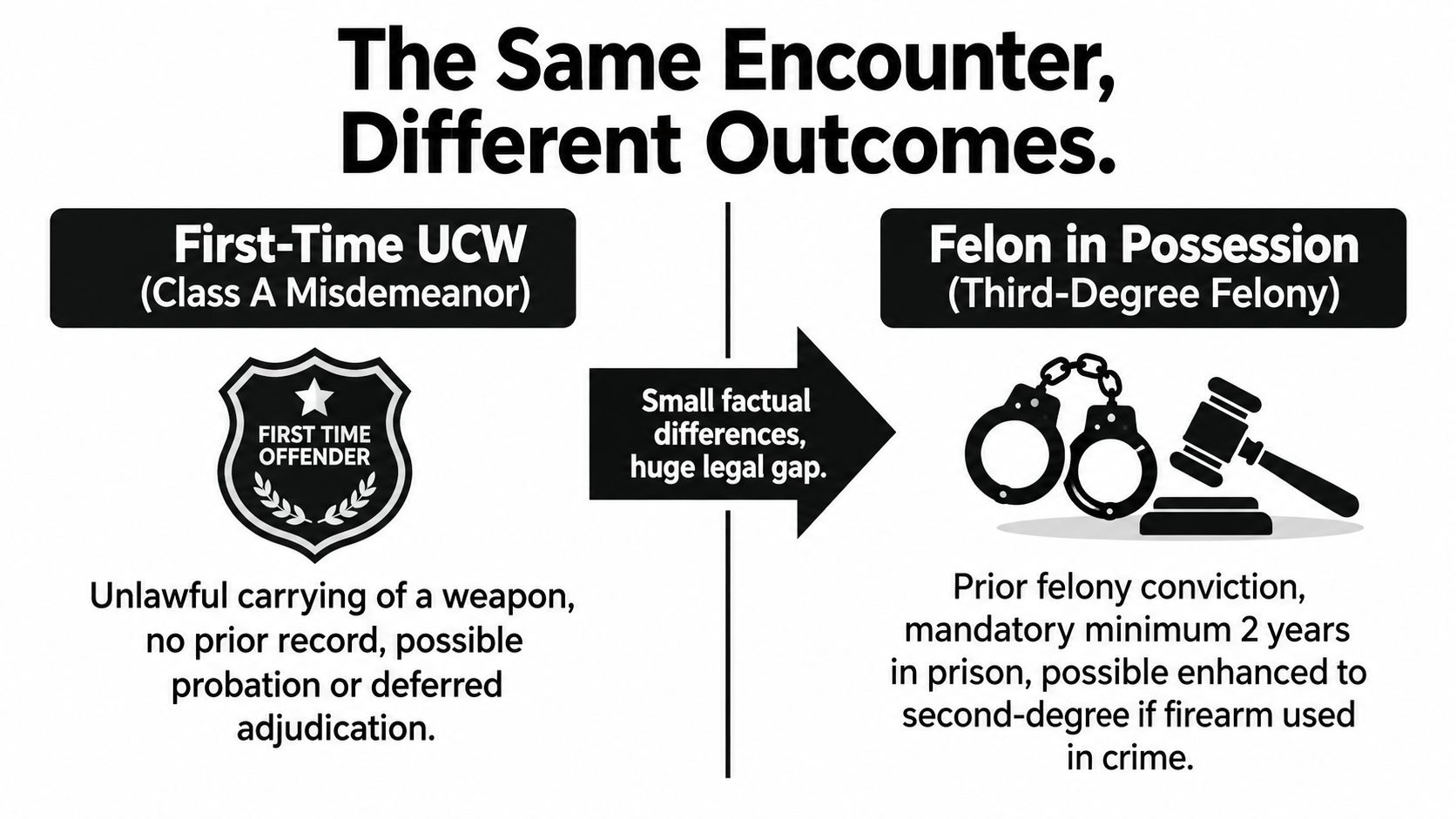
The same firearm and the same traffic stop can produce very different exposure. A standard unlawful-carrying allegation is commonly treated as a Class A misdemeanor, carrying up to 1 year in county jail and a $4,000 fine. Certain prohibited-place or prohibited-possession scenarios can become a third-degree felony, carrying 2 to 10 years in prison and up to a $10,000 fine. Texas weapons-charge penalty analysis
The charge can also change when a prior record is involved. Under Section 46.04, possession by a felon before the fifth anniversary of release from confinement or supervision can be a third-degree felony. After that period, the home-premises exception and the precise location of the firearm can still matter.
The same facts do not create the same case
| Situation | Potential classification | Main issue |
|---|---|---|
| First-time unlawful carrying allegation | Commonly Class A misdemeanor | Whether the State can prove unlawful carrying and whether the stop or search was lawful |
| Possession by a person with a qualifying felony conviction | Third-degree felony exposure during the applicable period | The prior judgment, release date, supervision records, and location of the firearm |
| Possession in a listed prohibited place | Generally third-degree felony | Whether the location qualifies and whether the State can prove the required mental state |
A prior conviction may affect classification, but counsel must inspect the actual judgment and records. A label in a police report isn't enough to establish that a prior offense qualifies under the current statute. Location matters just as much. A gun found in a person's residence can raise a different issue from one found in a vehicle, workplace, school setting, or court facility.
The practical points of impact are early and concrete: obtain release and supervision records, preserve video, examine the officer's reason for the stop, and test the search. Prosecutors may view a case differently once the defense identifies a gap in knowledge, possession, location, or statutory classification.
First Steps After a Weapons Arrest in The Woodlands
The first hours after arrest are about preventing avoidable damage. A person may be released through the Montgomery County Jail process and later appear before a magistrate. Bond depends on charge severity and criminal history, and available coverage describes a common range of about $1,000 to $2,000 for a standard unlawful-carrying charge, with higher averages reported in nearby Dallas and Tarrant counties. Texas bond and gun-rights overview
Use this checklist:
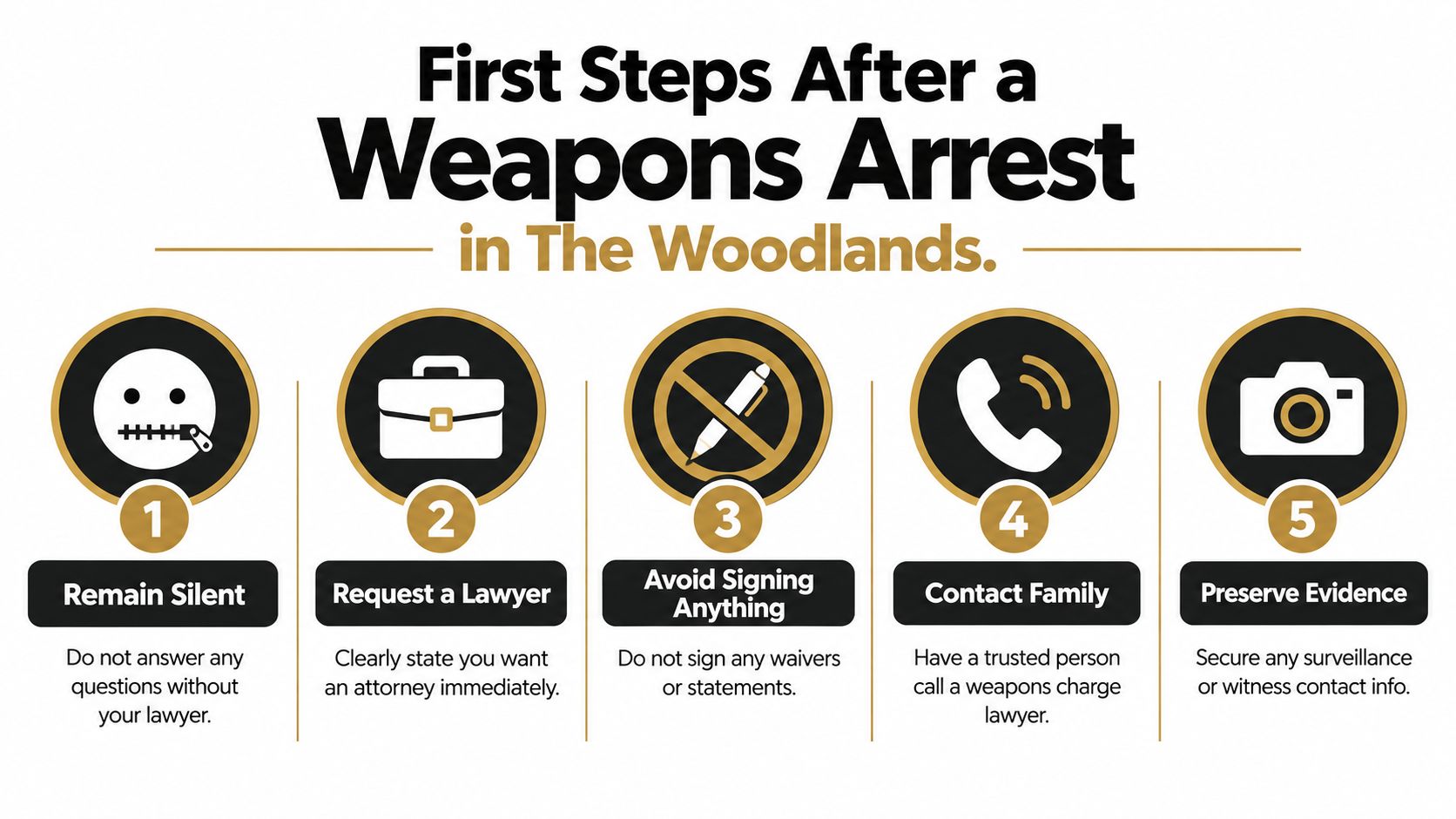
Remain silent. Don't answer substantive questions for the Montgomery County Sheriff's Office, Texas Department of Public Safety investigators, or anyone else investigating the allegation. Give identifying information when required, then say you want a lawyer.
Request counsel clearly. Ask for a criminal-defense attorney before a field interview, recorded statement, or follow-up conversation. Don't assume that asking to speak with family replaces a request for counsel.
Avoid signing statements. Don't sign waivers, written narratives, property acknowledgments, or consent forms without legal review. A late statement can conflict with body-camera footage or another witness.
Preserve digital evidence. Don't delete texts, photographs, social-media posts, location records, or firearm-related messages. Ask a trusted person to preserve relevant phone data, dashcam footage, and surveillance information.
Record the scene. Write down the road, time, reason given for the stop, people present, search location, questions asked, and whether anyone consented. Identify passengers and witnesses before memories fade.
Secure jail paperwork. Keep the booking paperwork, bond documents, property receipt, and every written condition. Missing a condition can create new problems and complicate negotiations.
Call counsel before the magistrate hearing. A lawyer can review the allegation before the initial hearing and address conditions that affect travel, firearm possession, contact with family members, or employment.
Montgomery County residents often focus on getting out of jail and overlook the paperwork that follows. Save every document, including notices that appear routine. The terms of release can influence later court decisions even when the original charge is a misdemeanor.
What 2025 Texas Law Changes Mean for Your Case
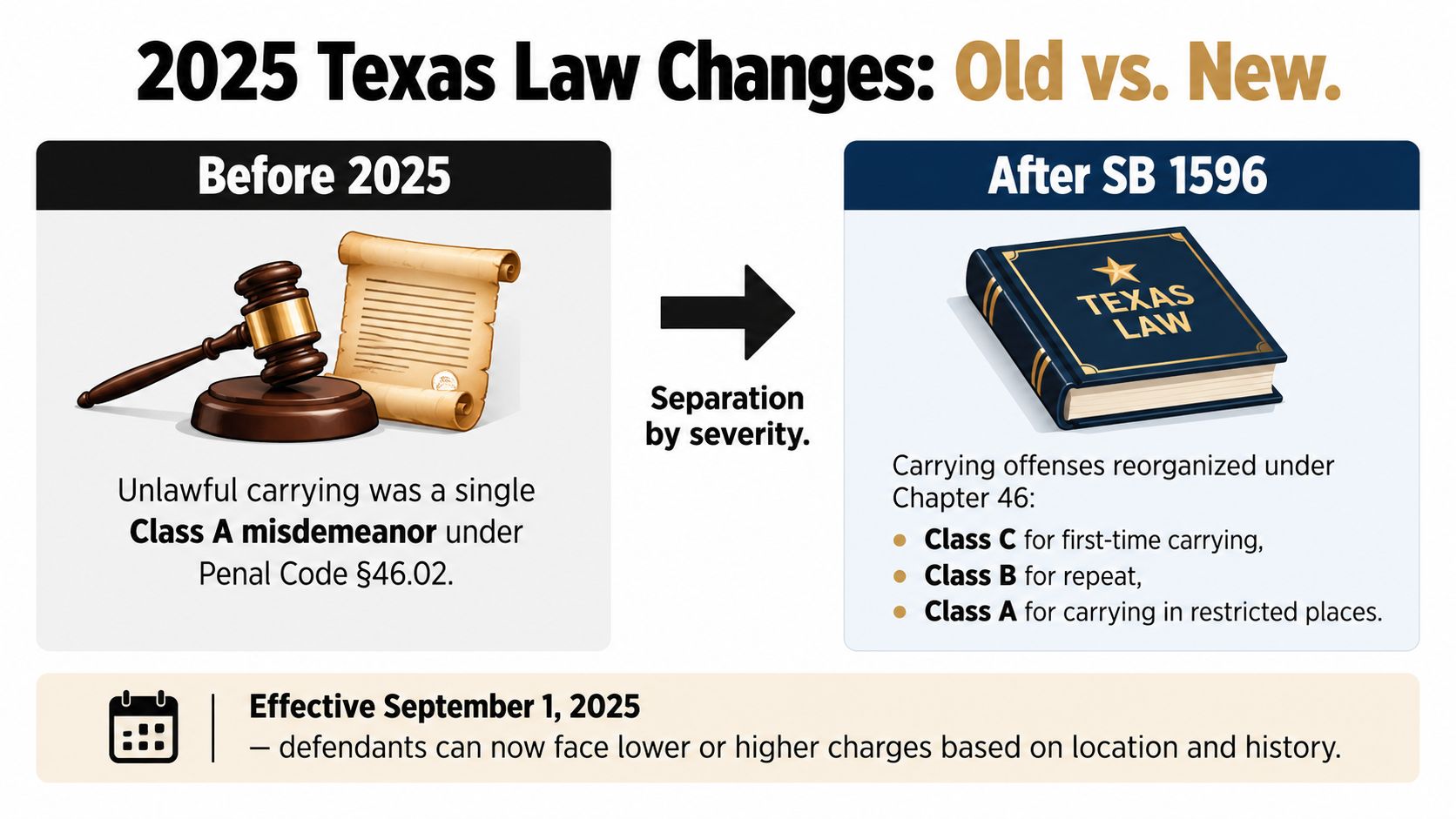
Texas's 2025 changes created confusion because several gun-law questions changed at the same time. Recent reporting identifies SB 1596, effective September 1, 2025, as removing short-barrel firearms from Texas's prohibited-weapons list. The same reporting identifies SB 1362 as rejecting recognition of red-flag orders and extreme-risk protective orders in Texas. Texas's 2025 gun-law changes
That doesn't mean every short-barrel firearm issue disappeared. Federal law can differ from Texas law, and a prosecutor still must identify the statute supporting the state charge. Counsel should examine the item, the date of the alleged conduct, the charging language, and whether police relied on outdated training or an old FAQ.
Permitless carry also doesn't eliminate every restriction. Qualifying adults may carry under Texas law, but federal disqualifications and location-specific restrictions still matter. A person can be legally eligible to carry in one setting and face a serious allegation in another.
Current-law warning: Don't rely on a forum post or an old carry guide. The item, location, date, and person's legal status must be matched to the statute in effect when the conduct allegedly occurred.
A protective order presents a separate concern. Texas protective orders can bar a person found to have committed family violence from possessing firearms, and the ATF's Texas summary explains that a protective order may include that restriction. ATF Texas firearms-law summary This can matter in Montgomery County divorce, custody, enforcement, and family-violence proceedings even when no criminal weapons charge has yet been filed.
The practical question for a Woodlands defendant isn't whether a law changed. It's whether the change affects the exact item, the exact location, the exact date, or the exact order involved.
Defenses and Mitigation Strategies That Hold Up
A strong defense starts with the theory that matches the evidence. Suppression may be the right focus when the officer extended a traffic stop without lawful grounds or searched beyond the limits of a lawful frisk. Article 38.23 of the Texas Code of Criminal Procedure can become important when the State's evidence resulted from an unlawful search or seizure.
That strategy has a trade-off. Suppression litigation can take time, and the defense may need to reveal part of its factual theory through motions and hearings. But if the firearm is excluded, the prosecution's case may change substantially.
Match the defense to the proof
| Defense Strategy | Best Trigger | Typical Montgomery County Outcome | Client Trade-Off |
|---|---|---|---|
| Search-and-seizure challenge | Weak basis for the stop, extension, or search | Possible exclusion of the firearm or related statements | Requires detailed litigation and may delay resolution |
| Lack of knowledge or possession | Firearm found in a shared vehicle or area | Focus shifts to control, access, ownership, and awareness | The State may rely on circumstantial evidence |
| Prior-record challenge | The State uses an incorrect or legally insufficient prior conviction | Potential reduction in felony exposure | Requires certified records and careful timeline review |
| License-holder defense | Statutory criteria fit the person and conduct after the 2025 changes | May affect the classification or negotiation posture | The defense may fail if a location restriction applies |
| Self-defense justification | Evidence supports a reasonable need to use force | Can support dismissal discussions or trial defense | Every action, statement, and witness account will be scrutinized |
| Identification challenge | Suggestive show-up or unreliable identification | May weaken an essential part of the State's proof | Courts examine the full identification procedure |
A firearm in a vehicle with several occupants creates a possession question. The State may need to prove more than proximity. Messages, fingerprints, admissions, ownership records, and witness accounts can all affect whether the evidence shows knowing possession.
Mitigation is different from winning a suppression motion. A safety course, community references, stable employment records, and a carefully organized character packet may help during negotiations, but they don't replace a legal defense. A client should weigh whether a negotiated resolution protects future record options. For related information, review record sealing considerations for The Woodlands.
How a Weapons Charge Lawyer Helps at Every Stage
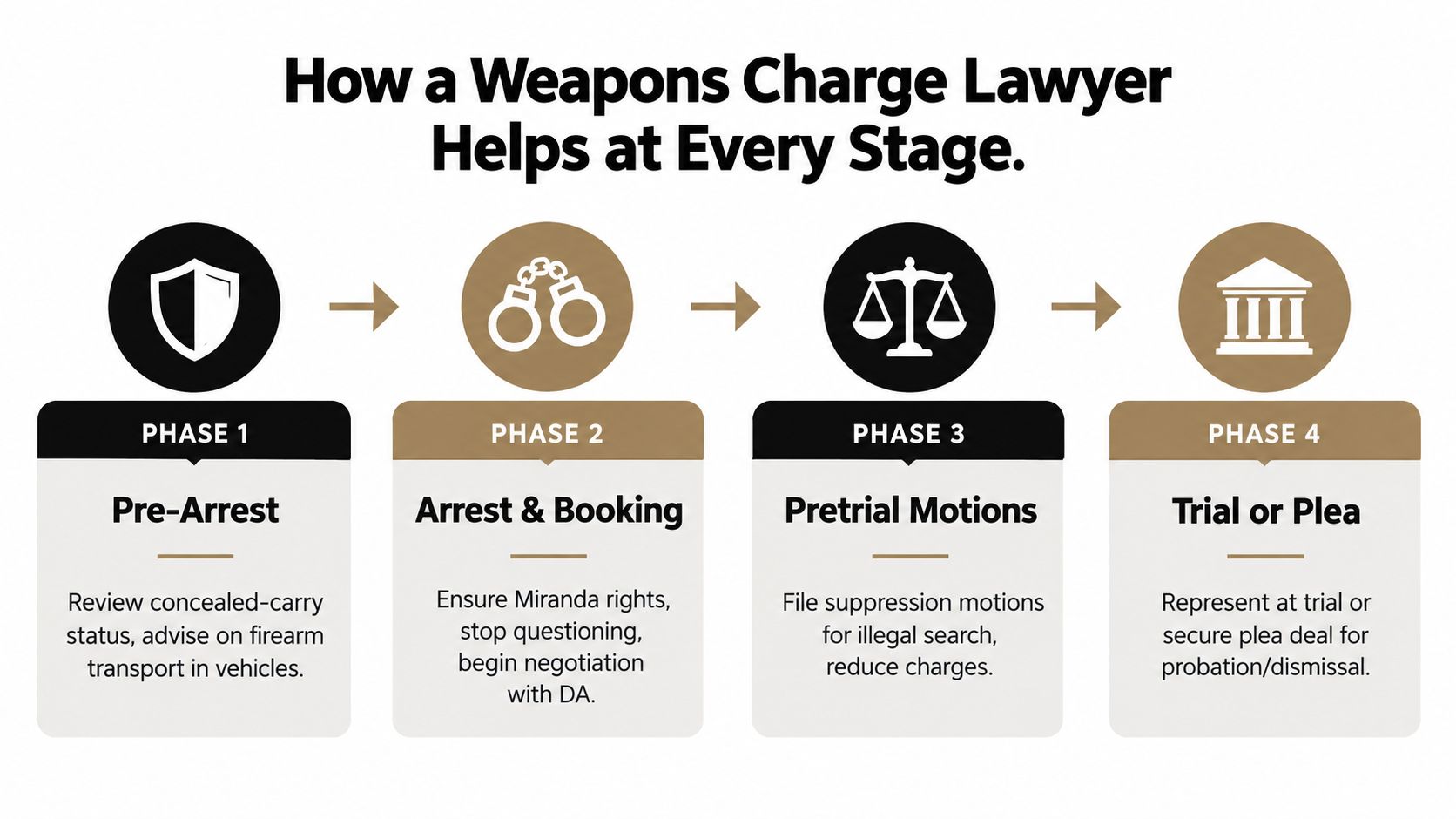
A weapons-defense attorney can add value before an arrest, during booking, throughout pretrial litigation, and at trial. The earlier the review begins, the more likely counsel can preserve video, obtain records, and address bond conditions before the case hardens around the police narrative.
Before arrest
Pre-arrest advice can prevent a legal problem from becoming a criminal case. Counsel may review concealed-carry status, firearm transport in vehicles, pending license-to-carry issues, and the effect of a protective order or prior conviction. The goal is accurate advice tied to the client's specific facts, not a general internet summary.
Arrest and booking
After arrest, the immediate work includes stopping unnecessary questioning, reviewing the booking paperwork, and preparing for a magistrate appearance in Conroe. Counsel can examine bond conditions and challenge restrictions that are unsupported or unnecessarily broad.
The attorney also begins testing the original stop. Was the traffic violation legitimate? Did the officer extend the detention? Did the officer request consent? Was the firearm visible, and did police document who had access to it?
Pretrial litigation
The Montgomery County District Attorney's Office evaluates evidence, criminal history, location, and the applicable statute. Defense counsel can use suppression motions, prior-record challenges, possession disputes, and statutory changes to create negotiation leverage.
A diversion or reduced-charge discussion may depend on the client's record and the strength of the State's proof. Safety-course completion and a structured character packet can support mitigation, but counsel must first determine whether accepting a plea would create firearm, employment, immigration, licensing, or record consequences.
For broader context about local defense representation, see criminal defense services in The Woodlands.
Trial preparation
Trial work requires more than reviewing the arrest report. Counsel may examine the arresting officer's Texas Department of Public Safety audit, dispatch records, body-camera footage, property records, laboratory materials, and every version of the State's possession theory.
Motions to suppress can determine what the jury never hears. If the case reaches trial, jury instructions must address the charged offense, possession requirements, justification issues, and any weapon-related enhancement supported by the indictment and evidence.
The Law Office of Bryan Fagan primarily serves families in The Woodlands and surrounding Montgomery County communities in family-law and probate matters. A person facing a criminal weapons charge should confirm that any lawyer considered has the specific criminal-defense experience needed for the charge and court involved.
Choosing Counsel and Scheduling a Consultation
A Woodlands resident should evaluate counsel based on relevant experience, not just a website description. Look for a Texas State Bar criminal-defense certification, a record of handling cases in Montgomery County courts, familiarity with local prosecutors and judges, and actual weapons-trial experience.
Ask direct questions during the consultation:
- Who will appear at hearings? Confirm whether the lawyer you meet will handle the magistrate hearing, pretrial settings, motions, and trial.
- What is the fee structure? Ask what the fee covers, what could create additional costs, and whether investigators or expert services are separate.
- What happens first? The attorney should identify the first records to obtain and the immediate risks involving bond or release conditions.
- What are the realistic timelines? No lawyer can promise an outcome, but counsel should explain the procedural stages and factors that may cause delay.
- Have you tried weapons cases before a Montgomery County jury? A trial record matters if negotiations fail.
- What defenses fit these facts? Listen for specific questions about the stop, search, possession, location, prior record, and the firearm itself.
Bring the arrest affidavit, bond paperwork, property or inventory receipt, search-warrant materials if any, and references to body-camera or dash-camera footage. Include the names of passengers and witnesses, relevant messages or photographs, prior criminal-history documents, and proof of lawful firearm ownership such as an LTC.
You can also review information about a criminal-defense lawyer in The Woodlands while comparing counsel. This article is not legal advice, and no online explanation can determine whether a particular search, conviction, protective order, or charge is legally valid. Early consultation generally preserves more investigative and negotiation options than waiting until a court date is close.
The Law Office of Bryan Fagan serves The Woodlands and surrounding Montgomery County communities, with its primary practice focused on family law and probate rather than criminal weapons defense. Visit The Law Office of Bryan Fagan to schedule a confidential consultation about a related family-law issue, including how a protective order or firearm restriction may affect your case.
