 Skip to content
You may be reading this right after a CPS investigator, a caseworker, or a court ruling turned your world upside down. In The Woodlands and across Montgomery County, parents often call only after they realize they're dealing with more than one kind of appeal, and that the deadline depends on which kind of decision they're fighting.
That confusion is common. It's also dangerous.
A parent can be dealing with an administrative CPS finding on one track and a court order on another. Those are not the same process. They aren't heard in the same place, and they don't move on the same timetable. If you're searching for a CPS appeal attorney in Montgomery County, the first job is to identify which decision you're trying to challenge before a deadline closes.
After the CPS Ruling What Happens Now
A parent in The Woodlands gets a call, then a letter, then maybe a hearing date. By the time they sit down at the kitchen table, they're trying to sort out words like “reason to believe,” “conservatorship,” “termination,” and “appeal,” while also figuring out school pickup and whether they should answer the next CPS call.
That moment feels chaotic, but it can be managed.
The first thing to understand is that a negative CPS result is not always the end of the case. Some decisions can be challenged. The hard part is knowing what kind of ruling you received and what deadline controls it. If you're still in the investigation stage or trying to understand the earlier parts of the process, this overview of how to fight CPS in Montgomery County helps put the appeal question in context.
Immediate reality: The right move after a CPS ruling usually isn't talking more. It's getting the paperwork, identifying the decision, and finding out what clock is already running.
What parents usually get wrong
Many parents assume “appeal” means one single form and one single deadline. It doesn't. A CPS administrative finding and a final family court order are different animals.
Parents also wait for someone else to explain the next step. That delay can cost valuable time. In real practice, the safest approach is simple: keep every document, stop guessing about deadlines, and get a lawyer to review the exact paper you received.
A word of caution
This article is for general education only. It is not legal advice, and reading it doesn't create an attorney-client relationship. CPS appeals turn on the exact wording of the finding, the date a document was signed, and the posture of the case under Texas law. If your rights as a parent are at risk in Montgomery County or The Woodlands, speak with a qualified attorney promptly.
Understanding Your Two Main Appeal Paths
The biggest mistake I see is treating every CPS outcome like it goes through the same appeal channel. It doesn't. Parents usually need to sort their case into one of two paths.
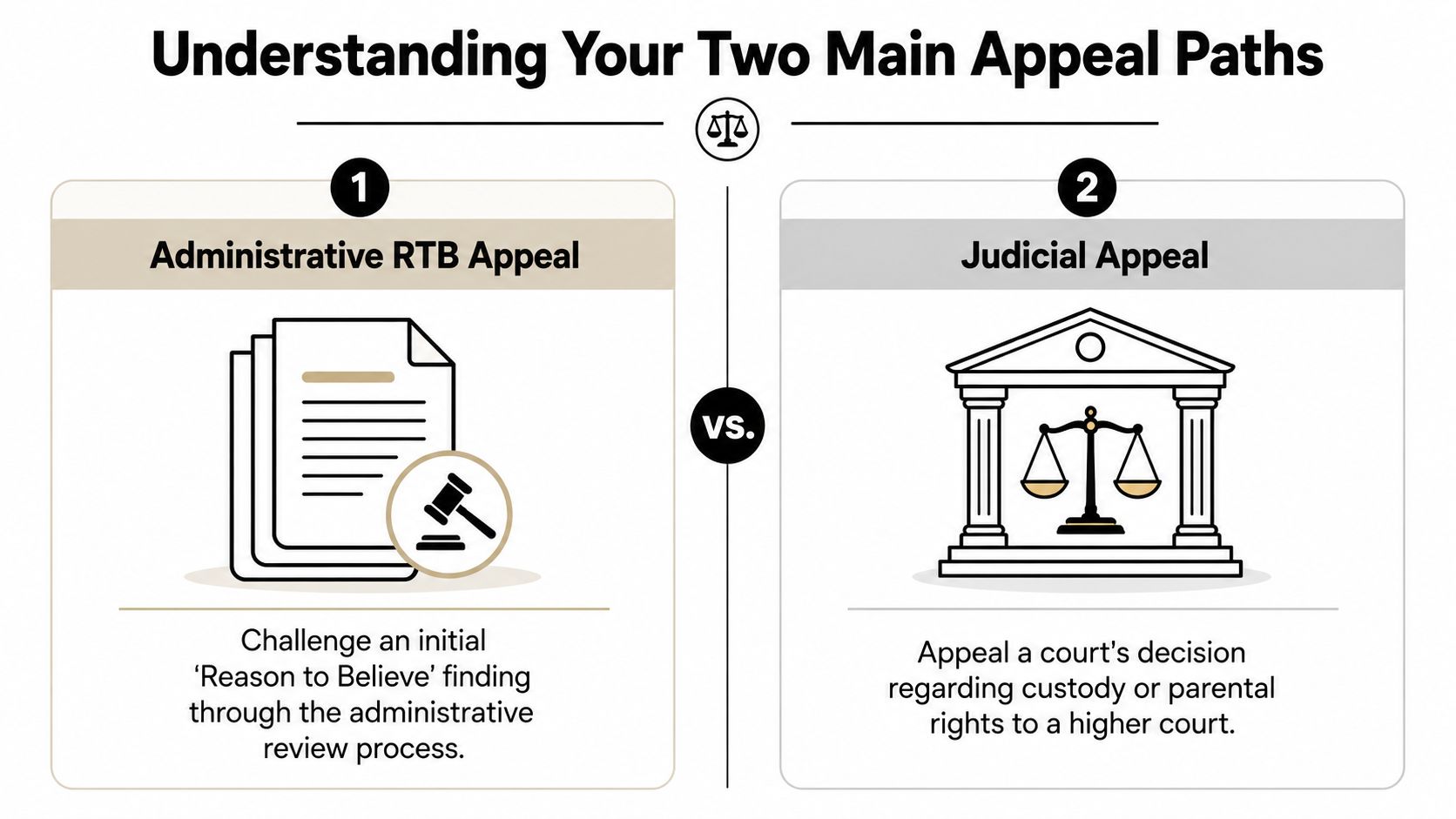
Administrative RTB appeal
A Reason to Believe finding is an administrative finding. It is not the same thing as a final court order terminating parental rights or naming a conservator. The process for challenging it is separate.
The Texas Children's Commission notes that a common pitfall is failing to distinguish between administrative appeals for “reason to believe” findings, which may have a 45-day deadline, versus final order appeals with the strict 20-day deadline, and that confusion can lead to automatic denials, as discussed in this Texas Children's Commission material on handling a child welfare appeal.
Some parent-facing materials also refer to a 30-day deadline to appeal a Reason to Believe finding, which is one reason families get mixed messages and miss their window. The practical lesson is the same. Don't assume the RTB process follows the court appeal rules, and don't assume the deadline is generous.
If your problem is an RTB finding tied to an investigation, strategy often focuses on the agency record, the basis for the finding, and the consequences that follow from leaving that finding in place.
Judicial appeal from a final court order
A court order is different. This is the route that applies when a judge signs a final order in a CPS case, such as an order affecting parental rights or conservatorship. That appeal goes through the judicial system, not the agency's internal process.
Texas Family Code provisions about appointment of counsel matter here because court-filed child protection cases can involve indigent parent representation and ongoing appellate obligations. Once the case is in court, the appeal turns on the trial record, legal error, preservation issues, and the standards the appellate court applies.
For families still responding to an investigation or removal risk before a final order exists, a CPS Defense Attorney in The Woodlands handles defense against CPS investigations for The Woodlands families.
Side by side comparison
| Appeal Type | What You're Appealing | Typical Deadline | Where It's Heard |
|---|---|---|---|
| Administrative RTB Appeal | A CPS “Reason to Believe” finding | May be 45 days in some circumstances, and some parents encounter references to 30 days | Administrative review process |
| Judicial Appeal | A final court order in a CPS case | 20 days after the order is signed | Court of Appeals |
Two paths can exist in the same overall CPS matter, but they don't substitute for each other.
If you're in Montgomery County, that distinction matters more than almost anything else at the start.
Navigating Critical Appeal Timelines in Montgomery County
The court appeal timeline in Texas CPS cases is unforgiving. Parents often expect the rules to work like ordinary civil litigation. They don't.

The deadline that controls the case
In Texas CPS cases, the notice of appeal must be filed within 20 days after the judgment is signed under TRAP 26.1(b), that deadline is not extended by other motions, and missing it forfeits appellate rights, as explained in the State Bar presentation on your first CPS appeal.
That point deserves plain English. The clock starts when the judge signs the final order. Not when you receive a copy. Not when you calm down enough to read it carefully. Not after a motion for new trial buys more time in some other kind of case.
It's signed, and the countdown starts.
What happens right after the notice
Once the notice of appeal is filed in a final CPS appeal, the pressure doesn't ease. The appellate record must be filed in the Court of Appeals within 10 days after the notice of appeal is filed, according to this overview of Texas CPS appeals.
That compressed schedule is why delay creates real damage. A parent who waits a week just to start making calls may leave a lawyer with very little runway to secure the order, the clerk's record, the reporter's record, and the issues that need to be preserved.
Practical rule: If you're asking whether you still have time, act as if you don't and confirm the date today.
What to do in Montgomery County
If your case came through a removal or emergency hearing, it helps to understand the court sequence that led to the order. This overview of CPS removal hearings in The Woodlands is useful background for many families.
Local procedure also matters. Montgomery County Family Courts: A Local Guide explains how family law cases proceed in Montgomery County courts serving The Woodlands.
Use this short sequence:
Find the signed order
Look for the exact date the judge signed it.Confirm what the order is
Temporary rulings, administrative findings, and final orders trigger different responses.Contact appellate-capable counsel immediately
Not every trial lawyer handles accelerated CPS appeals.Preserve every document
Orders, service plans, reports, and hearing notices all matter.
Building a Strong Case for Your Appeal
A deadline preserves your right to appeal. It doesn't win the appeal.
The substance of a CPS appeal usually lives in the record. That means your lawyer has to identify legal error, weak proof, procedural problems, or evidence that doesn't support the result under the standard the appellate court will apply.
What the appellate court looks at
In termination-related CPS appeals, the burden is demanding. The Texas Children's Commission explains that appellate courts apply a clear and convincing burden of proof standard. In practical terms, the evidence must be strong enough to remove serious or substantial doubt, as discussed in this Texas Children's Commission resource on handling your first child welfare appeal.
That doesn't mean a parent has no chance. It means vague objections and general complaints won't carry the day. Appeals need organized facts, preserved issues, and a disciplined theory of why the ruling cannot stand.
What actually helps
Useful appeal preparation often includes:
The signed orders and docket information
Your lawyer needs the exact order, not your memory of what the judge said.CPS reports and service-plan documents
These can show what allegations were made, what was required, and what was disputed.Hearing transcripts if available
Appeals usually rise or fall on the written record from the trial court.Contradictory proof
School records, medical records, receipts, photos, and messages can matter if they tie directly to a contested finding.Reliable witnesses
Neighbors, teachers, relatives, counselors, or service providers may help, but only if their testimony fits the legal issue on appeal.
A real-world example
A parent in Conroe is accused of neglect because the home was in poor condition during one visit. On appeal, the focus isn't just saying, “That wasn't fair.” The stronger approach is more specific: dated receipts for home repairs, photographs showing the condition before and after, and testimony from a neighbor who can speak to the parent's care of the child and the home over time.
That kind of evidence does two things. It challenges the narrative and gives the court a record anchored in dates, observations, and documents rather than emotion alone.
Appeals are built, not announced. The parent who gathers records early is in a better position than the parent who only tells the story from memory.
What usually doesn't work
Some things feel powerful to a parent but don't help much on appeal:
Repeating every frustration with CPS
Appellate courts don't retry the whole relationship with the agency.Bringing in new explanations too late
If an issue wasn't developed in the trial court, the appeal may not be the place to fix that.Assuming honesty alone is enough
Credibility matters, but appeals depend heavily on the existing record and legal standards.
The practical goal is to connect facts to an appellate issue. That is where disciplined case review matters most.
How to Choose the Right CPS Appeal Attorney
Parents often start by asking who handles CPS cases. A better question is who handles CPS appeals under accelerated deadlines in Montgomery County.
That's a narrower skill set.

Start with the right qualifications
Under the Texas Family Code, courts must appoint an attorney for an indigent parent immediately after TDFPS files a termination or conservatorship suit, and that appointment continues until appeals are exhausted or waived, as summarized in this report on court-appointed legal representation in Texas child protection cases.
That protection matters. It does not mean every appointed lawyer approaches appeals the same way, and it does not mean every retained lawyer is a fit. You need to ask focused questions.
Here are good ones:
How many CPS appeals have you handled?
Trial experience helps, but appellate work has its own demands.How do you handle accelerated deadlines?
Ask what the lawyer does in the first day or two after being hired.Will you personally review the signed order and record issues?
You want to know who is doing the analysis.What is your plan if the trial lawyer must act before appellate counsel is formally in place?
In CPS practice, that transition point matters.Have you handled cases involving The Woodlands or Montgomery County courts?
Local knowledge isn't everything, but it helps with procedure, expectations, and timing.
Understand the trade-offs
A court-appointed lawyer may be the right and necessary option for some families. A retained lawyer may offer different staffing, communication, and case-review resources. Neither arrangement guarantees an outcome.
Parents should also understand fees before signing anything. Ask whether the firm uses a retainer, hourly billing, or a staged structure tied to the notice of appeal, record review, briefing, and oral argument if needed. Ask what is included and what is not.
If you're contacting firms after hours and trying to avoid missed messages while you compare options, tools like Expressify AI's virtual assistant can help families understand how some offices manage intake and responsiveness.
Look for local fit, not just broad family law labels
A lawyer can be strong in family law and still not be the right fit for an accelerated CPS appeal. The same is true of firms that primarily handle related matters like Child Support Attorney in The Woodlands, which focuses on establishing, modifying, and enforcing child support in Montgomery County. Useful experience, but not the same assignment.
For parents comparing options in this area, CPS attorney services in Montgomery County describe one local practice area that includes CPS representation. That's one option among others to evaluate.
A good consultation should leave you with a clearer picture of deadlines, the kind of appeal involved, what the lawyer needs from you today, and what realistic issues exist in the record from Panther Creek to Alden Bridge and the rest of Montgomery County.
What to Do Next A Checklist for Action
When parents are overwhelmed, a short list helps. Focus on the next move, not the whole case.
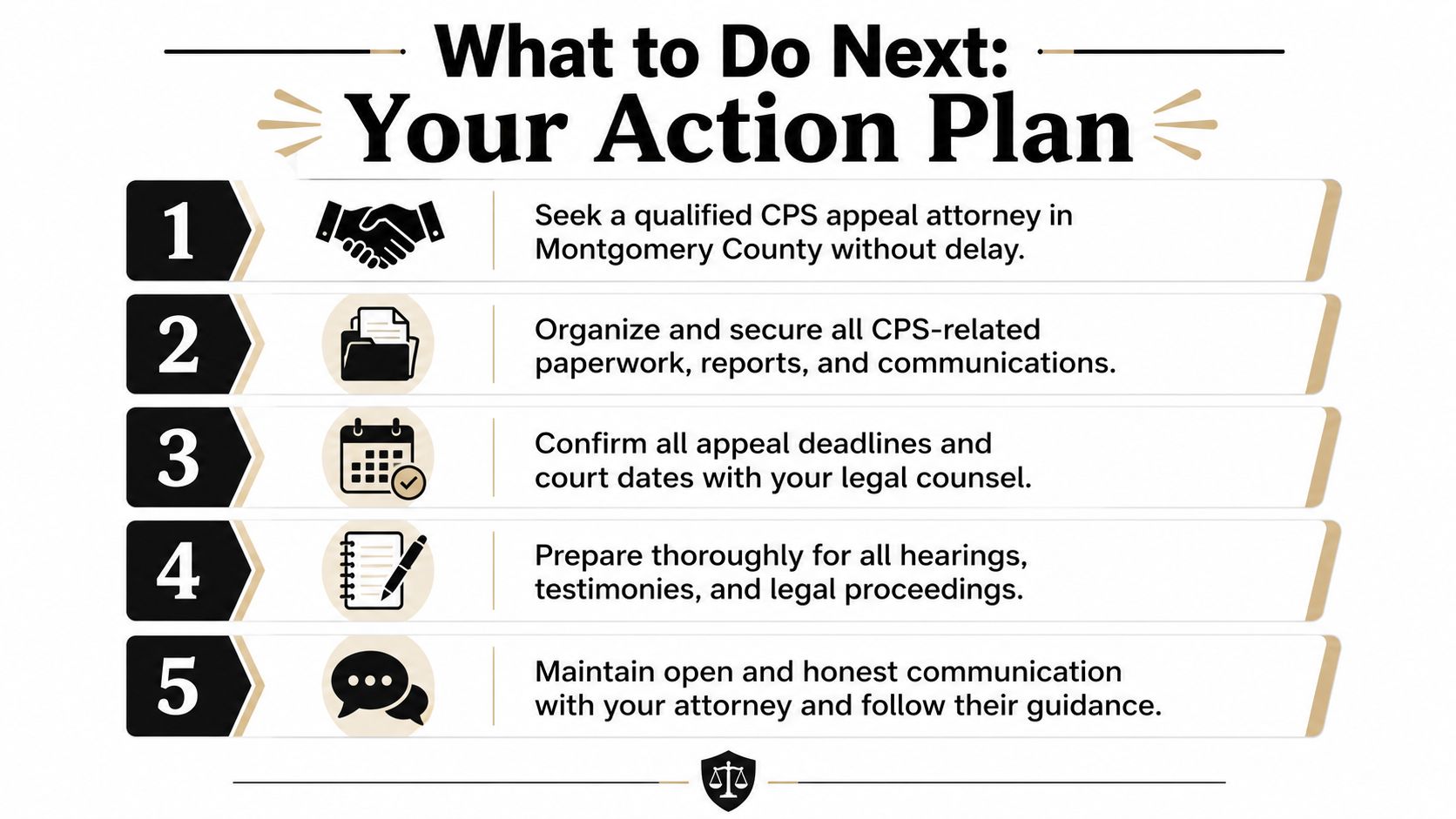
Your immediate checklist
Identify the decision
Find out whether you're challenging an administrative RTB finding or a final court order.Calendar every date today
Use the date on the paperwork, not your memory of the meeting or hearing.Collect the full file
Orders, notices, investigator letters, service plans, emails, texts, and hearing information should all go in one folder.Stop making casual statements to CPS
Until a lawyer reviews the posture of the case, extra explanations can create problems.Set consultations quickly
Ask each lawyer the same focused questions so you can compare answers.Ask who is filing what, and when
Don't assume someone else is handling the notice or request.
The parent who acts early has more options than the parent who waits for clarity to arrive on its own.
If you're trying to compare law firms, communication quality and client experience can matter. Some parents find it useful to review reviews collected by Testimonial as one way to think about how firms present client feedback and responsiveness, while still doing their own independent vetting.
This article is for educational purposes only. It is not legal advice. CPS appeals are highly fact-specific, and deadlines can turn on the exact type of ruling and the date it was entered.
If you need to talk through a CPS ruling in The Woodlands or Montgomery County, you can schedule a consultation with The Law Office of Bryan Fagan to discuss the decision you received, the deadline that may apply, and what immediate steps make sense in your case.
