 Skip to content
When CPS shows up at your home in The Woodlands, Conroe, or anywhere in Montgomery County, the fear is immediate. You start thinking about your kids, your house, your job, and whether one wrong sentence could turn into a court case.
That fear is justified. CPS investigations move fast, and the system is not designed to coach you through protecting yourself. The investigator at your door works for the state. You need someone who works for you.
The biggest mistake I see is confusion about who represents whom. Parents hear “county attorney” and assume that office might help them sort things out. In a CPS case, that assumption can cost you time you don't have. When seeking a CPS attorney in Montgomery County, focus on one question first: who is defending your parental rights?
The Knock on the Door What to Do When CPS Arrives
It usually starts with an unexpected visit. A CPS investigator is standing on your porch in Panther Creek, Alden Bridge, Creekside, or near downtown Conroe. They say they received a report. They want to come in. They want to talk. They may sound calm, even reassuring.
You still need to treat the situation seriously.
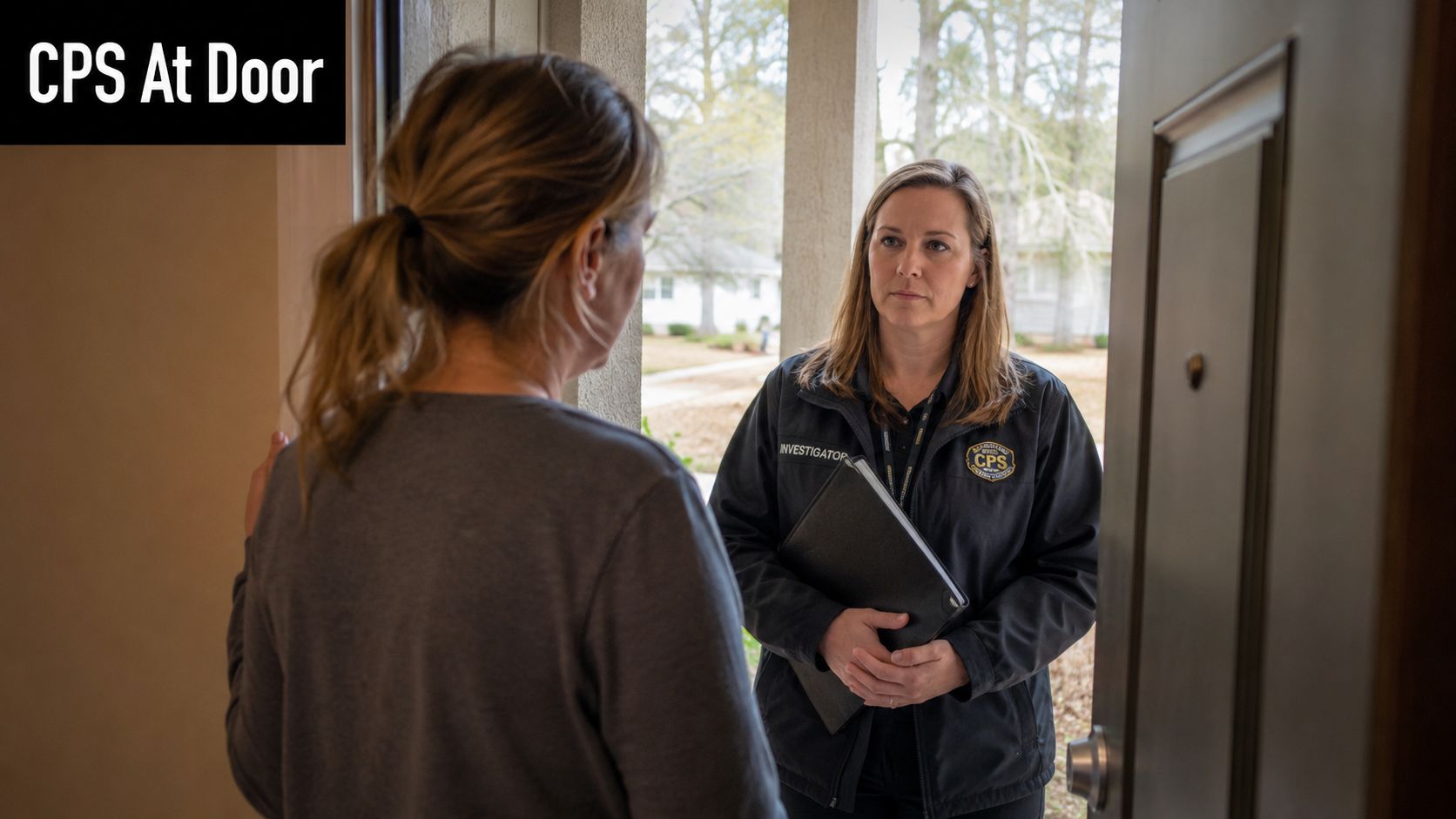
The first few minutes matter because CPS is gathering evidence from the moment contact begins. Your tone, your words, your home, your reactions, and your willingness to agree to things on the spot can all become part of the case file. That's why parents in this situation often need immediate guidance from a CPS defense lawyer in The Woodlands.
What the investigator is doing
CPS is investigating allegations of abuse or neglect. The investigator is not your advisor. They are not there to protect your legal position. Their job is to collect information and decide whether CPS should close the matter, push services, or seek court action.
That doesn't mean you should be rude. It means you should be careful.
Practical rule: Be calm, be polite, and stop talking before you start explaining.
What you should do in that first contact
- Ask for identification. Get the worker's full name, office, and contact information.
- Find out the basic allegation. You need to know what they say they are investigating.
- Don't start defending yourself on the porch. Parents often talk too much when they're scared.
- Don't sign papers on the spot. Read nothing and sign nothing until your lawyer reviews it.
- Call a private CPS defense attorney immediately. Early advice can change the entire course of the case.
If you're innocent, that is not a reason to go without counsel. Innocent parents talk themselves into trouble every week because they assume the truth will sort itself out. In CPS matters, truth still has to be organized, documented, and defended.
The Most Important Person You Need to Hire Right Now
A lot of parents in Montgomery County make the same mistake in the first 24 hours. They hear that “the county has attorneys involved” and assume some lawyer in the system will explain their rights or help them keep their child at home.
That is wrong.
The government already has counsel. That lawyer represents CPS and the State of Texas. The lawyer you need is a private defense attorney whose job is to protect you, your position, and your parent-child relationship. Montgomery County says so itself. The Montgomery County Attorney divisions page explains that its office handles CPS matters on behalf of the state agency. It does not defend parents.
That distinction changes everything. If you miss it, you lose time. In CPS cases, time is dangerous. The agency is building a record from the first contact, and you need someone building yours at the same time.
The two roles are completely different
Here is the plain-English comparison:
| Who they represent | What they do |
|---|---|
| County Attorney / CPS legal team | Supports CPS, files court papers, and argues for the state's position |
| Private parent defense attorney | Advises you, protects your rights, challenges weak claims, and works to keep or reunite your family |
A private attorney can help before a lawsuit is filed. That is often when the most important decisions are made. Should you agree to a drug test today? Should you sign a safety plan? Should you let CPS interview your child without limits? Should you hand over medical releases? Those are legal decisions, not paperwork decisions.
A good parent-defense lawyer handles the case early and aggressively. That can include reviewing proposed safety plans, stopping careless statements that hurt you later, organizing records that support your parenting, and pushing back when CPS overreaches. This overview of a CPS attorney's role in protecting your family gives a general explanation of how that works.
If you want a general explanation in video form, this is a useful starting point:
Who you should hire
Hire a lawyer who regularly defends parents in CPS investigations and removals. Choose someone who knows Montgomery County practice, knows how local courts treat emergency orders and safety plans, and knows the difference between cooperating wisely and surrendering ground for no reason.
Ask direct questions. Do you handle CPS investigations before court is involved? Have you defended parents in Montgomery County removal cases? Will you review any safety plan before I sign it? Can you speak with CPS for me now?
Then book a family law consultation in The Woodlands focused on CPS defense immediately.
The right lawyer does more than appear at a hearing. The right lawyer helps you avoid mistakes that create the hearing in the first place.
Navigating the CPS Investigation in Montgomery County
At this stage, parents often make the same mistake. They treat the investigation like an informal conversation. It is not. CPS is building a case, deciding whether to close the file, push services, or ask a court for power over your child.
The confusion gets worse because families hear the word "attorney" and assume everyone with a government title is there to help them. They are not. If CPS files in court, the County Attorney represents the State and CPS. That lawyer is not your lawyer, not your advisor, and not there to protect your parental rights. Your lawyer is the private defense attorney you hire to protect you before the case gets worse.
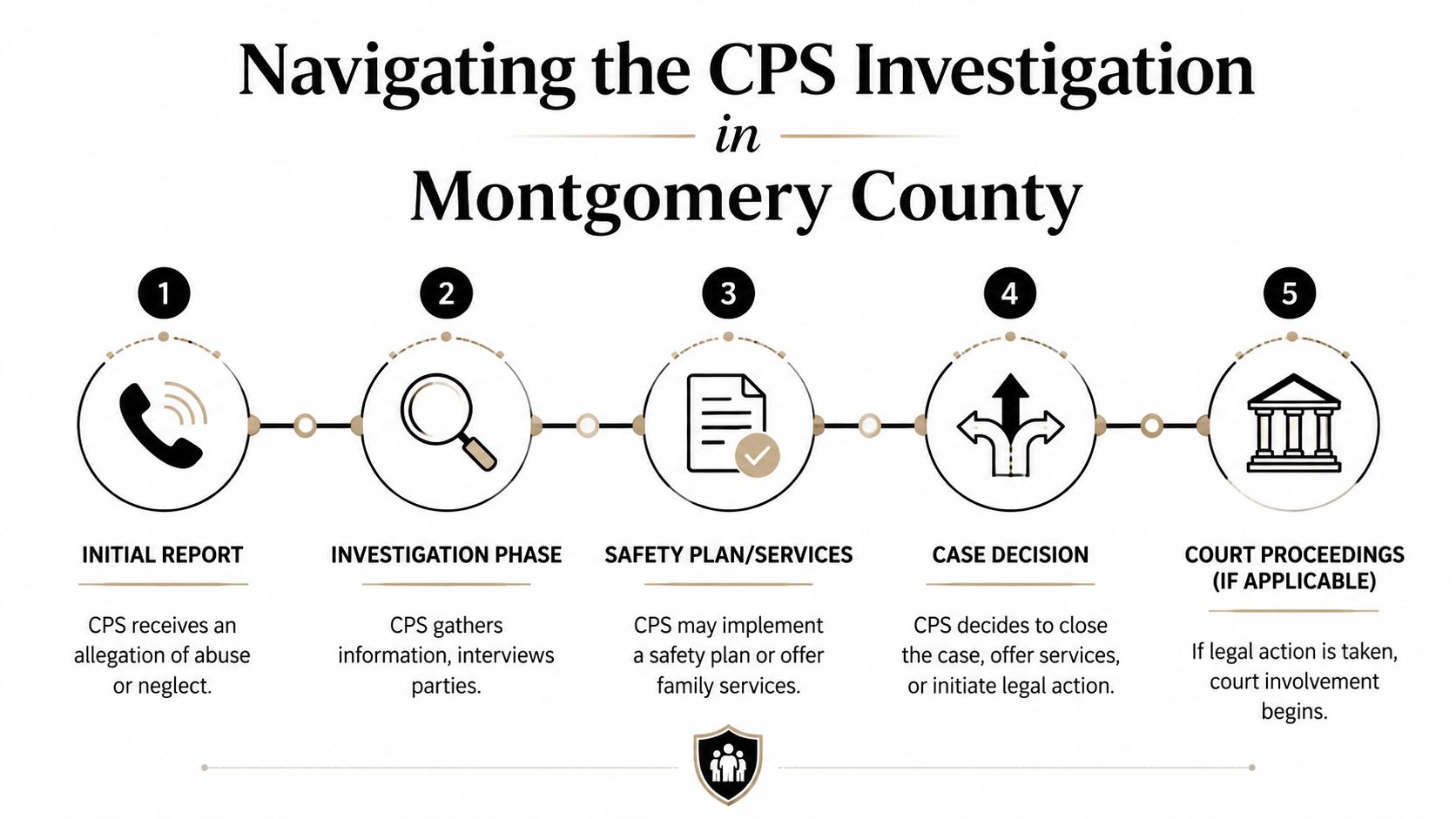
How a Montgomery County CPS investigation usually unfolds
The Texas Family Code allows CPS to investigate abuse or neglect reports and gather information from parents, children, relatives, schools, doctors, and other witnesses. In real life, the process usually looks like this:
Initial contact
An investigator calls, comes to your home, or contacts your child at school. You may get only a broad description of the allegation.Information gathering
CPS interviews people around your child and starts comparing stories. Small inconsistencies get treated like signs of risk.Home assessment
The investigator may ask to see the home, where the child sleeps, what food is available, how medications are stored, and who lives there.Service demands and safety proposals
CPS may ask for drug testing, releases, counseling, parenting classes, or a safety plan that limits where your child stays and who can be around them.Case decision
CPS can close the case, keep it open for services, ask for a voluntary placement, or seek court action.
That sequence matters because each step creates a record. Once something goes into the file, you are stuck dealing with it.
A false report can still become a real case
A mother in The Woodlands gets a visit after someone reports that her child is left alone for long periods. The accusation is false. She is angry, embarrassed, and ready to explain everything on the spot.
That is how parents talk themselves into trouble.
The better response is controlled and boring. Get the investigator's name and contact information. Ask what the allegation is. Do not start guessing who made the report. Do not give a long emotional statement. Start gathering records that answer the accusation, such as school pickup logs, work schedules, text messages, daycare records, and names of adults who saw your parenting.
False allegations are beaten with proof and discipline, not outrage.
Why timing matters in Montgomery County
These cases can speed up without warning. A school interview can turn into a home visit. A home visit can turn into a safety plan. A safety plan dispute can turn into a removal request or an emergency hearing.
If CPS is threatening immediate action, learn how emergency family court orders work in Montgomery County and get counsel involved before you walk into a hearing unprepared.
Do not assume you will have plenty of time to fix misunderstandings later. You may get very little time.
Weak allegations become harder to beat when parents give shifting explanations, miss deadlines, or sign documents they do not understand.
Watch the language CPS uses
During an investigation, words that sound casual often carry legal weight.
A "safety plan" is not just a friendly suggestion. It can limit your contact with your child, control where your child lives, and create a paper trail CPS later uses to argue that even you agreed there was danger.
A "voluntary" placement is also not harmless. If your child goes to a relative and the arrangement stretches on, CPS may use that history to support broader court involvement.
Listen carefully. Ask questions. Get legal advice before you agree to terms that change your day-to-day rights as a parent.
Relatives can become part of the case early
CPS often starts asking about grandparents, aunts, uncles, or family friends early in the investigation. That does not mean the agency is trying to help you. It means they are identifying backup placement options if they decide your child should not stay with you.
Family members need to understand what role they are stepping into, what information they are giving CPS, and whether their involvement helps you or strengthens the State's position. A relative with good intentions can still make a bad record if they speak carelessly.
When Your Case Goes to Montgomery County Family Court
If CPS decides to file suit, the case changes immediately. You are no longer just dealing with an investigation. You are now in family court, where deadlines control everything and the judge makes temporary decisions that can shape the rest of the case.
The phrase you may hear is temporary managing conservatorship. In simple terms, that means CPS is asking the court for legal authority over your child while the case moves forward. In Texas family law, conservatorship is the legal framework for rights and duties involving a child under the Texas Family Code.
The first hearing is a hard deadline
Texas does not give parents a court-appointed lawyer during the investigation stage. If you want representation before CPS files a lawsuit, you must hire your own attorney. Parents become eligible for a free appointed attorney only if three things are true: they are indigent, CPS has filed a formal court case seeking temporary managing conservatorship or termination, and the parent opposes the petition, according to Texas Law Help's explanation of a parent's right to a lawyer in CPS cases.
The first court hearing after CPS removes a child, or asks for removal, must happen within 14 days. If you do not have a lawyer by then, you need to ask the court to appoint one immediately if you qualify.
That deadline is why waiting is risky. By the time you are standing in that courtroom, CPS may already have weeks of statements, notes, photos, service recommendations, and witness contacts.
What the judge is deciding
At the early stage, the court is not deciding every final issue. The judge is deciding immediate control questions, such as:
- Should the child remain removed
- Who has temporary legal authority
- What visitation will look like
- What services the parent must complete
- What deadlines will govern the case
A parent walking into that hearing alone is at a disadvantage. The court process moves too fast for improvisation. If CPS has already sought emergency action, you may also need immediate relief in related family matters, and an emergency family court order in Montgomery County may be part of the discussion depending on the posture of the case.
Waiting for appointed counsel is not a strategy
Court-appointed counsel matters for parents who qualify. But it is not a substitute for early defense. If your first lawyer enters the picture only after removal and at the edge of the 14-day hearing, a lot of the damage may already be done.
That is why I tell parents the same thing every time. If you can hire counsel before the case reaches court, do it. If you cannot, be prepared to request appointment immediately when the case is filed.
Your Immediate CPS Contact Checklist
When CPS contacts you, your job is not to “clear it all up” in one conversation. Your job is to protect your family from preventable mistakes.
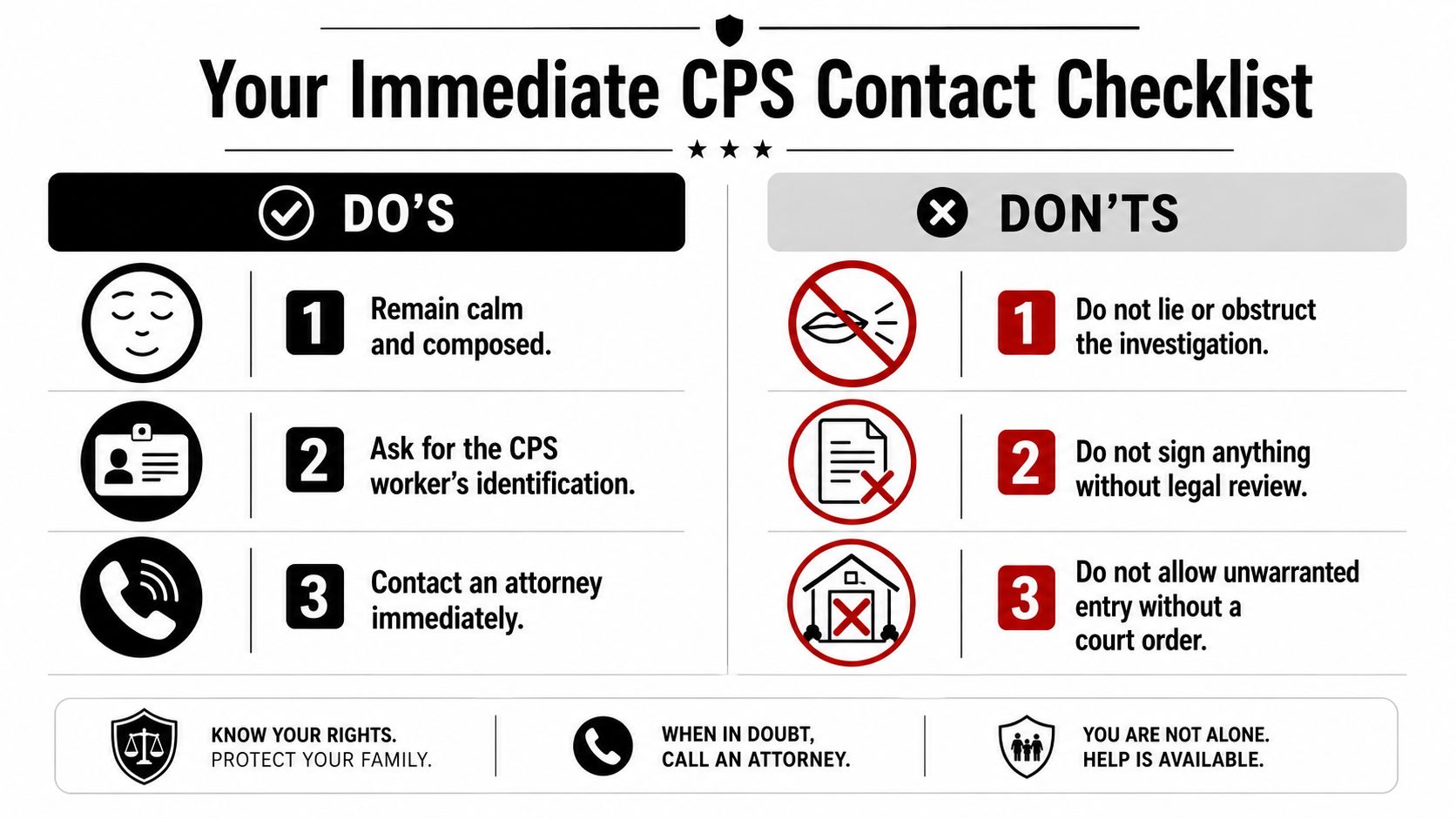
Do these things first
- Stay calm. Panic causes rambling, apologizing, and bad decisions.
- Ask for the worker's ID. Write down the name, title, office, phone number, and the date and time of contact.
- Get the allegation in basic terms. You need the subject matter, not a debate on the porch.
- Call a lawyer immediately. A CPS attorney in Montgomery County can manage contact, review proposed services, and hold CPS to Texas Family Code deadlines and documentation duties, as described in this discussion of the attorney's role in Montgomery County CPS cases.
- Keep your own notes. Record who contacted you, what was requested, and what was said.
Avoid these common mistakes
- Don't lie. False statements create credibility problems that follow you into court.
- Don't volunteer extra details. Extra talking often fills gaps CPS did not even know existed.
- Don't sign documents without review. Safety plans, releases, and service agreements can have major consequences.
- Don't consent to everything because you're scared. Cooperation without strategy is not protection.
- Don't turn this into a family feud. Angry texts to an ex, a teacher, or a relative often come back as evidence.
Keep your communication boring, brief, and documented.
If CPS asks for services
Parents often assume that agreeing to parenting classes, counseling, or drug testing will automatically make the case go away. Sometimes services help. Sometimes they create a paper trail that expands the case. Your attorney's job is to make sure any service plan is realistic, lawful, and connected to the actual allegation.
A good lawyer also tracks whether CPS is doing its own job. That includes proper documentation, procedural compliance, and deadlines. You should not be the only one under scrutiny.
What to do next
- Write down every contact from CPS today
- Save all texts, emails, letters, and voicemails
- Do not sign or agree to anything before legal review
- Identify safe relatives who may help if placement becomes an issue
- Schedule a private attorney consultation immediately
How to Choose the Right CPS Attorney in The Woodlands Area
You may hear the words “county attorney” and assume that lawyer will help your family. In a CPS case, that is usually wrong. The County Attorney represents the government's position. Your private CPS defense attorney represents you, protects your rights, and pushes back when CPS asks for more than the law allows.
Start there, because confused parents hire the wrong kind of lawyer every week.
A CPS case in Montgomery County is not general family law with a different label. It is a fast, procedural fight with deadlines, hearings, safety plans, and evidence problems that can change your life in days. You need a lawyer who regularly defends parents in CPS investigations and court cases, not someone who mainly handles divorces and takes the occasional CPS matter on the side.
Local court knowledge matters too. A lawyer who knows how Montgomery County courts run can prepare you better, spot practical problems sooner, and avoid wasting time while CPS keeps building its case.
You also need clear communication. If the lawyer cannot explain, in plain English, who files what, who speaks for CPS, what hearing is coming next, and what your immediate risk is, keep looking. Fear makes legal jargon sound impressive. It is not a substitute for strategy.
The professional duties you are entitled to
Your lawyer owes loyalty to you. Whether you hire counsel privately or the court appoints one after a suit is filed, your attorney's job is to protect your interests, keep your communications confidential, and give competent advice. The Montgomery County Attorney FAQ page discussing the attorney's obligations in CPS proceedings helps clarify those roles, and it also highlights why parents must understand who is on their side.
Ask this in the first meeting: “Are you defending me against CPS, or will I be dealing with the government's lawyer in court while you catch up?”
That question cuts through the sales pitch fast.
Questions worth asking in a consultation
- How often do you represent parents in CPS cases
- Do you get involved during the investigation stage, before CPS files a court case
- Who from your office will respond if CPS contacts me after hours
- How do you evaluate safety plans, drug testing requests, and home visit demands
- What is your approach if CPS wants a relative placement or emergency removal
- How do you prepare parents for adversary hearings, status hearings, and service plan disputes
Watch for direct answers. A good CPS lawyer should be able to tell you what they do, what they do not do, and what your first week as a client will look like.
One factual example of a local option is The Law Office of Bryan Fagan, which serves families in The Woodlands and surrounding Montgomery County communities in family law matters, including disputes involving parental rights. Local presence can help when hearings move quickly and the facts are tied to county-specific practice.
One more practical point. CPS cases often spill into your phone, your texts, and your social media faster than parents expect. Before you meet with counsel, review your public online presence with Digital Footprint Check's online guide. It can help you spot posts, photos, and account details that CPS or the other side may try to use against you.
Choose the lawyer who understands CPS parent defense, explains the case clearly, and knows the difference between the lawyer bringing the case and the lawyer defending your family. That distinction is where good decisions start.
Protecting Your Family's Future Starts Today
A CPS case can make decent parents feel helpless. That feeling is dangerous because helpless people freeze, and frozen parents miss deadlines, sign bad paperwork, and trust the wrong people.
The core problem is simple. The state has investigators, procedures, and lawyers already in place. You need your own advocate early, especially if you live in The Woodlands, Conroe, or elsewhere in Montgomery County where a local court timetable can move faster than most families expect.
Keep your focus narrow
You do not need to solve your whole case tonight. You need to do the next right thing.
That usually means preserving documents, limiting direct communication, avoiding emotional mistakes, and getting legal guidance before you make decisions that can't be taken back. If your online activity may become part of the dispute, it also helps to review practical privacy basics. A simple consumer resource is Digital Footprint Check's online guide, which can help you think more carefully about what your public online presence reveals.
One last point that matters
This article is for general informational purposes only. It is not legal advice. Reading a blog post does not create an attorney-client relationship, and no online article can account for all the facts in your case. Texas family law issues, including CPS matters under the Texas Family Code, are fact-specific and urgent.
If CPS has contacted you, the safest move is to act quickly and get advice specific to your situation. That is not overreacting. That is how parents protect their rights.
If you're in The Woodlands, Conroe, or anywhere in Montgomery County and need to talk through a CPS investigation or court case, you can schedule a consultation with The Law Office of Bryan Fagan. A private conversation with counsel is often the first step toward getting control back.
