 Skip to content
You hear a knock at the door in The Woodlands. A CPS investigator is standing there, asking to come in and talk about your child. Your stomach drops. You want to look cooperative, but you also don't want to make a mistake that follows you into the Montgomery County courthouse.
That instinct is right.
If you're searching for how to fight CPS in Montgomery County, you need practical steps, not vague reassurance. CPS cases move fast. The first conversation matters. The first hearing matters even more. What you say, sign, text, and hand over can shape the case from day one.
This guide is written for parents in The Woodlands, Conroe, Magnolia, Montgomery, and nearby communities who need a local playbook. It is not legal advice. It is general information to help you avoid the most common errors and understand what usually happens next under Texas law.
The Knock on the Door Immediate Actions for Montgomery County Parents
When CPS shows up, slow the moment down.
You do not need to panic. You do need to get organized immediately. In Montgomery County, CPS volume is high. 6,920 cases of child abuse were reported in 2017, a 27.2% increase from 5,036 the year before, and DFPS requires Priority I investigations to start within 24 hours and Priority II investigations to start within 72 hours, according to Community Impact's reporting on Montgomery County child welfare demand. That means the agency often moves quickly, and you should too.
What to say at the door
Keep it simple. Be polite. Don't start explaining.
Use a script like this:
I want to cooperate appropriately, but I'm not answering questions or signing anything until I've spoken with a lawyer.
That sentence does three things. It keeps you calm, avoids an argument, and protects you from talking too much.
What to do right away
- Ask for identification. Get the investigator's full name, office, phone number, and business card if they have one.
- Ask the basic issue. You can ask what allegations they're investigating. Don't start responding to the facts on the spot.
- Write down the time. Start a log immediately. Record when they arrived, what they asked for, and whether anyone else was present.
- Call a lawyer fast. If CPS is already at your door, timing matters. A local CPS investigation lawyer in The Woodlands can help you decide how to handle interviews, home access, and any proposed paperwork.
What not to do
Don't make the classic panic mistakes.
- Don't volunteer background stories. Parents often talk themselves into trouble by trying to sound innocent.
- Don't guess. If you don't know what they're talking about, don't speculate.
- Don't let fear push you into signing papers. Fast signatures create long problems.
- Don't turn this into a fight on the porch. Anger won't help you in front of a judge later.
The first tone matters
A CPS case often begins before you've had time to think. The first interaction sets the tone for everything that follows. You want to look stable, respectful, and deliberate.
Practical rule: Calm is not weakness. Calm is control.
If your child is in school, daycare, or with a relative, assume CPS may contact others quickly. Start thinking like a case manager for your own family. Gather names, dates, addresses, medications, school contacts, and any recent records that show your child is cared for.
And remember this. Cooperation does not mean surrender. You can be civil without giving away your case.
Understanding Your Rights When CPS Investigates
A CPS investigator does not show up in Montgomery County to clear your name. The investigator shows up to gather facts, test your reactions, and decide whether to ask the court for tighter control over your family. If you treat that visit like an informal chat, you can hand over statements and signatures that are hard to undo once your case reaches the courthouse on North Thompson.
Texas law gives you rights at the investigation stage. Use them early, or you may spend the first court setting trying to repair avoidable damage.
Your rights mean nothing if you waive them under pressure
Parents get in trouble because they confuse being respectful with saying yes. Those are not the same thing in a CPS case.
You can be calm, polite, and firm while still protecting yourself.

Here is what parents in Montgomery County need to understand right away:
- CPS does not get automatic entry into your home. If the investigator has no court order and no warrant, you do not have to treat the request like a command.
- You do not have to sign paperwork on the spot. If a form affects placement, supervision, testing, or admissions, stop and get legal advice first.
- You can refuse broad releases. Medical, counseling, school, and drug testing requests should be reviewed carefully, not signed out of fear.
- You can ask to delay questioning until you speak with counsel. That includes interviews that seem casual but are really evidence gathering.
Montgomery County judges see the written record, not your private panic. If the file says you consented, admitted, or agreed, that is what your lawyer has to fight later.
Safety Plans cause more trouble than parents expect
A Safety Plan is not harmless because it is labeled voluntary. In practice, it can control where your child stays, who can be around your child, and what CPS will claim you agreed was necessary. I tell parents the same thing every time. Do not sign a Safety Plan just to make the investigator leave.
If CPS believes your child is in danger, CPS can go to court. If CPS wants your signature instead, slow the conversation down and find out why.
That matters in Montgomery County because local cases move fast once DFPS asks for emergency relief. A signed “temporary” agreement can shape the judge's first impression before your side is fully developed.
What this means at the Montgomery County courthouse
This county is not a generic statewide example. Local practice matters.
If CPS files for removal or temporary orders, your case can move from investigation to emergency court review quickly. The judge will not focus on whether you felt pressured in your living room unless your lawyer can tie that pressure to the exact document, statement, or consent CPS is using against you. That is why precision matters from day one.
Keep every paper CPS hands you. Save every text and voicemail. If you need a practical system for managing essential family records, use one now, before deadlines start stacking up.
Texas law in plain English
CPS is building a case long before most parents realize a case is being built.
Your job is to stop making their job easier. Answer carefully. Sign nothing you do not understand. Refuse to guess. Get legal advice before you consent to anything that changes where your child lives, how you see your child, or what records CPS can collect.
If you are dealing with an active investigation in Conroe, The Woodlands, or anywhere else in the county, speak with a CPS attorney serving Montgomery County before the investigator turns a “voluntary” step into evidence for court.
How to Document Your Case for Montgomery County Courts
Walk into the Montgomery County courthouse with only your memory, and CPS will control the story. Walk in with organized records, dates, photos, and witness names, and your lawyer has something a judge can use.
That is the difference.
Judges handling CPS cases in Montgomery County want specifics. They want to know what happened, when it happened, who saw it, what records back it up, and whether your timeline holds together under pressure. General statements like “I'm a good parent” or “the investigator twisted my words” do not carry a hearing. Documents do.
Build a court-ready timeline
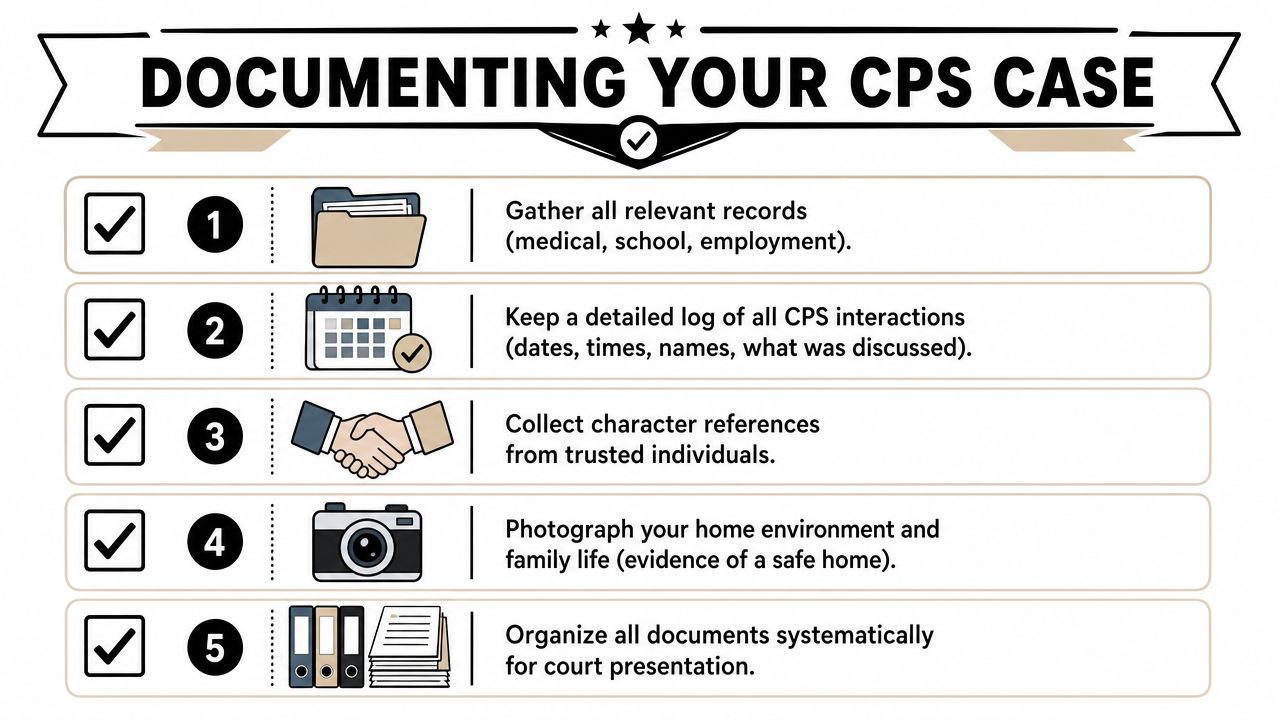
Start one master timeline today. Keep it in one place and update it every day. A notebook works. A phone note works. A folder system is better if you will maintain it.
Include:
- Every CPS contact. Date, time, full name, job title, phone number, and a short summary of what was said or requested.
- Every event involving your child. School attendance, doctor visits, medications, injuries, discipline issues, pickup and drop-off times, and who was present.
- Every paper or message you receive. Letters, safety plans, business cards, emails, portal messages, and forms.
- Every potential witness. Teachers, daycare staff, relatives, neighbors, counselors, coaches, and doctors with firsthand knowledge.
- Every step you took to address concerns. Counseling appointments, home repairs, drug tests, parenting classes, pediatric follow-ups, and childcare arrangements.
Preserve ordinary evidence before it disappears
Start saving the boring proof. That is often the evidence that wins these fights.
Save text messages and voicemails. Export emails. Download school attendance records and parent portal notices. Keep pharmacy receipts, discharge papers, counseling records, and daycare sign-in sheets. Take clear photos of the child's bedroom, food in the home, working utilities, medications stored properly, and any safety item CPS may question, such as car seats, baby gates, or locks.
If you need help with managing essential family records, use a system that keeps medical, school, insurance, and ID documents together and easy to retrieve on short notice.
If your CPS case overlaps with divorce or custody litigation, keep those files separate but coordinated. In Montgomery County, family court issues often spill into CPS court fast. That is why some parents also need a Divorce Lawyer in The Woodlands, TX when allegations start inside an active custody dispute.
Document for the way Montgomery County cases are actually argued
Generic Texas advice misses this point. Local practice matters.
At the Montgomery County courthouse, your lawyer may need to put together a clean packet quickly for an early setting, a status conference, or a contested hearing. That packet is stronger when your records are already organized by date and topic. Do not hand your lawyer a pile of screenshots with no labels. Sort them. Name the files. Put dates on everything. If a photo matters, note when it was taken and what it shows.
Make your proof easy to use:
- Put documents in chronological order.
- Label screenshots with the sender, recipient, and date.
- Save originals, not just cropped images.
- Back up everything to a cloud folder and a second device.
- Bring printed copies to court meetings if your lawyer asks for them.
A parent who is organized looks credible. A parent who guesses at dates and cannot find records looks unprepared, even when telling the truth.
A local example of what works
A Montgomery County mother was accused of leaving her child alone after school. She did the right thing. She stopped arguing and started collecting proof.
She gathered text messages showing the grandmother had the child, a school pickup notification from that afternoon, and her work time log showing when she clocked out. Her written timeline matched the phone records. That gave her lawyer a clean factual argument instead of a denial with no support.
A dated timeline, phone records, and school messages usually carry more weight than a long emotional explanation.
Why this record matters beyond one hearing
CPS files can follow a family for years. Prior allegations, prior services, and prior investigator notes can resurface later if another report is made. Your documentation helps your lawyer challenge exaggerations, correct errors, and show the court that conditions in your home were stable and your child was being cared for.
Treat your record like trial preparation from the first contact. In Montgomery County, that is not overreacting. It is how parents protect themselves.
The First 14 Days Emergency Hearings and Court Procedures
Your child is removed on a Friday. By Monday, CPS has a file, a lawyer, and a courtroom date. If you spend those first days arguing with the investigator instead of preparing for court, you hand CPS the advantage.
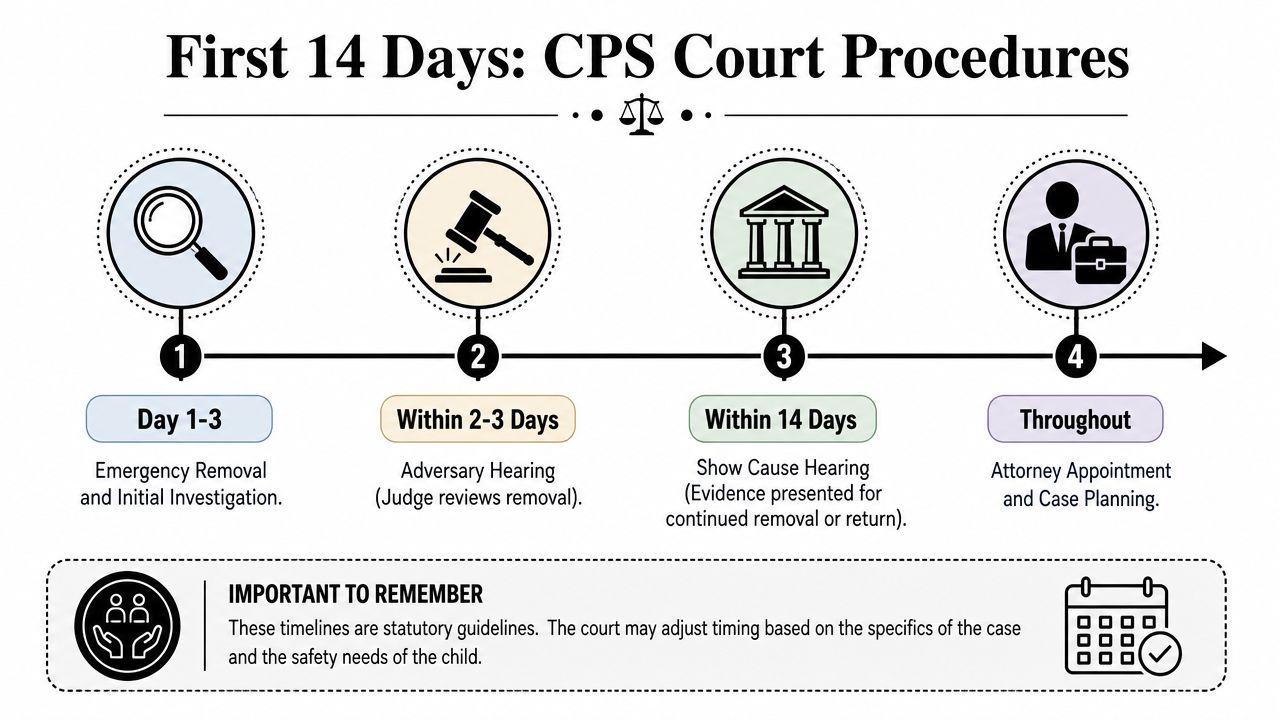
In Montgomery County, the first 14 days are where the case starts to harden. Judges in the courthouse will make early decisions about temporary conservatorship, placement, visitation, and services. Those early rulings shape everything that follows. A weak showing at the start can haunt your case for months.
What the first hearing actually decides
The first hearing is about control of the case and immediate safety findings. The judge is deciding whether CPS keeps temporary authority over your child and whether the agency has shown enough to justify emergency action.
Treat that hearing like a real fight, because it is one. If you appear late, show up confused, or fail to contest the petition, the court can enter temporary orders that give CPS the upper hand right away.
What usually happens in Montgomery County
Generic Texas guides miss the practical part. At the Montgomery County courthouse, speed and preparation matter more than speeches. The judge will usually have read the CPS affidavit before you speak. That means the agency starts with the first impression, and your job is to challenge it with facts, documents, and a clear position.
Expect the court to focus on a few immediate questions:
| Court issue | What it means for you |
|---|---|
| Immediate danger | Be ready to address the specific safety claim, not your general character as a parent. |
| Temporary placement | If a relative is an option, your lawyer should raise that quickly and with names, contact details, and reasons the placement is safe. |
| Visitation and access | Ask for clear, workable terms. Vague orders create problems fast. |
| Services and conditions | Do not casually agree to terms you do not understand. Temporary agreements often shape later hearings. |
What you need to do before the hearing
Get focused. These are the tasks that matter in the first few days:
- Confirm the exact hearing details. Get the date, time, and courtroom from the notice or clerk information. Do not trust memory or a hallway explanation.
- Get your lawyer the petition and affidavit immediately. Those papers tell you what CPS is alleging.
- Build a hearing packet. Include the notice, petition, names of witnesses, contact information for relatives, and the strongest records that answer the safety claim.
- Prepare for short, direct answers. Montgomery County judges do not want a long emotional speech when the issue is immediate safety.
- Arrive early and look prepared. That affects credibility. It should not, but it does.
One more point. If a relative already has the child, do not assume the danger has passed. Relative placement does not end the case. It often becomes the new status quo if you do not challenge the legal basis for removal and the facts in the affidavit.
Mistakes that hurt parents in the first 14 days
I see the same errors over and over.
Some parents miss the hearing because they assume CPS will call again. Some show up and start explaining every grievance they have with the investigator, which wastes the small amount of time the court gives them. Others agree to temporary conditions just to get out of the courtroom, then learn those conditions are now part of the case record.
The better approach is simple. Show up. Contest the petition. Stay disciplined. Let your lawyer target the weak spots in the CPS story and push for the least restrictive temporary orders the facts support.
In Montgomery County, early temporary orders can shape where your child lives, how often you see your child, and what CPS demands from you before the next hearing.
That is why the first 14 days matter so much. Court starts quickly here, and the parent who treats the early hearing like a formality usually regrets it.
Common Defenses and Building Your Legal Strategy
You do not beat a CPS case with outrage. You beat it with a theory, proof, and discipline.
A good legal strategy answers four questions. What exactly is CPS alleging? What evidence supports it? What evidence undermines it? What safer, less drastic alternative should the judge consider?
Attack weak evidence first
A surprising number of CPS cases begin with thin facts, family conflict, or a one-sided report. That does not mean you can ignore them. It means you must test the evidence hard.
Common defense angles include:
- No firsthand proof. If the accusation comes from rumor, repetition, or a hostile co-parent, your lawyer should expose that.
- No current danger. Old arguments, messy houses during a bad week, or temporary stress do not automatically equal endangerment.
- Missing context. Medical conditions, behavioral issues, school problems, or custody disputes often get flattened into simple accusations.
- Contradictory records. Texts, attendance records, treatment records, and witness accounts can break apart a CPS narrative.
Procedural mistakes matter
Investigators are not above scrutiny. If CPS failed to preserve context, skipped important witnesses, overstated what a parent agreed to, or relied on sloppy documentation, that matters.
Judges care about child safety, but they also care about whether the state followed proper procedure. If the file contains assumptions instead of facts, your lawyer should say so clearly.
Show the court a safe home, not a perfect one
Parents often think they must look flawless. They do not.
They need to show that the child is safe, supervised, fed, medically cared for, and living in a stable environment. There is a big difference between a family under stress and a child in actual danger. Your defense should highlight that difference with specifics.
Use practical proof:
- school attendance records
- doctor appointments
- counseling compliance
- clean and current photographs of the home
- testimony from people who see you parent
Match the defense to the accusation
Different claims require different responses.
If CPS alleges neglect based on supervision, focus on schedules, caregivers, pickup routines, and communication records. If the issue is home conditions, use dated photos, repair receipts, and witness testimony. If the complaint is emotional instability, controlled behavior in court and documented treatment can matter.
Judges do not need broad promises. They need concrete reasons to doubt CPS or trust you.
Build a narrative the court can follow
A common misstep for parents occurs when they have pieces of evidence, but lack a clear story.
Your lawyer should be able to explain the case in plain English. The allegation came from this person. It was made during this conflict. CPS missed these records. The child was safe because of these facts. The proposed restriction is too broad because these alternatives exist.
That is how you fight effectively in Montgomery County. Not with a speech. With a record.
When and How to Hire a Local CPS Defense Attorney
The right time to hire a CPS lawyer is earlier than most parents think.
If CPS has already called, visited, asked for a meeting, proposed a Safety Plan, or filed anything in court, you are already on the clock. A lawyer does more than “go with you to court.” A lawyer helps control communication, spot waiver traps, organize evidence, and frame your case before the record hardens against you.

Why local experience matters in Montgomery County
A CPS case in Montgomery County is not just “a Texas case.” Local court habits matter. Filing practices matter. Judges have expectations. So do court staff and agency lawyers.
You should look for an attorney who handles family law disputes in The Woodlands and Montgomery County courts and understands how CPS allegations can affect custody, conservatorship, and enforcement matters. If you need one option to review, a CPS defense lawyer in The Woodlands, TX handles these kinds of parent-rights disputes in the local area.
What to ask before you hire anyone
Don't ask whether the lawyer is “aggressive.” Ask better questions.
- Have you handled CPS matters tied to custody cases in Montgomery County?
- Will you review Safety Plans or voluntary placements before I sign anything?
- What documents should I gather tonight?
- What hearing is next, and what is the goal of that hearing?
- How should I communicate with CPS from this point forward?
Those questions tell you whether the lawyer thinks strategically or just reacts.
A short video can also help you understand the tone and urgency of these cases before you meet with counsel.
What to do next
Use this checklist today.
- Stop signing documents without review.
- Write down every CPS contact you've had so far.
- Gather school, medical, and caregiver records.
- Save texts, emails, photos, and voicemail messages.
- Confirm any hearing date in writing.
- Show up to court and respond in opposition if a petition has been filed.
- Get legal advice quickly.
This guide is not legal advice. It is general information for parents in The Woodlands and Montgomery County who need to understand the process and avoid preventable mistakes. Your facts matter. Your timeline matters. Your courtroom strategy matters.
If CPS is involved, don't wait for the situation to “clear itself up.” Schedule a consultation and get a case-specific plan in place.
If you need help understanding what happens next in a Montgomery County CPS case, The Law Office of Bryan Fagan serves families in The Woodlands and surrounding communities in family law matters, including disputes involving custody and parental rights. A consultation can help you understand your options and the next steps for your specific situation.
