
Your hours were cut last month, the mortgage in The Woodlands did not shrink, and the child support deduction still leaves your paycheck at the old amount. Or you are the parent receiving support, and your child's costs have risen while the other parent's income clearly has too. A child support modification hearing is where Montgomery County parents ask a judge to change that number with evidence, not with a handshake. Understanding what the associate judge expects before you walk in reduces surprises and helps you decide whether court, or administrative review, fits your situation.
When a Modification Hearing Becomes the Right Path
A father in Panther Creek loses overtime that had been steady for years. He calls the other parent, they agree verbally to lower payments for a few months, and he pays the smaller amount in good faith. Months later he learns the court record still shows the original amount, and the difference is treated as unpaid.
That scenario plays out often because only a court can change an existing Texas child support order, and parents cannot permanently change the court-ordered amount merely by reaching a private agreement. A private deal may help you cooperate day to day, but it does not rewrite the enforceable order, erase arrears shown on paper, or update wage withholding.
Court Hearing Versus Administrative Review
Not every change needs a contested hearing on day one. Some parents start by requesting a review through the Texas Office of the Attorney General. That path can work when both sides share records willingly and the math is straightforward.
A hearing becomes the right vehicle when income is disputed, possession has changed, one side will not cooperate, or you need a judge to weigh competing evidence. It is also the right vehicle when medical support, health insurance allocation, or a change in the child's residence is tangled up with the cash amount.
Practical rule: Keep paying the current ordered amount until a judge signs a new order. Filing paperwork alone does not pause the obligation.
What to Expect Emotionally and Practically
Parents from Sterling Ridge, Alden Bridge, Creekside, and across Montgomery County usually feel the same pressure. You are asking a stranger in a robe to reset a household budget. That is stressful even when your records are clean.
The process ahead has distinct stages, from filing and service, to building a timeline, to presenting exhibits, to getting a signed order entered. Costs, time off work, and conflict with the other parent are real trade-offs. Weigh them against the cost of leaving an outdated order in place for years. If the change in your life is documented, lasting, and tied to income, custody, or your child's needs, a modification hearing gives you a formal way to align the order with current facts.
Filing the Motion and Serving the Other Side
Filing starts with a petition to modify the parent-child relationship in the court that holds continuing jurisdiction. You are not asking for an automatic recalculation. You must first show you are eligible to ask.
Texas uses two main pathways. Under the eligibility-and-evidence sequence used for Texas modifications, the existing order must be more than three years old with a guideline variance, or there must be a material and substantial change since the prior order. For the three-year pathway, the current amount must differ from the guideline amount by at least 20% or $100 per month. The material-change pathway focuses on documented events since the last order, such as a major income shift, a change in the child's residence, or a change in health insurance.
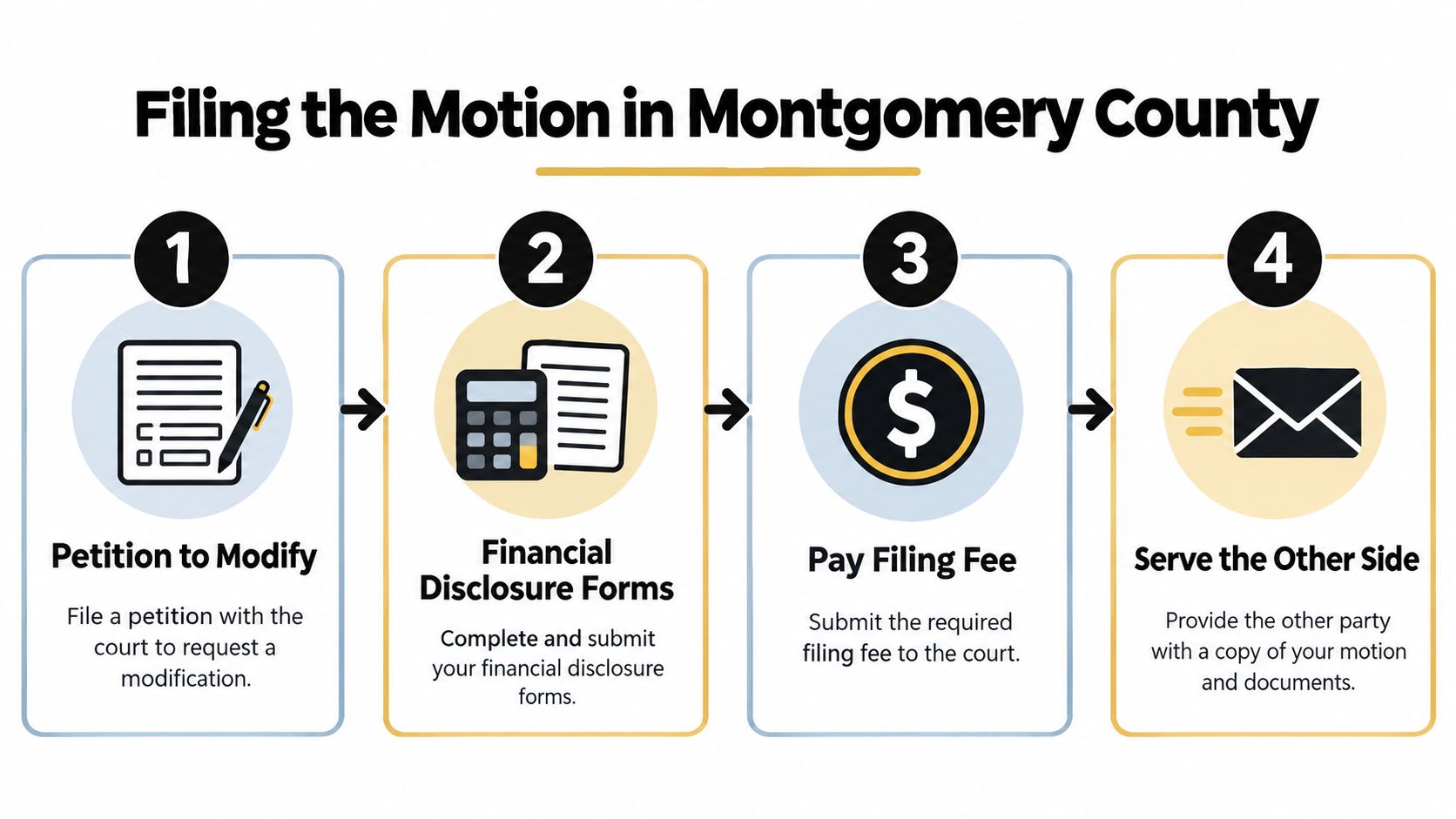
This step turns on paperwork discipline, and the visual below maps the filing sequence most Montgomery County parents follow.
What You File and Why Service Matters
Bring the petition, required family court forms, and your financial information together rather than piecing them out later. Review the Montgomery County family court forms required at filing before you visit the district clerk so you do not lose a trip over a missing form. Expect a filing fee unless you qualify for a waiver under court rules, and keep stamped copies for your records.
- Petition to Modify: States the prior order, what changed, and what new amount you are requesting.
- Financial Disclosure: Gives the judge and the other side your income picture before testimony starts.
- Proposed Order: Shows the exact terms you want signed if you prevail.
- Service Documents: Prove the other parent received formal notice.
Proper service protects the result. If the other parent is not served correctly, the hearing can be delayed or the order can be challenged later. Personal service is the cleanest record. Do not rely on texting a photo of the petition and assuming that counts.
Some modification cases also raise conservatorship questions, especially when possession has shifted. A Child Custody Lawyer in The Woodlands, TX handles custody and conservatorship representation for The Woodlands families, which can overlap with support when residence changes. Mark your answer deadlines and hearing settings on a calendar the day you file. Missing a deadline because you assumed the clerk would remind you is an avoidable error.
Building Your Documentary Timeline and Evidence Package
Judges decide modification cases on paper first and testimony second. A parent who says income fell, but brings no records, asks the court to guess. A parent who brings a clear timeline lets the judge verify the story quickly.
Build that timeline from the date of the last order to the filing date. Mark job changes, hours changes, insurance changes, moves, and school changes in order. Then sort proof using the four calculation categories of gross income, allowable deductions or adjustments, health-insurance costs, and possession or residence facts.
The Four Folders to Build
Folder 1, gross income. Gather recent pay stubs, W-2s, tax returns, and, for self-employment, records that explain variable earnings. If income fluctuates, show a month-by-month history instead of cherry-picking a low month. Judges notice gaps. For detail on what counts, review what income counts for child support in Texas before you finalize your numbers.
Folder 2, deductions and adjustments. Bring proof for legally relevant adjustments you are claiming, not a list of every household bill. Credit card debt, a larger car payment, or voluntary spending rarely moves guideline math the way documented income and allowable items do.
Folder 3, health insurance and medical support. Bring premium proof that separates the child's cost from the whole family plan when possible. The court may address medical and dental support alongside cash support, so treating insurance as an afterthought weakens your package.
Folder 4, possession and residence. If your child now lives primarily in a different home in The Woodlands or elsewhere in Montgomery County, bring school enrollment records or similar proof. A residence change can affect the review, yet parents often omit this folder entirely.
Do not try to reconstruct a year of income from memory the night before the hearing. The documents either tell a coherent story or they do not.
A Concrete Example
Suppose a parent's documented income dropped after a permanent schedule change, and the child also began spending substantially more nights at that parent's home under an agreed arrangement that was never formalized. Folder 1 proves the income change over time, Folder 4 proves where the child sleeps and attends school, and Folder 3 shows who now carries insurance. Together, those folders let the judge apply Chapter 154 of the Texas Family Code to current facts instead of arguing from assertions.
Bring originals or clean copies, plus copies for the judge and the other side. Label exhibits before you arrive. That small step signals credibility before you say a word.
Inside the Montgomery County Courtroom
Hearing day in Conroe starts earlier than most parents expect. You check in, find the correct courtroom, and wait while the docket moves through other family cases. Bring your exhibit copies, a notepad, and patience. Leave children with a caregiver at home.
The image below reflects the waiting and check-in part of the morning that catches first-time litigants off guard.

Who Does What in the Room
The bailiff keeps order and calls cases. The court reporter creates the record, so speak clearly and do not talk over anyone. The associate judge hears the evidence, reviews disclosures, and makes findings on income and guideline support.
For background on the local setting, many parents first read about what happens at a child support hearing in Montgomery County, then still feel surprised by how document-driven the actual proceeding is. Under Texas local-rule material for support cases, each party must prepare a financial disclosure form, provide it to the opposing party or counsel and the judge or associate judge before the hearing, and furnish two current pay stubs. If that exchange has not happened, the judge may reset you or proceed without your best evidence.
How Testimony Actually Goes
You will be sworn in. Your attorney, or you if you are self-represented, presents exhibits and asks direct questions. The other side cross-examines, which is narrower and less dramatic than television suggests. The judge often interrupts with practical questions, such as how a bonus is paid or who claims the child for insurance.
- Address the Judge Properly: Say "Your Honor," stand when required, and do not argue with the other parent directly.
- Dress Conservatively: Treat it like a job interview, not a weekend errand.
- Keep Devices Off: No recording, and silenced phones prevent an embarrassing interruption.
- Answer the Question Asked: Long speeches about the other parent's character usually hurt more than they help.
When both sides are represented, attorneys often narrow disputes before the case is called. When one side is self-represented, the judge still holds both sides to the same rules of evidence. Goodwill does not substitute for a missing pay stub.
Likely Outcomes and How the Judge Decides
A modification hearing is mostly a math problem with a gatekeeping question in front of it. First, are you eligible under the three-year rule or the material-and-substantial-change standard. Second, what do current resources and guideline calculations show under Chapter 154 of the Texas Family Code.
The scale explains why parents fight hard over seemingly small monthly differences. Historical national data show that in the Census Bureau's 2011 report using 2012 data, approximately 14.4 million custodial parents were identified, and 48.9%, about 7.1 million, had a legal or informal child-support agreement. Those figures are national and dated, but they show why formal orders, not side deals, govern millions of households.
The dollars add up the same way in a single Montgomery County home. Separate Census reporting for 2010 found 4.8 million parents paid child support for children under age 21, generating $24.4 billion in payments, with average child-support payments of $5,150 per year. Even without treating those averages as a prediction for your case, the lesson holds. A modest monthly change, repeated over years, becomes a major household transfer.
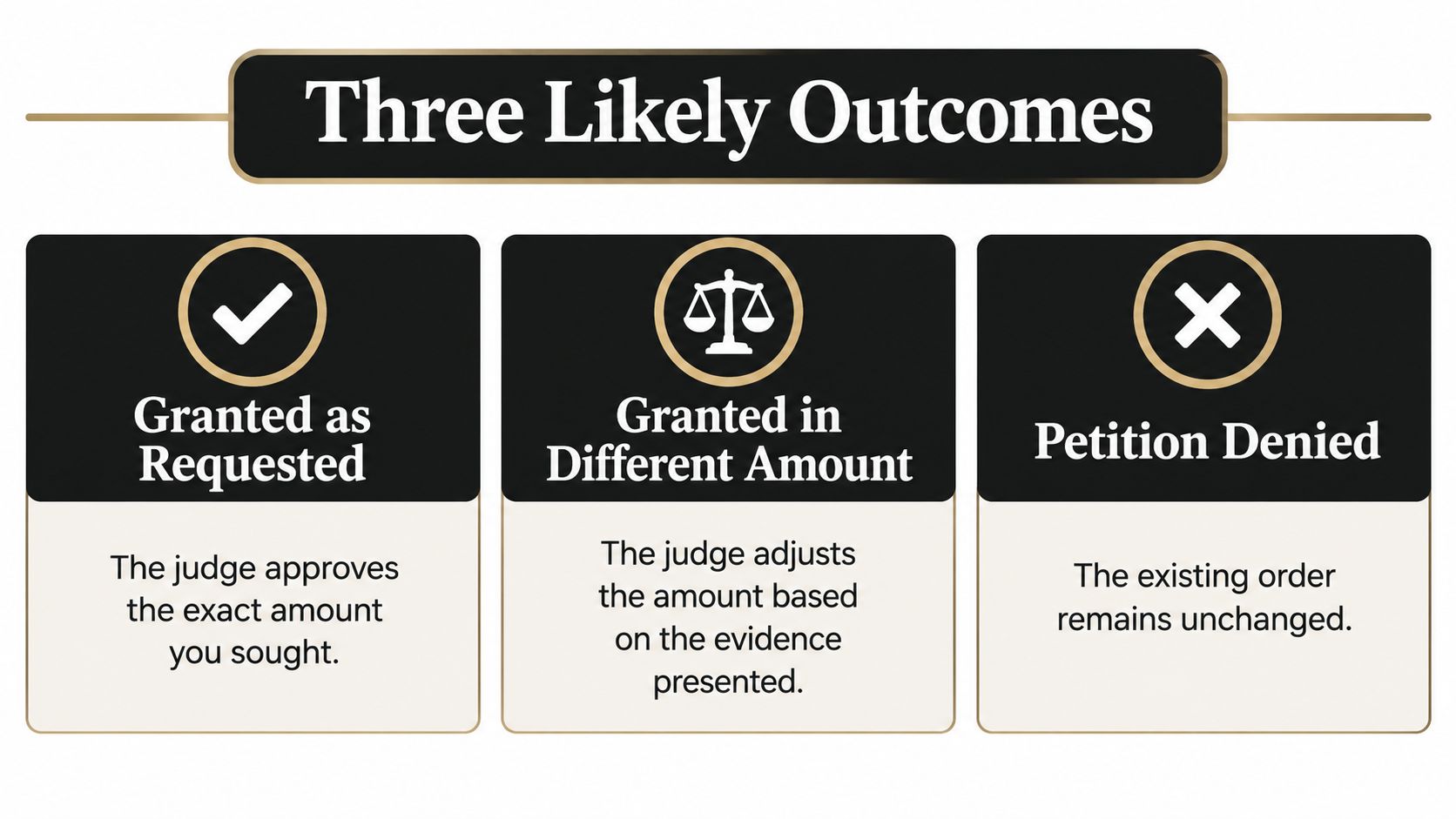
The chart below summarizes the three results parents should prepare for mentally and financially.
The Three Realistic Results
Granted as requested happens when eligibility is clear and your guideline calculation matches the documents. The judge adopts your proposed amount, addresses medical and dental support, and sets an effective date.
Granted in a different amount is common. The judge may find a change occurred but calculate income differently, allocate insurance differently, or account for possession facts in a way that produces a number neither side proposed. This is not a loss if the new order is sustainable and accurate.
Denied means the existing order stays in place. Denials usually trace back to weak proof of change, unreliable income evidence, or a guideline difference that does not meet the legal threshold. Sometimes the court continues the matter for more evidence instead of denying outright, which costs time but preserves the request.
Preparation quality drives which bucket you land in. Judges do not reward volume. They reward records that connect the prior order, the change, and the requested number without contradictions.
After the Judge Rules, Order Entry and Next Steps
Hearing the judge rule from the bench is not the finish line. The ruling must be reduced to a written, signed order before payroll offices and enforcement systems treat the new amount as controlling.
Typically, one side prepares a proposed order reflecting the ruling and circulates it for review. Check every detail before it is signed, including names, the support amount, medical and dental support language, and the effective date. An error that looks small on paper can create months of confusion with withholding.
Once signed, get a conformed copy for your records. The new terms should flow to the appropriate child support enforcement channels so income withholding can be updated and sent to the employer. If the first full pay cycle passes with no change, do not assume someone else caught it. Follow up with a copy of the signed order and document who you contacted.
What to Do Next
- Read the Signed Order Carefully: Confirm the amount, effective date, and insurance duties match the ruling.
- Keep Paying Until Withholding Changes: Do not self-adjust your paycheck deduction.
- Save Proof of Every Payment: Keep records outside the withholding system if you make any direct payments the order allows.
- Calendar Post-Judgment Deadlines: Options to challenge a result are limited and time-sensitive, so act quickly if you believe a legal error occurred.
- Update Your Budget and Records: Adjust automatic bills and keep the order with your tax and insurance files.
After the hearing: The signed order, not your memory of what the judge said, is what employers and enforcement staff will follow.
Challenging an unfavorable result may involve a motion for new trial or an appeal, depending on the procedural posture and the type of ruling. Those steps have strict deadlines and narrow grounds. Dissatisfaction with the amount alone is rarely enough. You need a legal or evidentiary basis, and you need advice quickly while options remain open.
If the other side challenges the result, keep following the current signed order unless a court orders otherwise. Uncertainty during a challenge is not permission to stop paying or to withhold possession.
When Hiring a Local Attorney Makes the Difference
Self-represented parents can succeed in simple modification cases. If income is from one employer, both sides exchange clean records, and possession is undisputed, careful preparation may be enough. Problems start when the case stops being simple.
Self-employment income, bonuses, disputed arrears, a child who has moved households, or an ex-spouse who hides income all raise the difficulty fast. I have seen parents lose ground not because their underlying facts were weak, but because an exhibit was never marked, a disclosure went to the wrong party, or a guideline calculation used the wrong starting figure.
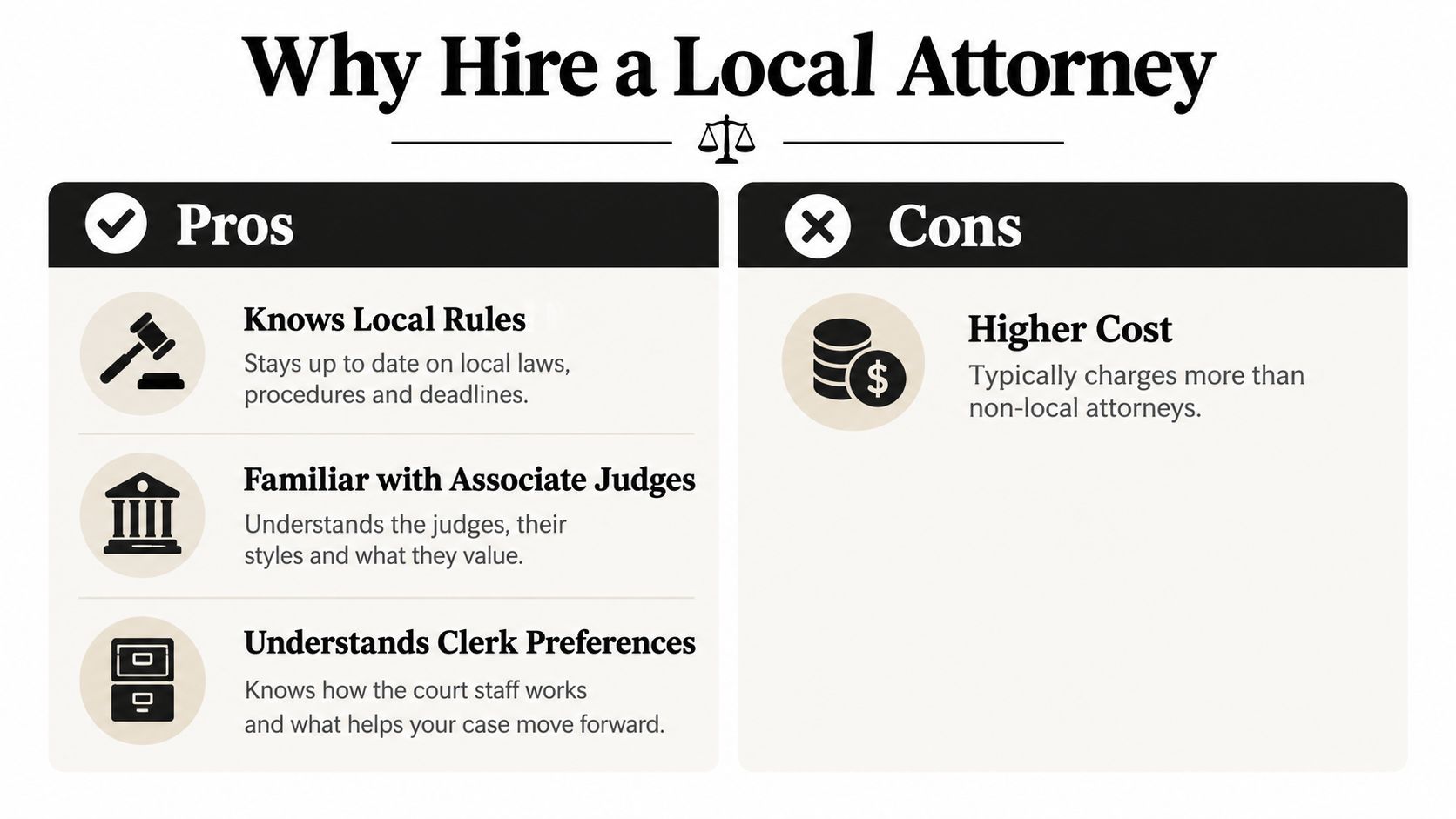
The comparison below weighs local knowledge against cost, which is the trade-off most Woodlands families are making.
| Task | Self-Represented | With Local Attorney |
|---|---|---|
| Eligibility Screening | You research the three-year and material-change pathways alone | Attorney tests your facts against the threshold before filing |
| Evidence Package | You decide which records matter and how to label them | Attorney builds the timeline around what the associate judge reviews |
| Courtroom Presentation | You testify, handle exhibits, and respond to objections yourself | Attorney presents exhibits and cross-examines the other side |
| Order Drafting | You check the proposed order without a second legal review | Attorney reviews language before signature and withholding updates |
A local attorney familiar with Montgomery County procedure knows how disclosures are expected, how associate judges run their dockets, and where filings get tripped up at the clerk's office. The Law Office of Bryan Fagan is one option families consider for divorce, child custody, child support, and related family law matters in The Woodlands area. Whether you hire counsel or proceed alone, compare the cost of help against the long-term cost of an order that is too high, too low, or vulnerable to challenge.
This article provides general information about Texas child support modification hearings and is not legal advice for your specific facts. Laws, local procedures, and deadlines can affect your case, so talk with a qualified Texas family law attorney before filing or responding.
If your income, possession schedule, or child's needs have changed and you need a clear plan for a Montgomery County modification hearing, schedule a consultation to review your current order and evidence before you file. Visit The Law Office of Bryan Fagan to discuss child support, custody, and related family law options for your family in The Woodlands and take the next step with local guidance.