
You won a judgment in Montgomery County, sent the debtor a demand, and still haven't collected a dollar. The court win matters, but it doesn't put money in your account. The next question is whether the debtor has assets Texas law lets you reach, and whether the likely recovery justifies the cost of pursuing it.
A judgment enforcement attorney helps answer that question before you spend on writs, garnishments, or contested hearings. In The Woodlands and nearby communities, the sound approach is to assess assets, exemptions, deadlines, and bankruptcy risk first, then choose a collection method that fits what the debtor owns.
What a Judgment Enforcement Attorney Actually Does
Say a local contractor gets a civil judgment after a customer fails to pay. The contractor has a signed court order, but doesn't know whether the debtor has a bank account, real estate, or income that can be reached. A demand letter may prompt a payment plan, but if it doesn't, active enforcement takes investigation and careful use of court procedures.
A judgment enforcement attorney works on the stage after the lawsuit. The job can include confirming the balance, finding non-exempt assets, asking the debtor to disclose financial information, recording a judgment lien, and seeking court process to reach eligible property. The attorney may also negotiate a payment arrangement when voluntary payments make more sense than the expense and delay of a contested collection effort.
That work is different from proving the original case. The lawyer who handled the trial may know the dispute well, but collection involves its own procedural rules, asset questions, and cost-benefit decisions. If your original case involved a contract, for example, civil litigation representation in The Woodlands may be relevant to the underlying dispute, while enforcement requires a separate assessment of how the judgment can be collected.
The difference between a letter and enforcement
A post-judgment letter asks the debtor to pay or discuss terms. It's relatively simple, but it can't identify hidden assets or compel a response. Court-supervised discovery and remedies can offer greater negotiating power, but they also require time, preparation, and attention to exemptions and notice rules.
A judgment may also matter in a family-law case. Enforcement of Court Orders in The Woodlands concerns enforcing divorce decree and custody order provisions in Montgomery County. The right process depends on what the order requires and which legal remedy applies.
Practical rule: Don't spend on a remedy until you have a credible reason to believe it can reach an asset the debtor owns and the law allows you to pursue.
Doing nothing has a cost, too. Under Texas Civil Practice and Remedies Code §34.001, a court-of-record or justice-court judgment becomes dormant if no writ of execution is issued within 10 years after it's rendered. It can become dormant again if another writ isn't issued within 10 years after the first. A local attorney can help you decide whether to seek payment, investigate first, or preserve the judgment before time complicates collection.
Confirming the Judgment Is Ready to Enforce
You have a signed judgment and a lead on the debtor's property. Before spending money to pursue it, confirm that the court record permits collection and that the asset justifies the expense. A stay, an incorrect balance, or a bankruptcy filing can derail the effort before you collect anything.
Check the judgment and balance
Start with the signed judgment and the docket. Confirm finality, the judgment holder's identity, and any appeal, stay, or order limiting enforcement. If the judgment was assigned or the original creditor changed, establish who has authority to collect. Have counsel review any appeal bond and related orders before requesting process.
Get a current payoff calculation separating the original award, recoverable costs, and applicable interest, with payments credited. An old demand letter isn't a reliable balance.
For a judgment arising from unpaid contractual obligations, a breach of contract lawyer in The Woodlands can review the judgment record and resolve questions about what the award covers.
Match readiness to the property
If real estate is the target, confirm that the abstract of judgment has been properly recorded in each county where the debtor owns qualifying property. Recording alone doesn't establish collectible equity. Check ownership, exemptions, and existing liens before treating that property as a source of payment.
Keep the spending decision tied to the asset. A modest records review can prevent an expensive pursuit of property that offers no recovery. Check for a bankruptcy filing before authorizing enforcement, because an automatic stay can stop collection even when the judgment and asset information are otherwise in order.
Out-of-state judgments need a Texas route
A judgment from another state requires the applicable Texas recognition procedure before local enforcement. Have counsel prepare the authenticated judgment, required affidavit, and notice package before filing.
For judgments eligible for registration under the framework associated with the Uniform Enforcement of Foreign Judgments Act of 1948 and its 1964 revision, focus on complete filing papers and proper notice. Resolve authentication defects and confirm that Texas enforcement is available before paying to pursue the debtor's property.
The Four Main Texas Enforcement Tools Compared
The right tool depends on the asset, not on which remedy sounds most aggressive. A judgment lien may be economical to record but won't create equity. A garnishment may reach a bank account, but only if funds are there and the legal requirements are met. A writ of execution can reach eligible property, while turnover relief may help when a debtor controls non-exempt property that ordinary process hasn't recovered.
| Remedy | Best Asset Type | Typical Wait | Main Limitation |
|---|---|---|---|
| Judgment lien | Non-exempt real estate the debtor owns | After the required filing and recording steps | Little value if the debtor has no reachable equity or other liens take priority |
| Writ of execution | Non-exempt personal property that can be levied and sold | Ordinarily, at least 30 days after final judgment or denial of a motion for new trial | Property must be legally reachable; levy and sale can add expense |
| Garnishment | Funds held by a third party, such as a bank | Depends on the application, service, and court process | Requires a legal basis and eligible funds; exemptions and procedural rules apply |
| Turnover relief | Eligible non-exempt property or intangible assets | Depends on the court process and the facts | Can become contested and costly if ownership, control, or exemptions are disputed |
Where each remedy earns its keep
A judgment lien can put a recorded claim against qualifying real property, but a lien isn't a payment. If the debtor has no equity or other creditors have priority, recording may preserve value without producing money soon.
A writ of execution directs a sheriff or constable to levy and sell non-exempt property. It can fit a case where the creditor has identified reachable property, but it's a poor bet when the target is exempt or the debtor owns nothing worth selling. Texas procedure generally requires a 30-day wait after the final judgment or denial of a motion for new trial before a writ may issue, as summarized by the Texas State Law Library's guide to collecting a judgment.
Garnishment targets property in the hands of a third party, often funds held by a bank. It's not a blanket right to take earnings or money regardless of source. Federal and Texas protections, exemptions, and the facts of the account matter.
Turnover relief can be useful when a debtor has eligible property or intangible rights that aren't easily reached through a straightforward levy. It's often the more involved option, so use it when the asset value justifies the litigation cost. A careful attorney weighs expected recovery against fees, delays, and the risk that a court will reject the proposed target.
Building the Post-Judgment Discovery and Collection Workflow
Good collection starts with information, not a stack of writs. Texas post-judgment discovery can help identify employment income, accounts, vehicles, real estate, business interests, and property transfers. The attorney then matches what the debtor owns to the remedy most likely to reach it without spending more than the likely recovery.

Start with written discovery
An attorney can serve post-judgment questions and requests for records under Texas procedure, including Rule 621a. The requests may seek information about accounts, income, property, and transfers. The debtor generally receives at least 30 days to respond, and those response dates need to be tracked.
If written answers are incomplete, a judgment debtor examination can allow counsel to ask questions under oath. The process is practical, not theatrical. The goal is to learn what assets exist, who owns them, whether exemptions apply, and whether the debtor's answers match the available records.
The divorce discovery process provides context for formal financial disclosure in family cases. Post-judgment discovery has a different purpose: identifying assets to satisfy an existing judgment.
Match the remedy to the asset
Once the attorney has useful information, the plan should stay focused. A bank account may support a garnishment application. Non-exempt property may support a writ of execution. A debtor's interest in property that can't be reached through a simple levy may call for turnover relief. A judgment lien may be worth recording if the debtor owns qualifying real estate.
Child support follows a separate route. Texas Family Code Chapter 158 authorizes income withholding for current support and, when properly ordered, arrearages. The amount withheld depends on the controlling support order and applicable limits, so it's not necessarily a full paycheck deduction. A parent who thinks an employer is withholding the wrong amount should compare the notice with the order and payment history and promptly seek review through the appropriate process.
Post-judgment discovery can begin without a separate filing when no appeal has been perfected and the judgment isn't dormant. That doesn't mean every question or remedy is automatically proper. Exempt property and premature process are costly mistakes, and can lead to objections, delay, or wrongful-levy exposure. Ask a local attorney to check the prerequisites before taking the next step.
Montgomery County Timeline, Costs, and Local Court Realities
A debtor has a bank account in Montgomery County, but the property you hoped to seize sits elsewhere. Those assets call for different budgets and timelines. Before paying for another filing, ask which asset offers the best recovery after service costs, attorney fees, and the risk of a bankruptcy filing.
Start with the asset's likely net value. Preparing and recording an abstract of judgment is comparatively straightforward. Garnishment and turnover proceedings require more paperwork and court involvement, especially when ownership or exemptions are disputed. A judgment entered in a Montgomery County justice court or district court may still require discovery, service, court review, and coordination with a sheriff or constable before money reaches you.
Build a realistic timeline, not a promise
Ask counsel to separate mandatory waiting periods from practical delays. For a writ of execution, Texas procedure ordinarily requires waiting 30 days after final judgment or denial of a motion for new trial. Discovery has response periods; garnishment and turnover proceedings have filing, service, and court requirements. Ask counsel to check execution requirements under the Texas statute on judgment dormancy when assessing whether the proposed process is ready to proceed.
A court date is not a payment date.
A voluntary payment plan may start sooner and cost less than contested enforcement, but cooperation can disappear. A levy may take longer and return nothing if the property is exempt, unavailable, or worth less than the expense of pursuing it. Bankruptcy risk makes that spending decision harder: an expensive remedy needs a stronger recovery prospect than a low-cost step.
Ask for the tradeoff in plain terms: What will this step cost, what asset could it reach, and what happens if the debtor has no collectible value?
In Montgomery County, abstract recording and constable service fees follow the county's fee schedule. Request a line-item estimate before authorizing a levy, including attorney time and service costs. As a budgeting example, a contested turnover proceeding could consume several thousand dollars in attorney time. Pursue it only when the identified asset's collectible value materially exceeds the projected expense.
Property outside Montgomery County adds another cost question. Counsel must address the property's location and the applicable local process; the same officer may not handle every stage. Require a budget that accounts for that coordination before committing to the remedy.
How Bankruptcy Can Disrupt Even the Best-Laid Collection Plan
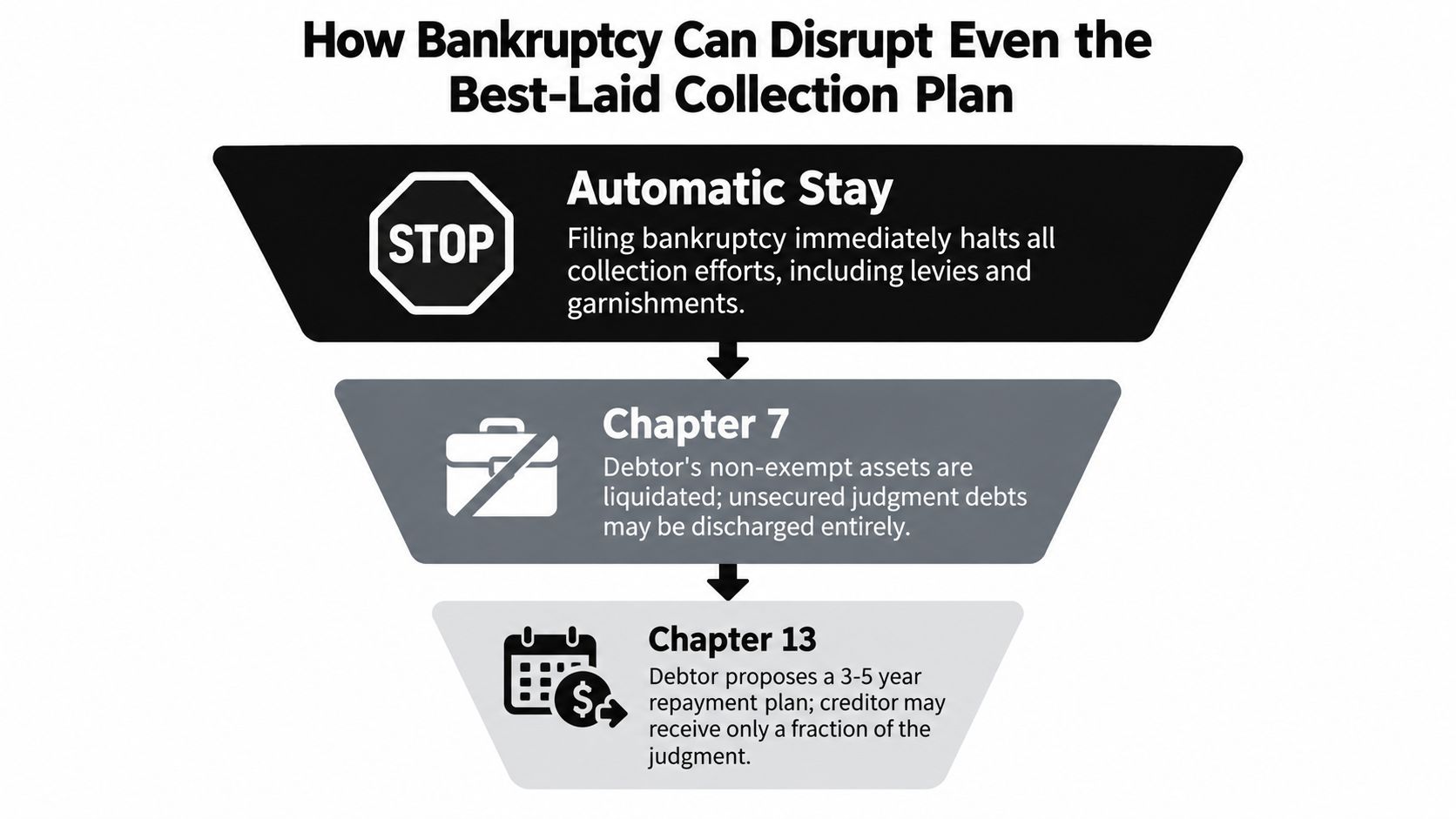
More collection activity doesn't necessarily mean more money. If a debtor files bankruptcy, the automatic stay can halt collection efforts, including pending garnishment or levy activity. Pushing ahead without checking for a filing can create legal problems and waste money.
The risk deserves attention. U.S. bankruptcy court statistics for 2025 report 557,376 petitions, an increase of 53,264 from the prior year. More than 540,600 individual petitions involved predominantly consumer debts, up 12% year over year. Those figures don't predict what any one debtor will do, but they make bankruptcy screening a sensible part of an enforcement plan.
Screen before spending on aggressive remedies
Chapter 7 and Chapter 13 can affect a creditor's options in different ways. In Chapter 7, the treatment of property and debt depends on exemptions, the bankruptcy estate, and discharge rules. In Chapter 13, a debtor may propose a repayment plan. Neither chapter guarantees a particular recovery, so don't assume that a judgment automatically survives unchanged or that bankruptcy means nothing can be collected.
Family-law debts need careful classification. Child support and some divorce-related obligations can receive special treatment under bankruptcy law, including 11 U.S.C. §523(a). The exact nature of the award matters. A support obligation, property division award, and attorney-fee award shouldn't be treated as interchangeable just because they appear in a divorce order.
Bankruptcy can change the question from “Which remedy should I use?” to “Should collection pause while counsel checks the stay, exemptions, and likely recovery?”
Before filing repeated writs, ask counsel to assess bankruptcy exposure, the debtor's realistic assets, and whether the expected recovery justifies enforcement costs. An early screen may prevent you from spending on a remedy that a bankruptcy filing interrupts.
What to Do Next and When to Call a Local Attorney
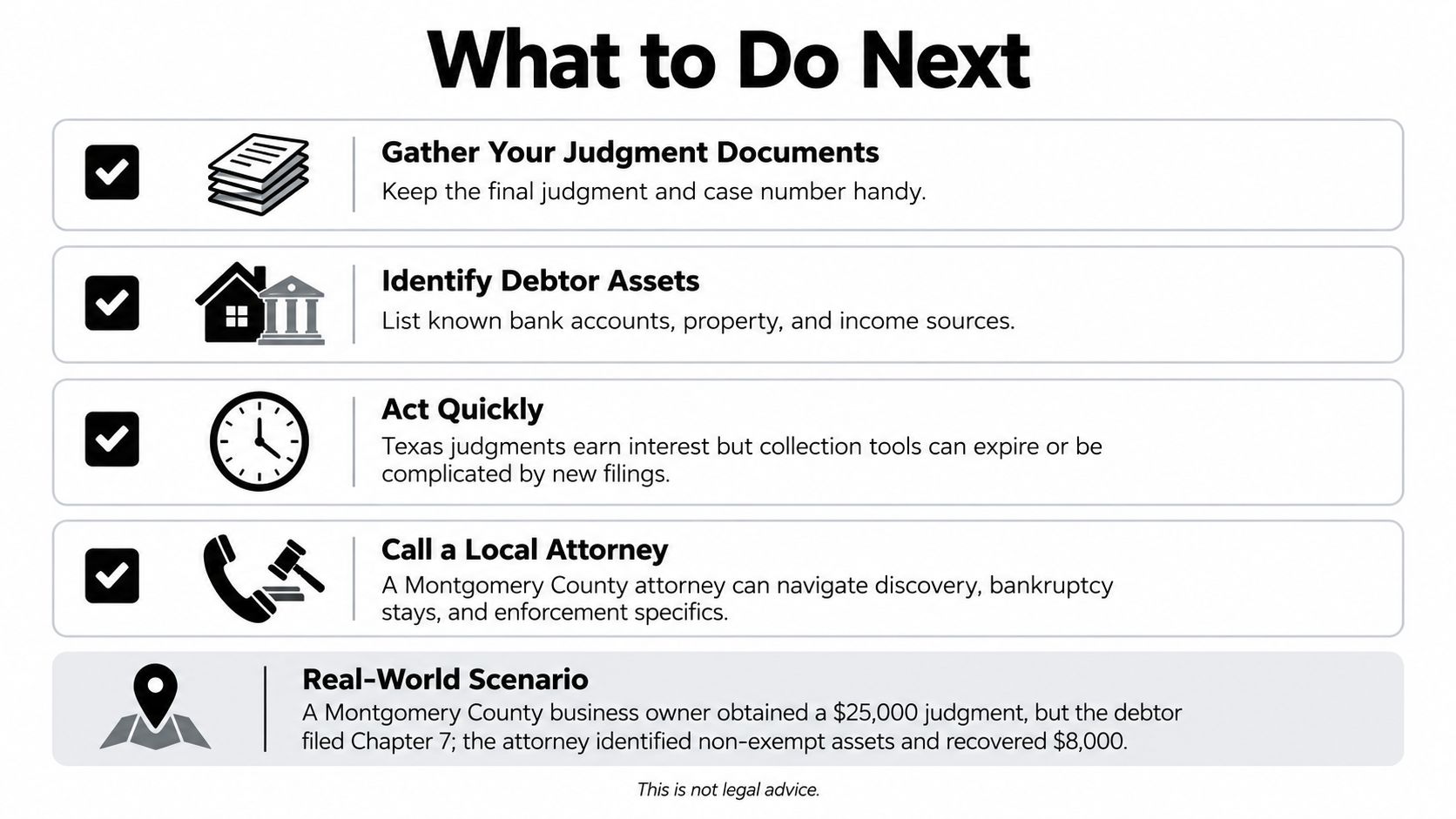
Start with a short asset-and-deadline review. Don't assume the most forceful remedy is the most useful one. For a Montgomery County creditor, the practical question is whether a reachable asset exists and whether pursuing it makes financial sense.
What to do next
- Gather the judgment documents: Keep the signed judgment, case number, and any appeal or stay records together.
- Check the balance and ownership: Get a current payoff calculation and confirm who has the right to enforce the judgment.
- List likely assets: Note known real estate, accounts, income sources, vehicles, and business interests.
- Screen for bankruptcy: Ask whether a filing affects collection and how the underlying obligation may be treated.
- Compare likely recovery with expense: Consider equity, priority claims, exemption risk, service difficulty, and legal costs before approving a contested remedy.
A Montgomery County example
A Montgomery County ex-spouse is trying to collect an unpaid property-division award when the former spouse files for bankruptcy. Instead of pressing ahead with a garnishment, the creditor's attorney checks the bankruptcy case, reviews the award's classification, and weighs the debtor's assets and exemptions before choosing what to do next. That approach may mean collection pauses while counsel evaluates the legal effect of the filing.
Contempt is another possible response to failure to obey a court order, but it isn't a substitute for asset-focused collection. Under Texas Government Code §21.002, contempt penalties depend on the court and proceeding, and the person accused generally needs notice and an opportunity to respond. For family-law enforcement, the governing procedure also matters. The priority is to act promptly, protect deadlines, and select a remedy that has a realistic path to recovery.
This article is general information, not legal advice. A lawyer must review your judgment, court record, assets, and circumstances to advise you about your options.
The Law Office of Bryan Fagan works with families in The Woodlands and Montgomery County on matters including child support, property division, and enforcement of court orders. If you're weighing collection options or have questions about a bankruptcy filing, consider scheduling a consultation through The Law Office of Bryan Fagan.