 Skip to content
A parent in Sterling Ridge waits at the usual exchange spot. The child's backpack is ready. The order says pickup is at a specific time and place. Then the text comes in: “Not today. It's not a good idea.”
That moment is infuriating. It's also where many parents in The Woodlands and Montgomery County make a mistake. They argue by text, leave without proof, or assume the police will fix it. Usually, they won't. Custody enforcement in Texas is a court process, and the parent who walks into court with organized facts usually stands in a much stronger position than the parent who walks in with understandable anger.
If you're trying to figure out how to enforce custody order in Texas, the short answer is this: document the violation carefully, keep following your own order, and use the court that issued the original order to file a Motion to Enforce when the facts support it.
This article is written for parents in The Woodlands, Conroe, Magnolia, Montgomery, and nearby communities who need a practical roadmap through Montgomery County family court procedures. It is for informational purposes only. It is not legal advice, and reading it does not create an attorney-client relationship.
Introduction
Most custody enforcement cases don't begin in a courtroom. They begin in a parking lot, outside a school, or at a familiar exchange point off Research Forest, Kuykendahl, or FM 1488 where one parent realizes the other parent isn't going to follow the order.
That's the hard part about these cases. The problem feels immediate and personal, but the solution is procedural. Judges in Montgomery County don't decide these cases based on who sounds more upset. They decide them based on whether there is a clear order, a provable violation, and proper notice under the Texas Family Code.
Under Texas Family Code § 157.001, the court that issued the original possession or access order generally has authority to enforce it. That matters because enforcement usually isn't about starting over. It's about asking the same court to compel compliance with an order already in place.
Practical rule: A violation feels obvious to you. The court still needs it spelled out with precision.
If the other parent has denied visitation once, changed pickup terms at the last minute, or started creating a pattern of no-shows, your next move should be strategic, not reactive. The right response depends on whether this is a routine denial, a repeated pattern, or a true emergency involving safety.
A short scenario shows the difference. A parent in Alden Bridge goes to the exchange location exactly as ordered. The other parent never arrives and sends a vague message blaming the child's mood. That may support enforcement if the order is specific and the denied parent can prove the date, place, and time. But if the concern is that the child may be in immediate danger or hidden from the other parent, the response may need to be much faster and more aggressive.
Documenting Violations and Initial Communication
The first fight to win is the proof fight.
In Montgomery County, enforcement cases often turn on details that feel small when you are living through the problem. The judge will want to see that you followed the order, showed up where you were supposed to show up, and kept a clean record of what happened. If your notes are vague or your communication spirals into arguments, a strong complaint can become a weak enforcement case fast.
Under Texas Family Code § 157.002, an enforcement motion has to identify the exact order provision that was violated, describe the noncompliance, and state the relief requested. For possession and access disputes, that means your documentation needs to be specific enough to track each missed exchange to the wording of the order.
Build a denial log that a judge can actually use
Start one file and keep everything there. Paper is fine. A notes app is fine. What matters is consistency.
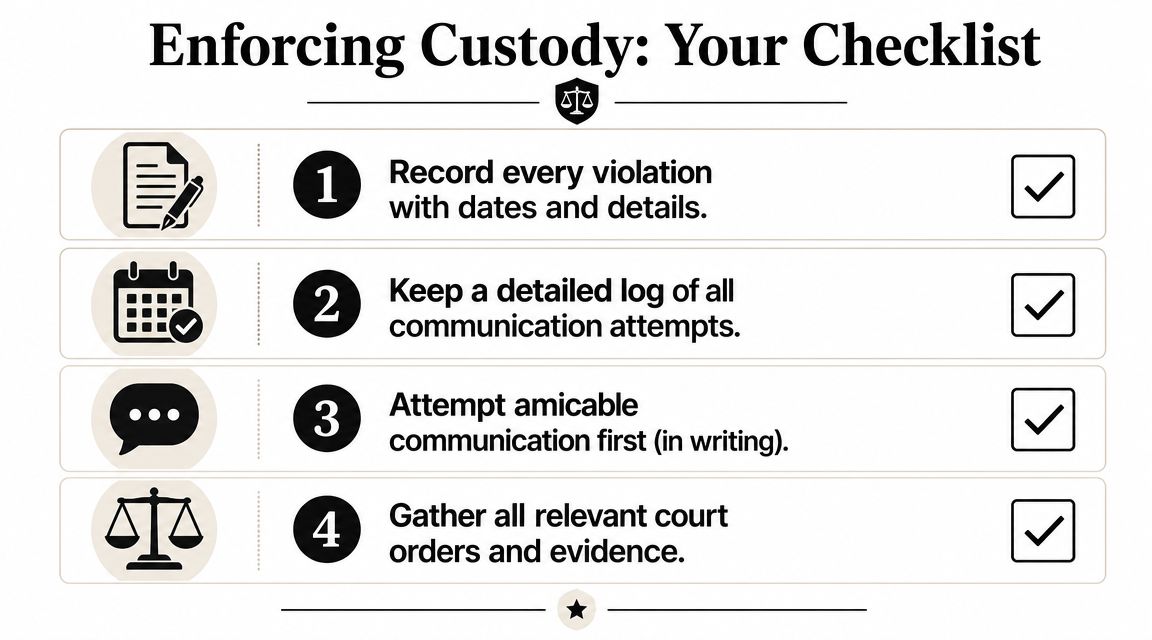
For every denied visit or failed exchange, record:
- Date of exchange: Use the exact date tied to the order.
- Time you arrived: Note when you got there and how long you waited.
- Place: List the precise exchange location in the order.
- What happened: Keep it factual. “I arrived at 6:00 p.m. at the Starbucks on Research Forest Drive. Other parent did not arrive.”
- Communication received: Save any text, email, voicemail, or app message about the exchange.
- Witnesses or supporting proof: Include names, receipts, photos, or anything else that confirms you were present and ready.
Parents make a costly mistake here. They stop going once the other parent says, “Don't come,” or “The child doesn't want to go.” In many cases, you still need to appear at the ordered place and time unless your lawyer tells you there is a good legal reason not to. A text message helps. Proof that you showed up usually helps more.
If this has happened more than once, keep logging every incident. One denial may be explainable. A pattern is easier to enforce.
Save evidence in a way your lawyer can organize quickly
Good evidence loses value when it is scattered across screenshots, old phones, and half-remembered calendar notes.
Use one folder, one notebook, or one cloud folder and save:
- Texts and emails: Keep full threads when possible, not cropped snippets.
- Photos: Save originals if you can.
- Receipts: A timestamped purchase near the exchange site can support your timeline.
- Calendar records: Keep your parenting calendar current.
- Copies of the current order: Include modifications, not just the original decree.
Montgomery County courts see plenty of “he said, she said” disputes. Organized proof stands out. If you want a practical overview of what judges and lawyers look for, this guide on evidence needed for child custody in Texas is a useful starting point.
Your anger may be justified. Your evidence still has to carry the case.
Keep the first message short and usable
A brief written message to the other parent can help if it stays calm and factual.
A workable example is: “I was at the exchange location at the ordered time and was ready for pickup. Please confirm when you intend to comply with the order.”
That message does two things. It shows you were attempting to follow the order, and it creates a record without adding language that will hurt you later. In Montgomery County, judges and associate judges read these messages closely. Petty comments, insults, and threats rarely help the parent who sent them, even when that parent was the one denied time.
Do not argue for an hour by text. Do not threaten to keep the child next time to “make it even.” Do not agree to repeated side deals that conflict with the written order unless you are prepared for the other parent to deny the agreement later.
Should you call the police?
Sometimes, yes. Usually for documentation, not immediate enforcement.
For a standard visitation denial in Montgomery County, law enforcement commonly treats the matter as a civil issue unless there is a separate safety concern, a criminal issue, or clear interference that fits a different legal category. An officer may write an incident report. That report can help your paper trail. It often does not result in the child being turned over on the spot.
That is frustrating, but it is common.
The practical goal at this stage is to avoid making the case worse. Show up at the right place. Follow the order exactly. Preserve your proof. Keep your communication clean. Those steps put you in a much stronger position when it is time to ask the court to act.
Filing a Motion to Enforce Your Custody Order
You followed the order. You showed up. You kept the messages clean. The other parent still denied your time.
At that point, the next step in Montgomery County is usually a Motion to Enforce filed in the same court that signed your current order. This is the court process that asks the judge to do more than listen. It asks the court to enforce the order in a way the other parent cannot ignore.
Under Texas Family Code § 157.001, Texas courts can enforce possession and access provisions. In practice, whether your case gains traction often comes down to precision. A judge in Conroe needs a motion that ties exact facts to exact order language.
What the motion needs to say
A Motion to Enforce is a formal pleading. It has to be specific enough for the court to act.
That means identifying the order, quoting or closely tracking the possession terms, and listing each violation separately by date, time, and what should have happened under the order. If the order says pickup is at 6:00 p.m. on the first, third, and fifth Fridays at a named location, the motion should say which Friday was denied, where you were, and how the other parent failed to comply.
General accusations are weak. Specific violations are usable.
A workable motion usually includes:
- The court, cause number, and parties
- The order you want enforced
- Each alleged violation stated separately
- The relief you are asking for
- A request for the court to require the other parent to appear
What filing looks like in Montgomery County
For Montgomery County cases, filing usually runs through the district clerk in Conroe, in the same court that signed the existing order. That sounds simple. It often is not.
The common problems are procedural. A parent files in the wrong court after a transfer. The motion describes violations too loosely. The paperwork gets filed, but service is not completed correctly, so the hearing has to be reset. Those mistakes cost time, and time matters when missed periods of possession keep stacking up.
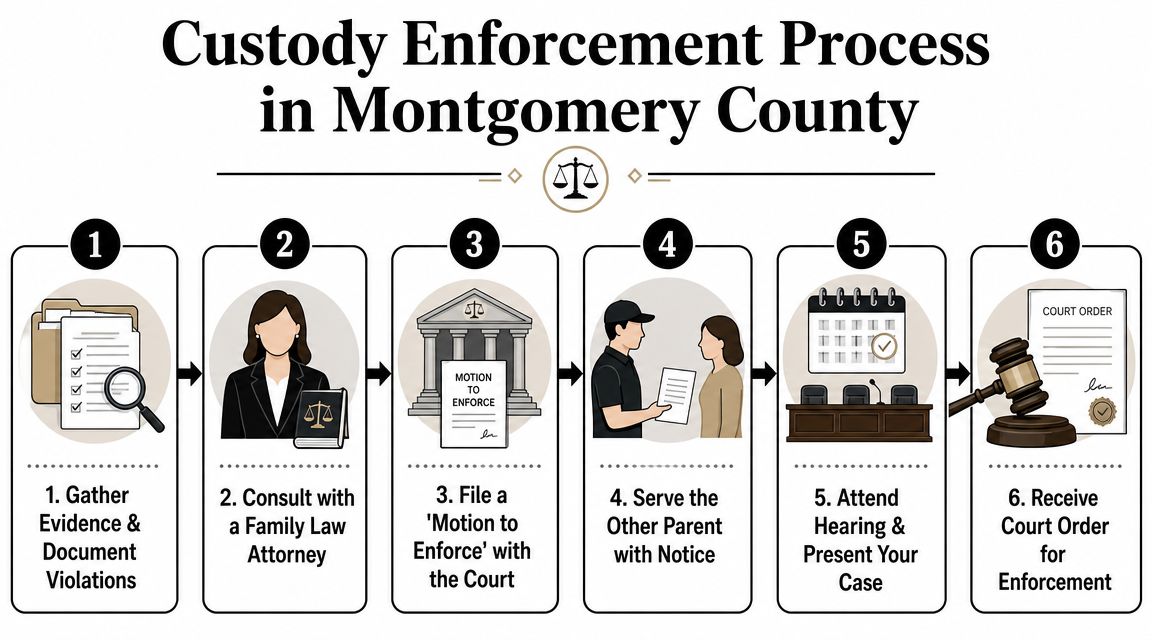
Here is the usual sequence:
| Step | What happens |
|---|---|
| Gather the documents | Pull the signed order, your violation log, texts, emails, photos, and any police incident report or witness details |
| Draft the motion | Match each alleged violation to the order language |
| File the case papers | File in the court with continuing jurisdiction over your order |
| Get the court's setting paperwork | The court issues the paperwork needed to bring the other parent to court |
| Complete formal service | A constable, sheriff, or private process server serves the other parent |
| Confirm the return is filed | The court usually cannot proceed until proof of service is on file long enough under the rules |
In Montgomery County, parents often underestimate the clerk-side details. The court cannot fix a vague motion for you. The court also will not excuse bad service just because the other parent obviously knew about the case.
Service problems delay a lot of enforcement cases
Service is where many self-filed cases stall.
The other parent usually must be formally served with the motion and the court's order to appear. A text message, email, or copied screenshot of what you filed is usually not enough. If service is defective, the judge may have no choice but to reset the hearing, even if your facts are strong.
There is also a timing issue. After service, the return usually must be on file for the required period before the hearing can go forward. Parents are often frustrated by that delay, but it is part of getting an enforceable result instead of a hearing that falls apart on procedure.
I tell clients this all the time. Filing gets your case started. Proper service gets your case heard.
What helps your motion in a Montgomery County courtroom
Judges and associate judges here tend to respond well to organized, narrow enforcement requests. They do not want a month of relationship history if the legal issue is three denied weekends. They want the order, the dates, the proof, and a clear request for relief.
What usually helps:
- A clear order with enforceable possession terms
- A separate paragraph for each violation
- Exhibits labeled by date
- Proof you were at the exchange location as ordered
- A proposed order that matches the relief requested
What often hurts:
- Combining old grievances with current violations
- Asking for contempt when the underlying order is too vague
- Showing up with screenshots but no chronology
- Assuming repeated denials automatically make it an emergency
- Treating the motion like a chance to vent instead of prove
That last point matters. Enforcement cases are won with detail and discipline, not outrage.
When You Need an Emergency Custody Order
Your ex does not show up for the exchange. Then the phone goes off. A few hours later, you hear they may be leaving the area with your child. That is the kind of fact pattern that changes the question from enforcement to emergency relief.

Parents in Montgomery County often call every denied visit an emergency because it feels like one. I understand that reaction. The court usually draws a sharper line. Emergency orders are generally for situations where waiting for the normal hearing process could put the child at immediate risk, allow a parent to hide the child, or make recovery much harder if the child is taken out of the county or out of Texas.
That distinction matters in Conroe and the surrounding Montgomery County courts. If you ask for emergency relief on facts that look like a standard enforcement dispute, you can lose time, lose credibility, and still end up having to proceed the regular way.
What usually qualifies as an emergency
Missed exchanges, repeated lateness, last-minute schedule changes, and a parent who refuses to cooperate are serious problems. They often support enforcement. They do not automatically support emergency pickup orders or emergency temporary relief.
Emergency facts usually look more urgent and more specific, such as:
- A credible threat to take the child out of Texas
- The child's whereabouts being concealed
- Recent family violence, abuse, or threats tied to the child's immediate safety
- Serious drug use, mental health instability, or dangerous living conditions creating a present risk
- A violation of geographic restrictions combined with evidence the child may not be returned
In Montgomery County, judges want concrete facts, not fear-based conclusions. “I think she might leave” is weaker than flight information, packed belongings, a goodbye text, or messages saying the child will not be returned.
The court tools depend on the problem
Different emergencies call for different filings. Picking the wrong one can slow you down.
- Temporary restraining relief can be appropriate if there is a real risk the other parent will remove the child, hide the child, or violate current restrictions before a hearing.
- Writ of Habeas Corpus may be used to require that the child be brought before the court when one parent is unlawfully withholding possession.
- Writ of Attachment may be available in narrow circumstances where law enforcement assistance is needed to recover the child.
- Emergency modification may be the better fit if the current order no longer protects the child from immediate harm.
For a more local breakdown of how courts handle urgent requests, review this guide on an emergency custody order in The Woodlands.
A short explanation of the difference between emergency and non-emergency custody problems can also help:
Common Montgomery County mistakes
I see the same problems over and over. A parent waits too long because they hope things calm down. Or they rush into court with a real concern but very little proof.
If you may need emergency relief, do these things fast:
- Save the messages exactly as they came in
- Write down times, locations, and who said what
- Gather school, medical, or police records if they exist
- Keep your request focused on immediate safety or concealment
- Avoid padding the filing with months of unrelated co-parenting complaints
That last point matters more than many parents realize. In a Montgomery County emergency hearing, old resentment can bury the urgent issue. Judges and associate judges are looking for the present danger, the supporting proof, and the narrow order needed to stabilize the situation.
A quick local example
A parent in Creekside reports that the other parent missed a weekend exchange and stopped responding for several hours. That is upsetting. Standing alone, it often stays in the enforcement category.
Change the facts. The other parent cuts off contact, tells relatives they are leaving Texas, removes the child from school, and there is a recent history of violence or drug use. That is the kind of record that may justify asking the court for emergency relief right away instead of waiting for the normal enforcement timeline.
What Happens at the Enforcement Hearing
The hearing is usually less dramatic than parents expect and more technical than they hope. In Montgomery County, the judge or associate judge is not there to sort through every co-parenting problem you have had. The court is deciding a narrower question. What did the order require, what exactly happened, and can you prove the violation in a way the court can enforce.
That point matters. A parent can be completely truthful and still lose an enforcement case if the order is too vague or the proof does not match the wording of the order.
What the judge will focus on
Come ready to prove each violation line by line. In practical terms, that usually means:
- A certified or file-stamped copy of the current order
- A clean violation log with dates, times, and exchange locations
- Texts, emails, call logs, or app messages tied to each denied period
- Proof you showed up as required, such as photos, map history, receipts, or witness testimony
- A clear request for relief, such as make-up time, contempt, attorney's fees, or another specific remedy allowed by the order and the facts
In Montgomery County courtrooms, organized proof carries weight. Judges see plenty of parents who are upset. The parent who can point the court to Exhibit 3, identify the exact paragraph of the order, and explain what happened in two or three direct sentences is usually in a better position.
Here is the basic framework most courts are using:
| Judge's question | What helps answer it |
|---|---|
| What exactly did the order require | A signed order with the relevant provisions highlighted |
| What specific provision was violated | Your motion and testimony tied to one denied date at a time |
| How do you know it happened | Messages, logs, witness testimony, and proof you appeared as ordered |
| What should the court do about it | A precise request for make-up time, contempt, fees, or another enforceable remedy |
How the hearing often plays out in Montgomery County
Many parents expect a long trial. Often, it is more compressed than that.
The court will call the case, confirm appearances, and take up any preliminary issues. The parent who filed the motion usually presents first. That means testimony, exhibits, and a clean explanation of each alleged violation. The other parent then gets a chance to respond, explain, and challenge your proof.
If you are in front of an associate judge, expect a brisk pace. You may not get much patience for side issues. Long answers, scattered exhibits, and arguments about old grievances can hurt an otherwise good case. That is a common problem in Montgomery County. Parents arrive with a real complaint, but they spend their limited hearing time arguing about respect, tone, or support issues that are not part of the possession violation before the court.
What the court can order
Texas courts have real enforcement tools, including contempt in the right case. As the Texas State Law Library explains in its SAPCR enforcement guide, available remedies can include civil or criminal contempt, and a court may issue a capias if a properly served party fails to appear as ordered.
In possession and access cases, the outcomes I see most often are more practical than dramatic:
- Make-up possession
- A clarified pickup and drop-off process
- Attorney's fees and court costs in the right case
- Contempt findings when the order is clear and the proof is strong
- Orders aimed at getting future compliance, not just punishing past conduct
The trade-off is straightforward. If you ask for everything, including relief the facts do not support, you can lose credibility. If you ask for too little, you may leave court with an order that does not solve the problem.
What tends to go wrong at these hearings
Some mistakes hurt good cases more than bad facts do:
- Trying to relitigate the divorce or prior custody fight
- Mixing child support complaints into a possession enforcement hearing
- Submitting piles of screenshots with no dates or labels
- Admitting you also withheld the child or ignored the order
- Relying on what you believe the order meant instead of what it says
A hard truth: fairness alone is not enough. Enforcement hearings turn on specificity.
If your order says pick up at 6:00 p.m. at a named location, and you can show you were there at 5:58 p.m., texted that you had arrived, waited, and got a refusal in writing, that is usable proof. If your testimony is “I never get my time and this has been going on forever,” the judge hears frustration but may not have what is needed to enforce.
The parents who do best at these hearings are usually the ones who stay narrow, stay calm, and stay tied to the actual language of the order.
Timelines Costs and When to Hire an Attorney
Parents usually ask two practical questions near the end of this process. How long will this take, and can I handle it myself.
The honest answer is that enforcement is rarely instant. Even when the facts are strong, you still have to draft the motion, file it correctly, get the other parent served, wait for the service record to ripen, and get onto the court's calendar. In Montgomery County, that can feel slow when you've already missed important time with your child.
The timeline you should expect emotionally
A custody enforcement case often moves in bursts. You work hard gathering records, then you wait for service. You prepare for hearing, then a setting changes. That doesn't always mean something is wrong. It means court procedure is doing what court procedure does.
The bigger risk is not delay. It's delay without preparation.
If your documentation is weak, the time you spend waiting won't improve the case. If your documentation is strong, that waiting period can be used to organize exhibits, update your log, and prepare clear testimony.
Costs and trade-offs
There are usually at least three categories of expense:
- Court filing costs: You'll pay to open the enforcement request with the court.
- Service costs: A constable or private process server usually has to complete formal service.
- Attorney's fees: If you hire counsel, fees depend on complexity, conflict level, and how contested the hearing becomes.
I'm not giving dollar figures here because the right number depends on the court, the service method, and the facts of the case. What matters more is the trade-off. Doing it yourself may save money up front. It may also weaken your position if the pleading is defective, the service is mishandled, or the hearing presentation falls apart.
When self-help usually stops being enough
Some parents can manage a straightforward enforcement filing. Others shouldn't try.
You should strongly consider hiring a lawyer if:
- The order is hard to interpret
- The denials are repeated and escalating
- The other parent already has counsel
- You're worried about relocation or concealment
- The case may involve emergency relief
- You need contempt remedies pursued properly
- You have a history of high-conflict litigation in Montgomery County
If you are comparing firms, communication style matters. So does whether the lawyer regularly handles enforcement in local family courts. For families trying to evaluate legal representation more broadly, even outside litigation strategy, resources like Cloud Present's guide for legal firms can help you think about how law practices communicate clarity and trust before you ever schedule a meeting.
If you want local representation as one option, a child custody lawyer in The Woodlands can help assess whether your facts support enforcement, emergency relief, modification, or some combination of those approaches. The Law Office of Bryan Fagan is one firm that handles custody enforcement and related family-law disputes in this area.

What to do next
If you're dealing with denied visitation or a parent who won't follow the order, take these steps now:
- Pull your signed order: Make sure you're working from the latest version.
- Start a denial journal: Record each violation with the date, place, and time.
- Preserve every message: Save texts, emails, and voicemails in one place.
- Appear as ordered: If the order says show up, show up.
- Stay compliant yourself: Don't give the other side easy arguments.
- Assess the pattern: One confusing exchange may not justify filing. A repeated pattern often does.
- Watch for emergency facts: Safety threats and concealment issues need faster action.
- Get legal advice early when the situation is complex or critical: Especially if the order is unclear or the other parent is escalating.
If you came here looking for how to enforce custody order in Texas, the main takeaway is simple. Courts enforce specifics. They do not enforce frustration.
If you're dealing with repeated custody order violations in The Woodlands or anywhere in Montgomery County, it may help to talk through your facts before the situation gets worse. You can schedule a consultation with The Law Office of Bryan Fagan to discuss your order, your documentation, and the most practical next step for your case.
