 Skip to content
When you're dealing with a child support case in The Woodlands, it’s easy to get lost in legal jargon and emotional stress. The Texas Family Code, which governs these matters, can seem complicated.
But the core idea is simple: child support is the right of the child. It is a legal provision to ensure your child has the financial stability they need to thrive. A skilled child support lawyer in The Woodlands is your advocate to make sure any court order is fair, accurate, and truly serves your child’s best interests.
Understanding Child Support In The Woodlands
Once parents decide to live apart, one of the first questions is always: how will we provide for the kids? For families across Montgomery County, from Conroe to Spring, figuring this out is the first step toward a new normal.
The Texas system isn't random. It’s based on specific guidelines in the Texas Family Code that dictate how support is calculated, ordered, and changed. The goal is to create a predictable and fair outcome, but the details can get complicated.
Key Aspects of Texas Child Support
For parents here in The Woodlands, the court looks at each parent’s financial reality and the child’s specific needs.
Here’s what’s always on the table:
- Establishing Paternity: Before a support order can be made, the court must know who the legal parents are. For unmarried parents, this is a crucial first step.
- Calculating Payments: Texas law uses a percentage-based formula applied to the non-custodial parent's monthly net resources. This calculation is the foundation of every support order.
- Providing Health Insurance: The court will order one or both parents to cover the child's health and dental insurance. The cost of these premiums can adjust the final child support amount.
- Modifying Orders for Life Changes: A job loss, a big promotion, or a change in custody can be valid reasons to modify a support order.
Real-World Scenario: A mother in Alden Bridge had just separated. Her ex-husband had a high-paying job with a complex bonus structure. She was terrified her kids wouldn't get the support they were entitled to because his income was hard to track. We stepped in to perform discovery, uncover all income sources, and fight for an order based on the complete financial picture.
Quick Answers For Parents In The Woodlands
| Common Question | Short Answer For Texas Parents |
|---|---|
| How is child support calculated? | It's a percentage of the non-custodial parent's net monthly income (20% for one child, 25% for two, etc.), up to a certain income cap. |
| Who pays for health insurance? | The court will order one or both parents to provide it. The cost is factored into the final support calculation. |
| Can I change my support order? | Yes, if there has been a material and substantial change in circumstances for the parents or the child, as defined by the Texas Family Code. |
| What if the other parent won't pay? | You can file an enforcement action. The court can order wage garnishment, license suspension, and even jail time. |
This table is a starting point, but every family's situation is unique.
What to Do Next Checklist
Feeling overwhelmed is normal. Taking small, proactive steps can make a huge difference.
- Gather financial documents: Collect your last two years of tax returns, recent pay stubs, and any records of the other parent’s income.
- List your child’s costs: Make a practical list of what it costs to raise your child each month, including healthcare, childcare, school fees, and activities.
- Define your goals: Think about what a fair and sustainable arrangement looks like for your family.
- Seek legal advice: Speak with an experienced family lawyer in The Woodlands to get advice tailored to your specific situation.
Disclaimer: This article is for informational purposes only and does not constitute legal advice. Child support matters are complex, and you should consult with a qualified attorney to discuss your specific situation. This information does not create an attorney-client relationship.
Navigating the court system in Montgomery County requires a solid grasp of the law and local procedures. To get personalized guidance, you can schedule a consultation with our team.
How Texas Calculates Child Support Payments
Child support in The Woodlands isn't just a number pulled from thin air. Texas law lays out a specific, guideline-based formula to keep things consistent.
Everything hinges on a term you'll hear in a Montgomery County courtroom: "net monthly resources." This figure is the starting point for every child support calculation in Texas.
What Counts As Net Monthly Resources?
Think of "net monthly resources" as the paying parent's total income from almost all sources, minus a few key deductions allowed by the Texas Family Code. It’s more than just what's on a paycheck.
The court will look at:
- Employment Income: Wages, salary, commissions, overtime, tips, and bonuses.
- Self-Employment Earnings: Net income generated by a business.
- Other Income: Interest, dividends, rental income, royalties, severance pay, retirement benefits, and even Social Security or unemployment benefits.
To get the "net" number, the court subtracts federal income taxes, Social Security taxes, union dues, and the cost of the child's health insurance. The remainder is the net monthly resource figure used to calculate support.
The Texas Guideline Percentages
Once net monthly resources are determined, Texas applies a percentage system:
- 20% for one child
- 25% for two children
- 30% for three children
- 35% for four children
- 40% for five or more children
As of 2026, guideline support is generally calculated on the first $11,700 of monthly net resources. A judge can order support above this cap if the child's proven needs justify a higher amount.
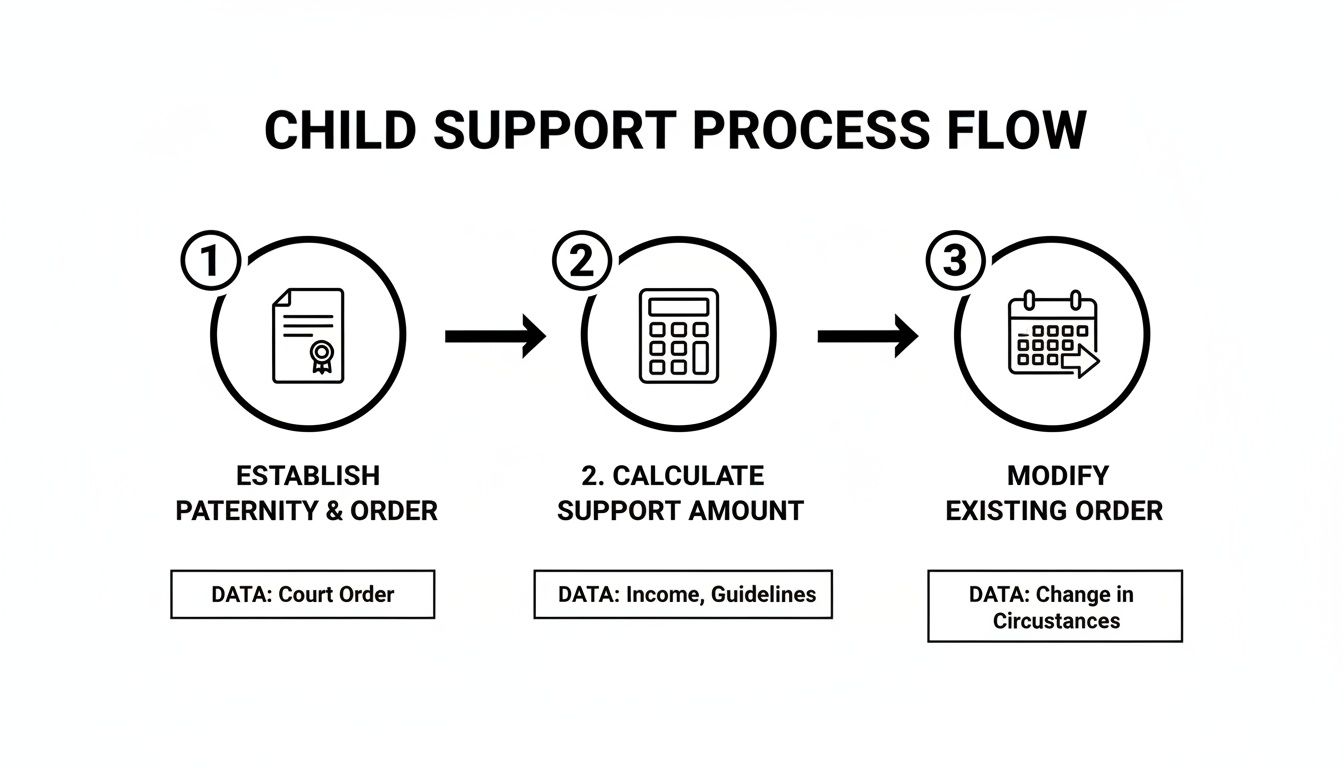
The key takeaway is that child support isn't set in stone. It’s a legal obligation that can change as your life changes.
Adjustments That Change The Final Amount
These guidelines are the starting point. A judge in a Montgomery County court can deviate from the formula if applying it would be unfair.
Real-World Scenario: Imagine a father in Sterling Ridge is paying support for one child from a previous marriage. He now has a second child from a new relationship requiring a support order. The court won't just apply the standard 20%. The Texas Family Code provides for a credit, so the percentage will be reduced to account for his legal duty to support his other child.
Common factors for adjustment include:
- Children in Other Households: The obligor gets a credit for other children they are legally required to support.
- Possession Schedule: If the paying parent has the child for much more time than a standard possession order in Texas outlines, the judge might reduce the support amount.
- Special Needs of the Child: If a child has extraordinary medical or educational needs, the court can order support above the guidelines.
An experienced family law attorney can make sure all income is properly accounted for and that any credits or deviations are correctly applied.
When To Hire A Child Support Lawyer In The Woodlands

It’s tempting to handle child support on your own. In a perfect world, both parents would be transparent about finances and agree on what’s fair.
But child support cases are rarely straightforward. The moment income gets complicated or trust breaks down, that simple formula becomes a complex legal process. This is when hiring a child support lawyer in The Woodlands becomes a crucial investment. An attorney is your advocate, working to ensure your child receives what they are entitled to.
Complex Income Situations
The state's guidelines work best for simple W-2 jobs. For many families in Montgomery County, that's not the reality.
You likely need an attorney if the other parent:
- Is a business owner or self-employed: It is difficult to pinpoint the "net monthly resources" of a business owner. A lawyer has tools like subpoenas and depositions to find the real numbers.
- Works on commission, bonuses, or has seasonal income: An attorney knows how to analyze income over time and argue for an amount that reflects true earning capacity, not just a slow month.
- Is a high-earner: When income goes above the state's guideline "cap," you can’t just rely on the formula. A lawyer is essential for proving your child’s needs warrant an above-guideline support order.
Going it alone in these situations risks accepting a support figure based on incomplete data, short-changing your child for years.
Real-World Scenario: A mother in Panther Creek was convinced her ex-husband, a consultant, was lowballing his income. His tax returns showed a dip in earnings, but his spending hadn't changed. We launched formal discovery and found he was running personal expenses through his business and delaying client payments to lower his income. The judge imputed a much higher income to him, resulting in a fair child support order.
When You Suspect Hidden Assets or Income
Unfortunately, a parent may try to lower their child support obligation. A seasoned child support lawyer knows the red flags when a parent might be:
- Intentionally underemployed or unemployed: A parent can't just quit a good job to dodge responsibility. We can ask a judge to set support based on what they should be earning.
- Hiding assets: They might transfer funds to a new spouse or deal in cash to avoid a paper trail.
- Failing to disclose all income: A side hustle, rental property, or freelance work all count as income under the Texas Family Code. We know how to uncover these sources.
The Advantage of Local Montgomery County Knowledge
The Woodlands has a unique legal system. There are many lawyers, but you need someone who truly understands the local courts. You can explore attorney listings for The Woodlands to see your options. An experienced local attorney brings firsthand knowledge of the Montgomery County judges, which can provide a strategic advantage.
What to Do Next Checklist
If you see your situation in any of these scenarios, be proactive.
- Assess your case: Does it involve self-employment, hidden income, or high assets? If so, legal guidance is critical.
- Gather documents: Collect pay stubs, tax returns, and bank statements for yourself and any evidence of the other parent's income.
- Document everything: Keep a log of all communications with the other parent about money and child-related costs.
- Talk to a professional: Schedule a consultation to get a clear picture of your rights and a solid game plan.
Disclaimer: This article is for informational purposes only and does not constitute legal advice. You should consult with a qualified attorney to discuss your specific situation. This information does not create an attorney-client relationship.
To get clear, actionable advice, schedule a consultation to discuss how we can protect your interests.
Modifying and Enforcing Child Support Orders
A child support order is a legally binding command from a judge. But life happens. People lose jobs, get promotions, and kids’ needs change.
A critical warning: verbal agreements to change child support are unenforceable. If you agree to lower payments but don't get a new court order signed by a judge, you are still legally on the hook for the original amount. Any change must go through the court.
How to Modify a Child Support Order
To change a child support order in Montgomery County, you must prove a “material and substantial change in circumstances” has occurred since the last order was signed. This is the legal standard required by the Texas Family Code.
Common reasons for modification include:
- A significant, involuntary job loss or major promotion.
- A large change in the cost of the child’s health insurance.
- A change in the child's primary residence.
- The child develops a new medical condition or educational need with significant, ongoing expenses.
Real-World Scenario: A father in Creekside Park lost his engineering job and took a position with a lower salary. He couldn't just decide to pay less. His attorney filed a formal Petition to Modify, submitting proof of his termination and new income. A judge reviewed the evidence and issued a new order reflecting his current ability to pay.
What Happens When a Parent Stops Paying?
When a parent refuses to pay court-ordered child support, they are violating a court order. You have the right to file an enforcement action. A child support lawyer in The Woodlands can guide you through this process.
Montgomery County judges have powerful tools to force compliance. After an enforcement case is filed, a judge can order:
- Wage Garnishment: An order sent to the employer to deduct payments from every paycheck.
- Property Liens: A lien placed on assets like a house or truck, preventing sale until the debt is cleared.
- License Suspension: Suspension of a driver’s license, professional licenses, and even hunting or fishing licenses.
- Jail Time and Fines: For repeated violations, a judge can order jail time and levy heavy fines for contempt of court.
The message is clear: supporting your children is a priority, and courts will enforce it.
What to Do Next Checklist
- Find Your Current Order: Locate the most recent, judge-signed child support order.
- Gather Your Proof: If seeking a modification, collect documents showing the "material and substantial change."
- Create a Payment Ledger: For enforcement, make a detailed spreadsheet of every missed or partial payment.
- Stop Verbal Agreements: All discussions about changing support should be in writing and finalized in a new court order.
Disclaimer: This article is for informational purposes only and does not constitute legal advice. You should consult with a qualified attorney to discuss your specific situation. This information does not create an attorney-client relationship.
Navigating a modification or enforcement can feel overwhelming. To get clear advice for your situation, schedule a consultation with our team.
Preparing To Meet With Your Lawyer

You've decided to talk to a child support lawyer in The Woodlands. To get the most out of that first meeting, you’ll want to do a little homework. Walking in organized saves time and money and gives your attorney the clear picture they need to start building your case.
What Documents Should I Gather?
Your attorney needs the black-and-white reality of your situation. Try to pull together as many of these documents as you can.
- Financial Records: This is key. We need your last two years of tax returns, recent pay stubs, and any W-2s or 1099s. Bring proof of bonuses, commissions, or other income. Bank statements are also very helpful.
- The Other Parent's Financials: If you have access to any of the other parent’s financial documents—like old joint tax returns or pay stubs—bring them.
- Existing Court Orders: Bring a copy of any divorce decree, paternity order, or previous child support order.
- Proof of Child-Related Expenses: Get receipts or statements showing what you spend on health insurance premiums, daycare, and uninsured medical costs.
Real-World Scenario: A dad from Sterling Ridge came to see me, worried about a child support review. He brought tax returns, pay stubs, and a detailed expense spreadsheet. He even had texts showing a verbal agreement with his ex-wife to lower support—an agreement she now denied. Because he was so organized, we mapped out a clear strategy in that first meeting.
Preparing Your Questions and Goals
A consultation is a two-way street. It's your chance to see if an attorney is the right fit. Before the meeting, think about what you want to accomplish.
Come in with a list of questions, such as:
- What’s your experience with cases like mine in the Montgomery County courts?
- What is the biggest hurdle in my case?
- What is your strategy for dealing with a self-employed parent or hidden income?
- How will we communicate, and what are your fees?
What to Do Next Checklist
- Gather Your Docs: Start a folder with your tax returns, pay stubs, bank statements, and court orders.
- Document Communications: Print important emails or text messages with the other parent about money.
- Create an Expense Log: List what you spend each month on your child, especially big-ticket items like health insurance and daycare.
- Write Down Your Questions: Jot down your questions for the attorney about their experience, strategy, and fees.
Disclaimer: This article is for informational purposes only and does not constitute legal advice. You should consult with a qualified attorney registered with the State Bar of Texas to discuss your specific situation. This information does not create an attorney-client relationship.
Taking that first step is often the hardest part. If you’re ready to discuss your child support case with an experienced local attorney, schedule a consultation. We're here to give your family the clear, direct advice you deserve.
