 Skip to content
Your phone buzzes. You check your bank app before school pickup, before groceries, before the next bill hits. The child support payment that helps cover the week is not there.
For many parents in The Woodlands, that moment brings the same questions. Was it delayed? Did payroll mess it up? Do I wait a few days, or do I act now? If you already carry most of the housing, childcare, school, and medical costs, even one missed payment can put real pressure on your household. In such situations, people often lose time. They assume the system will fix itself. Sometimes it does. Often it does not.
If you are dealing with unpaid child support the woodlands tx, you have options. Texas law gives courts strong enforcement tools, but results usually depend on how quickly you document the problem, how clearly you present the missed payments, and whether you choose the right path for your situation in Montgomery County.
That Sinking Feeling When Child Support Is Late Again
A missed payment rarely feels like just a missed payment.
It usually lands in the middle of ordinary life. Rent or mortgage. After-school fees. Gas. Lunch money. A prescription that cannot wait. The legal issue becomes personal very fast.

What parents in The Woodlands usually worry about first
Most parents are not asking for a legal lecture. They want to know three things.
- Will the payment show up late: Sometimes wage withholding takes time, but repeated lateness points to a larger problem.
- Can the court make the other parent pay: Yes. If there is a valid order, Texas courts can enforce it.
- Should I wait or act now: Waiting can make proof harder, especially if the payment history becomes messy.
The stress gets worse when communication with the other parent is unreliable. Some promise to catch up next week. Some send partial payments without explanation. Some stop responding altogether.
Why this problem gets big so quickly
Child support debt does not stay small on its own. Nationally, child support arrears reached $105.4 billion by September 2006, and a federal review of nine large states found that 11% of obligors accounted for 54% of the arrears. The same review found that 40% of current support obligors with no or low reported income generated 60% of unpaid current support, and for obligors with incomes of $10,000 or less annually, median orders consumed 83% of reported income while median payments covered only 7%. Those findings help explain why arrears can spiral when support orders and actual ability to pay are far apart, as discussed in the federal review of child support arrears in nine large states.
A missed payment is not just an accounting issue. It affects stability for the child and provides an advantage in court for the parent who is doing the day-to-day work.
In Montgomery County, judges expect specifics: not frustration, not rough estimates, but specific dates, specific amounts, and a clean copy of the order.
That is the practical shift. Once you move from worry to documentation, you put yourself in a stronger position.
Your First Steps After a Missed Payment in The Woodlands
The first job is not filing something. It is building a record that a court can use.

Start a payment ledger immediately
Use a notebook, spreadsheet, or simple running document. The format matters less than consistency.
Track:
- Due date: List every payment date required by the order.
- Amount due: Use the exact amount from the signed order or modification.
- Amount received: Mark full, partial, or no payment.
- Method of payment: State Disbursement Unit, direct transfer, check, or another method.
- Notes: Add short facts only. Example: “No payment received by end of day” or “Partial payment arrived three days late.”
If support is supposed to go through the State Disbursement Unit, match your ledger to that history. Montgomery County courts often want exact missed payment details and due dates tied to the official payment record. Local guidance also notes that hearings are often set within 30-60 days and that there is no OAG office directly in The Woodlands, with the closest offices in Conroe or Bryan. That is one reason complete records matter from the start, as described in this discussion of Montgomery County child support collection and enforcement procedures.
Save the order and every later modification
Many people have the divorce decree but not the later child support modification. Others have screenshots but not the signed file-stamped version.
You need the controlling order.
Create one folder with:
- Original support order
- Any modification orders
- Medical support provisions
- Income withholding order if one exists
- Payment history records
A lawyer or court cannot work efficiently if the paperwork is incomplete.
Preserve communication the right way
Text messages can help, but only if they are preserved clearly.
Good evidence usually includes:
- Screenshots with dates visible
- Emails saved as PDFs
- Voicemails summarized in a dated note
- A short log of phone calls
Do not edit messages. Do not argue by text to create “proof.” Keep your side calm and factual.
If you need to send one message, make it simple: ask whether the missed payment was intentional, request a date for cure, and stop there.
Separate support issues from parenting disputes
Parents often mix everything together. Late support. missed exchanges. rude texts. school problems.
That is understandable, but it can weaken your presentation.
Child support enforcement works best when the missed payments are presented as their own issue. If you also need help with modification, a local child support lawyer in The Woodlands can help sort out which issues belong in which filing.
Here is a short explainer that may help you organize your thinking before you move forward:
What not to do
A few common mistakes create avoidable problems.
- Do not rely on memory: Judges do not enforce based on “he has been behind for months.”
- Do not accept vague side deals: If the order says one thing and the parties casually do another, enforcement gets harder.
- Do not wait for a large balance to build: Delay usually helps the nonpaying parent, not the child.
- Do not stop visitation on your own because support is unpaid: Support and possession are separate issues under Texas family law.
The parents who tend to do better in enforcement cases are not the loudest. They are the ones with a clean timeline, a complete order, and records that line up.
Choosing Your Path OAG vs Private Counsel in Montgomery County
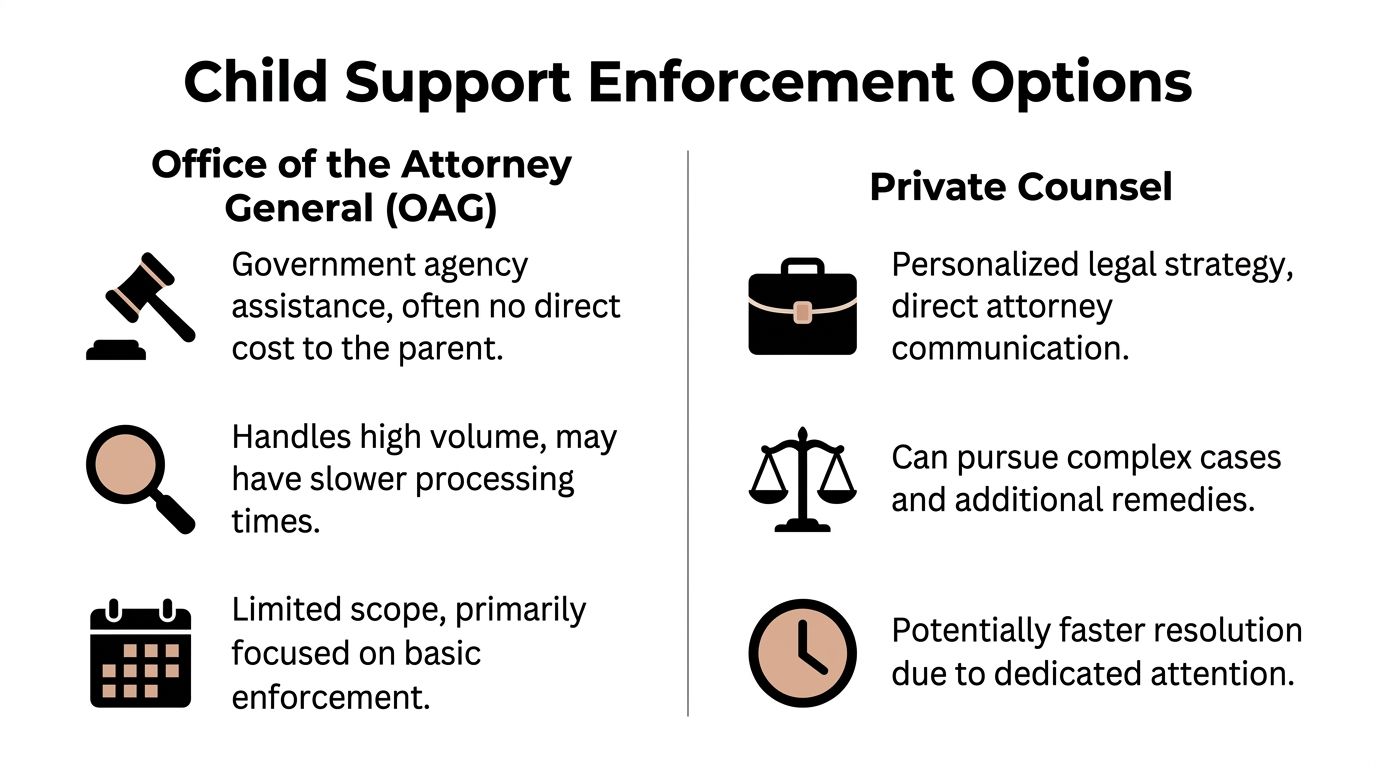
Once your records are organized, the next decision is practical. Do you use the Texas Office of the Attorney General, or do you hire private counsel?
Both paths can work. They serve different needs.
The OAG path
The OAG handles child support matters across Texas. For many families, it is the first stop because there is usually no direct attorney fee to open or maintain the case.
That option makes sense when the problem is straightforward. A valid order exists. The other parent has regular employment. There are no custody disputes mixed into the support issue.
The trade-off is scope and pace. The OAG handles support. It does not represent you as your personal attorney, and OAG reviews for reduced support based on unemployment do not include custody changes. One local discussion also states that self-represented OAG reviews succeed in 40% of low-income cases, while attorney-led petitions in contested Montgomery County courts are closer to 70%, according to the firm's stated experience with those matters in Texas child support modification cases involving unemployment.
The private counsel path
Private counsel costs money. That is the clearest downside.
The upside is focus. A private attorney can build the enforcement case around your facts, prepare the motion with exact violations, and address related issues if support is only one part of the problem. That matters in The Woodlands cases involving contested divorces, modification requests, hidden income, business ownership, reimbursement disputes, or conflict that spills into parenting.
This is also the one place where a broader strategy matters. If the other parent is manipulative or uses conflict to wear you down, practical communication support can help alongside legal action. Some parents find outside guidance on co-parenting with a narcissist useful for managing day-to-day contact while the legal case moves forward.
Side by side comparison
| Factor | Office of the Attorney General (OAG) | Private Attorney (The Law Office of Bryan Fagan) |
|---|---|---|
| Cost | Usually no direct fee to the parent for basic support enforcement | Attorney fees apply |
| Who is represented | The state process handles support enforcement, not your full personal legal strategy | The attorney represents your interests directly |
| Scope | Child support focused | Can handle support enforcement plus related family law issues |
| Speed | May move slower because of volume | Often more direct case management |
| Best fit | Straightforward support case with limited disputes | Contested case, mixed issues, or need for customized courtroom preparation |
What works best in real life
Use the OAG when the facts are simple and your patience is longer than your urgency.
Use private counsel when one or more of these are true:
- The other parent is self-employed
- Income is irregular or hidden
- There have been repeated broken promises
- You may also need a modification or custody-related filing
- You want one person accountable for moving the case
Neither path is automatically better. The right choice depends on whether you need a system process or a case strategy.
In Montgomery County, the best enforcement route is usually the one that matches the complexity of the facts, not the one that sounds toughest.
Filing an Enforcement Motion What to Expect
Once you decide to move forward, the formal step is usually a motion to enforce.
Under the Texas Family Code, enforcement filings need precision. The court has to know what order was violated, what payment was due, when it was due, and what was not paid.

What goes into the motion
A proper filing usually identifies:
- The exact order to be enforced
- Each missed payment
- The date each payment became due
- The amount due and amount unpaid
- The relief requested
Relief can include a money judgment for arrears, confirmation of the unpaid balance, attorney fees if appropriate, and contempt remedies when the facts support that request.
If you want contempt, the details have to be especially careful. Courts do not like vague pleadings in contempt cases.
Your evidence checklist
Evidence checklist
- File-stamped child support order and any later modifications
- Payment ledger with every missed or partial payment
- State Disbursement Unit history if available
- Texts, emails, and other communication about payment
- Employment information for the paying parent if known
- Proof of direct payments, returned payments, or partial transfers
- Notes of relevant dates, including when you followed up
What a Montgomery County hearing often feels like
Most parents expect drama. Many hearings are more procedural than dramatic.
The judge wants organization. If your records are clean, your presentation becomes easier. If dates and amounts are inconsistent, the hearing becomes harder than it needed to be.
The court may ask practical questions:
- What order controls
- Which payments were missed
- Whether payments were made directly or through the state
- Whether the other parent had notice of the hearing
- Whether contempt is being requested
Possible outcomes
Not every enforcement hearing ends the same way.
A judge may:
- Confirm arrears and sign a judgment
- Order ongoing withholding
- Set a payment plan on the arrearage
- Award attorney fees if the facts and pleadings support it
- Find contempt if the violation was clear and willful
Texas also uses public pressure in some cases. The Attorney General maintains a child support evader list, and listed cases include examples such as $57,997 owed for one child. Families in the Houston area have also reported waiting months for money already collected by the state, which is one reason some parents decide that a direct court filing is necessary instead of waiting passively. Those points appear in the Texas OAG's public child support evader listings.
If your case is moving toward court, practical local guidance on enforcing child support in Montgomery County can help you understand what has to be proven and how to prepare.
What does not work
Three approaches fail often.
First, showing up with only a rough estimate.
Second, assuming the judge will “already know” the other parent is behind.
Third, asking the court to fix support problems that were never reduced to a written order.
Courts enforce orders. They do not enforce side understandings.
Powerful Collection Tools Under Texas Law
A child support order has force because Texas law gives courts and agencies real collection tools.
The strongest one in many cases is income withholding. The process starts with an administrative withholding order sent to the employer. That can pull support from wages and other income before the money reaches the parent who owes support.
The collection tools parents should know
Here are the main tools that matter most in practice:
Income withholding from earnings
This is often the most practical tool when the parent has regular payroll income.Property liens
A lien can attach to certain property interests and create pressure before a sale or refinance.Intercepts of federal tax refunds and certain government payments
These can redirect money toward past-due support.Credit reporting consequences
Arrears can affect the debtor's financial position beyond the family court file.License-related penalties
In the right case, unpaid support can trigger suspension issues involving driving or professional licensing.
Interest changes the stakes
Texas Family Code §157.265 matters because unpaid support accrues 6% simple annual interest. One Texas discussion explains that enforcement starts with income withholding and can escalate to liens and federal tax refund interception, and it notes that a $5,000 debt can grow to nearly $10,000 over ten years if left alone because of interest under that section of the code. The same discussion states this interest is almost never waivable in practice, as described in this article on the consequences of unpaid child support in Texas.
That is why delay is expensive even when the original missed amount did not seem overwhelming.
Parents often focus on collecting the principal. The law also cares about the time value of the missed support.
Contempt and court authority
Texas courts can use contempt in the right case when a parent had a clear obligation and failed to comply. That is serious, and it requires careful pleading and proof.
For worried parents, the practical point is simple. Enforcement is not limited to sending reminders. If the order is valid and the evidence is strong, the court has meaningful authority.
For paying parents who have fallen behind, the lesson is different. Ignoring the case is usually the worst move. If there has been a genuine income change, the answer is usually a prompt request for prospective modification, not silence.
What works and what does not
Works well: regular payroll withholding, a clear arrears judgment, and early action before the file gets messy.
Works poorly: handshake payment plans, long periods of inaction, and assuming the other parent can waive statutory consequences informally.
A Woodlands Parent's Success Story and Your Next Steps
A mother in Sterling Ridge came in after several missed payments followed by sporadic partial ones. She had done one thing right before she called. She kept a simple ledger and saved every payment-related text.
That made the next steps cleaner. The court had a clear order, clear dates, and a clear payment history. The case moved toward withholding and a structured path for the arrears instead of another round of promises. The key was not drama. It was preparation.
What to do next
- Pull your orders today and confirm which child support order currently controls.
- Build a payment ledger with due dates, amounts due, and amounts received.
- Download and save communications about missed or partial payments.
- Do not make side deals that conflict with the written order.
- Decide on your path by weighing OAG processing against private counsel and the complexity of your case.
- Act before the record gets harder to prove and before the unpaid amount grows further.
This article is for informational purposes only. It is not legal advice and does not create an attorney-client relationship. Child support enforcement turns on the language of your order, your payment records, and the facts of your case.
If you are in The Woodlands, Alden Bridge, Panther Creek, Sterling Ridge, or elsewhere in Montgomery County, a consultation can help you decide what to file, what proof you need, and what result is realistic.
Frequently Asked Questions About Child Support Arrears
Can a court erase back child support if the paying parent lost a job
Usually no, not for amounts that already came due.
Texas Family Code §156.401 allows modification going forward, not backward. A common mistake is waiting and hoping the court will wipe out old support. That does not happen. If support is already due, the focus usually shifts to enforcement or to adjusting future payments through a proper child support modification in The Woodlands.
How is interest calculated on unpaid support in Texas
Under Texas Family Code §157.265, interest is 6% simple annual interest applied from the due date of each missed payment. The formula is Interest = Principal × 0.06 × (days delinquent ÷ 365), and it does not compound on prior interest, as explained in this discussion of how interest on missed child support is calculated in Texas.
What if the other parent is self-employed
These cases are often harder because payroll withholding may not solve the problem the way it does with a traditional employer. The case may require closer review of bank records, business income, and other sources of payment. The main practical point is to gather as much financial information as you lawfully can and move quickly.
What if the other parent moved out of state
That does not end the obligation. Interstate enforcement is possible, but the process can become more technical. When a parent leaves Texas, precision in the original order and payment history becomes even more important.
If you are dealing with unpaid child support in The Woodlands or anywhere in Montgomery County, The Law Office of Bryan Fagan can review your order, your payment history, and your enforcement options so you can make a clear next move without guessing.
