 Skip to content
One phone call can turn an ordinary evening in The Woodlands into a legal crisis. A neighbor calls police after an argument. An officer sees a mark on someone's arm. Or a spouse files for a protective order while a divorce is already brewing. Suddenly you're dealing with bond conditions, court dates, and questions about whether you can go home or see your children.
When seeking an assault lawyer in The Woodlands, TX, theory is likely not your primary concern. You want to know what happens next, what can go wrong, and how to protect yourself without making the situation worse.
For many people in Montgomery County, the biggest surprise is that an assault allegation doesn't stay in one lane. It can affect your criminal case, your divorce, your custody dispute, your job, and your standing in the community all at once.
The Moment Your World Changes An Assault Charge in The Woodlands
The first hours after an assault allegation are disorienting. Individuals often aren't thinking clearly. They're trying to call family, figure out where they'll sleep, and understand paperwork filled with terms they haven't seen before.
A common pattern in The Woodlands is simple. An argument gets loud in Panther Creek, Alden Bridge, or Sterling Ridge. Police arrive. They separate everyone, ask fast questions, and make a decision before you feel like you've even explained yourself. That decision can shape everything that follows.
Texas treats assault allegations seriously for good reason. At least 33% of adults have been sexually assaulted in their lifetime, and among those victims, over 65% were victimized more than once, according to The Woodlands sexual assault lawyer data summary. That helps explain why officers, prosecutors, and judges often move cautiously and aggressively when assault is alleged.
Practical rule: The night of the arrest is usually not the night you fix the case. It's the night you avoid making it worse.
What often hurts people most at this stage isn't only the charge. It's panic. They text the other person. They call repeatedly. They post online. They try to "clear things up" with police. Those choices can create evidence the prosecutor didn't have before.
A better approach is calmer and less satisfying in the moment. Read your paperwork. Follow release conditions exactly. Save every court notice. Then get legal advice focused on the facts that matter in Montgomery County, not general internet advice from somewhere else in Texas.
Understanding Your Assault Charge in Montgomery County
The charge on your paperwork matters. The word "assault" covers more than one type of conduct under Texas law, and the level of the charge changes the risk.
Under Texas assault law as summarized under Penal Code § 22.01, assault is defined as intentionally, knowingly, or recklessly causing bodily injury, threatening imminent bodily harm, or engaging in offensive physical contact. The presence of "bodily injury" raises the charge from a Class C to a Class A misdemeanor.
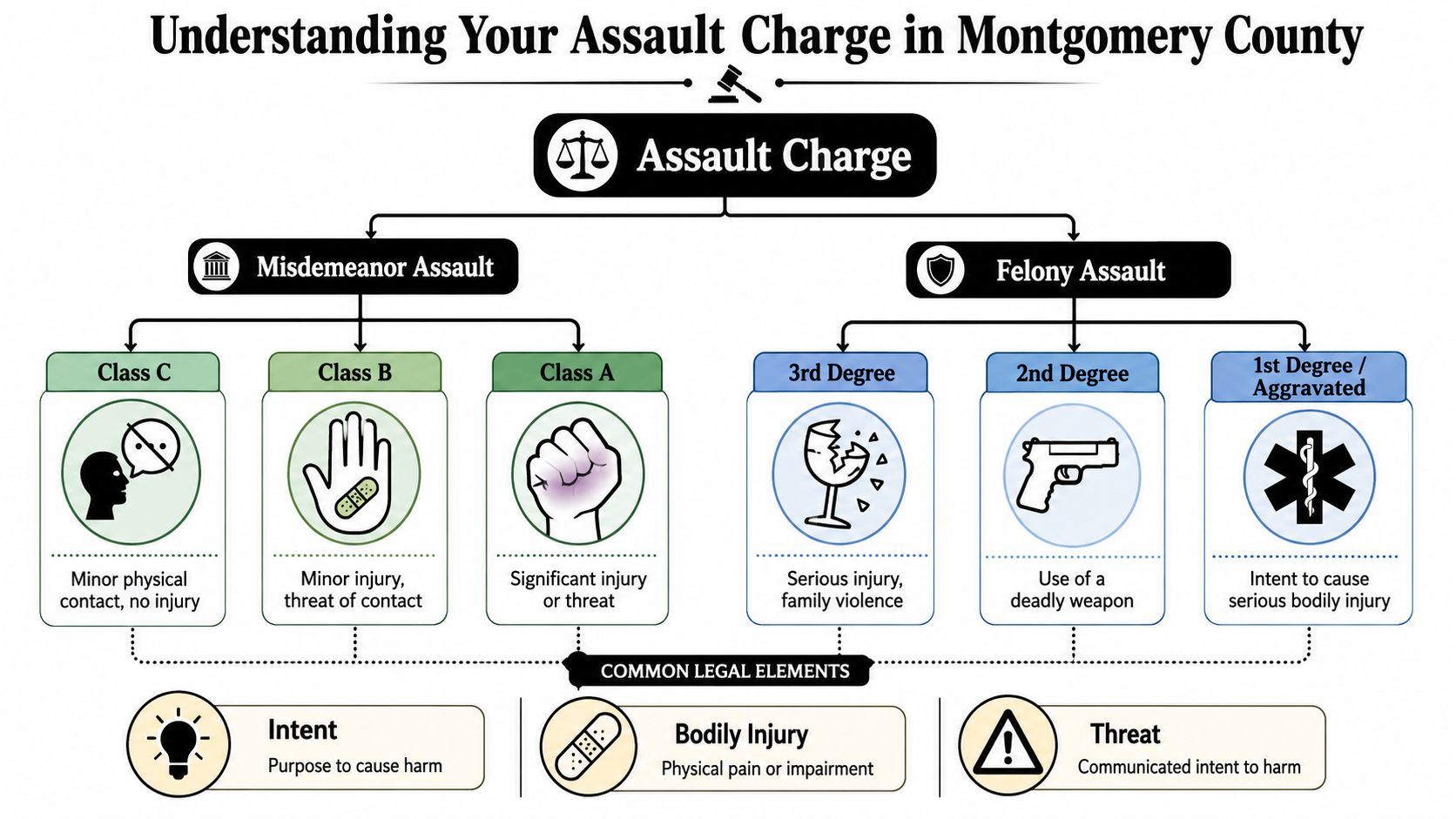
What the legal definition means in real life
In plain English, prosecutors usually look at three buckets:
| Charge type | What the allegation usually looks like | Why it matters |
|---|---|---|
| Offensive contact | Unwanted physical contact without claimed injury | Often lower-level, but still serious because it creates a record and court process |
| Threat-based assault | Allegation that someone threatened immediate harm | The words used, the setting, and witness accounts become important |
| Bodily injury assault | Claim that the other person felt pain, illness, or impairment | The case usually becomes more serious because injury changes the charge level |
The word injury often surprises people. They assume it means a broken bone or hospital stay. It doesn't have to. In many cases, the dispute centers on whether the other person felt pain and whether the evidence supports that claim.
When the charge becomes more serious
Some facts raise the stakes quickly.
- Family relationship: If the allegation involves a spouse, dating partner, former partner, or household member, the case can carry family violence consequences beyond the criminal file.
- Serious injury: More severe alleged harm can push a case toward felony territory.
- Weapons: If a deadly weapon is alleged, the case changes dramatically.
- Prior history: Repeat allegations can affect charging decisions and bond conditions.
If your case also touches a divorce, SAPCR, or custody fight, it helps to understand Montgomery County Family Courts: A Local Guide because family court procedure often starts moving while the criminal case is still in its early stages.
The most expensive mistake is treating the charge label as a technical detail. It isn't. It drives strategy, exposure, and what the judge may do next.
Navigating the Montgomery County Criminal Court Process
Fear of the unknown often outweighs fear of the courtroom itself. The process feels less overwhelming when you can place each event in order.
Early in the case, you'll usually deal with custody, booking, release conditions, and a first court setting. If the allegation is severe, especially where serious bodily injury or a deadly weapon is claimed, the case can involve felony prosecution because felony assault in Texas includes assaults causing serious bodily injury or involving a deadly weapon, prosecuted in Montgomery County courts serving The Woodlands residents.
A visual overview helps:
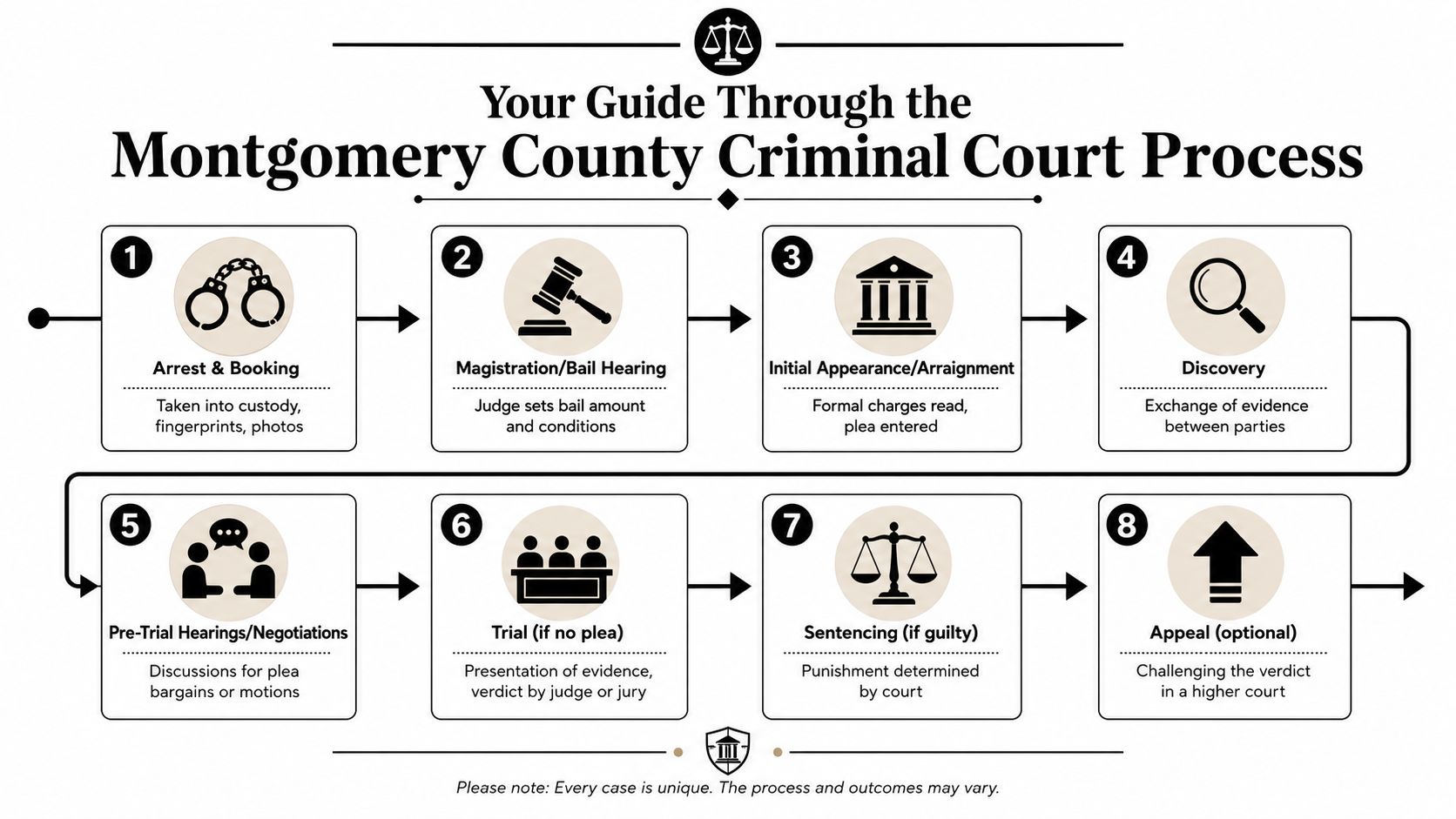
The usual path after arrest
Arrest and booking
Police take fingerprints, photographs, and basic identifying information. This is not the time to argue your whole case.Magistration and bond conditions
A judge or magistrate reviews the charge, sets bond, and may impose restrictions. Those restrictions can include no-contact terms or limits on returning home.Initial court appearance
You appear in court, learn the formal status of the case, and the court tracks deadlines and future settings.
After that, the case moves into exchange and review of evidence. That stage often matters more than people expect because videos, 911 calls, body camera footage, photographs, and witness statements can all shape negotiation or trial decisions.
The court process becomes easier to follow when you see it laid out step by step:
Where cases are often won or lost
Many assault cases don't turn on dramatic courtroom speeches. They turn on preparation.
- Evidence review: Does the report match the photos, video, and witness accounts?
- Motions practice: Some issues are legal. Others are factual. Good lawyering separates them.
- Negotiation: A plea discussion isn't surrender. It's a risk analysis.
- Trial choice: Trial can be the right move in some cases, but not every case improves by forcing one.
People sometimes ask whether another criminal charge type offers a useful comparison for procedure. A DWI attorney in Montgomery County often deals with the same local court mechanics, even though the facts and defenses differ.
A criminal case doesn't move in a straight line. Settings get reset, evidence arrives late, and strategy can change once the file is complete.
Real-World Scenario A Dispute in a Sterling Ridge Home
John and Mary live in Sterling Ridge and are already under strain over money. One night the argument gets louder. Mary heads toward the door. John grabs her arm to stop her from leaving. A neighbor hears yelling and calls 911.
Police arrive within minutes. They separate both spouses and see a bruise on Mary's arm. John says he wasn't trying to hurt anyone. The officer arrests him for assault involving family violence.
By the next morning, John is dealing with problems that have nothing to do with guilt or innocence in the abstract. He may have bond conditions that keep him away from the house. He may not be able to contact Mary directly. If the couple was already discussing divorce, that conversation is now happening in a far more dangerous legal setting.
The bruise becomes more than a bruise. It may become a photo in the criminal file, a talking point in temporary orders, and a reason the family court takes a hard look at the children's living situation.
Many people often make a costly mistake. They think, "If the criminal case works out, the family case will take care of itself." In practice, those tracks can move at the same time, and what happens in one can affect the other quickly.
When Criminal Charges and Family Law Collide
This is the part many criminal-defense-only articles miss. In Montgomery County, a family violence allegation can change your home life immediately, even before the criminal case is resolved.
Texas family courts don't have to wait for a criminal conviction to address child safety, possession schedules, or temporary restrictions. Under the Texas Family Code, allegations of family violence can affect temporary orders, conservatorship, possession, and exchanges. A judge deciding what arrangement protects a child may consider police reports, photos, testimony, and whether a protective order has been requested or entered.
Data also shows how often people need help on both fronts. Texas Legal Services Center data shows that 68% of sexual abuse survivors in Texas need concurrent legal support for family law and criminal matters, as discussed in this Texas Legal Services Center video reference.
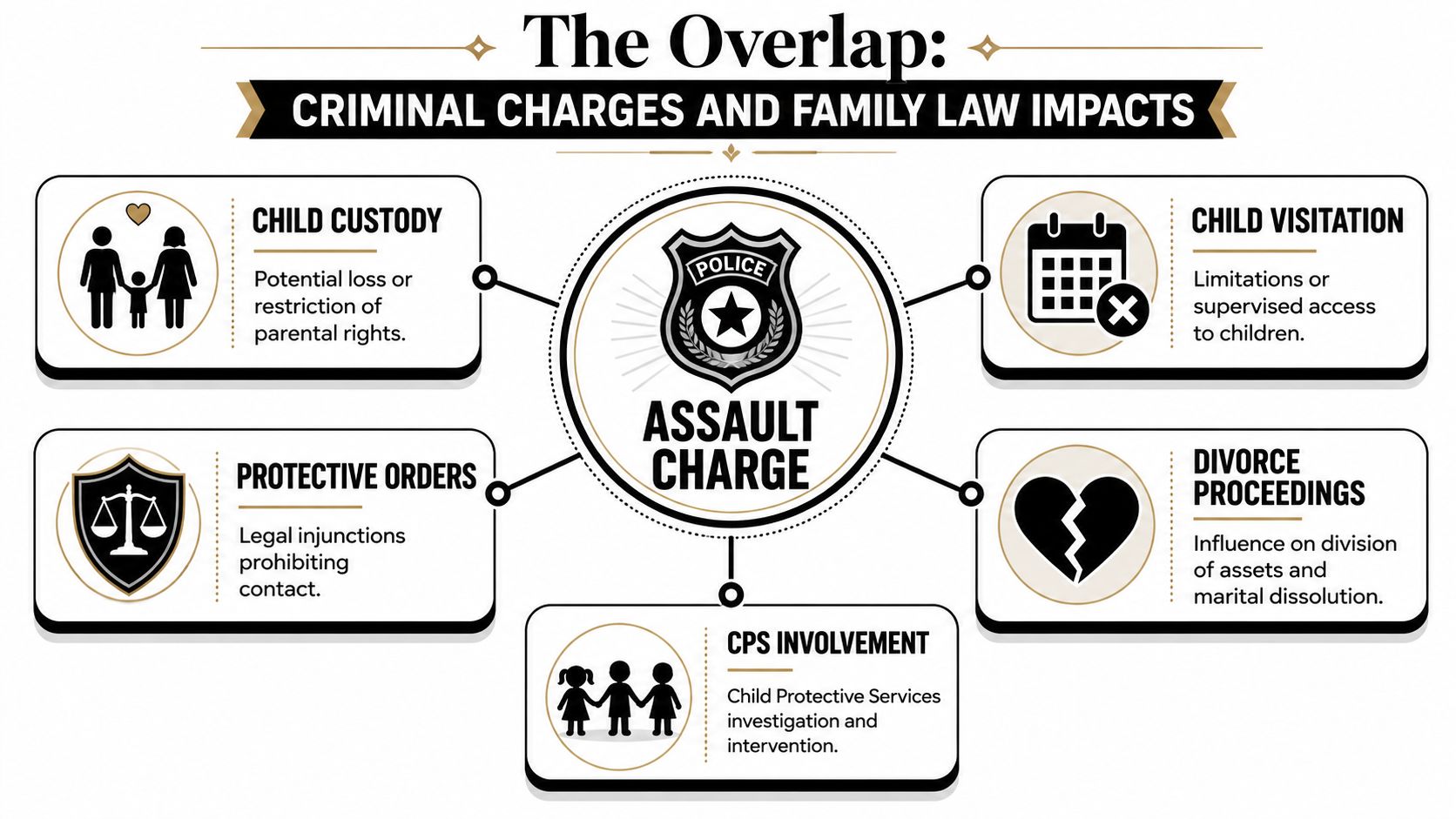
The family law consequences people underestimate
A pending assault case can trigger several separate family-law problems at once:
- Protective orders: You may be barred from going home, contacting the other party, or going near a school or workplace.
- Child custody pressure: Judges may limit decision-making rights or create temporary restrictions while the facts are sorted out.
- Visitation changes: Parenting time may become supervised, structured, or suspended temporarily.
- Divorce implications: Allegations can affect the tone and strategy of a divorce from the first hearing forward.
For parents, that overlap is why a family law attorney in The Woodlands, Texas may need to coordinate closely with criminal counsel, especially where temporary orders are already on the calendar.
Why silence in criminal court and action in family court must be balanced
The hard part is that the right move in one case can create risk in the other.
If you speak freely in family court affidavits, texts, emails, or co-parenting apps, those statements may surface in the criminal matter. If you say too little and ignore family court deadlines, the judge may enter orders that shape custody and possession for months.
Under the Texas Family Code, courts can restrict unsupervised possession when family violence is a concern. Under the Texas Estates Code, related consequences can also matter in probate or incapacity planning if a family crisis disrupts who can safely act for a vulnerable adult or child, though that issue is more case-specific.
Key point: The criminal case asks whether the State can prove a charge. The family case asks what the judge thinks is safest right now. Those are different questions.
Families with children need one coordinated strategy. That may include preserving evidence, avoiding direct contact that violates orders, preparing for temporary hearings, and making sure one case doesn't accidentally sabotage the other. If custody is already at issue, a dedicated Child Custody Lawyer in The Woodlands, TX can address the parenting side while criminal counsel handles the prosecution.
What to Do Next A Practical Checklist
If you've been charged, your next steps matter more than your explanations. Use this checklist to protect yourself.
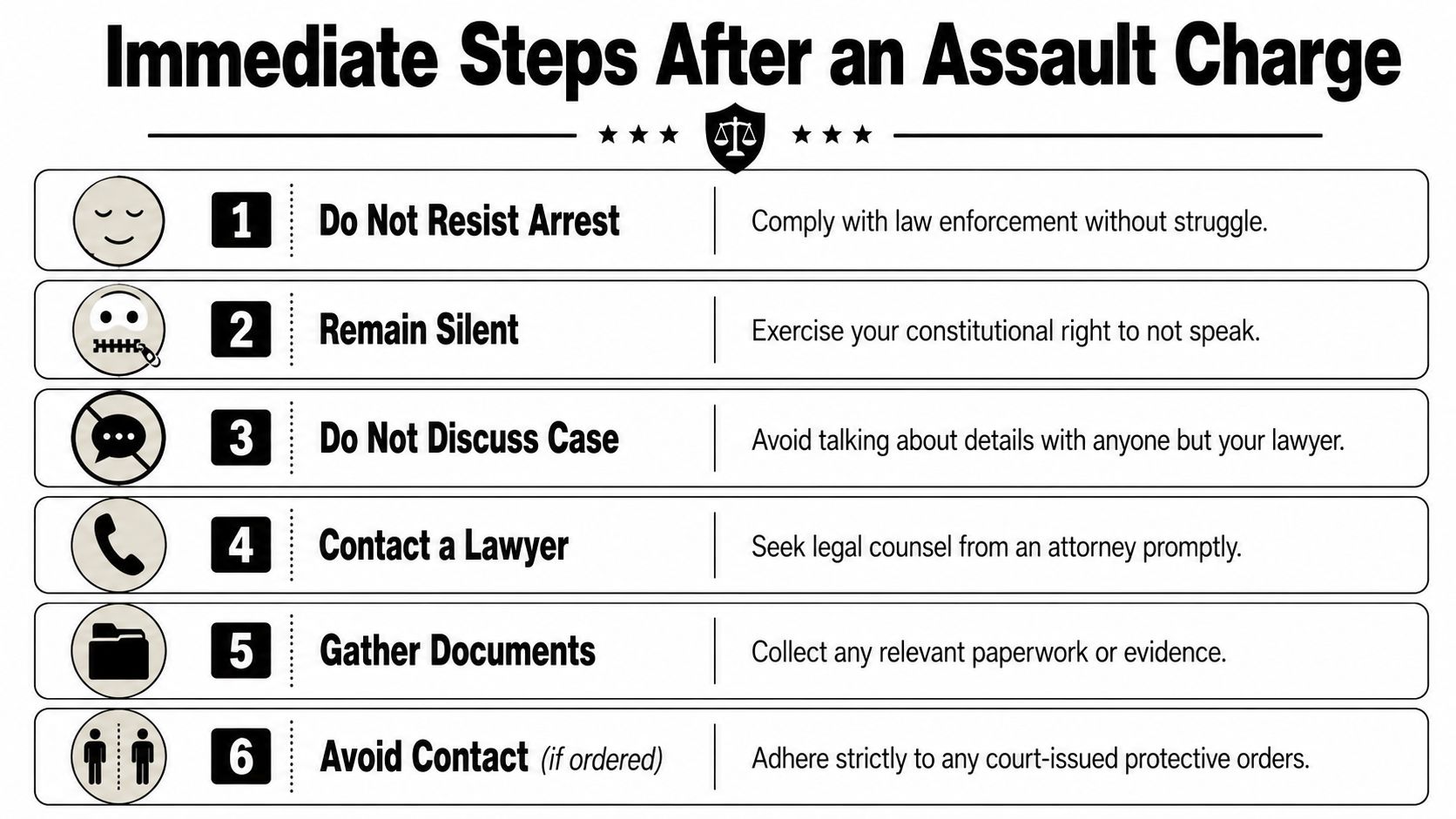
Immediate actions
- Stay silent about the facts: Don't explain the incident to police, the other person, friends, or social media. Anything you say can be repeated, screenshot, or misunderstood.
- Read every bond condition: Judges often include no-contact terms, firearm restrictions, travel limits, or orders about returning home.
- Follow protective orders exactly: Even well-meaning contact can become a new problem if the order prohibits it.
- Preserve evidence: Save texts, call logs, voicemails, photos, receipts, location history, and names of witnesses.
- Get your paperwork in one folder: Keep the complaint, citation, bond papers, court notices, and any family court filings together.
What to bring to your first legal meeting
Bring what exists. Don't panic if you don't have everything yet.
| Document or item | Why it matters |
|---|---|
| Charging papers | Shows the exact allegation and level of offense |
| Bond paperwork | Lists conditions you must obey right now |
| Protective order documents | Defines contact restrictions and hearing dates |
| Family court papers | Helps identify custody, divorce, or temporary order deadlines |
| Screenshots and photos | May preserve context before data disappears |
A few things usually don't help. Angry messages to the complainant don't help. Long written narratives sent to relatives don't help. Telling your side to ten different people doesn't help.
If you're unsure whether contact is allowed, assume it isn't until a lawyer reviews the order.
A simple order of operations
First, stop talking about the facts.
Second, obey the court's restrictions.
Third, organize documents and ask for legal guidance tied to Montgomery County practice.
That sequence gives your lawyer something usable to work with.
Choosing the Right Assault Lawyer in The Woodlands
Not every lawyer is built for a case that touches both criminal court and family court. If children, divorce, or a protective order are involved, you need someone who understands how one hearing can affect the next.
Local knowledge matters. A lawyer handling assault cases in Montgomery County should understand how judges approach bond conditions, temporary family orders, and scheduling realities in Conroe and nearby courts serving The Woodlands.
Questions worth asking in a consultation
Ask direct questions and listen for direct answers.
- Have you handled assault cases that also affected divorce or custody?
- How do you protect a client from hurting the criminal case while still responding in family court?
- Who handles communication when orders restrict contact with a spouse or co-parent?
- What documents should I gather before the next setting?
- If trial isn't the best option, what alternatives are realistic in my situation?
You should also ask who will appear in court, how often you'll receive updates, and what the first thirty days usually look like. Vague answers now often become frustrating answers later.
Public defender or private counsel
Texas does provide counsel for people who qualify. Under Montgomery County legal aid and appointed counsel information, if a person is charged with a crime and can't afford a private attorney, they can be appointed a public defender, and in Montgomery County this service is accessible through the State Counsel for Offenders.
That option is important. But if your case also involves custody, divorce, or emergency family orders, many people look for private counsel who can build a more integrated plan. One local resource in that broader conversation is The Law Office of Bryan Fagan's criminal defense page, which sits alongside the firm's family law work for The Woodlands and Montgomery County families.
If you're evaluating law firms more generally, whether as a consumer comparing websites or as a lawyer trying to understand why some firms communicate more clearly online, this guide on how to grow your law firm with marketing offers a useful look at how firms present services and client education.
The right fit is usually the lawyer who can explain your risks plainly, spot the family-law spillover early, and give you a plan you can follow this week.
This article is not legal advice. Assault allegations and family-law consequences are fact-specific, and small details can change the outcome. If you're facing an assault-related issue in The Woodlands or Montgomery County, schedule a consultation and get advice based on your actual paperwork, court orders, and family situation.
If you're dealing with an assault allegation that may also affect divorce, custody, or protective-order issues, The Law Office of Bryan Fagan handles family law matters for clients in The Woodlands and Montgomery County and can discuss how those issues may intersect with your case. Scheduling a consultation is a practical next step if you need case-specific guidance.
