 Skip to content
You're probably reading this with your phone in your hand, your mind racing, and the yellow paperwork from the stop sitting on the counter.
Maybe it happened on Woodlands Parkway after dinner. Maybe it was on I-45 heading home. Maybe you thought the worst part was getting booked and released. It wasn't. The most important part often starts the next morning, when the clock begins running on your driver's license.
If you're looking for a DWI attorney in Montgomery County, start with this priority: protect your license first, then build the rest of the defense around it. Waiting to “see what happens” is the mistake that causes the most avoidable damage.
The First 15 Days Are the Most Important
A DWI arrest in The Woodlands feels like everything is happening at once. Your car may be impounded. Your family has questions. Your employer may find out. And you're trying to figure out whether the criminal case is the only problem.
It isn't.

Why the deadline matters
After a DWI arrest in Montgomery County, if you refused a breath or blood test or failed a breath test, you have only 15 days to request an Administrative License Revocation hearing to challenge the license suspension, as explained in this Montgomery County DWI attorney overview.
That hearing is separate from the criminal case.
A lot of people miss that. They assume hiring a lawyer later will fix everything in one place. It won't. If the ALR deadline passes, you can lose the chance to challenge the suspension through that process.
Practical rule: Treat the 15-day ALR deadline as your first emergency deadline, not your court date.
What this looks like in real life
A common The Woodlands scenario goes like this. A person gets stopped late on a Friday night, is embarrassed, gets released, tells themselves they'll call a lawyer once things calm down, and then spends the next week trying to keep work and home life from unraveling. By the time they focus on the paperwork, the deadline is close or gone.
That's why I tell people to read the papers, put the deadline on the calendar, and talk to counsel immediately. If you need a basic local starting point, this guide on what to do after a DWI is worth reviewing while you organize your next steps.
The point of hiring early
The first lawyer call isn't about sounding brave or planning a trial speech. It's about speed. A lawyer who gets involved early can focus on the license issue, preserve documents, and start evaluating the stop before details fade from memory.
That first move gives you direction. Panic comes from uncertainty. Action cuts it down fast.
Your Immediate Post-Arrest Action Plan
You don't need to solve the whole case tonight. You do need to stop making it worse.
The best first response is simple, organized, and quiet. Don't argue with friends about whether the stop was fair. Don't post about it. Don't call five people for opinions. Start building your own record of what happened.
Do these five things first
Call a lawyer quickly
Don't wait for the first court setting. The ALR issue is time-sensitive, and early decisions matter.Write down everything you remember
Do it while it's fresh. Where were you stopped. What did the officer say was the reason. Were you asked to step out. What instructions were given during field sobriety testing. What did you say. What did the officer say you failed to do.Save your paperwork in one place
Put the citation, bond papers, towing documents, and any temporary driving paperwork in a single folder. If you're scrambling later, this saves time.Stay off social media
Don't explain the arrest. Don't joke about it. Don't vent. Don't post photos from that night.Tell only the people who need to know
A spouse, a trusted family member, or the person helping with transportation. Keep the circle small.
If you can't remember the exact words used during the stop, write down what you do remember. Partial notes made early are far better than confident guesses made later.
Know the basic legal threshold
Texas law defines DWI as operating a vehicle with a blood-alcohol concentration of 0.08 or higher, which is the statutory threshold for intoxication offenses in Montgomery County, including The Woodlands, according to this explanation of Texas DWI law and BAC.
That doesn't mean every case is simple. It means you need to understand what the state is trying to prove, and why every detail from the stop matters.
Sarah's story
Sarah is a professional who lives in The Woodlands and drives daily for work meetings across Montgomery County. After a DWI arrest, she focused on the criminal court date because that felt more serious. She missed the ALR deadline.
The result was immediate practical trouble. She had to scramble for rides, explain absences, and rethink basic work obligations before the criminal case had even meaningfully developed. Her biggest regret wasn't the court appearance. It was losing time at the very start.
What to do next
- Mark the 15-day deadline on your phone and a paper calendar
- Photograph every document you received after the arrest
- Make a timeline of the stop, arrest, release, and any testing
- Arrange transportation in case your driving status changes
- Prepare questions before you speak with any attorney
A DWI arrest often spills into family issues faster than people expect. If you're in the middle of a divorce, custody fight, or support dispute, the facts can start showing up in those cases too. Under the Texas Family Code, courts focus on the child's best interest in conservatorship and possession matters. That means your next steps after arrest can affect more than the DWI case.
How to Choose the Right DWI Attorney in Montgomery County
This decision holds greater weight than commonly perceived. You are not just hiring someone to stand next to you in court. You're hiring someone to move quickly, handle the ALR problem, evaluate the stop, and make hard judgment calls early.
A general practice lawyer may be perfectly competent in other areas. That doesn't mean they are the right fit for a DWI case in Montgomery County.
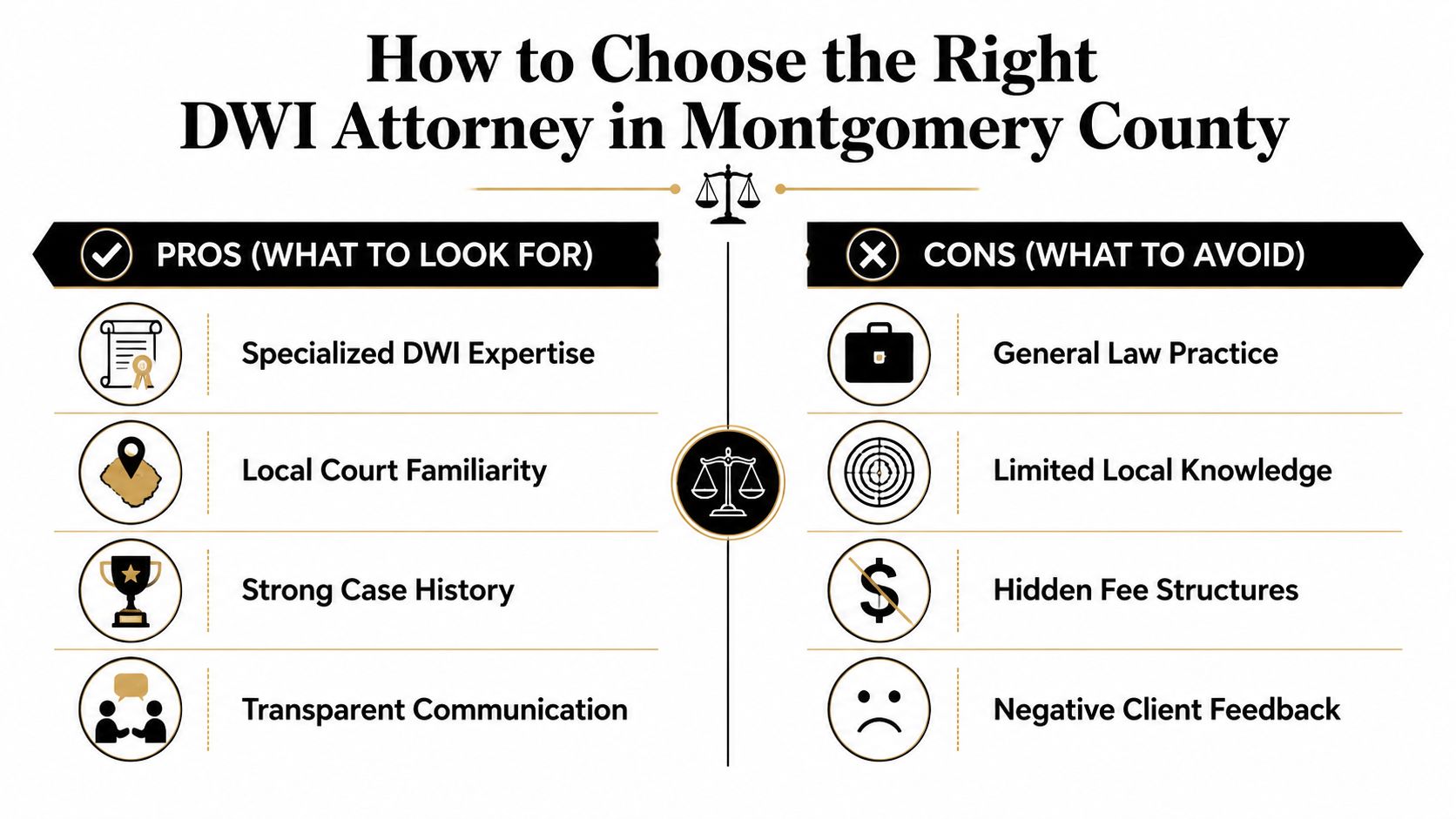
Private retained counsel versus appointed counsel
In Montgomery County, court-appointed attorneys are funded under a cap system that allocates about $60,000 annually to represent at least 81 criminal defendants, which works out to roughly $740 per case, according to this discussion of court-appointed attorney funding in Montgomery County.
You don't need to be cynical to see the problem. DWI cases often turn on details. Video review, officer training records, breath or blood issues, and motion practice take time. A lawyer working under a thin per-case structure may not have the same room to dig.
That doesn't mean every appointed lawyer is careless. It means the system creates pressure. If you can hire private counsel, that usually gives you more focused attention.
What local experience should look like
A good DWI attorney in Montgomery County should be comfortable discussing local procedure in Conroe and what happens when a case creates overlap with family or probate concerns. For some readers, that overlap is real. A pending divorce may already be underway. In that setting, factual family-law support such as Divorce Lawyer in The Woodlands, TX can become relevant because the DWI allegation may surface in temporary orders or custody disputes.
If you want a local criminal-law starting point, this page on a criminal defense lawyer in The Woodlands, TX is one example of a local resource to compare against other firms you interview.
Here's a quick video that helps frame the selection process:
Questions to ask in a consultation
Use the consultation to test whether the lawyer is organized, direct, and familiar with Montgomery County practice.
| Question | Why it matters |
|---|---|
| Do you handle ALR hearings personally | You need an answer on the immediate license issue |
| What documents do you want from me today | Organized lawyers move faster |
| What parts of the stop do you evaluate first | This shows how they think |
| Who will actually appear in court | You should know who is responsible |
| How do you communicate case updates | Silence makes a bad situation worse |
Ask direct questions. If the answers are vague, rushed, or evasive, keep looking.
Small practical signs that matter
Pay attention to how the office handles intake. If they can't get engagement documents to you quickly, that's a warning sign when time is already tight. Many firms now use tools such as BoloSign for lawyers and attorneys to send and sign documents fast, which can help when you need to retain counsel without losing days.
For readers trying to sort through options, The Law Office of Bryan Fagan is one local firm serving families in The Woodlands and Montgomery County, primarily in divorce, custody, support, property division, and probate matters. If your DWI charge is colliding with those issues, that kind of family-court familiarity may matter when choosing who coordinates your legal strategy.
Navigating the Montgomery County DWI Court Process
You get out of jail, sleep badly, and wake up thinking the hardest part is over. It isn't. The court case is only starting, and what happens in the early weeks shapes almost everything that follows.
A Montgomery County DWI case usually feels slow from the outside and active behind the scenes. Court dates may be brief. Weeks may pass between settings. Meanwhile, essential work is happening in the file. Your lawyer should be getting reports, video, breath or blood records, and patrol car footage, then deciding where the stop, arrest, testing, or paperwork can be challenged.
A first-time DWI in Texas can carry jail time, fines, community supervision terms, classes, and a long list of practical consequences that affect work, insurance, and driving. If you want a broader overview of local criminal defense representation in The Woodlands and Montgomery County, start there. Then focus on your own case timeline, because DWI defense is won or lost in the details.
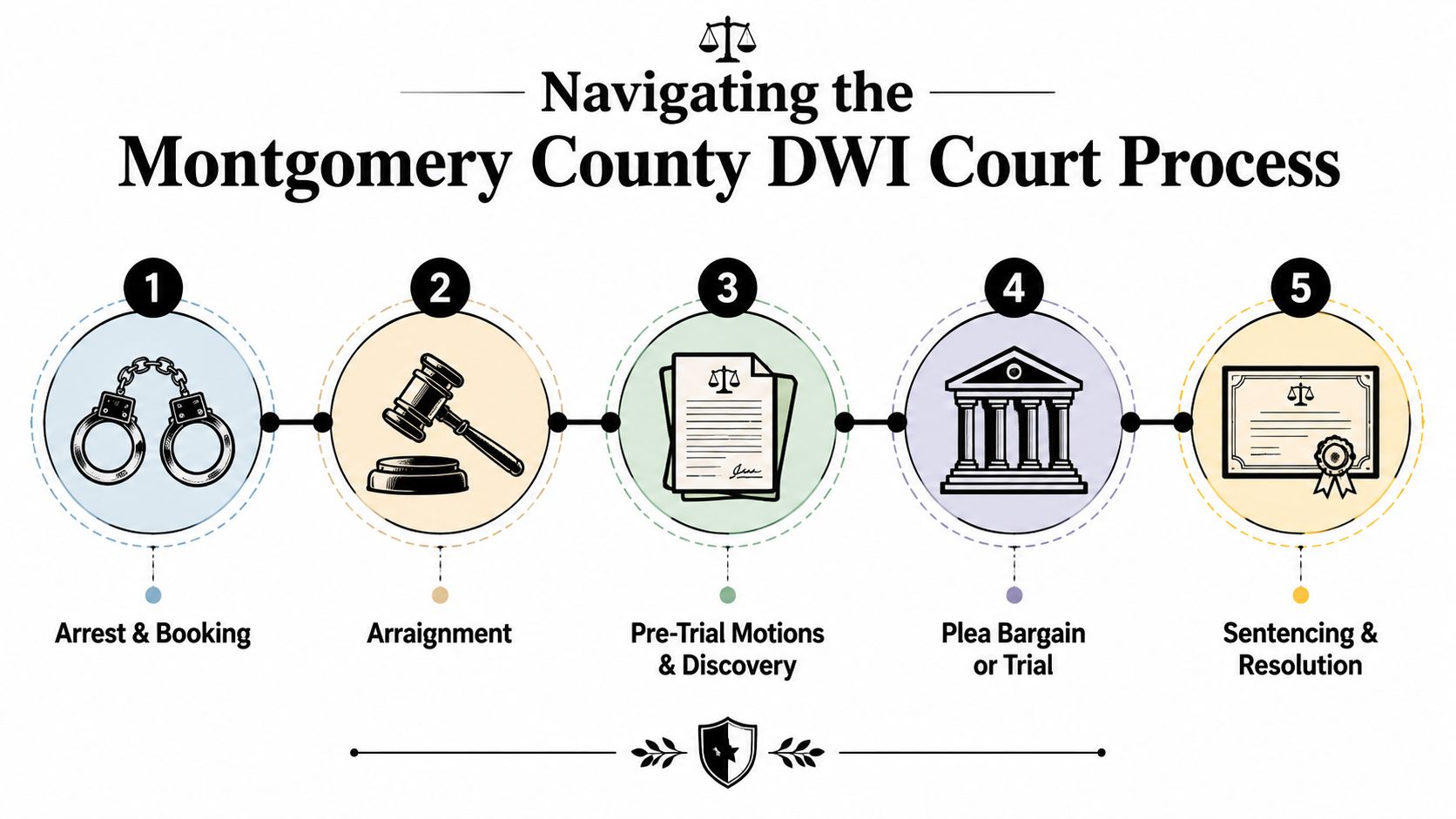
The basic court path
Most Montgomery County DWI cases move through the same broad stages:
Arrest and booking
The paperwork starts here. So do the officer narratives and testing records your lawyer will later examine.First court setting
This puts the case on the court's calendar and starts the formal process.Pre-trial review and motions
This stage matters most. The defense reviews evidence, files motions, and presses legal issues before a plea or trial decision is made.Negotiation or trial setting
Some cases are resolved through negotiated terms. Others should be set for a contested hearing or trial.Sentencing or final disposition
If there is a plea or conviction, the court imposes the outcome here.
Where cases are actually decided
Pre-trial work decides the direction of a DWI case. I am talking about whether the stop was lawful, whether field sobriety testing was administered correctly, whether the blood draw was handled properly, whether body camera video matches the report, and whether the State can prove each required element cleanly.
Do not count on an appeal to fix sloppy work done at the front end. The Texas Office of Court Administration publishes appellate court data that shows criminal appeals are a narrow path, not a safety net. That is why waiting passively for a better result later is a mistake. The best defense is built before plea negotiations harden and before the court file starts telling only the State's version of events.
The Woodlands residents often have another problem at the same time
A DWI arrest can spill into a custody case, divorce, or probate conflict fast. That is especially true if there are temporary orders, parenting disputes, or a tense co-parent already looking for an advantage. If you need the family-court side explained, Montgomery County Family Courts A Local Guide gives a useful overview of how those local courts operate.
You do not need a second lecture about the 15-day ALR deadline here. You already know that is the first deadline that matters. But its effect carries into the court case too. A lawyer hired before that window closes usually starts earlier, preserves more options, and gets into the facts before the prosecution's version of the case settles in.
That early start matters.
What the process feels like
Expect waiting, uncertainty, and short hearings that seem less important than they are. That is normal.
Good defense work is rarely dramatic. It is built through record requests, careful review, witness preparation, legal objections, negotiation strategy, and timing. If your lawyer explains what each setting is for and what is being done between dates, you will feel more in control and make better decisions.
Understanding Attorney Fees and Retainers for DWI Defense
Cost matters. Anyone who tells you otherwise isn't talking like a real person with a mortgage, kids, and bills.
The right question isn't “Who is cheapest?” The right question is “What am I paying for, and what is included?”
The two fee models you'll usually see
Some lawyers charge a flat fee for a defined scope of work. Others bill hourly and draw from a retainer. Neither model is automatically better. What matters is clarity.
Ask whether the fee covers the ALR hearing, routine court appearances, motion practice, trial preparation, and trial itself. Don't assume those are all bundled together.
Questions that should be answered in writing
Use this list before you sign anything:
What does the retainer cover
Ask for the exact stages included.What costs are separate
Trial expenses, experts, investigators, and record fees may be separate.Who appears in court
The lawyer you meet may not be the lawyer who stands with you.What triggers additional fees
Trial settings, contested hearings, and extensive motion work often change cost.
A suspiciously low fee can be a red flag. DWI defense takes time. If the number sounds too good to be true, ask what work is being left out.
Why this affects family and future planning
For many people in The Woodlands, a DWI charge lands in the middle of a bigger legal and financial mess. Divorce, support disputes, and property concerns don't pause because of an arrest. If you need a broader overview of local criminal-law resources while sorting cost and scope, review this page on criminal defense matters in The Woodlands.
A clear fee agreement reduces stress. You want to know what you owe, what you're getting, and what happens if the case becomes more complicated.
Good lawyers don't dodge fee questions. They answer them plainly.
Your Path Forward and Important Legal Disclaimer
You get arrested at night, get home exhausted, and wake up thinking the court date is the next thing that matters. It usually is not. In Montgomery County, the first mistake I see is waiting too long to deal with the license suspension issue. If you do nothing, you can lose a chance to fight that part of the case before your defense strategy even gets started.
Your next steps need to be simple and fast. Start with the deadline that can hurt you first, then get organized, then get legal advice tied to your facts.
What to do next
- Read every page the officer gave you today
- Mark the ALR deadline on your phone and calendar
- Write down everything you remember about the stop, the testing, and the arrest
- Do not discuss the case by text, social media, or casual calls
- Talk to a DWI lawyer before the 15-day window closes
That early call matters for more than your license. A lawyer who gets involved right away can request the ALR hearing on time, preserve issues that may help your defense later, and start looking at the stop before memories fade and paperwork gets buried. That is the single best first move after a DWI arrest.
Keep the rest of your life in view too. A DWI charge can affect custody arguments, divorce conflict, job stability, and professional reputation. If you are already under strain at home, treat this case as part of the bigger problem and handle it with that in mind.
This article is for informational purposes only. It is not legal advice, does not create an attorney-client relationship, and is not a substitute for advice from a lawyer who has reviewed your specific facts. The details matter. The reason for the stop, the officer's reports, any testing, your prior record, and any related family-law issues can change the right strategy.
If you need direct advice about what to do next in The Woodlands or Montgomery County, schedule a confidential consultation and get case-specific guidance.
If you're facing a DWI issue that may also affect your divorce, custody, support, property, or probate matter, you can schedule a consultation with The Law Office of Bryan Fagan to discuss the facts of your situation and your next practical steps.
