 Skip to content
A lot of people in The Woodlands don't start looking for an expunction lawyer until a background check brings an old arrest back to life.
It often happens at the worst time. A promotion is pending. A new apartment application is in review. A school or volunteer opportunity asks about prior arrests. Then a case that was dismissed years ago suddenly shows up and creates questions you thought were over.
That's where Texas expunction law can matter in a very real way. In the right case, expunction doesn't just hide a record. It can erase it. For Montgomery County residents, that can mean the difference between carrying an old mistake, or old accusation, into every application and moving forward with a clean slate.
If you're searching for an expunction lawyer in Montgomery County, you probably need straight answers more than legal jargon. You also need local perspective. Filing in Conroe, identifying the right agencies, and avoiding common eligibility mistakes all matter. Even people who could qualify often talk themselves out of trying.
What an Old Arrest Means for Your Future in Montgomery County
A resident in The Woodlands applies for an internal promotion. Human resources runs a routine background check. The applicant isn't worried because the arrest never led to a conviction. The charge was dropped. Life moved on.
Then the employer asks for an explanation.
That moment is why old arrest records matter so much in Montgomery County. Even when a case ended favorably, the record can still create hesitation for employers, landlords, schools, licensing boards, and volunteer organizations. The practical problem isn't only what happened in court. It's what still appears in databases when someone searches your name.
Why dismissed does not always mean gone
Many people assume a dismissal automatically clears the record. It doesn't. A dismissed case may still appear until a court grants expunction and agencies comply with the order.
That gap between dismissal and actual removal causes real stress. People in The Woodlands, Conroe, Magnolia, and Spring often come in after learning this the hard way. They believed the case had disappeared because it was over. Legally, that's not the same as expunged.
Old records create modern problems. The case may be over, but the paperwork may still be very much alive.
A local lawyer's role is practical. Review the disposition. Check timing. Identify whether expunction or sealing is the better fit. If your situation is tied to a broader criminal case history, you may also want to understand related local resources, including criminal defense representation in The Woodlands.
Local reality in Montgomery County
Montgomery County residents usually want one clear answer. Can this be removed, yes or no?
The honest answer depends on details that seem small but change everything. Was a charge ever formally filed. Was the case dismissed. Was there deferred adjudication. Was family violence alleged. Did the state decline to indict. Those facts control the result.
If you're worried because an old arrest keeps surfacing, you're not overreacting. You're dealing with a problem that can affect work, housing, and reputation long after the case ended.
Erasing Your Record vs Sealing It
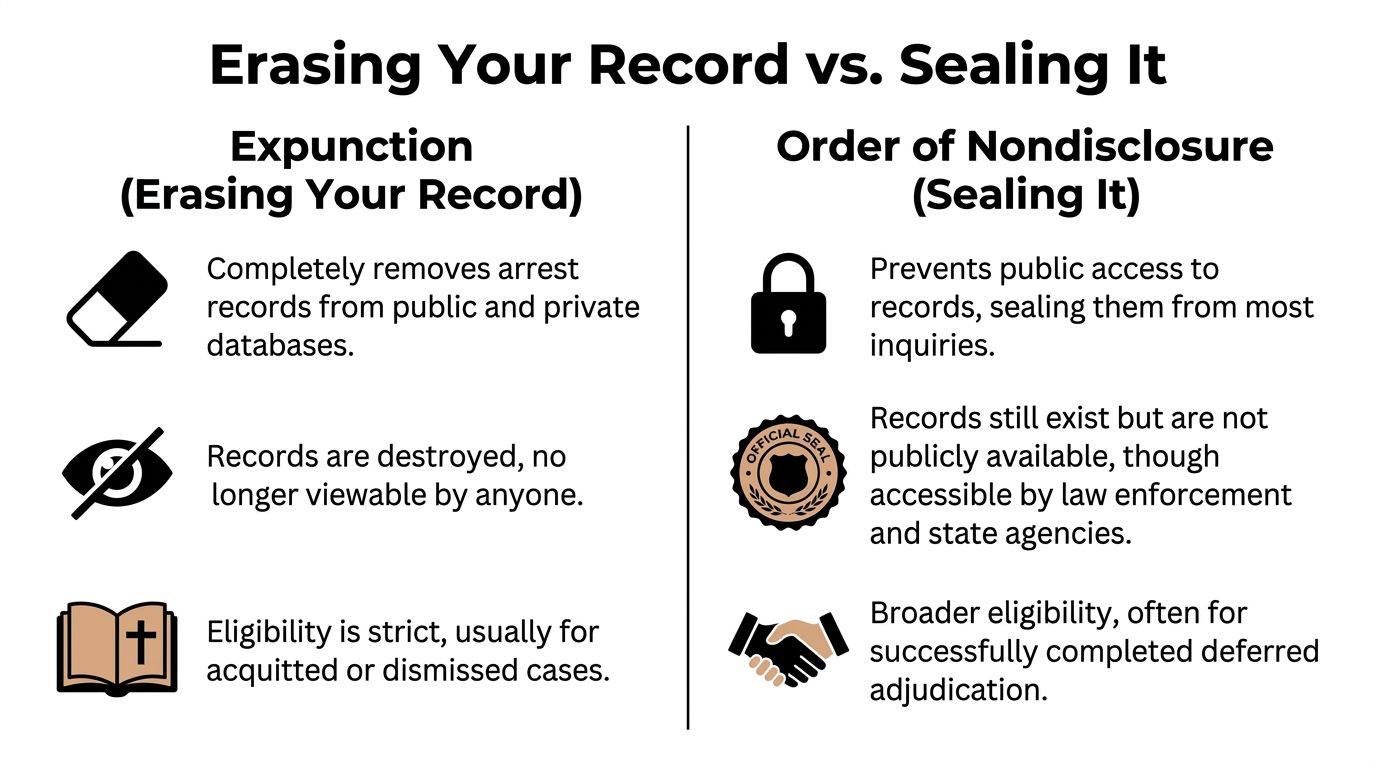
Expunction and nondisclosure are not the same remedy.
A simple way to think about it is this. Expunction is shredding the document. Nondisclosure is locking the document in a cabinet. Both can help, but they do very different things.
What expunction actually does
When a Texas court grants an expunction, all government agencies that collected criminal history information about the arrest, including the county or district clerk, police departments, and the Department of Public Safety, must permanently delete their records of the arrest. Once expunction is granted, the person can legally deny the arrest ever occurred, as explained in this Montgomery County expunction overview.
That's the strongest result Texas law offers in this area.
For someone in Montgomery County, that means the goal is total removal, not partial privacy. If you qualify, expunction is usually the cleaner remedy because it aims at erasure rather than limited access.
What nondisclosure does instead
Nondisclosure is different. The record still exists. The public generally can't see it, but law enforcement and certain state agencies still can.
That's why nondisclosure can be helpful, but it's not the same as having the matter erased. It manages exposure. It does not rewrite history the way expunction can.
This distinction matters in related family and safety contexts too. For example, Protective Orders in The Woodlands involve domestic violence and family safety matters, and records connected to those issues can raise different legal questions than an arrest record eligible for expunction.
Expunction vs Nondisclosure at a Glance
| Feature | Expunction (Erasing) | Nondisclosure (Sealing) |
|---|---|---|
| Core result | Record is erased | Record is sealed from public view |
| Agency access | Agencies must delete covered arrest records | Law enforcement and certain agencies may still access it |
| Public visibility | Intended to remove the record from public and legal history | Public access is restricted, but the record still exists |
| Best fit | Arrests and cases that meet strict expunction rules | Cases that don't qualify for expunction but may qualify for sealing |
| Practical effect | You may legally deny the arrest occurred | You usually still need to understand who can see the record |
If your goal is a true clean slate, the first question isn't whether some remedy exists. It's whether you qualify for expunction before settling for sealing.
A lot of confusion starts because people use the words interchangeably. Courts do not. Lawyers should not. You shouldn't either when you're deciding how to move forward.
Who Qualifies to Clear Their Record in Texas
Eligibility starts with the outcome of the case, not just the arrest itself. Texas expunction law is strict, and small differences in court history can decide whether you qualify.

Common paths to eligibility
A person may qualify for expunction in Texas when the state never filed formal charges after an arrest, when charges were filed and later dismissed, or when a conviction resulted from identity theft and another person was ultimately convicted, as summarized in this expunction eligibility discussion.
Other qualifying situations can include acquittal or a pardon. In practice, the key question is whether the law treats the case as one that can be erased rather than merely sealed.
Here's the plain-English version of who often has a viable expunction conversation:
- No filed case: You were arrested, but the prosecutor never formally filed charges.
- Dismissed case: Charges were filed, but the case was dismissed later.
- Wrong-person situation: Identity theft caused the criminal history issue.
- Acquittal or pardon: A conviction was overturned by acquittal or erased through pardon.
The waiting periods that matter
If the prosecutor never filed charges, Texas law imposes waiting periods tied to the level of the alleged offense. For Class C misdemeanors, the waiting period is 180 days. For Class A and B misdemeanors, it is one year. For felonies, it is three years, according to this Montgomery County expungement guide.
Those timelines sound simple, but people regularly miscalculate them. They count from the wrong date, misunderstand the offense level, or assume a dismissal changes the clock in every case.
Practical rule: Before filing anything in Conroe, verify both the charge level and whether a prosecutor ever formally filed the case.
When people usually do not qualify
A conviction usually blocks expunction unless the law provides a narrow exception such as acquittal on appeal or pardon. Some deferred adjudication outcomes also do not qualify for expunction. Texas law is especially sensitive to the type of offense and the way the case ended.
The legal framework comes from Chapter 55 of the Texas Code of Criminal Procedure. Family law codes can matter too when criminal allegations overlap with household or parent-child issues. For example, the Texas Family Code often governs protective orders and family violence findings, which can affect related legal strategy even when the expunction question itself is controlled by criminal procedure.
What works and what doesn't
What works is a document-based review. Arrest date, court records, dismissal paperwork, indictment history, and final disposition tell the story.
What doesn't work is relying on memory alone. People often remember the result correctly but not the exact procedural path. In expunction practice, procedure is everything.
Your Timeline for Filing an Expunction in Conroe
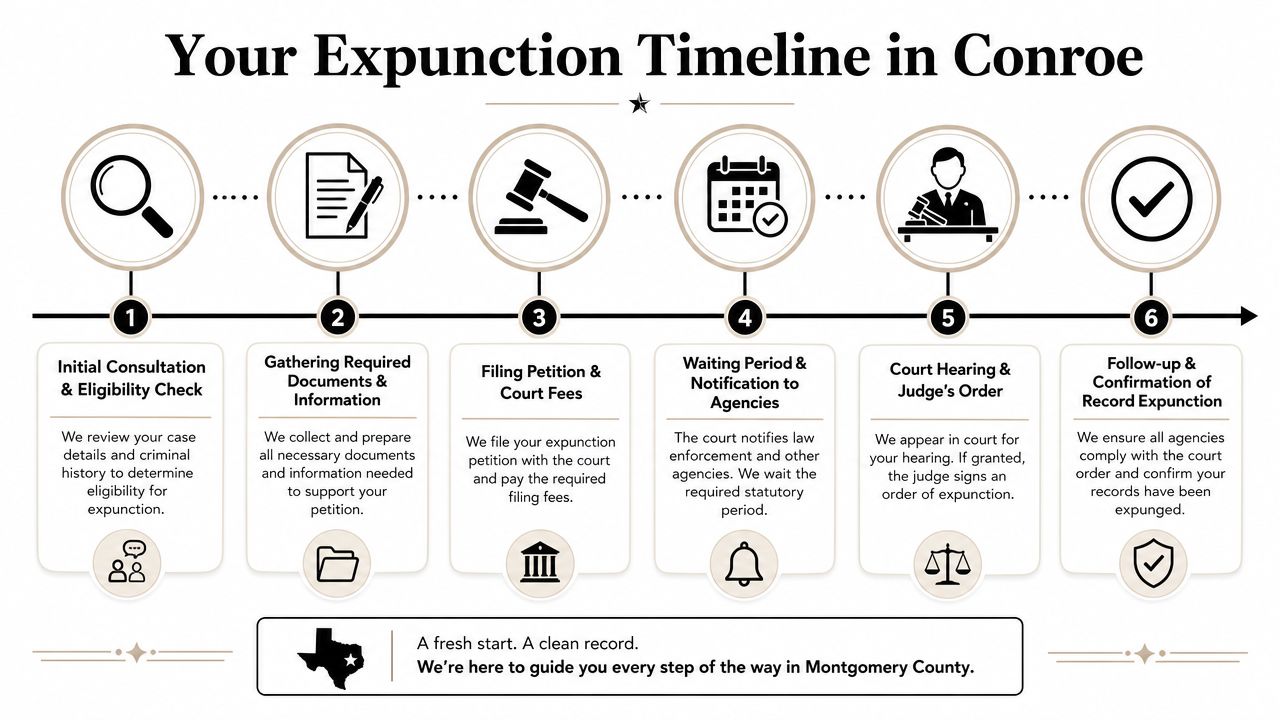
Once eligibility looks promising, the process becomes a paperwork and precision exercise. Most expunction cases in Montgomery County move through the courthouse in Conroe, and the timeline depends on getting each step right.
Step by step in Montgomery County
Confirm the legal basis
Start with the final case outcome. An expunction may be available if the state never filed charges after an arrest, if charges were filed and later dismissed, or if the matter arose from identity theft where another person was ultimately convicted, as noted in this Texas expungement explanation.Collect the right records
You'll usually need arrest details, case numbers, court disposition records, and agency information. Missing one agency can create a practical problem later because the order needs to reach every entity holding the record.Draft and file the petition in Conroe
The petition is filed with the district clerk in the proper court. Many self-filed cases begin to encounter difficulties at this stage. The petition has to identify the case accurately and list the agencies that should be bound by the order.Notify all relevant agencies
That may include the original arresting agency, the Montgomery County Sheriff's Office, the prosecutor, the clerk, and Texas DPS, depending on the case history.Handle any hearing issues
Some cases move without heavy dispute. Others require a hearing, especially if the state objects or the record is incomplete.Follow through after the order
The judge's signature is a major milestone, but not the end. Agencies still need time to process and comply.
A short real-world scenario
A Woodlands resident came in after a dismissed charge kept appearing in employment screening. The person assumed the dismissal had already taken care of the problem. It hadn't.
The work involved wasn't dramatic. We matched the dismissal paperwork to the arrest record, identified the agencies that needed notice, filed in Conroe, and followed the case through the signed order. The biggest relief came later, when the client no longer had to explain an old case that should have been over long ago.
Where people lose time
Most delays come from avoidable issues:
- Wrong case details: A bad cause number or incomplete arrest date can slow everything down.
- Missed agencies: If an agency isn't properly identified, the record may continue showing up somewhere.
- Bad assumptions about timing: Filing too early can waste months.
- Thin documentation: If the paperwork doesn't clearly prove eligibility, objections become more likely.
Court orders don't erase records by magic. Someone has to identify the right agencies, notify them correctly, and make sure the paperwork matches the actual case history.
People familiar with other court processes often expect a similar rhythm here. For example, The Divorce Process in The Woodlands: What to Expect gives a step-by-step look at filing for divorce in The Woodlands and Montgomery County. Expunction practice also rewards sequence and detail, but the agencies, legal standards, and records involved are different.
Why You Should Not File for Expunction Alone
A do-it-yourself expunction can fail even when the person should have qualified.
The problem usually isn't effort. It's that Texas expunction law is technical, local filing practice matters, and the paperwork has to match the exact procedural history of the case. In Montgomery County, that means you need more than a general idea that your case was “dismissed.”
The deferred adjudication mistake
One of the biggest misconceptions is that deferred adjudication automatically kills any chance at expunction. That's not always true. Texas law under Article 55.01 can allow expunction when deferred adjudication was followed by dismissal, and the Montgomery County District Attorney's Office FAQ notes the process takes “several months” because the statutes are complex, as discussed in this expunction FAQ PDF.
That misunderstanding stops many people before they even ask the right question. They assume nondisclosure is the only option and never have anyone review whether expunction is still on the table.
What lawyers actually prevent
A lawyer doesn't just “file papers.” A lawyer checks whether filing is smart before filing at all.
Common failure points include:
- Misreading eligibility: Deferred dismissal cases, no-bill cases, and timing questions often trip people up.
- Incomplete agency lists: If the petition misses a record holder, cleanup may be incomplete.
- Weak hearing preparation: If the state objects, you need the record history organized and ready.
- Local process mistakes: Filing rules and practical courthouse expectations aren't always obvious from the statute alone.
For readers curious how legal practices present useful public guidance online, some firms study resources like law firm SEO playbooks to make complex subjects more understandable. That's helpful for education, but your case still turns on your own records, not on a generic article.
One practical option in The Woodlands
If you're looking for a local starting point, the The Law Office of Bryan Fagan serves The Woodlands and Montgomery County in court-based matters and consultations tied to local procedure. If your search began with broader criminal concerns, you may also review how to find a criminal defense lawyer in The Woodlands for related context.
The main point is simple. Expunction is too important to guess at. A failed filing costs time, energy, and sometimes strategic opportunity.
Answering Your Top Expunction Questions
People usually ask the same practical questions once they realize expunction may be possible. Here are direct answers.
How much does an expunction cost in Montgomery County
There isn't one universal total. Costs usually involve court filing fees, service or notice costs, and, if you hire counsel, attorney's fees.
The right way to evaluate cost is to compare it against the cost of getting it wrong. If a background check keeps surfacing a removable record, delay can be expensive in ways that don't show up on an invoice. The actual answer comes from reviewing the case history and identifying how many agencies need to be included.
My family violence charge was dismissed. Can I get it expunged
Often, no. Texas expunction law is explicitly barred for family violence cases even if dismissed, based on the offense type itself, as explained in this expunction analysis.
That result surprises people because dismissal sounds final. In this area, dismissal alone does not control eligibility. The nature of the allegation can block expunction. If your background check issue stems from a charge tied to assault, DWI, or another criminal matter, a related local resource is this Montgomery County DWI attorney page.
After the judge signs the order, is my record clear immediately
Usually not. Agencies need time to process the order and update or delete records.
That is why clients often feel a two-stage relief. First, the order is signed. Later, the record stops appearing where it used to appear. Patience matters after the hearing because compliance takes time.
A signed order is the legal command. Actual cleanup happens afterward, agency by agency.
Do I need all my paperwork before speaking with a lawyer
No. Bring what you have. A lawyer can often help identify what is missing and where to get it.
What helps most is accurate basic information. Approximate arrest date, arresting agency, charge description, court location, and whether the case was filed, dismissed, or declined. Even partial records can be enough to begin the analysis.
Does the Texas Family Code or Texas Estates Code apply here
The expunction itself is generally governed by criminal procedure law, not the Texas Estates Code. The Texas Family Code can become relevant when the underlying facts involve family violence, household relationships, or protective-order issues, because those issues may affect surrounding legal decisions even though the expunction petition is not an estates matter.
What to Do Next for a Clear Record
If an old arrest is still causing trouble in The Woodlands or anywhere in Montgomery County, the next move should be organized and private.
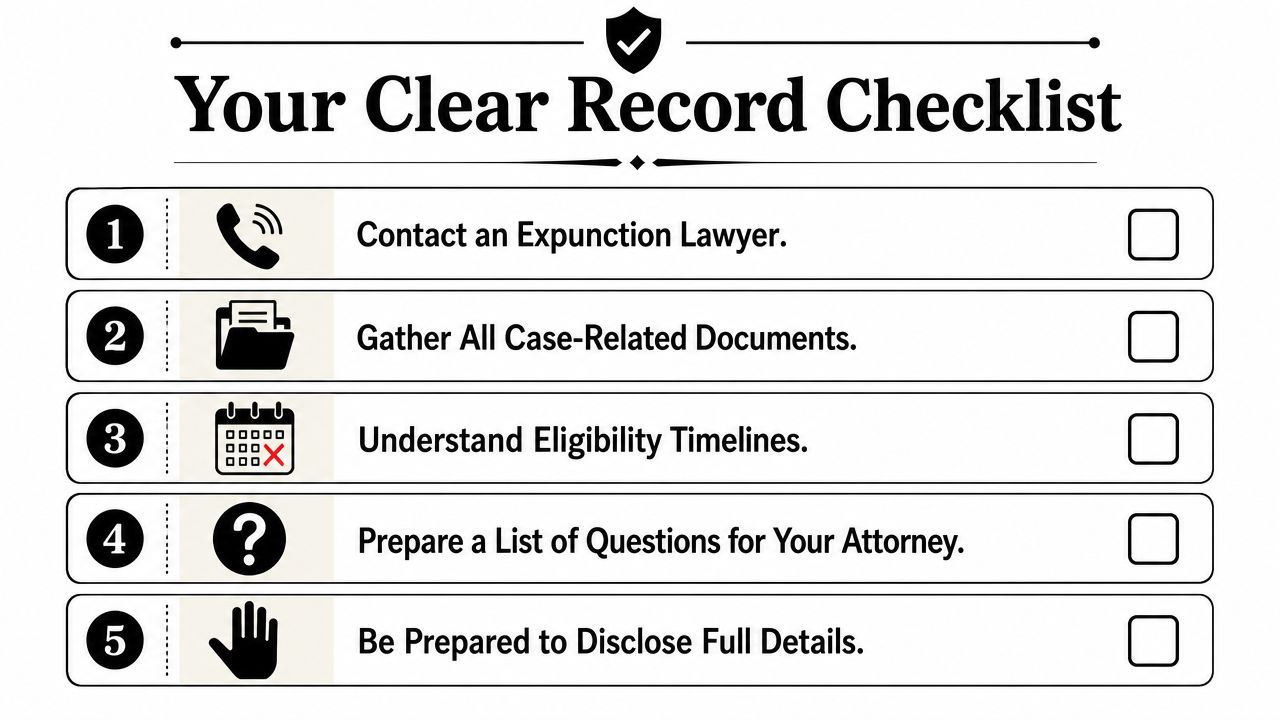
What to do next
- Gather your documents: Collect anything you have from the arrest, court case, dismissal, or discharge.
- Write out the timeline: List dates, agencies, court appearances, and the final outcome as best you remember.
- Keep the discussion limited: Don't rely on advice from friends, employers, or online forums about whether you qualify.
- Ask about timing: Waiting periods and dismissal details matter, so confirm them before filing.
- Schedule a confidential consultation: A case review can tell you whether expunction, nondisclosure, or no remedy is the realistic answer.
This article is for informational purposes only. It is not legal advice and does not create an attorney-client relationship.
If you're ready to talk through your options, The Law Office of Bryan Fagan offers private consultations for people in The Woodlands, Conroe, and across Montgomery County who want a clear answer about whether an old record can be removed.
