 Skip to content
You were driving home through The Woodlands, or maybe a friend called from the Montgomery County jail. Now your stomach is in knots. You're worried about your job, your family, your record, and whether one bad stop is about to wreck the next few years.
Take a breath. A drug arrest is serious, but panic makes people hand the State extra evidence. Smart, early decisions matter more than dramatic ones. If you're looking for a drug possession lawyer in The Woodlands, you need local strategy, not generic criminal defense talk.
Facing a Drug Charge in The Woodlands?
A lot of people arrested in Montgomery County think they're the only one in this spot. They're not. Drug enforcement is a major part of the system. In fiscal year 2023, 29.9% of all arrests nationally were drug-related, while Texas reported 17.9%, according to The Woodlands drug crime statistics discussion. That tells you two things. First, these cases are common. Second, common does not mean simple.
Montgomery County cases turn on local habits, local timing, and local procedure. A lawyer who handles broad criminal defense matters in The Woodlands may be helpful, but for a possession case, you want someone who knows how this county operates.
What your case probably feels like right now
You may not even know what you were charged with. You may only remember the stop, the search, the cuffs, and the ride. That's normal.
What matters right now is this. Your case is not decided by the officer's confidence, the arrest report, or what was said on the roadside. It will be shaped by what can be proven, what can be challenged, and whether your lawyer sees local options before they disappear.
Practical rule: The first version of the story in the police report is not the final version of the case.
What people often get wrong
People assume possession means the State automatically wins. That's not how real defense works. The State still has to prove the substance, prove possession, prove knowledge, and survive any challenge to the stop, search, seizure, and testing.
They also assume every lawyer will handle the case the same way. That's false. In Montgomery County, timing and local familiarity can open doors that a generalist misses.
Your First 24 Hours After a Drug Arrest
The importance of your first day after arrest is often overlooked. This is when people talk too much, text the wrong person, or try to explain things away. Stop doing all of that.
Here's the basic rule. Be polite. Be quiet. Ask for a lawyer.
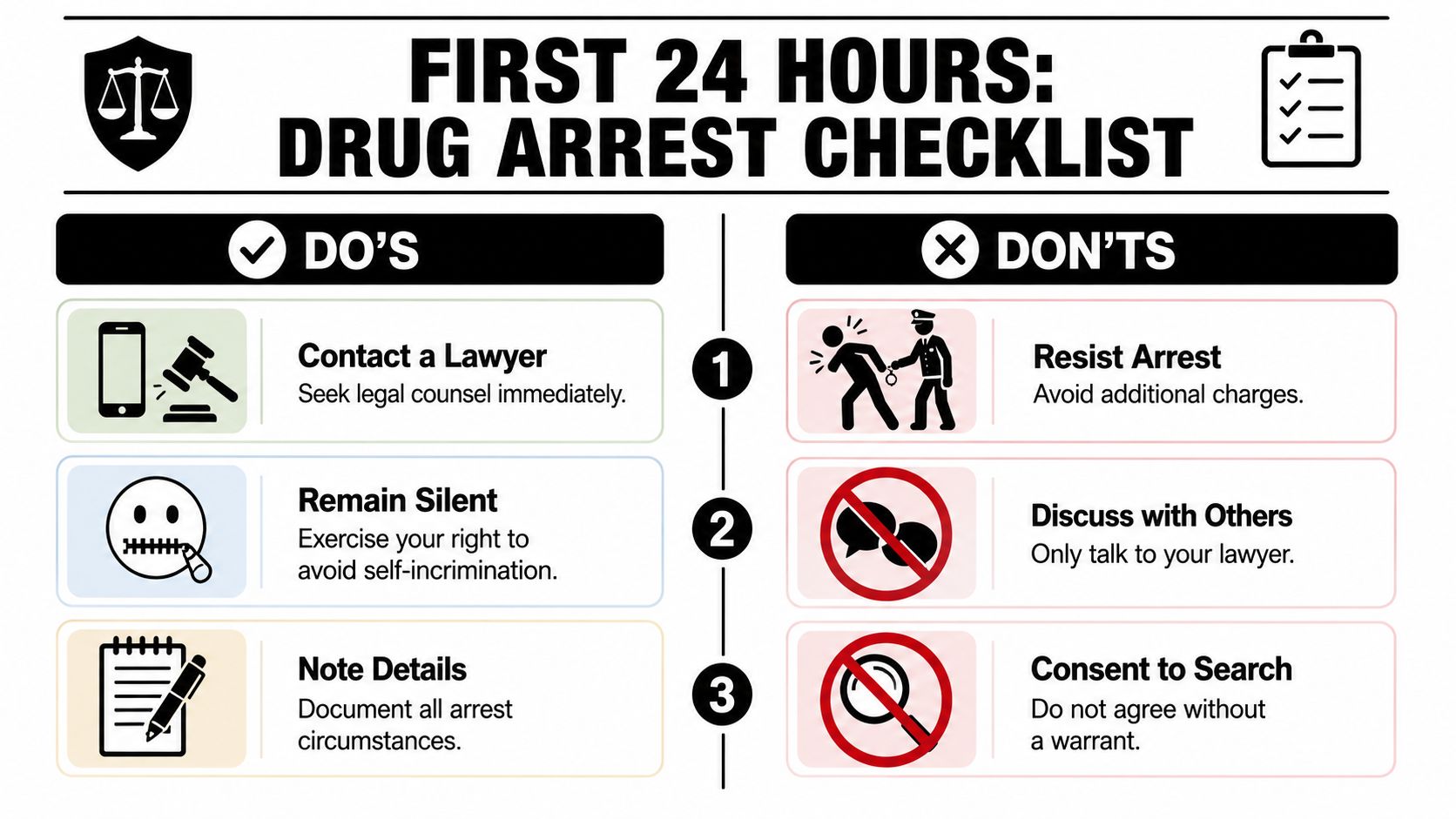
Do these things immediately
- Stay silent: Don't try to “clear it up.” Officers are gathering statements, not giving second chances.
- Ask for counsel: Say clearly that you want a lawyer.
- Write down facts: As soon as you can, note where you were, who was present, what was searched, and what was said.
- Preserve your phone carefully: Don't delete messages, photos, or call logs. Deleting looks bad and can create new problems.
- Read a local arrest guide: A practical arrest guide for The Woodlands area situations can help you avoid the usual early mistakes.
Don't do these things
- Don't consent to more searching: If they have legal authority, they'll act on it. You don't need to help.
- Don't post online: Not on Facebook, Instagram, Snapchat, or in a group chat.
- Don't explain your version to friends or family in detail: Those conversations can become evidence.
- Don't resist physically: Even a weak possession case gets worse if you add another charge.
A lot of families ask whether a criminal case can spill into other court matters. It can. For example, if you're already dealing with custody or visitation disputes, issues like Grandparents' Rights in The Woodlands can intersect with broader family court concerns in Montgomery County.
A short local scenario
Alden Bridge resident Jason got stopped late at night and found with a controlled substance in the car. He thought honesty would help, so he told the officer, “It's not mine, but I knew it was there.” That one sentence gave the prosecution an argument on knowledge and possession that his lawyer now has to fight around.
Don't do Jason's job for the State.
Later, if you want a plain-language overview of common first-step issues, this video is useful:
Say less than you think you should. Early explanations usually help the prosecution more than the defense.
How to Choose the Right Woodlands Defense Lawyer
Two lawyers can look the same on a website and handle your case very differently in Montgomery County. One starts pushing a plea before the lab file, body cam, and search issues are fully reviewed. The other starts building exits from day one, including diversion screening, suppression issues, and how the 2026 HB 2675 reclassification may affect charge level, plea posture, or dismissal options. Hire the second kind.
Start with one question. Does this lawyer know how possession cases are handled in Montgomery County, not just how criminal law works in general?
Ask questions that expose real local experience
Ask the lawyer these questions and pay attention to whether the answers are specific:
- How often do you handle drug possession cases in Montgomery County courts?
- What do you request first in a possession case: offense report, body cam, lab records, or dispatch? Why?
- Do you check early for county diversion or pretrial intervention before the case gets pushed into a standard plea offer?
- How do you defend a case involving a shared car, shared apartment, or borrowed backpack?
- How do you evaluate whether the 2026 HB 2675 reclassification changes the risk level or negotiation strategy in my case?
- Who updates me about court dates, settings, and deadlines?
- What is your first move if the police report says I admitted knowledge or ownership?
A strong answer sounds concrete. A weak answer sounds rehearsed.
You also want a lawyer who runs a tight file. Possession cases turn on details. Missing body cam footage, sloppy discovery review, bad note-taking, or delayed follow-up can weaken your position with the prosecutor. If you want context on how law offices keep records and dictation accurate, this overview of understanding legal speech-to-text tools is useful.
Red flags to take seriously
| Red flag | Why it matters |
|---|---|
| Guarantees of dismissal | No honest defense lawyer can promise that |
| Fast pressure to hire without asking facts | That is intake sales, not legal judgment |
| Generic talk about being aggressive | Aggression does not replace a suppression strategy or diversion analysis |
| No discussion of Montgomery County programs | Local off-ramps are often where the real value is |
| No mention of HB 2675 reclassification | They may be missing a change that affects how your case should be assessed |
My advice: hire the lawyer who talks about evidence, timing, local court practice, and dismissal paths. Skip the one selling personality.
One practical option to review is The Law Office of Bryan Fagan's criminal defense page in The Woodlands, especially if your possession arrest overlaps with family court problems in Montgomery County.
If your case touches another legal problem, tell your defense lawyer immediately. Bond conditions, travel limits, protective orders, custody disputes, and anything you have said in another court file can affect strategy in a possession case. Silence and coordination beat damage control every time.
Defenses and Unique Montgomery County Strategies
Every possession case starts with the usual defense questions. Was the stop legal? Was the search lawful? Was the substance tested properly? Can the State prove you possessed it?
Those are the baseline issues. They matter. But in Montgomery County, the better question is whether your lawyer sees the local off-ramps that can keep a criminal case from becoming a conviction.
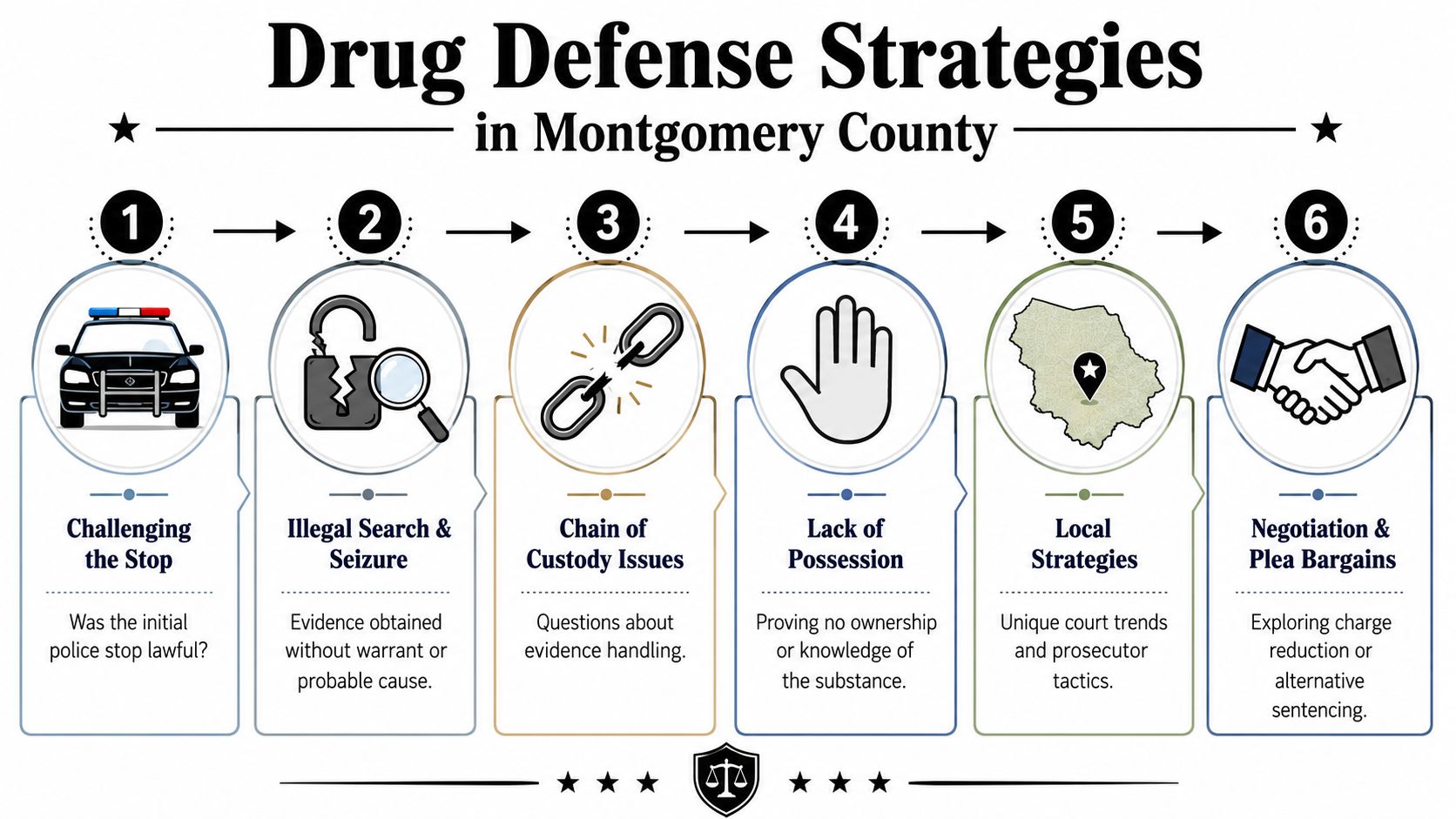
The standard defenses still matter
A skilled defense lawyer should examine:
- The initial stop: If the detention was weak, everything after it may be vulnerable.
- The search itself: Consent, probable cause, warrant scope, and timing all matter.
- Chain of custody: If evidence handling is sloppy, reliability becomes a real issue.
- Possession and knowledge: Being near something is not the same as knowingly possessing it.
- Lab proof: The State has to prove what the substance was, not just what an officer thought it was.
One verified local point matters here. A defense approach can include independently checking lab work and challenging chain of custody, and in Montgomery County courts, diversion program success for first-time offenders has been reported at 60% to 70% in a discussion of drug possession lawyer defense methods. That's exactly why early case review matters.
The Montgomery County issue most people miss
Montgomery County has a local timing problem that catches people off guard. Data shows 34% of eligible cases in Montgomery County received pretrial diversion in 2025, and the option is often forfeited if it isn't requested within 10 to 14 days of arrest, according to this discussion of questions to ask a drug possession attorney.
That's not a small procedural detail. That can be the difference between a dismissal path and a record.
Ask your lawyer, bluntly, whether you may qualify for pretrial diversion and whether anything needs to be filed or requested immediately. If the answer is vague, that's a warning sign.
The 2026 HB 2675 angle
Another issue many people still haven't heard about is Texas House Bill 2675, which the source material describes as effective in January 2026. According to this discussion of drug possession defense developments, 28% of possession cases filed in Montgomery County in Q1 2026 were downgraded to administrative violations, and 62% of eligible defendants in 2025 failed to receive the administrative downgrade because their attorneys didn't cite HB 2675 at arraignment.
That means some low-level possession cases may have a non-criminal pathway. If your arrest falls into that category, your lawyer should be talking about more than suppression motions and plea deals. They should be asking whether your case belongs outside the normal criminal track entirely.
Local knowledge isn't just about knowing the courthouse. It's about knowing which door to knock on before it closes.
Potential Penalties and Collateral Consequences
A possession case in Montgomery County can punish you in two different ways. First through the charge itself. Then through the record it leaves behind if your lawyer does not cut it off early.
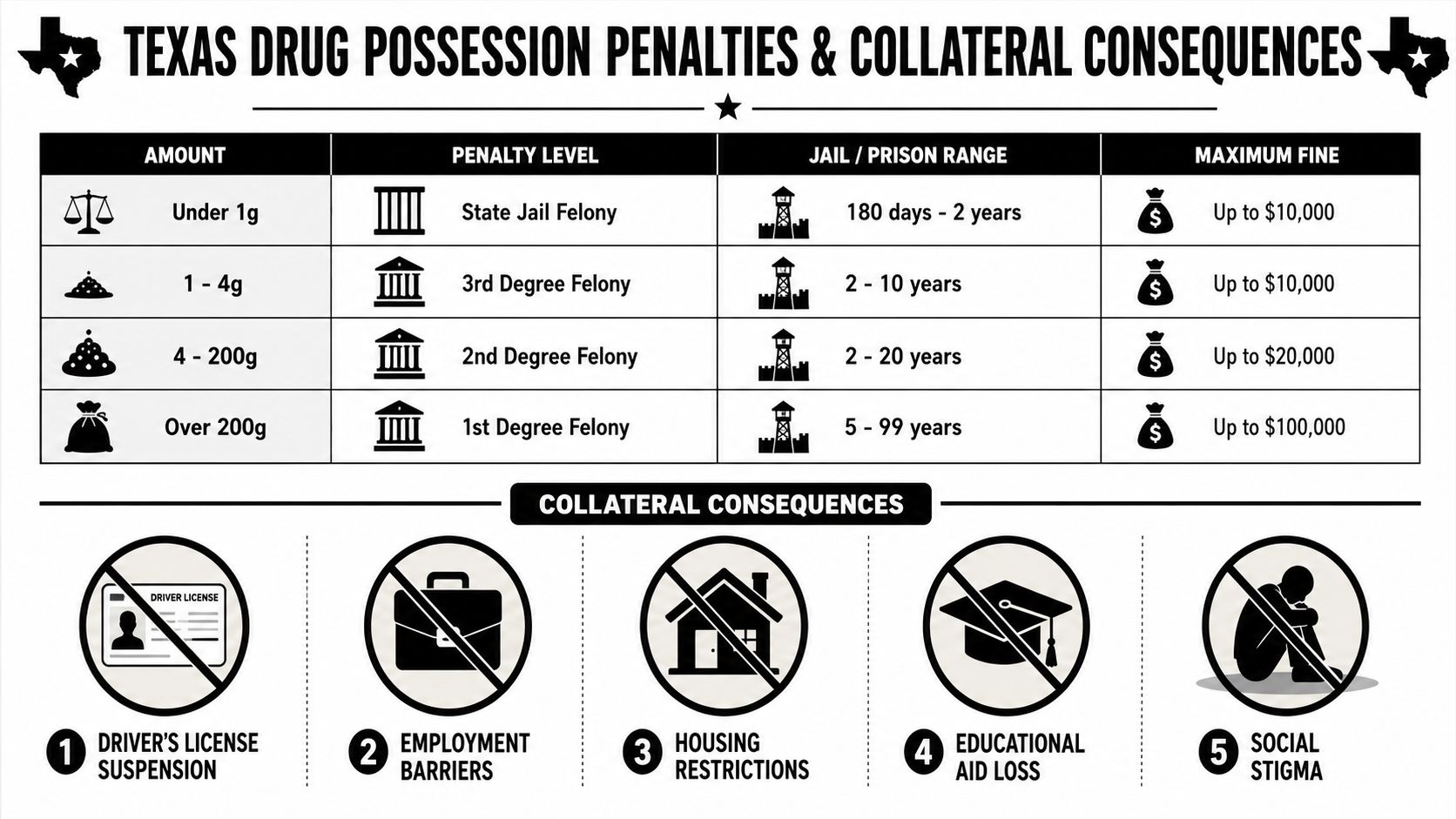
What the charge can carry
Texas possession penalties depend on the substance, the penalty group, and the alleged amount. A misdemeanor can still mean jail, fines, bond conditions, drug testing, and a record that follows you long after court ends.
Under Texas law, a Class A misdemeanor drug possession charge can lead to up to one year in jail and a fine up to $4,000, while a State Jail felony carries 180 days to two years in prison and a fine up to $10,000, as outlined in this review of Texas drug crime penalties.
Some allegations are treated far more aggressively. In Montgomery County, possession of less than one gram of a controlled substance such as methamphetamine or cocaine is described as a Second-Degree Felony with a mandatory minimum penalty of two years of incarceration in this Montgomery County possession charge discussion.
And for Penalty Group 2 substances, including ecstasy and some prescription drugs, penalties can reach first-degree felony levels with prison terms of 5 to 99 years and fines up to $10,000, according to this explanation of Texas drug offense levels.
Those ranges are exactly why local case strategy matters. In this county, the right approach may be reducing the charge, pushing for diversion, or forcing the court to treat an eligible low-level case under the 2026 HB 2675 reclassification rules instead of letting it stay on the ordinary criminal track.
The consequences outside the courtroom
A bad plea can cost more than the sentence on paper.
A conviction or even a poorly handled pending case can create problems with:
- Employment: Background checks can block hiring or promotion.
- Housing: Property managers and landlords may deny applications.
- Professional licensing: Licensing boards can open investigations or demand explanations.
- Education and financial aid: Schools and programs may ask about pending or past drug cases.
- Bond conditions and daily life: Random testing, travel limits, curfews, and no-contact rules can make it hard to work and keep your life stable.
For some people, treatment becomes part of the case. That can help or hurt, depending on how it is presented to the court and whether it is voluntary, negotiated, or ordered. This overview of Tru Dallas Detox guidance on court-ordered treatment gives a plain-English explanation of how rehab and legal requirements can overlap.
The main point is simple. Do not measure your case only by the maximum jail number. Measure it by what ends up on your record, what conditions get imposed now, and whether your lawyer is using Montgomery County options that can keep the case from turning into a lasting problem.
Your Action Plan and Next Steps
You don't need to solve the whole case tonight. You do need to stop making it worse and start protecting your position.
What to do next
- Call a lawyer quickly: In Montgomery County, local timing can affect diversion and other options.
- Stop talking about the case: Friends, relatives, coworkers, and social media are not safe places to explain anything.
- Save every document: Bond papers, charging paperwork, property receipts, and court notices all matter.
- Write your timeline: Keep it factual. Where you were, who was there, what was searched, what was said.
- List possible witnesses: Passenger, roommate, friend, or family member. Don't coach them. Just identify them.
- Flag family law risk: If you have an open custody, visitation, divorce, or support case, tell your lawyer immediately.
- Ask direct questions: Am I diversion-eligible? Is there an administrative pathway? What deadlines apply right now?
Keep your head clear
The biggest mistake after arrest is acting from fear. People confess to things they didn't possess. They consent to searches they didn't have to approve. They hire the loudest lawyer instead of the most prepared one.
Do the opposite. Be disciplined. Be quiet. Get local legal help fast.
Bottom line: The best early move in a possession case is usually the simplest one. Stop talking and start preparing.
Important disclaimer
This article is for general informational purposes only. It is not legal advice, does not create an attorney-client relationship, and should not replace advice from a lawyer who has reviewed the facts of your Montgomery County case.
If you're dealing with a drug possession arrest in The Woodlands and you need a calm, practical read on what to do next, you can schedule a confidential consultation with The Law Office of Bryan Fagan.
