 Skip to content
A divorce in The Woodlands can cost a few thousand dollars for an amicable, uncontested case or more than $30,000 to $50,000 for a complex, contested trial. The final number usually turns on two things: how much you and your spouse fight, and how complicated your property and parenting issues are.
That's the part individuals are trying to figure out when they first call a lawyer. They're not asking for a perfect prediction. They want to know whether they're looking at a manageable legal process or a financial drain that could follow them for months.
In The Woodlands, that concern is justified. Families here often own homes with substantial equity, retirement accounts, business interests, stock compensation, or separate-property claims tied to inheritance and premarital assets. Once those issues are disputed, legal fees climb fast.
The good news is that divorce cost is not random. In many cases, you can identify the main cost drivers early and make better decisions before the case gets expensive. If you're searching for how much does a divorce cost in the woodlands texas, the most useful answer is not a statewide average. It's a local, practical look at what gets billed in Montgomery County and what tends to keep those bills under control.
Estimating Your Divorce Cost in The Woodlands
You may be sitting at the kitchen table in Sterling Ridge or Creekside with bank statements pulled up, trying to answer a simple question before you file. Can I afford this, and what is this likely to cost by the time it is over?
That question gets harder in The Woodlands than it does in many other parts of Texas.
A statewide average does not tell you much if the marital estate includes a house with significant equity, brokerage accounts, restricted stock, a professional practice, or a separate-property claim tied to inheritance or premarital savings. In Montgomery County, those are common facts, not outliers. The cost range widens fast once those issues are disputed, because the work shifts from drafting papers to tracing assets, valuing accounts, and preparing for hearings that may have real financial consequences.

What the range looks like in practice
In a straightforward case where both spouses exchange information promptly and settle early, fees stay on the lower end. In a contested case involving custody disputes, business records, reimbursement claims, or a fight over the marital home, the bill can climb into five figures and sometimes far beyond that if the case goes through trial.
The reason is simple. Attorney time is what drives cost. Every disagreement over inventory, parenting terms, temporary support, or document production adds work. Every hearing adds preparation time. Every delayed disclosure creates follow-up work that someone has to review, organize, and respond to.
I tell prospective clients to budget based on the level of conflict and the complexity of the finances, not on a generic Texas average.
Why Montgomery County timing affects cost
The 60-day waiting period in Texas is often misunderstood as a cheap pause in the process. It is not. In many Montgomery County cases, those two months still include temporary-orders hearings, document gathering, appraisals, business valuation work, parenting-course requirements, and back-and-forth negotiation between lawyers.
That waiting period can save money if both spouses use it to exchange records and reach a settlement. It can also increase cost if one spouse uses the time to stall, withhold information, run up debt, or fight over temporary possession of the house and children. For higher-income families in The Woodlands, those interim disputes can be expensive because the status quo matters. Who pays the mortgage, who keeps control of accounts, and whether anyone requests temporary support all affect both strategy and cost.
Local reality matters more than a headline number.
If you want a clearer sense of how fee arrangements and case complexity affect the final bill, this overview of divorce lawyer cost in The Woodlands is a useful starting point.
The Anatomy of a Divorce Bill in Montgomery County
A Montgomery County divorce bill usually breaks into three parts. Court charges, attorney time, and case-specific expenses such as appraisals, business valuations, or custody professionals. In The Woodlands, that third category is often what separates a modest divorce from a very expensive one.

Court costs are real, but they are rarely the main expense
Court costs are the easiest charges to identify because they are tied to filing and procedure. In Montgomery County, the original petition, service fees, and routine court-related charges often put a family a few hundred dollars in before substantive legal work begins. Cases involving children may also require a parenting course. Woodlands Online's local summary of divorce filing expenses gives a useful snapshot of those baseline costs.
Those numbers matter, but they are usually not what drives the final bill. For many families in The Woodlands, court costs are the smallest line item by the time the case ends.
Attorney fees usually rise with the amount of work, not the number of forms
Clients often come in focused on a filing fee or a retainer. The larger cost question is how much lawyer time the case will require. Hourly billing is common in divorces involving property division, custody disputes, temporary orders, or formal discovery. A retainer is not the final price. It is the amount paid up front so the lawyer can begin work.
What does that work include? A lot more than courtroom appearances.
A divorce file grows through email review, strategy calls, financial document analysis, drafting pleadings, preparing inventories, revising settlement proposals, and getting ready for mediation or hearings. If a spouse owns a business, receives stock compensation, has restricted units, holds separate-property claims, or moved money between accounts during the marriage, the lawyer has to sort that out before anyone can negotiate from a position of strength.
Discovery is where many Montgomery County bills expand
In higher-asset divorces, the bill often increases during the information-gathering phase. Formal requests for records, subpoenas, depositions, and follow-up disputes over incomplete answers all add time. That is especially true if one spouse controls the finances or if the family lifestyle was supported by bonus income, business distributions, or irregular compensation. A clear explanation of the divorce discovery process in Texas helps show why this stage can be expensive even when no trial date is set.
This is one of the biggest gaps between a statewide “average divorce cost” and a Woodlands divorce involving substantial assets. The forms may be the same. The financial investigation is not.
The 60-day waiting period still generates fees
Texas requires a waiting period in most divorces, but that time is rarely idle. In Montgomery County, those weeks are often filled with temporary-orders preparation, document production, property tracing, account review, and settlement talks. If the spouses use that time well, they may avoid a hearing or narrow the issues for mediation. If they use it to delay, hide records, argue over possession of the home, or dispute temporary support, the cost rises fast.
I often explain it this way to clients. The waiting period does not stop the meter if legal work is still being done.
Expenses that clients do not expect
The surprise charges are usually not dramatic on their own. They add up because they come in layers.
- Process servers, certified copies, and subpoena fees
- Mediation fees
- Appraisers for real estate, businesses, or valuable collections
- Forensic accountants or valuation experts
- Guardian ad litem or custody evaluator fees in parenting disputes
- Extra drafting after a failed settlement conference or temporary-orders hearing
In a lower-conflict case, those expenses may stay limited. In a contested Woodlands divorce with significant income or property, they can become a serious part of the overall cost.
The practical takeaway is simple. Filing starts a divorce. Information fights, temporary disputes, and financial complexity usually determine the bill.
Key Factors That Drive Your Divorce Costs Up or Down
A Montgomery County divorce can start with the same filing fee as a divorce anywhere else in Texas and still end up costing far more. In The Woodlands, the price usually turns on four practical questions. How much do you fight, how complicated is the money, are children involved, and will anyone need to testify besides the spouses.
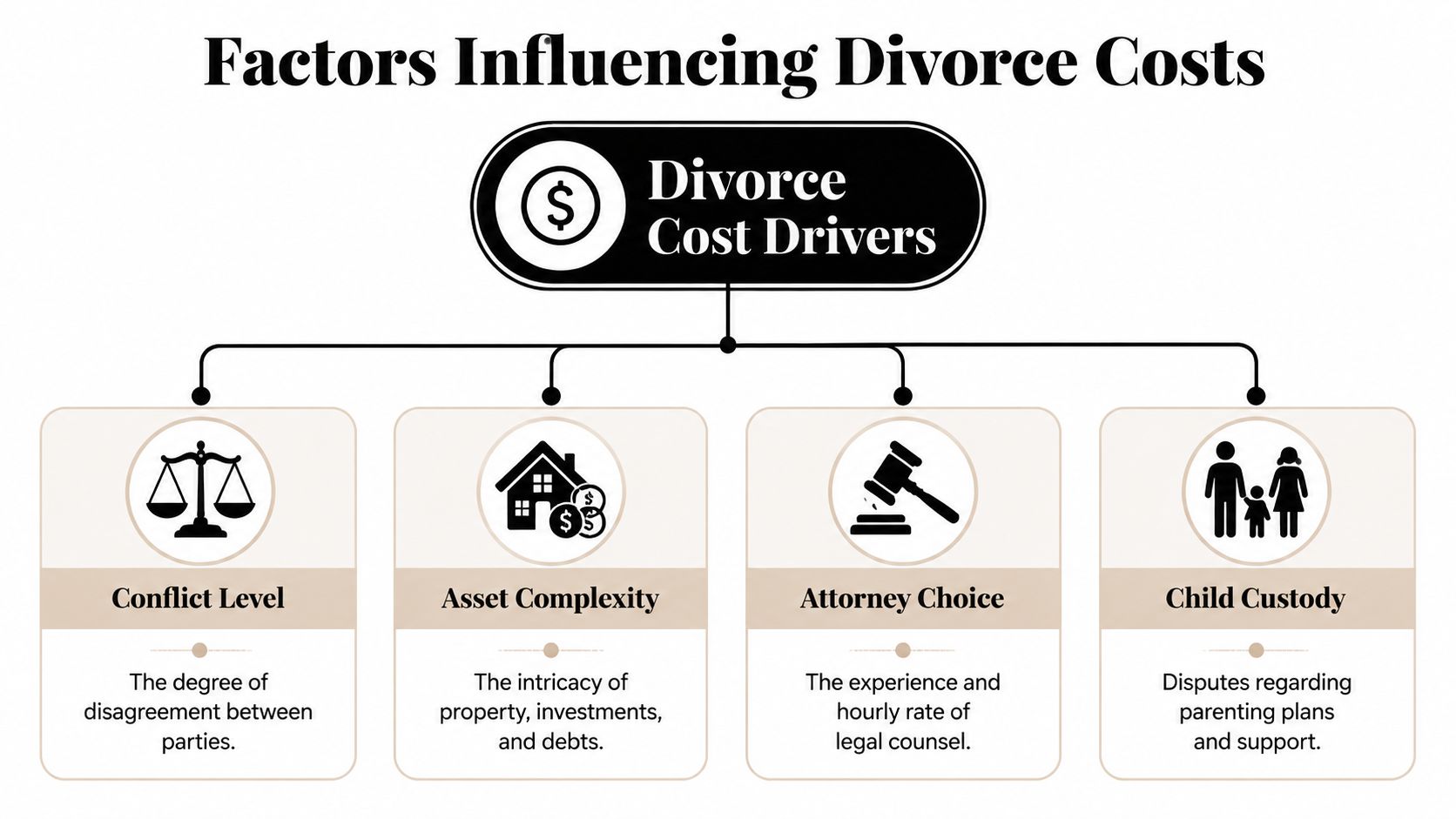
Conflict level is usually the biggest cost driver
Attorney time is what clients feel first. A case stays more affordable when both spouses exchange records, answer proposals, and narrow disputes early. Costs climb when one spouse withholds documents, changes positions repeatedly, cancels mediation, or forces the other side to get court orders for basic cooperation.
That pattern matters in Montgomery County because local cases often involve more than paychecks and a checking account. A spouse may be paid in bonuses, restricted stock, commissions, partnership distributions, or business income. Once those issues are disputed, each disagreement creates more work: more drafting, more review, more calls, more court preparation.
The practical point is simple. The bill usually reflects the amount of unresolved work, not just the number of months the case has been pending.
Property complexity matters more in The Woodlands than statewide averages suggest
Statewide divorce averages can be misleading here. A divorce involving one home, regular W-2 income, and modest retirement savings is different from a Woodlands case with executive compensation, a closely held business, lake property, separate-property claims, or money moved between accounts over many years.
Texas courts divide community property under the Texas Family Code based on what the court considers just and right. The legal rule is familiar. The expensive part is proving what belongs in the estate, what is separate property, what an asset is worth, and whether a proposed division is fair.
In high-asset cases, discovery often becomes the turning point. If records are complete and produced early, settlement is easier. If documents are missing or the financial story does not match the paper trail, costs rise quickly because formal requests, follow-up demands, and possible motions become necessary. This overview of the divorce discovery process helps explain why information fights can add so much to a Montgomery County divorce bill.
Parenting disputes change both the budget and the pace of the case
Cases involving children cost more because they require more detail. Parents may need temporary schedules, holiday terms, decision-making language, school provisions, geographic restrictions, and support calculations. Even parents who agree on most issues can spend meaningful time and money getting those terms right.
If the disagreement is over who decides extracurricular activities, the added cost may stay moderate. If the dispute is over primary residence, school zoning, mental health concerns, relocation, or a parent's reliability, the case can shift fast from settlement drafting to evidence gathering and hearings.
That is often the moment clients realize the 60-day waiting period has a financial side. The case cannot finish yet, but the work continues. In a parenting dispute, those weeks often fill with temporary-orders preparation, witness interviews, calendar proposals, and revisions to parenting terms.
In The Woodlands, the hidden cost of the waiting period is not the passage of time. It is the amount of legal work packed into that time.
Experts can be necessary, not optional
Some cases need outside professionals. A business may need valuation. A disputed compensation package may need tracing and analysis. A serious parenting dispute may call for a custody evaluator, therapist records, or another neutral professional.
Experts increase cost, but they sometimes save a case from guesswork. In a high-asset Montgomery County divorce, a clear valuation or financial analysis can move settlement forward and prevent a bad deal based on incomplete information. In other cases, expert involvement confirms that a fight is not worth having.
Estimated Divorce Costs in The Woodlands, TX 2026
| Divorce Type | Typical Cost Range | Key Characteristics |
|---|---|---|
| Uncontested divorce | $1,500 to $5,000 | Agreement on major issues, limited conflict, minimal court involvement |
| Early mediation path | $1,000 to $3,000 for 4 to 8 hours at $200 to $500 per hour | Focused settlement effort, often used to avoid trial escalation |
| Contested divorce without children | $10,000 to $20,000 | Property disagreement, more attorney time, possible discovery |
| Contested divorce with children | $15,000 to $30,000 | Parenting issues add complexity and time |
| Non-jury property trial | $15,000 to $30,000 | Formal litigation over disputed property issues |
| Jury trial with major disputes | $30,000 to $50,000+ | High conflict, extensive preparation, major factual disputes |
| Case requiring business valuation or similar expert work | Can exceed $100,000 | High-asset estate, expert analysis, intensive litigation |
The figures in this table are drawn from the verified data provided earlier in the article, including local cost information already cited.
A Real-World Divorce Cost Scenario in The Woodlands
Mark and Sarah live in Alden Bridge. They have children, a home, retirement accounts, and two cars. At the start, they both say they want to stay reasonable.
If they agree on property division and a workable parenting schedule, their divorce may stay relatively controlled. They still have filing costs, document preparation, and the waiting period required by Texas law, but they avoid the worst cost driver, which is unresolved conflict.
Then one issue changes the case. Sarah wants the children's primary residence to remain near their current school. Mark wants a different schedule and disputes where the children should primarily live. Suddenly the case needs temporary orders, more attorney conferences, and more detailed evidence.
Under Texas Family Code Section 6.702, a divorce generally cannot be finalized until the statutory waiting period has passed. Many people hear “60 days” and assume that means the process will be short. It only means there is a minimum waiting period. It does not mean the conflict stops costing money.
A 60-day waiting period is a floor, not a finish line.
If Mark and Sarah spend that period exchanging proposals and finalizing terms, the case can still end without major litigation. If they spend it fighting over temporary possession, access to accounts, and the children's schedule, the budget changes fast.
This is also where local practice matters. In Montgomery County, a disagreement that looks minor at home can produce formal motions, hearing preparation, and emergency scheduling problems. That's why the same family can move from a manageable divorce budget to a painful one without any dramatic event other than one unresolved custody dispute.
The legal lesson is simple. The first real disagreement in a divorce is often the fork in the road. Handle it early, and the case may remain proportionate. Fight it badly, and the bill starts reflecting every hour it takes to unwind that decision.
Smart Strategies to Control Your Divorce Expenses
A divorce budget in The Woodlands usually gets controlled in small decisions, not one big one. The spouses who spend less are usually the ones who narrow issues early, organize documents before anyone asks twice, and stop treating every disagreement like it needs a courtroom response.

Use mediation before the case gets expensive
In Montgomery County, mediation often saves money because it forces real decisions before the case expands into hearings, discovery fights, and trial preparation. That matters even more in The Woodlands, where higher incomes, retirement accounts, business interests, and home equity can turn a routine divorce into a property case with a much larger price tag.
As noted earlier in this article, local cost discussions often place mediation far below the cost of fully contested litigation. The point is practical. Paying for one focused settlement session is often cheaper than paying both lawyers to prepare for multiple rounds of conflict.
If you want a clearer picture of how that process works locally, this page on divorce mediation in The Woodlands explains the structure and why many families use it to avoid prolonged court fights.
Mediation does not solve every case. It does, however, help people put numbers, schedules, and options on the table while the dispute is still manageable.
Treat the 60-day waiting period like billable time
The waiting period is often misunderstood. Clients hear “60 days” and assume there is time to pause. In reality, those two months can become one of the most expensive parts of a Montgomery County divorce if the parties drift, argue over temporary arrangements, or avoid exchanging information.
That problem is especially common in higher-asset Woodlands cases. A spouse may need temporary agreements about mortgage payments, access to accounts, business income, reimbursement claims, or parenting schedules. If those issues sit unresolved, lawyers spend time chasing documents, drafting proposals, answering anxious emails, and preparing for hearings that could have been avoided.
Use that window well:
- Get your records together early: tax returns, bank statements, retirement records, credit card statements, loan documents, business records, and property documents.
- Separate priorities from irritations: focus first on custody, support, the house, cash flow, and accounts that need immediate attention.
- Make targeted proposals: a clear settlement offer usually costs less than weeks of vague argument.
- Keep communication businesslike: emotional messages often become attorney problems, which means more billed time.
A waiting period is still an active period. In a contested case, delay has a price.
Bottom line: In Montgomery County, the cheapest 60 days are the ones used to exchange information and narrow disputes.
Here's a useful primer that many clients find helpful before a consultation:
Match the legal help to the problem
Some divorces need full representation from the start. That is common where there are custody disputes, a closely held business, separate property claims, hidden spending concerns, or a spouse who refuses to cooperate. Other cases do better with a narrower approach, such as advice on a proposed settlement, decree review, mediation preparation, or drafting the final paperwork correctly.
The cost difference can be substantial because the scope of the work changes the number of attorney hours involved. Good cost control is not about buying the least amount of legal help. It is about buying the right amount at the right stage.
That is also why one person's “average Texas divorce cost” is not very useful in The Woodlands. A simple case may stay proportionate. A divorce involving executive compensation, real estate, or competing custody requests usually will not. The Law Office of Bryan Fagan, for example, handles divorce, custody, property division, and contested family law matters in The Woodlands and surrounding Montgomery County communities.
Outside support can reduce legal fees
Lawyers are necessary for legal advice. They are expensive for conflict management that is really emotional, relational, or communication-based.
When co-parenting conversations keep collapsing, or every practical issue turns into a personal fight, outside support can lower the temperature and reduce the number of attorney exchanges. For some families, resources like professional couples support help stabilize communication enough to make settlement discussions more productive.
That will not fix dishonesty or serious power imbalances. It can help when the legal dispute is being driven by stress, resentment, or poor communication habits.
What usually costs more than it saves
I regularly see a few “money-saving” moves backfire:
- Using your lawyer as your primary emotional outlet: that time is billed at legal rates.
- Holding back documents until the other side asks again: it creates more suspicion, more follow-up, and often more formal discovery.
- Threatening trial before the facts are organized: once both sides gear up for trial, the bill rises quickly.
- Fighting over low-value property out of principle: the emotional point may be real, but the financial math is often terrible.
- Refusing early temporary agreements: short-term peace on account access, bill payment, and parenting logistics often prevents expensive emergency filings.
The clients who control cost best are usually not the ones who give up. They are the ones who know what matters, prove it efficiently, and stop paying lawyers to fight over everything else.
Your Next Steps and Final Considerations
If you're trying to budget for divorce in The Woodlands, the central point is straightforward. Cost follows conflict and complexity. A relatively cooperative case may stay in a lower range. A contested divorce involving children, disputed property, or expert analysis can become much more expensive.
That's why broad internet averages usually aren't enough. What matters is the shape of your case in Montgomery County. Do you and your spouse agree on custody? Is there a house, business interest, or separate-property claim? Are temporary orders likely? Those are the questions that move the budget.
What to do next
- Collect your financial records: gather bank statements, retirement statements, recent tax returns, pay information, mortgage documents, and debt records.
- List your main goals: separate what is essential from what is emotional but negotiable.
- Think about the children first: if custody is part of the case, identify the schedule and decision-making issues most likely to create conflict.
- Avoid impulsive spending decisions: major account moves, hidden transfers, or retaliation often make cases harder and more expensive.
- Schedule a consultation: get a case-specific assessment rather than relying on statewide averages or a friend's experience.
A final legal note
This article is for informational purposes only. It is not legal advice, and reading it does not create an attorney-client relationship. Divorce outcomes and costs depend on facts, court procedure, and the positions taken by both spouses.
If your case involves children, substantial assets, a business, inherited property, or immediate concerns about temporary orders, it's worth getting specific advice early. A short, focused consultation can help you avoid expensive mistakes and set a realistic plan for what comes next in The Woodlands or elsewhere in Montgomery County.
If you want to talk through your situation in a practical, confidential setting, you can schedule a consultation with The Law Office of Bryan Fagan. That conversation can help you understand likely cost drivers, what can be resolved early, and how to approach your divorce with a clearer financial plan.
