 Skip to content
You're sitting in traffic near Research Forest Drive when another driver hits you from behind. The damage looks manageable, but your neck feels tight, work is already becoming difficult, and the other driver's insurance company wants a recorded statement. You're left wondering whether to handle the claim yourself or call a car accident lawyer in The Woodlands, TX.
That decision shouldn't be based only on how badly the vehicles look. A low-speed collision can still create disputes about medical treatment, lost wages, fault, and whether an injury came from the crash. The right approach is to protect your health and evidence first, then decide whether professional help makes sense.
Why Crash Claims in The Woodlands Are Different
A rear-end crash on I-45 near The Woodlands can look straightforward until the insurance company asks questions that shift attention away from the collision. The adjuster may focus on the limited bumper damage, a gap in treatment, or a prior back complaint. Meanwhile, the driver may be dealing with headaches, missed work, repair delays, and bills that continue arriving.
That pattern is familiar across Montgomery County. Drivers in Panther Creek, Alden Bridge, Sterling Ridge, and Creekside deal with busy commuter routes, residential intersections, parking-lot impacts, and multi-vehicle wrecks. A suburban crash doesn't need to happen at high speed to create a serious claim dispute.
Texas remains a high-volume roadway injury state. In 2024, the state recorded 4,150 traffic deaths, down from 4,291 in 2023, while the fatality rate fell to 1.35 deaths per hundred million vehicle miles traveled. TxDOT also reported that one person was killed every 2 hours and 7 minutes on Texas roads. Those figures come from the 2024 TxDOT traffic safety report.
The statewide volume matters locally because injury claims aren't rare exceptions. TxDOT reported 307,490 motor vehicle crashes and 251,977 injuries in 2024, along with $56.9 billion in economic loss from traffic deaths, according to its 2024 crash comparison report.
What a lawyer actually does
A car accident lawyer investigates fault, organizes medical and wage evidence, handles insurer communications, evaluates damages, and protects the filing deadline. That work becomes especially valuable when the crash involves several vehicles, disputed responsibility, delayed symptoms, permanent limitations, or an insurer that stops responding.
You may not need counsel for every minor property-damage claim. You should strongly consider a consultation when injuries affect work or daily life, treatment continues, liability is contested, or the insurer pushes for a quick release.
The rest of this guide follows the claim from the first hours after the collision through evidence gathering, insurer delays, valuation, lawyer selection, and the decision about what to do next.
What to Do Immediately After a Car Accident
Your first priority is safety, not proving fault. Check yourself, passengers, and anyone else involved for injuries. Call 911 when anyone may be hurt, traffic is dangerous, or the collision needs official documentation.
If the vehicles can be moved safely, get them out of active lanes. Don't risk another collision to take photographs. Turn on hazard lights and wait for emergency personnel in a safe location.
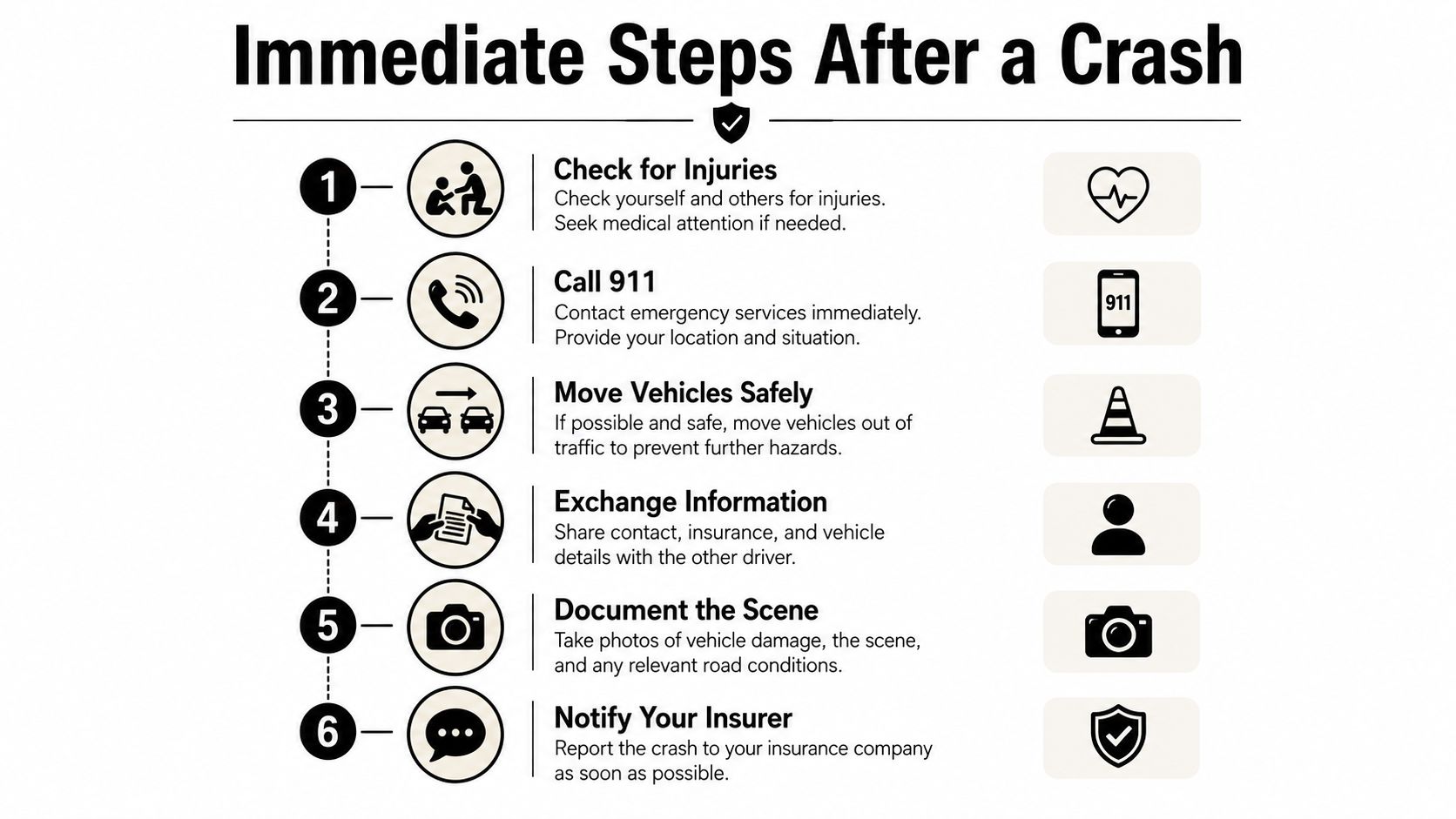
Exchange names, phone numbers, driver's license information, insurance details, and vehicle information. Get witness contact information if anyone saw the impact. Keep the conversation factual. Don't argue, accuse, speculate, or apologize for causing the crash.
Medical care comes before claim strategy
Accept medical evaluation at the scene when paramedics recommend it or when you have pain, dizziness, confusion, weakness, numbness, or any symptom that concerns you. Some crash injuries become clearer after the initial adrenaline wears off. Refusing evaluation can give an insurer an argument that you weren't seriously hurt, even though refusal doesn't prove you had no injury.
If you don't go to the hospital, arrange appropriate medical care promptly and describe every symptom accurately. Tell the provider that the symptoms followed the collision. Follow the treatment plan, attend appointments, and explain when pain affects sleep, driving, household tasks, or work.
Ask how to obtain the crash report and keep the report number. Depending on the investigating agency, records may involve local law enforcement, the Montgomery County Sheriff's Office, or the Texas Department of Transportation. The report can identify the vehicles, drivers, witnesses, roadway conditions, citations, and the officer's account of the collision. It isn't the final word on liability, but it gives the claim an important starting record.
What to say to insurers
Notify your own insurer according to the policy. Provide basic facts, but don't guess about speed, distance, fault, or the full extent of your injuries. You can say that you were involved in a collision and are receiving or arranging medical care. You don't have to provide a broad recorded statement before understanding what the insurer is asking and why.
Practical rule: Be accurate, be brief, and never sign a release until you understand every claim it ends.
The same discipline matters in other sensitive legal matters. For example, High-Net-Worth Divorce in The Woodlands involves complex asset division, which also requires careful document handling and precise statements.
Building Your Evidence Checklist Before You Call a Lawyer
Evidence doesn't need to be complicated. It needs to be preserved before memories fade, vehicles are repaired, records are misplaced, or an insurer frames the claim around a convenient detail.
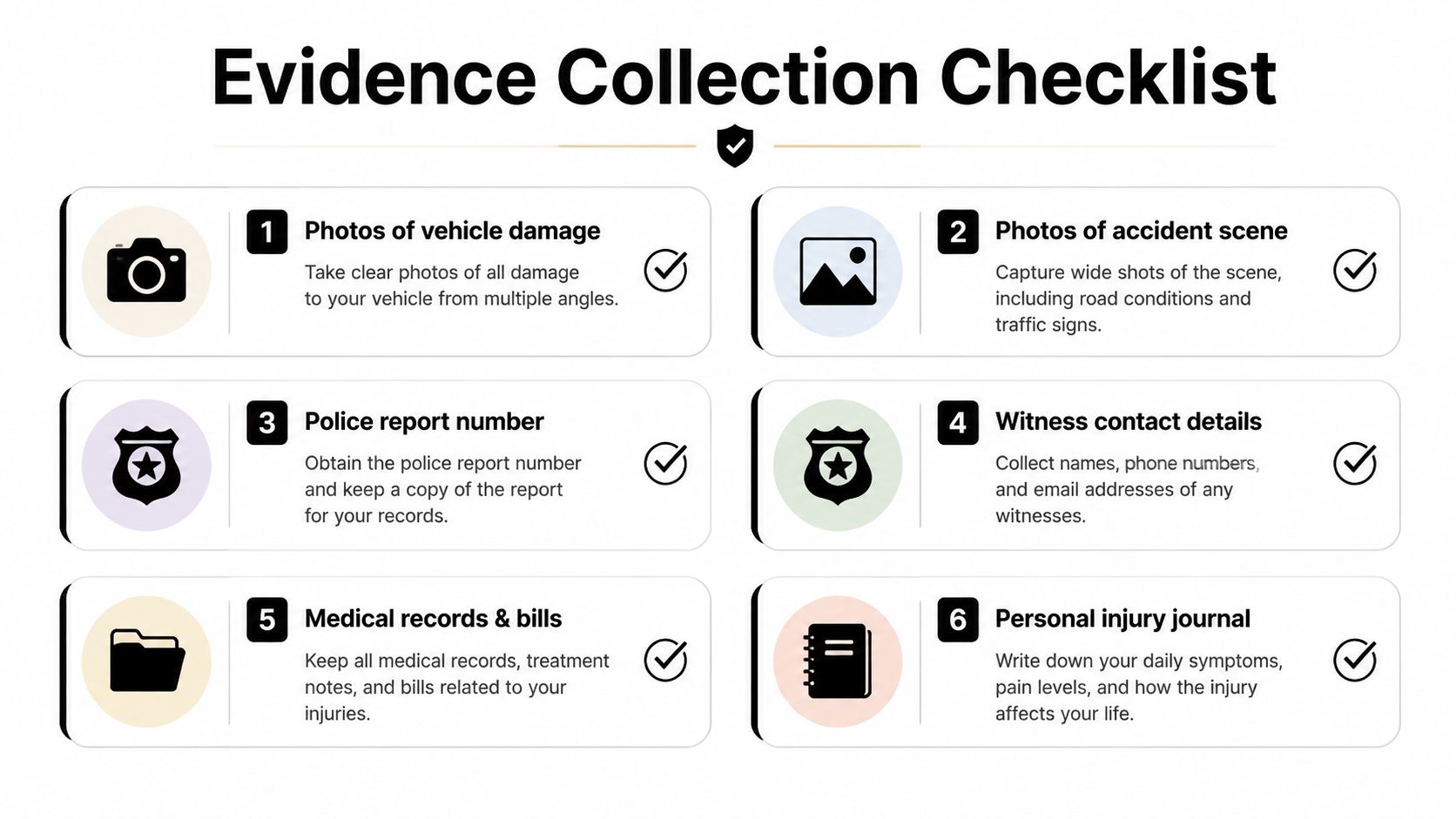
Start with photographs. Save images of every damaged area, the full vehicle, debris, skid marks, traffic signals, lane markings, weather, and the surrounding intersection. If the crash happened on Research Forest Drive, I-45, or a neighborhood road in Creekside, roadway design and traffic controls may help explain how the impact occurred.
Build one organized claim folder
Use a physical folder or a secure digital folder. Put the following materials in it:
- Crash information: Keep the police report number, exchange-of-information sheet, insurance correspondence, and photographs together.
- Witness details: Save names, phone numbers, email addresses, and a short note about what each person observed.
- Medical records and bills: Request records from emergency care, primary care, imaging providers, physical therapists, and specialists. Keep bills separate from explanation-of-benefits documents.
- Work-loss proof: Ask your employer for dates missed, wage information, reduced hours, missed shifts, and any restrictions caused by the injury.
- Symptom journal: Record pain, headaches, sleep problems, medication effects, appointments, and tasks you can't perform normally.
- Vehicle records: Preserve repair estimates, towing invoices, rental records, and photographs taken before repairs.
A symptom journal helps connect the injury to the crash without exaggeration. Write what happened on the day it happened. Don't fill gaps later from memory or copy language from someone else.
Lower-speed suburban collisions can still cause whiplash, concussion symptoms, back pain, and other problems that appear or worsen later. The important question isn't whether the bumper damage looks dramatic. It's whether the medical records, timing, examination findings, treatment, and daily limitations support a consistent account.
When the evidence points to a lawyer
A lawyer becomes more useful when multiple drivers blame one another, an injured person has delayed symptoms, an insurer disputes treatment, or the claim involves substantial wage loss. Organize your materials before the consultation so the attorney can assess the timeline rather than spend the meeting searching for basic documents.
For broader guidance on organizing proof, review this resource on how to present evidence in court. The same basic habit applies here, preserve original records, label documents clearly, and avoid editing photographs or messages.
Families dealing with separate legal issues may also need a Divorce Lawyer in The Woodlands, TX for divorce representation in The Woodlands and Montgomery County. Keep those records separate from your accident file.
Deadlines and Insurance Timelines That Affect Your Claim
Texas gives an injured person two years from the crash date to file a personal injury lawsuit. The deadline comes from Texas law, and missing it can prevent a court from hearing the claim, subject to limited exceptions that depend on the facts. Don't treat the insurance negotiation as a substitute for filing a lawsuit before the deadline.
Write the crash date on a calendar and work backward. A lawyer needs time to investigate, obtain records, identify all responsible parties, calculate losses, and file if negotiations fail. Waiting until the final months creates unnecessary pressure and can weaken the practical options available.
The insurer's response schedule creates a separate timeline. Texas rules give an insurer 15 business days to acknowledge a claim. After receiving the required information, the insurer generally has 15 business days to decide the claim, with one possible 45-day extension. These timelines are summarized in the Texas car accident claims guidance.
Silence isn't a settlement strategy
An adjuster may need records, statements, photographs, repair information, or additional facts before deciding liability. That's normal. Indefinite silence isn't something you should accept, especially when medical bills, vehicle expenses, and lost wages are accumulating.
Keep a written log of every call, email, request, document submission, and response. Ask what information remains outstanding and when the insurer expects to make a decision. Save letters and claim-portal messages rather than relying on memory.
A delay can also affect medical care. Don't stop treatment because an adjuster hasn't accepted responsibility. Health decisions belong between you and your medical providers. If the insurer requests a broad medical authorization, releases, or a recorded statement, have a lawyer review the request before you agree.
Calendar both deadlines
The insurer's internal response dates don't extend the lawsuit deadline. A claim can remain under investigation while the two-year filing period continues to run.
A lawyer can communicate with the insurer, challenge unsupported delay, and determine whether filing is necessary. That doesn't guarantee a faster resolution, but it prevents the claim from drifting without a plan.
Typical Damages and How Claims Get Valued in Texas
Texas injury claims usually involve more than vehicle repair. Depending on the facts, recoverable damages may include medical expenses, future medical needs, lost wages, reduced earning capacity, property damage, physical pain, emotional distress, and other losses supported by the evidence. Punitive damages may apply only in limited circumstances and shouldn't be assumed in an ordinary collision.
The value of a claim depends on proof. A medical bill shows an expense, but the records should also explain the diagnosis, treatment, causation, restrictions, and expected recovery. Wage loss requires more than saying you missed work. Employer records, pay information, and medical restrictions can help establish the loss.
| Damage Type | What It Covers | Key Evidence |
|---|---|---|
| Medical expenses | Emergency care, appointments, testing, medication, rehabilitation, and related treatment | Medical records, bills, treatment history, and provider opinions |
| Future medical care | Reasonably supported treatment expected after the claim | Medical evaluations, care plans, and prognosis |
| Lost wages | Income lost because injuries prevented normal work | Employer records, pay information, and work restrictions |
| Reduced earning capacity | Limits on the ability to earn because of lasting injury | Medical restrictions, job history, and vocational evidence |
| Property damage | Vehicle repair, replacement-related losses, towing, and rental expenses | Photographs, estimates, invoices, and insurer records |
| Pain and suffering | Physical discomfort and the effect of injury on daily life | Symptom journal, treatment records, testimony, and family observations |
Texas claims data shows why documentation matters more than raw claim volume. Bodily injury liability claim frequency declined from 0.95 per 100 car years in 2013 to 0.74 in 2022, while the average paid claim increased from $15,441 to $24,211. Property-damage claim frequency fell from 3.55 to 2.37 per 100 car years, while average severity increased from $3,231 to $5,313, according to this Texas car accident settlement analysis.
Those figures aren't a promise about your case. They show a broader valuation lesson. When claim frequency declines but average paid amounts rise, insurers and lawyers must focus more closely on injury severity, causation, and when losses occurred. A civil litigation lawyer can help evaluate disputes that require formal legal action.
Hiring a Car Accident Lawyer in The Woodlands
A contingency agreement usually means you don't pay an upfront attorney fee. The lawyer receives an agreed percentage of the recovery if the case produces compensation. The written agreement should explain the percentage, when it changes, how case expenses are handled, who pays costs if the claim produces no recovery, and whether settlement or trial affects the fee.
Read the agreement before signing. Ask for plain-English explanations of every expense category. Some firms advance costs and recover them from the result. Others may handle expenses differently. The document controls, so compare written terms rather than relying on a verbal summary.

Questions to ask at the consultation
Bring your evidence folder and ask direct questions:
- Local experience: How often does the attorney handle injury cases involving Montgomery County courts and local insurers?
- Actual attorney: Who will investigate the claim, communicate with you, and make settlement recommendations?
- Case assessment: What facts support liability, and what facts could hurt the claim?
- Medical proof: What records or expert opinions are still needed?
- Communication: Who answers questions, and how will you receive updates?
- Costs: Which expenses are advanced, and what happens to them if the case doesn't settle?
- Strategy: What would make the attorney recommend filing a lawsuit?
- Timeline: What should happen during the next several weeks?
A firm familiar with The Woodlands, Montgomery County, and communities such as Sterling Ridge and Creekside may understand local filing practices and court procedures. That local familiarity doesn't replace careful preparation, but it can make communication and case management more practical.
This video offers another way to think about the attorney-client consultation and fee agreement.
You can review the firm's personal injury lawyer services in The Woodlands while comparing attorneys. The important choice is the lawyer whose written terms, communication plan, and assessment fit the facts of your collision.
Your What to Do Next Checklist and Final Considerations
A Creekside resident is rear-ended while driving home. The driver gets medical care, saves photographs, requests the crash report, records symptoms, keeps work-loss documents, and speaks with counsel within two weeks. That preparation doesn't guarantee a particular result, but it gives the claim a clear timeline and makes it harder for missing evidence to control the discussion.
Your immediate plan should be simple:
- Confirm medical care: Follow up with an appropriate provider and report every crash-related symptom.
- Request the report: Use the report number and the investigating agency's records process.
- Finish the evidence file: Add photographs, witness information, bills, records, wage documentation, repair materials, and your symptom journal.
- Calendar the deadline: Mark the two-year Texas personal-injury filing deadline from the crash date.
- Track the insurer: Save every request and response, and ask what information remains outstanding.
- Schedule consultations: Speak with attorneys before signing releases or accepting a final settlement.
Don't let a low-speed collision decide the case before the medical picture is clear. Don't let an adjuster's silence persuade you that the claim is resolving itself. Your records should show what happened, how your condition changed, what treatment you received, and how the injury affected your life.
This article provides general information and is not legal advice. It doesn't create an attorney-client relationship, and outcomes depend on the specific facts, evidence, insurance coverage, injuries, and deadlines in each case. Families dealing with financial or custody consequences after a crash may separately need guidance from a child custody lawyer or other family-law counsel, but those matters require their own legal analysis.
If you were injured in The Woodlands or elsewhere in Montgomery County, schedule a consultation before the insurer asks you to close the file. Bring your crash report information, medical records, photographs, and wage-loss documents so an attorney can review the situation with you.
The Law Office of Bryan Fagan helps The Woodlands and Montgomery County families evaluate legal issues involving injury claims, family matters, and probate concerns. Visit The Law Office of Bryan Fagan to learn more and request a consultation about your car accident situation.
