 Skip to content
A child is bitten near a neighborhood sidewalk in Panther Creek. The family rushes to urgent care, tries to identify the dog's owner, and starts asking the questions that matter: Who pays for treatment? Was the dog dangerous before? Does the owner have insurance? Is hiring a dog bite lawyer in The Woodlands, TX financially sensible?
Those questions deserve a candid answer. A real injury doesn't automatically create a recoverable claim. In Montgomery County, the strength and value of a dog-bite case usually depend on medical evidence, proof of the owner's knowledge, available insurance or assets, and how quickly you preserve evidence.
This guide provides general information, not legal advice. Every bite involves different facts, and you should speak with a qualified Texas attorney before deciding how to proceed.
When a Dog Bite Changes Everything
The family in Panther Creek may have expected a normal afternoon. Instead, a loose dog approaches, the child screams, and an adult pulls him away with blood on his shirt. The parents have to manage the wound, calm their child, locate the owner, and determine whether the dog has current vaccination information. They may also need to miss work, arrange follow-up care, and preserve clothing that could later help establish what happened.

A bite that looks small can still require meaningful medical attention. The CDC reports that nearly 1 in 5 people bitten by a dog requires medical attention, and dog bites result in an estimated 885,000 people seeking medical care annually in the United States. CDC-linked medical guidance explains why prompt evaluation matters, including infection, tetanus status, rabies exposure, and possible damage to tendons, nerves, or bone.
Practical rule: Treat the injury first, then investigate the claim. Waiting to see whether a wound worsens can hurt both your health and your documentation.
The legal questions often become urgent after the initial shock. Texas doesn't use a simple statewide civil rule that automatically makes every dog owner liable for every bite. Prior aggression, complaints, fencing, leash control, and witness testimony can become central, particularly when the attack happened in a subdivision such as Alden Bridge, Sterling Ridge, or Creekside.
Write down what you remember while the details are fresh. Note the location, the dog's appearance, the owner's statements, the names of witnesses, and whether the dog was restrained. Keep medical records, bills, photographs, and damaged clothing together. You don't need to decide immediately whether the case is worth pursuing, but you do need to preserve the facts that allow a lawyer to make that assessment.
What to Do Immediately After a Dog Bite
Your first forty-eight hours should be organized around health, identification, reporting, and evidence. Don't rely on memory or assume the owner will cooperate later.
Start with medical care
Have the wound evaluated, even if the skin injury seems minor. A clinician can assess infection risk, determine whether additional treatment is needed, review tetanus status, and address possible rabies exposure. Seek emergency care when bleeding won't stop, the wound is deep, or the injury involves the face, neck, a joint, or possible tendon, bone, or nerve damage.
Ask for copies of discharge paperwork, treatment notes, prescriptions, and follow-up instructions. If a child was bitten, keep pediatric records and document changes in sleep, activity, fear, or school participation without exaggerating them.
Preserve the scene and physical evidence
Take clear photographs of the wound from multiple angles. Continue photographing healing, swelling, bruising, scarring, bandages, and any later treatment. Also photograph the location, damaged fence or gate, leash, sidewalk, lighting, and anything else that helps show how the dog reached the victim.
Save torn or bloody clothing in a clean bag. Don't wash or repair it before a lawyer reviews the evidence. Obtain the names and contact information of anyone who saw the attack, heard the owner discuss the dog, or knew about earlier complaints.
Identify and report
Get the dog owner's name, address, phone number, insurance information if voluntarily provided, and the dog's description. Don't argue with the owner or make statements about fault. A calm request for contact information is more useful than a confrontation.
Report the incident to the appropriate Montgomery County animal-control authority or local enforcement agency. Ask how to obtain the report and whether vaccination or quarantine information will be available. Animal-control records can help establish the dog's identity and may reveal prior complaints or incidents.
First forty-eight hours checklist
- Get medical evaluation: Follow treatment instructions and preserve every medical record.
- Photograph injuries: Capture the wound, surrounding bruising, healing, and scarring.
- Photograph the location: Document fencing, gates, restraints, and the path the dog took.
- Identify witnesses: Collect names, phone numbers, statements, and photographs they may have.
- Report the attack: Contact the applicable Montgomery County or local animal-control authority.
- Save clothing: Keep torn or bloodied garments unwashed and unrepaired.
- Avoid public accusations: Don't post accusations or detailed statements that may later be taken out of context.
- Discuss insurance and evidence: A consultation can help determine whether the owner, landlord, or another party may have coverage or responsibility.

If the attack occurred alongside another legal dispute, keep the issues separate. For example, Enforcement of Court Orders in The Woodlands concerns enforcing divorce decree and custody order provisions in Montgomery County, not handling a dog-bite injury.
When you're ready to discuss the broader personal-injury picture, you can also review information about a car accident lawyer in The Woodlands. The immediate dog-bite steps remain the same: obtain care, preserve evidence, identify the responsible parties, and report the incident.
Texas Dog Bite Liability and the One-Bite Rule
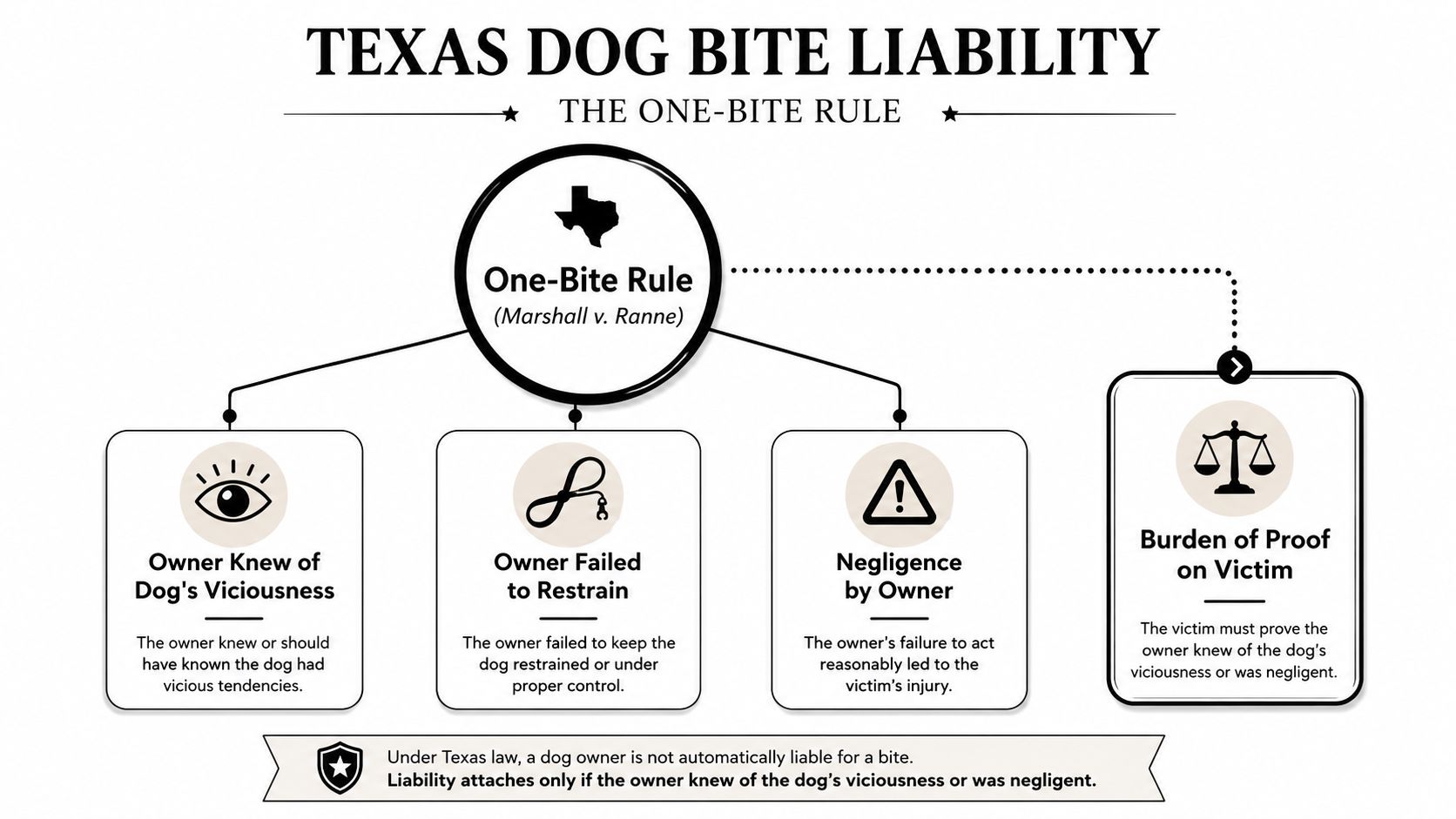
A bite in The Woodlands does not automatically produce a valuable claim. Texas law requires you to identify the legal theory, prove the owner's knowledge or lack of reasonable care, and determine whether insurance or assets can support recovery. Civil cases generally proceed under common-law negligence and the one-bite doctrine, not a standalone civil dog-bite statute.
The rule recognized in Texas
The Texas Supreme Court recognized the state's long-running one-bite rule in Marshall v. Ranne in 1974. Under that framework, an owner may face strict-liability-style exposure when the dog had dangerous propensities abnormal to its class and the owner knew or should have known about them. The State Bar of Texas discussion of the one-bite rule explains how prior knowledge can shape the claim.
A previous bite is strong evidence, but it is not required. Repeatedly charging pedestrians, snapping at neighbors, escaping through a broken gate, or generating animal-control complaints can show that the owner had notice. Neighbor warnings, HOA complaints, leash violations, and the owner's statements may also establish what the owner knew.
Consider a dog in Sterling Ridge that repeatedly ran toward pedestrians from an unfenced yard. If neighbors complained and the owner failed to repair the fence, those records could support negligence even without an earlier bite. The issue is whether the owner had reason to recognize the danger and failed to respond reasonably.
Evidence determines the legal theory
A lawyer may examine animal-control records, HOA communications, incident reports, witness accounts, photographs, text messages, and social-media posts. The purpose is to connect the owner to evidence of prior notice or inadequate control. The statement “he's never done that before” does not decide the case, but it may help establish the owner's account of the dog's history.
Negligence can support a claim when the owner ignored an ordinary safety obligation. Leaving a dog loose near a public path, failing to secure a gate, violating a leash requirement, or allowing a known aggressive dog to approach visitors may all matter. A lawyer may also examine whether a dangerous property condition, such as a broken gate, contributed to the attack, similar to issues in a property injury claim involving a slip and fall.
The Texas personal-injury discussion of dog-bite liability describes how knowledge of dangerous tendencies can affect the proof burden. Reporting the incident and identifying witnesses early therefore helps establish more than an administrative record.
Texas Health and Safety Code Chapter 822 addresses dangerous-dog and attack scenarios. State Bar materials describe Lillian's Law, effective September 1, 2007, as creating potential criminal liability in severe circumstances involving criminal negligence, failure to secure a dog, and an unprovoked attack off the owner's property causing injury or death. This article addresses civil recovery. A criminal investigation does not guarantee compensation, so the civil claim still needs its own evidence, liability theory, and realistic assessment of available insurance or assets.
Is Your Dog Bite Claim Worth Pursuing
A dog-bite case can be legally valid and still have limited economic value. The practical question is whether there's a realistic source of recovery, such as the owner's homeowners insurance, personal assets, or another party's potential responsibility.
Start with the injury. A superficial wound that heals quickly may not justify prolonged litigation, particularly if the owner has no insurance and little recoverable property. A facial scar, nerve injury, infection, permanent impairment, extensive pediatric trauma, or continuing psychological impact presents a different evaluation. Medical records, photographs, treatment plans, and expert opinions may be necessary to show the long-term effect.
Compare the recovery picture
| More favorable facts | More difficult facts |
|---|---|
| The owner has applicable insurance coverage. | The owner appears to have no insurance or meaningful assets. |
| Medical treatment documents substantial injury. | The injury was minor and the victim fully recovered. |
| The bite caused scarring, nerve symptoms, or lasting limitations. | The evidence about the dog and owner is unclear. |
| Witnesses or records show prior dangerous behavior. | No one can identify the owner or dog. |
| A landlord or another responsible party may have a role. | The available coverage excludes the loss or is insufficient. |
Homeowners insurance often becomes the first practical source of recovery, but coverage terms vary. Policies may contain limits, exclusions, or restrictions involving particular dogs. Don't assume that a homeowner's policy will pay every claim, and don't assume that a renter's lack of homeownership eliminates all possible coverage.
Landlord liability requires separate facts. A landlord may face questions about notice, control over the property, or known dangerous conditions, but ownership of the building alone doesn't establish responsibility. A lawyer should examine the lease, notice history, property arrangements, and the landlord's actual control.
Severe injuries deserve immediate attention because the legal and medical consequences can differ sharply from minor bites. A Texas-focused report states that in Austin and San Antonio, severe injury dog bites nearly tripled from 2018 to 2023, while moderate injuries rose much less and minor bites fell. The reported injury-severity trend doesn't determine the value of a particular Montgomery County claim, but it reinforces the need to distinguish a lasting injury from a wound that resolves quickly.
A responsible evaluation asks two questions together: how serious is the injury, and where could a recovery realistically come from?
How to Evaluate and Hire a Dog Bite Lawyer
Choose a lawyer who can explain the case without promising an outcome. For a The Woodlands or Montgomery County claim, local familiarity matters because investigation may involve subdivision witnesses, HOA records, animal-control procedures, nearby businesses, and the practical location of the attack.
Ask these questions during consultations:
- What legal theory fits the facts? Ask whether the lawyer sees evidence of prior knowledge, ordinary negligence, inadequate restraint, or another basis for liability.
- How will you investigate notice? The answer should address animal-control records, prior complaints, witness interviews, HOA communications, photographs, and owner statements.
- How will you evaluate coverage? Ask whether the lawyer will investigate homeowners insurance, renters insurance, landlord involvement, and policy exclusions.
- What damages will you document? The discussion should include treatment, scarring, lost work, continuing limitations, and the effect on a child's daily life when those facts exist.
- What is the fee arrangement? Get the contingency-fee terms, case expenses, responsibility for litigation costs, and settlement authority in writing.
- Who handles the file? Know whether you'll work directly with the attorney, a case manager, or several people.
A local attorney familiar with Panther Creek, Alden Bridge, Sterling Ridge, Creekside, and other Woodlands communities may know where to look for witnesses and how local records are typically obtained. That local knowledge doesn't replace legal skill, but it can make early investigation more focused.
You can review the firm's personal injury lawyer services in The Woodlands as one source of information while comparing attorneys. The Law Office of Bryan Fagan also handles family-law and probate matters, so confirm that the lawyer you consult is prepared to address the personal-injury issues in your specific case.
Red flags to avoid
Be cautious if a lawyer guarantees a result, gives a value estimate before reviewing medical evidence, pressures you to sign immediately, or avoids discussing insurance and collectability. A lawyer who says every bite is automatically a winning case isn't giving you a serious evaluation.
The right consultation should leave you with a clearer understanding of the evidence needed, the likely obstacles, the possible sources of recovery, and the decisions you must make next.
Statute of Limitations and Case Timeline
Texas generally gives an injured plaintiff two years to file a personal-injury lawsuit, and Texas dog-bite sources apply that same limitations period to bite claims. This overview of the Texas limitations period is a starting point, not a substitute for calculating the deadline for your specific facts.
Don't use the deadline as a reason to wait. The legal filing period may seem distant while evidence disappears immediately. Witnesses move, memories become less precise, surveillance footage may be deleted, damaged clothing may be discarded, and the dog may be relocated or become difficult to identify.
What the case usually involves
The first phase is investigation. A lawyer gathers medical records, photographs, animal-control information, witness statements, insurance details, and evidence about prior aggression or inadequate restraint. The attorney may also identify whether a property owner, landlord, business, or other person has a potentially relevant role.
Next comes a demand to the insurer or responsible party. The demand should connect the evidence to liability and explain the injury, treatment, continuing effects, and requested resolution. A demand isn't a guarantee of settlement, and the insurer may dispute notice, causation, damages, coverage, or the identity of the dog.
Negotiations can resolve the matter, but a lawsuit may become necessary when the parties can't agree. Litigation involves formal pleadings, discovery, depositions, expert review when appropriate, and preparation for trial. The process can take months and requires patience, even when the facts appear straightforward.
If the injured person dies, Texas Civil Practice and Remedies Code Section 71.021 provides that the personal-injury claim does not abate. The action can survive for heirs, legal representatives, or the estate and may be prosecuted as though the liable person were alive. Depending on the family and estate circumstances, the Texas Estates Code may also become relevant to estate administration and representative authority.
The best timeline is the one that starts with prompt evidence preservation, not the one that waits until settlement discussions fail.
Common Questions About Dog Bite Claims
Can a landlord be liable if the dog owner rents?
Possibly, but not only because the landlord owns the property. The facts may include whether the landlord knew about the dog's dangerous behavior, controlled the condition that allowed the attack, received prior complaints, or had a legal duty connected to the premises. The lease and notice history deserve review.
What if the bite happened on a trail, sidewalk, or park?
Public location doesn't eliminate a claim. Identify the exact spot, determine who controlled the area, locate surveillance or witnesses, and document whether the dog was leashed or otherwise restrained. A public setting may create additional evidence sources, but it doesn't automatically establish liability.
Can partial fault reduce recovery?
Potentially. Facts such as trespassing, provoking the dog, ignoring a warning, or entering an area marked against entry can affect the analysis. Tell your lawyer what happened before the bite, including facts that feel unfavorable. Withholding those details usually makes case evaluation harder.
What damages may be available?
Depending on the evidence, a claim may involve medical expenses, future treatment, lost wages, pain, scarring, disability, and other documented effects. A child's facial injury or lasting fear may require careful medical and family documentation rather than a quick estimate.
For a case-specific evaluation involving a bite in The Woodlands, Montgomery, Conroe, or a nearby Montgomery County community, schedule a consultation with an attorney who can assess liability, insurance, assets, and the evidence before you spend time pursuing a claim.
The Law Office of Bryan Fagan can discuss the facts of your dog-bite incident, help you understand the Texas liability issues, and identify the evidence and recovery sources that deserve attention. Visit The Law Office of Bryan Fagan to request a consultation about your situation.
