 Skip to content
You may be reading this from a hospital room after a driver turned across your lane near Woodlands Parkway, I-45, or FM 2978. Your helmet and jacket are still at the scene, the motorcycle is damaged, and an insurance adjuster may already be asking what happened. The decisions you make before the full extent of your injuries becomes clear can affect both fault and the value of a Texas injury claim.
A motorcycle accident lawyer in The Woodlands, TX, should do more than send a demand letter. The right legal review connects intersection evidence, vehicle data, helmet condition, medical records, insurance coverage, and Texas comparative-responsibility rules. Those details matter in Montgomery County because a claim can turn on where the motorcycle was positioned, whether the other driver saw the rider, and whether the defense tries to shift part of the blame to the rider.
A Crash on Woodlands Parkway and Why the Next 10 Minutes Matter
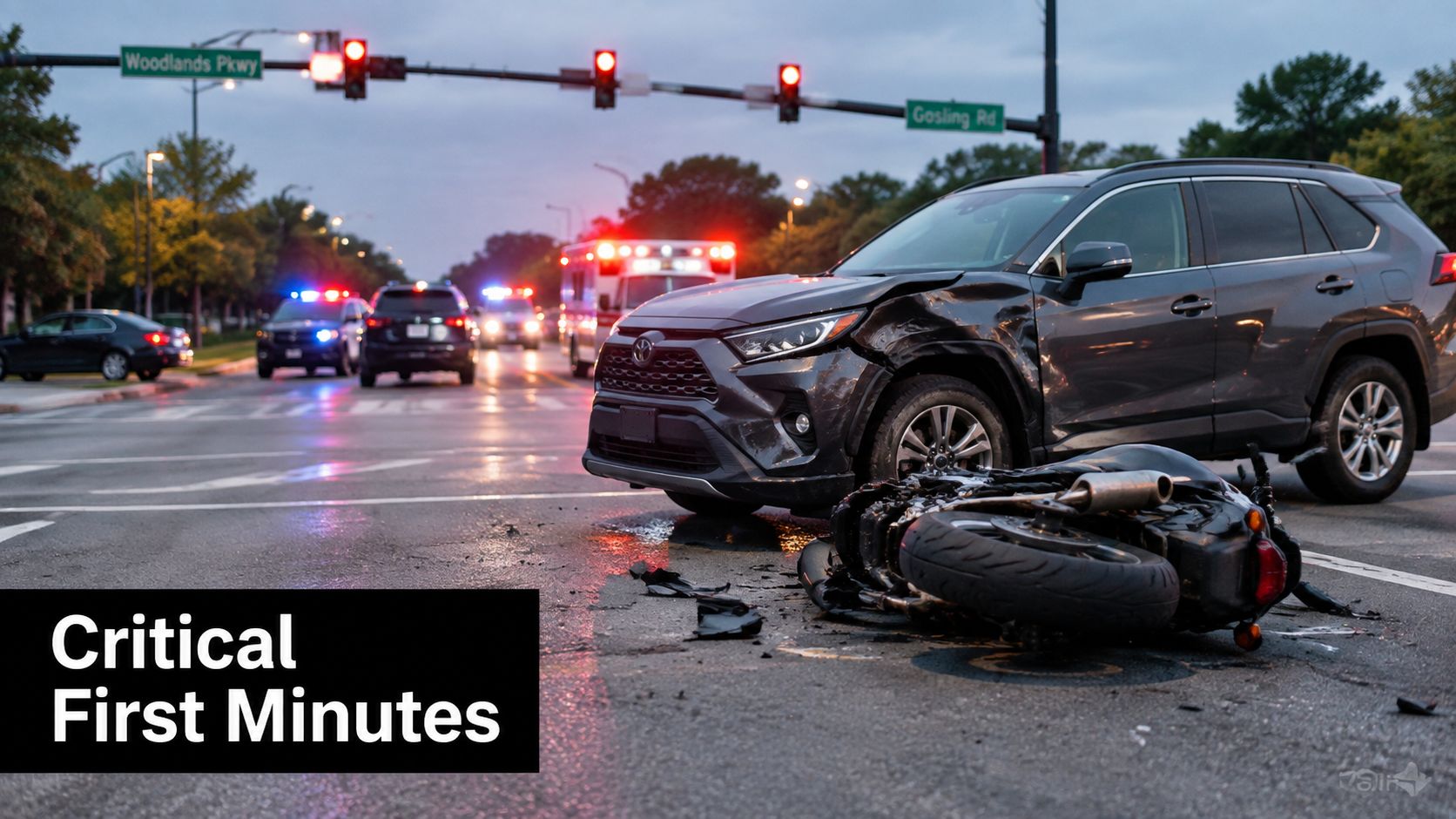
An SUV turns left at Woodlands Parkway and Gosling Road during evening traffic. The motorcycle enters the intersection with the rider's helmet secured, then the SUV crosses the bike's path. The motorcycle slides into the left-turn lane. A dash camera is still recording, and a witness pulls over before traffic scatters the evidence.
That scene contains more than a damaged motorcycle. The helmet may show impact location and retention-strap condition. The bike's final position can help establish lane movement. A dash-cam file may preserve signal timing, vehicle approach, and the other driver's turn. The witness may remember whether the SUV paused, signaled, or looked toward the motorcycle.
Practical rule: Protect the evidence before anyone moves, repairs, discards, or overwrites it.
Call 911 and remain focused on safety. Don't argue with the other driver or volunteer an explanation such as “I was probably going too fast.” A frightened rider may use ordinary conversational language that an insurer later presents as an admission. Fault should be evaluated from the scene, vehicle damage, witness accounts, video, and reconstruction, not from a rushed statement made beside a wrecked motorcycle.
The stakes are serious. TxDOT reported 8,441 motorcycle traffic crashes in Texas in 2022, including 562 motorcyclist deaths and 2,422 serious injuries in that year's crashes, as reported in its Texas motorcycle safety plan materials. TxDOT also reported 585 motorcyclist deaths in 2024, with 37% of those killed not wearing helmets in its motorcycle safety information.
Texas uses modified comparative responsibility. If the rider's share of responsibility reaches the statutory cutoff, recovery can be barred. If it doesn't, the award can still be reduced. That's why the first ten minutes should preserve facts, not produce an improvised liability narrative.
What to Do in the First 72 Hours After a Motorcycle Crash
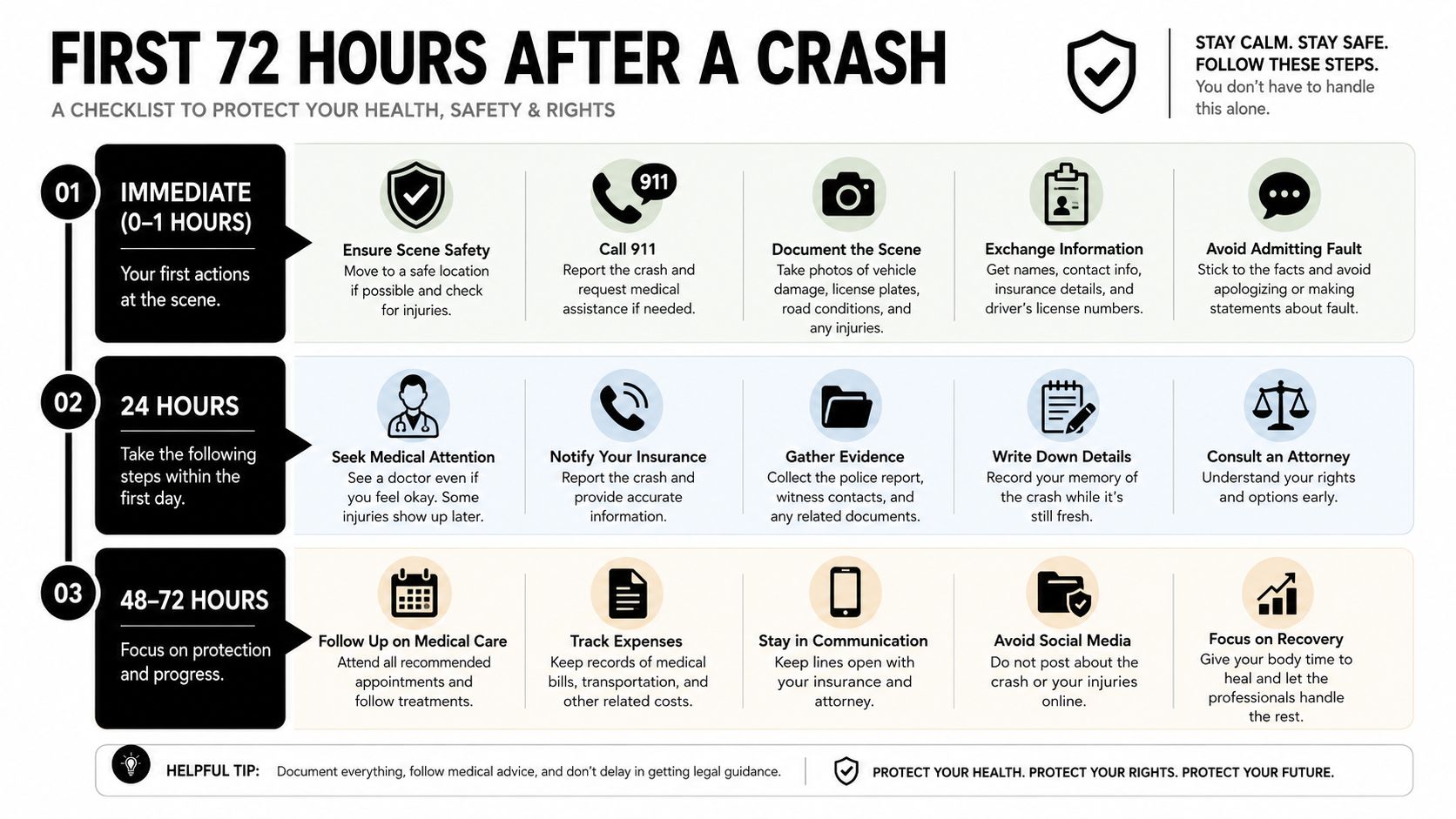
The first three days should be handled in order. Safety and medical care come before claim strategy, but evidence preservation shouldn't wait until the pain becomes severe.
Immediate actions at the scene
- Get out of danger: Move only when necessary for safety and follow emergency personnel's directions. A second collision can destroy evidence and worsen injuries.
- Call 911: Ask for law enforcement and emergency medical assistance. In Montgomery County, dispatch may involve the Montgomery County Sheriff's Office or another responding agency depending on the roadway and jurisdiction.
- Record what remains: If you can do so safely, photograph the motorcycle, roadway, lane markings, traffic signals, debris, skid marks, damage, and surrounding sightlines.
- Collect witness information: Get names and contact details, but don't coach witnesses or debate fault with them.
- Preserve video: Ask nearby drivers, businesses, or property managers whether cameras captured the intersection. Dash-camera footage may be overwritten quickly.
Within the first day
Get evaluated at a facility such as Houston Methodist The Woodlands or Memorial Hermann The Woodlands, even if pain seems manageable. Some serious injuries develop gradually, and a gap between the collision and treatment gives an insurer an argument that the crash didn't cause the condition.
Keep the helmet, jacket, gloves, boots, and other gear exactly as they were after impact. Don't wash, modify, or throw away damaged equipment. Photograph the motorcycle before repairs, then ask the repair facility to preserve damaged parts that may help a reconstruction expert.
You can use this The Woodlands car accident resource for additional local accident information, but a motorcycle collision involving significant injury deserves a case-specific review.
Between 48 and 72 hours
Request the crash report from the investigating agency when it becomes available. Keep a file containing medical records, discharge instructions, prescriptions, photographs, towing documents, employer communications, and every insurance letter or text.
Notify your own carrier as required by the policy. Answer basic coverage questions, but don't volunteer that you caused the collision or agree to a recorded statement before understanding what the policy and claim require. The other driver's carrier isn't your advocate. Its adjuster is collecting information for the insurer's position.
How Texas Comparative Fault and Helmet Evidence Shape Your Case
Texas motorcycle claims often involve two separate questions. Who caused the collision? And what injuries did the collision cause? Helmet evidence usually matters more directly to the second question, although insurers may try to use it to argue broader comparative responsibility.
Texas law generally allows recovery when the injured rider is found 50% or less responsible, with damages reduced by the assigned percentage. A finding of 51% or more responsibility bars recovery, according to the Texas rule summarized in this Texas motorcycle injury law resource. An insurer may therefore argue that a rider was 20%, 40%, or 55% responsible based on speed, lane position, visibility, or helmet use.
| Rider Fault % | Recovery Outcome in Texas | Helmet Evidence Effect |
|---|---|---|
| 20% | Recovery may be reduced by the assigned responsibility | May affect the argument about head-injury causation |
| 40% | Recovery may be reduced substantially, while remaining below the statutory bar | Clear helmet and medical evidence can narrow the dispute |
| 55% | Recovery is generally barred under modified comparative responsibility | Helmet evidence may become part of a broader defense narrative |
NHTSA reports that helmets reduce rider fatalities by 22% to 42% and brain injuries by 41% to 69%, as explained in its motorcycle safety countermeasures guidance. That doesn't mean a rider without a helmet automatically loses a claim. It means the defense may argue that helmet use changed the severity or cause of a head injury.
Preserve photographs of the helmet, including certification markings, impact points, visor condition, and strap damage. Keep the helmet itself. Medical imaging, emergency-room notes, neurological evaluations, and a reconstruction of the impact should be reviewed together rather than in isolation. Evidence presentation principles discussed in presenting evidence in court can help explain why a photograph alone rarely answers a causation question.
Texas headgear rules also contain an exemption for riders and passengers who are at least 21 and have completed a motorcycle safety course or carry qualifying health insurance, as described in this Texas motorcycle accident law overview. The exemption may affect a statutory argument, but it doesn't erase the need to examine how the crash produced the claimed injury.
The Divorce Lawyer in The Woodlands, TX listing concerns divorce representation for clients in The Woodlands and Montgomery County, not motorcycle injury litigation.
Working With Insurance Companies After a Motorcycle Collision
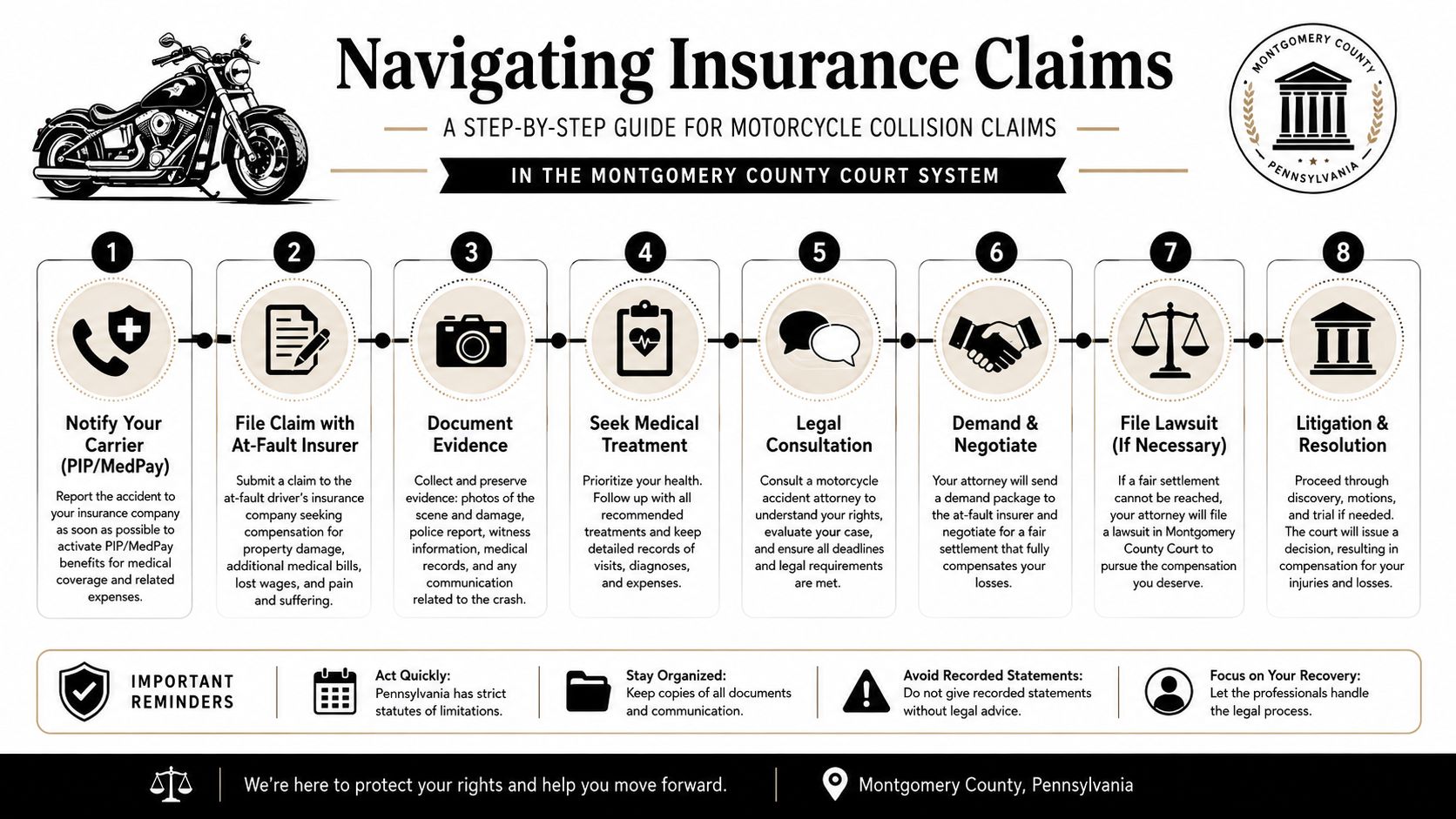
Insurance communication is a sequence of decisions, not a single phone call. Start with your own policy. Ask what medical-payment or other first-party coverage exists, how to submit bills, and what notice the policy requires. Then identify the at-fault driver's liability carrier and provide enough information to open the claim without giving a premature opinion about responsibility.
An adjuster may request a recorded statement quickly. The questions can sound harmless: How fast were you traveling? Which lane were you in? When did you see the vehicle? Were you wearing protective gear? A careless answer can create an apparent inconsistency, especially when the rider is medicated, frightened, or still trying to remember an impact that occurred in seconds.
Before recording: Know whether the request is required by your policy, what issue it addresses, and whether counsel should review the questions first.
A demand package should tell a coherent story. It should include the crash report, photographs, witness information, medical records, bills, wage documentation, motorcycle damage, gear damage, and evidence connecting the collision to the claimed injuries. It should also address unfavorable facts directly, including disputed lane position or helmet issues. Ignoring a weakness rarely makes it disappear.
If the carrier mishandles the claim, the Texas Department of Insurance consumer complaint process may provide a regulatory channel, although a complaint isn't a substitute for evaluating litigation rights. If negotiations stall, a lawyer may recommend filing in the appropriate Montgomery County civil court, including proceedings handled through the Conroe courthouse. Filing changes the timetable, cost, discovery obligations, and pressure on both sides, so it shouldn't be treated as an automatic escalation.
Choosing the Right Motorcycle Accident Lawyer in The Woodlands
A motorcycle claim requires more than a general promise to “fight the insurance company.” During a consultation, look for an attorney who can explain how the firm will investigate the intersection, preserve the motorcycle and gear, evaluate comparative responsibility, and connect medical findings to crash mechanics.
Fee terms deserve direct questions. Some lawyers use a standard contingency arrangement, while others use graduated percentages or different terms as a case moves toward litigation. Ask who advances case expenses, which expenses remain your responsibility, and what happens if the case doesn't recover money. You should understand the agreement before signing it.
| Evaluation Criteria | Strong Signal | Red Flag |
|---|---|---|
| Motorcycle experience | Explains lane position, impact mechanics, helmet evidence, and reconstruction | Treats the case exactly like a routine property-damage claim |
| Communication | Identifies the lawyer and staff member handling daily updates | Won't explain who actually works on the file |
| Comparative fault | Discusses unfavorable facts without minimizing them | Promises an outcome without reviewing evidence |
| Local litigation | Can describe Montgomery County procedures and courtroom experience | Has no clear plan if negotiation fails |
| Fees and costs | Gives written terms and explains expenses plainly | Avoids questions about costs or an unsuccessful case |
Ask whether the attorney has handled motorcycle injury cases involving left turns, intersections, disputed speed, or helmet evidence. Ask how the firm obtains video, preserves event data where available, and evaluates future medical needs. You can also ask what portion of the work the attorney personally handles and how often you'll receive meaningful updates.
Credentials can be part of the review, but they aren't a substitute for answers. Texas Bar membership and listings such as the Million Dollar Advocates Forum may be relevant to a lawyer's background, but you should still examine the lawyer's experience with facts like yours. A large volume practice may move files efficiently, while a smaller practice may offer more direct attorney contact. The trade-off depends on what your injury and evidence require.
For general context on local personal-injury representation, see this The Woodlands personal injury lawyer page. It shouldn't replace a consultation focused on the motorcycle collision itself.
Texas Deadlines, Montgomery County Procedures, and Case Timeline
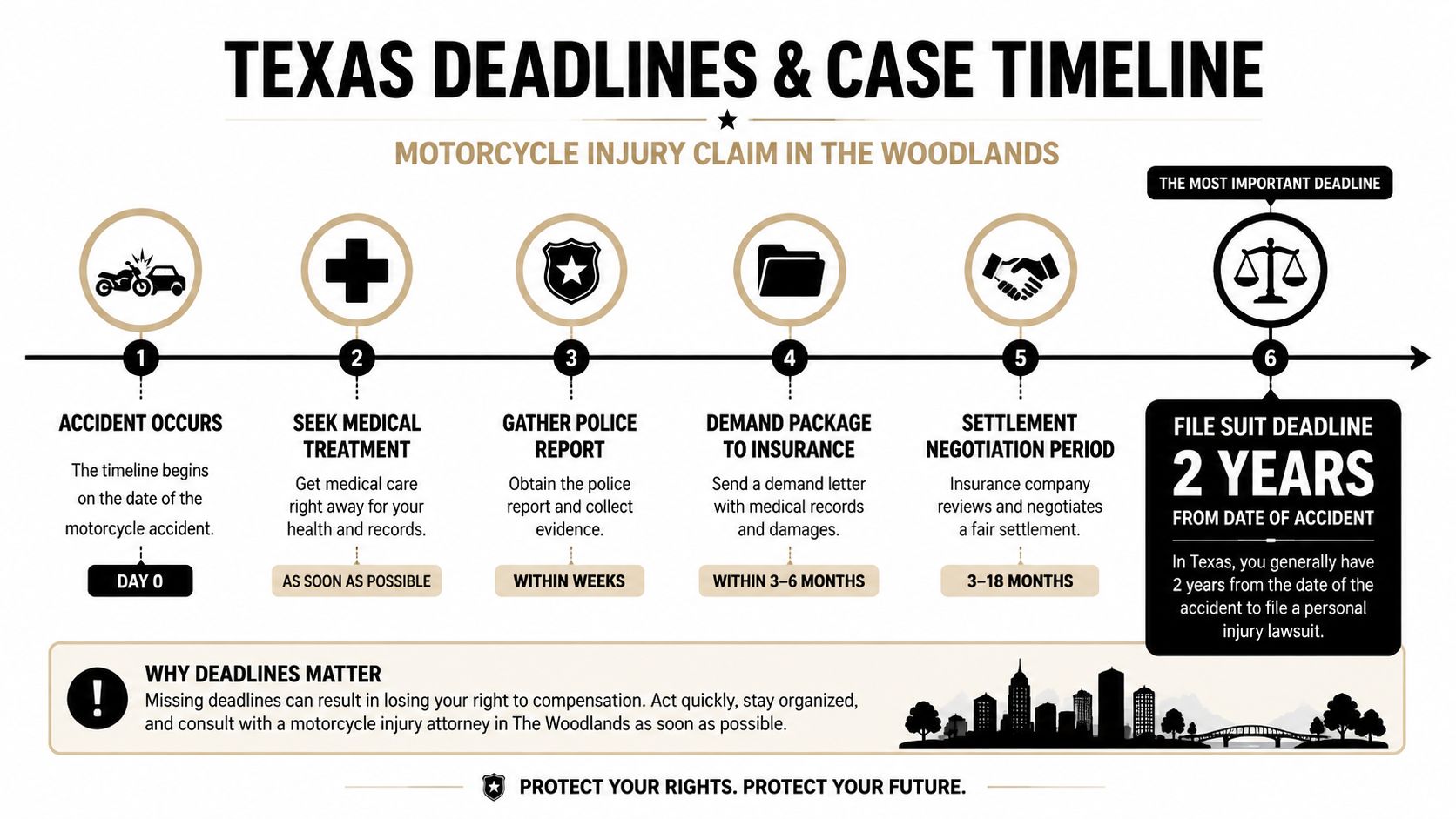
The central deadline for a Texas personal-injury claim is generally two years, as summarized in this Texas motorcycle accident limitations resource. Texas Civil Practice and Remedies Code Section 16.003 is the usual starting point, but exceptions can affect the calculation. Minors and certain delayed-discovery situations may require a different analysis, so don't calculate the deadline from memory.
Insurance notice can have its own requirements. Review your policy promptly, including any provisions concerning first-party benefits, medical payments, cooperation, and notice. A demand letter has no universal timing that fits every injury. Sending it before the medical picture is clear can undervalue the claim, while waiting without preserving evidence can create avoidable risk.
Texas Civil Practice and Remedies Code Section 33.001 addresses the comparative-responsibility bar discussed earlier. The practical lesson is simple: a lawyer should investigate responsibility before a deadline forces a rushed filing.
What a contested case may involve
A Montgomery County lawsuit may proceed through a district court in Conroe, including the 410th or 457th District Court when jurisdiction and case facts support that filing. The process can include filing, service, pleadings, discovery, expert review, scheduling orders, depositions, mediation, and trial preparation. The correct court and procedure depend on the parties, claims, and damages, so an attorney should confirm them rather than rely on a checklist.
A realistic sequence often looks like this:
- Early weeks: Intake, medical evaluation, photographs, crash-report collection, insurance review, and preservation letters.
- Following months: Treatment continues, records are gathered, experts may inspect the motorcycle, and liability evidence is tested.
- After medical clarity: The lawyer prepares a demand or evaluates filing suit, depending on responsibility, coverage, and injury outlook.
- Litigation phase: Discovery and depositions narrow disputed facts. Mediation may resolve the case, but trial preparation remains important.
- Longer resolution: A contested claim can take substantial time, especially when future care, permanent impairment, or fault disputes remain open.
Don't let settlement pressure replace deadline planning. Early legal review can identify what must be preserved now, what can wait, and whether negotiation is sensible before filing.
Mistakes Riders Make That Quietly Reduce Case Value
Riders often make understandable decisions that create problems later. The mistake usually isn't dishonesty. It's acting quickly while injured, assuming the insurance company is helping, or treating a legal document as broader than it really is.
Assuming a waiver ends the claim
A dealership form, track-day release, or event waiver may address a particular activity or risk. It doesn't automatically resolve a claim against a third-party driver who caused a roadway collision. The wording, parties, conduct, and location matter.
Do this instead: Keep every signed document and have it reviewed. Don't assume the title of a waiver tells you what claims it covers.
Taking the first check for motorcycle damage
A quick payment may help with towing or replacing the bike, but it can become a problem if the release also covers bodily injury. Head, back, nerve, and orthopedic injuries may require continuing evaluation. Once you accept a settlement and sign a release, you may lose the ability to seek additional compensation for conditions that become clearer later.
Do this instead: Separate property damage from injury claims in writing and confirm what any check or release resolves before depositing it.
Giving a recorded statement without preparation
The rider may believe the adjuster only wants basic facts. The recording can later be compared with medical records, the crash report, photographs, and testimony. A phrase about speed, visibility, lane position, or protective equipment can be taken out of context.
Do this instead: Ask whether the statement is required under your own policy. Don't provide a recorded statement to the other carrier until an attorney has reviewed the request and helped you give an accurate, focused account.
Posting riding photographs online
Trail-riding photographs, comments about speed, or posts showing recreational activity can be saved and used to suggest that the rider isn't as injured as claimed. A photograph doesn't prove the medical conclusion, but it can create an unnecessary credibility dispute.
Do this instead: Stop posting about riding, the crash, treatment, and recovery while the claim is open. Ask friends not to tag you in related content.
Discarding the helmet or damaged gear
A damaged helmet may be central to the defense's argument about head injuries. Throwing it away removes an item that could support either side. The same concern applies to gloves, boots, jackets, and electronic devices.
Do this instead: Store gear in a dry, secure place. Photograph it, preserve the original condition, and provide it for inspection through the proper legal process.
Failing to document the roadway
An intersection case may depend on visibility, turn movement, signal sequence, lane markings, construction, lighting, or obstruction. Conditions at I-45 feeder roads, FM 2978, and Woodlands Parkway can change after the collision.
Do this instead: Preserve photographs and video promptly. Note the direction of travel, lane, weather, lighting, traffic control, and the exact point of impact. Don't trespass or create a dangerous scene while collecting evidence.
Your short checklist: Get medical care, preserve the helmet and gear, photograph the motorcycle before repair, request the report, avoid recorded statements, keep insurance correspondence, and calendar the Texas filing deadline.
Texas motorcycle fatality risk remains a serious safety issue. NHTSA reported 6,228 motorcyclist deaths nationally in 2024, representing 16% of all U.S. traffic fatalities, in its motorcycle road-safety data. NHTSA also reported 6,335 motorcyclist deaths and about 82,564 injuries in 2023, with a motorcycle fatality rate of 31.39 per 100 million vehicle miles traveled, in its 2023 traffic fatality report. Those figures reinforce why injury documentation and reconstruction deserve attention from the beginning.
This article is not legal advice. It doesn't create an attorney-client relationship, and Texas rules govern each Woodlands-area motorcycle claim differently. Facts involving minors, family responsibilities, or an estate may require separate legal analysis. For example, the Texas State Law Library explains that a court order for child support, custody, or visitation typically requires a SAPCR and identifies Chapter 154 of the Texas Family Code as the child-support chapter. Texas Estates Code Section 31 also broadly describes probate proceedings, including will probate, heirship matters, allowances, and claims involving an estate. Those subjects aren't automatically part of a motorcycle injury case, but they can matter when a serious injury or death affects a family's existing legal obligations.
If you're in The Woodlands, Shenandoah, Conroe, or another Montgomery County community, consider scheduling a free consultation before signing a release or giving a recorded statement. The first call typically covers liability, available policy limits, evidence preservation, medical documentation, and a candid assessment of case value before you commit to a course of action.
The Law Office of Bryan Fagan can discuss how a Woodlands-area motorcycle collision affects liability, insurance coverage, and the evidence needed to evaluate the claim. Visit The Law Office of Bryan Fagan to schedule a consultation and bring your crash report, photographs, medical records, and insurance correspondence for review.
