
You live in The Woodlands, own a home, have retirement accounts, and probably assume your will will keep everything simple. Then a parent dies, a family member asks whether the house can be sold, and someone discovers that a document in a desk drawer doesn't transfer property by itself. In Texas, the important question isn't only whether you have a will or trust. It's which assets are titled in whose name, and what process each asset will require.
For Montgomery County families, the practical choice is often between a will used with streamlined probate and a properly funded revocable living trust that keeps eligible assets out of probate. A trust can be the right tool, but an unfunded trust can leave the family with the same probate problem it was supposed to prevent. This guide gives you a per-asset way to decide.
Why This Decision Matters for Woodlands Families
A parent in Panther Creek dies owning the family home, a 401(k), and a timeshare. The family finds a valid will, but the will doesn't transfer the house immediately. The document must be filed with a court of competent jurisdiction so the court can validate and administer it, as explained in this Texas will versus trust overview.
The probate matter is handled in Conroe, and the family waits for the court process needed to appoint an independent executor. Until that appointment occurs, the family may not have someone with authority to sell or refinance the house. A stalled sale becomes more serious if the family is already dealing with a changing market, carrying expenses, or trying to divide the property fairly.
The same family may face other immediate problems. A teenager needs a guardian named in a legally effective will. An adult child can't access a brokerage account because the account remains individually titled. The timeshare has its own ownership and transfer requirements, while the 401(k) follows its beneficiary designation rather than the will.
A neighbor in Sterling Ridge has a revocable trust and has retitled the home into that trust. After the neighbor's death, the successor trustee can generally manage and distribute trust-owned assets privately, without the probate sequence required for those assets. That result depends on funding, not merely signing trust papers.
Local reality: A will doesn't avoid probate in Texas. A funded trust can usually avoid probate for the assets the trust actually owns.
Montgomery County's probate matters are handled in Conroe, and the statutory probate court provisions give the county probate court concurrent jurisdiction over probate-related disputes. Texas also has no state estate tax, but that doesn't eliminate probate administration, title problems, family conflict, or delays. The local court's docket and the condition of the family's documents can materially affect how difficult the process feels.
Wills and Trusts in Plain English
A will is a written set of instructions that takes effect at death. It identifies beneficiaries, names an executor, and can nominate a guardian for a minor child. But the will generally must be admitted to probate before the executor can use it to administer individually owned property.
A revocable living trust is a legal container created during life. You transfer eligible property into the trust, manage it as trustee, and name a successor trustee to handle the property if you become incapacitated or die. For assets properly titled in the trust, the successor trustee can distribute property privately under the trust's instructions.
The difference becomes clearer when you look at ordinary Woodlands assets:
| Asset | Will-based plan | Revocable trust plan |
|---|---|---|
| Panther Creek or Sterling Ridge home | Usually requires probate unless another valid transfer method applies | Can usually pass outside probate if titled in the trust |
| 401(k) or IRA at Woodforest National Bank or a national broker | Passes under the account beneficiary designation | Usually remains outside the trust and passes under its beneficiary designation |
| Minor child's guardianship | A will can nominate a guardian | A trust generally doesn't nominate a guardian |
Under Texas Estates Code Section 1104.053, parents can nominate a guardian through a will. That function matters as much as property transfer. A trust can control money for a child, but it generally isn't the document that nominates the person who will care for the child.
Families often need both documents. A trust may serve as the primary vehicle for property, while a pour-over will catches assets that weren't transferred into the trust and states guardianship wishes. If you need a local review of wills, trusts, and estate plans for The Woodlands families, an Estate Planning Attorney in The Woodlands can evaluate how the documents work together.
The choice isn't a contest between two isolated forms. It's a decision about the primary transfer system, the family members who need protection, and whether every important asset will be handled correctly.
How Each Path Handles Probate in Montgomery County
A will-based estate usually begins with a filing in the Montgomery County Probate Court at 210 W. Davis in Conroe. The court considers the will, appoints the executor, and gives the personal representative authority to administer the estate. Under Texas Estates Code Chapter 401, independent administration can limit ongoing court supervision when the will authorizes it or the heirs agree as the law permits.
That straightforward process matters. Texas probate isn't automatically a disaster, and a properly drafted will can let an independent executor handle much of the work without constant court approval. The executor still has duties, including filing the estate inventory, appraisement, and list of claims within 90 days after qualification, unless an affidavit in lieu is allowed. Texas Estates Code Section 309.056 provides the deadline, and the court may remove an executor who fails to comply, as summarized in this Texas Estates Code deadline reference.
A muniment of title can be even simpler in the right case. Montgomery County guidance explains that a valid will with no unpaid debts except a mortgage may qualify for muniment of title, which transfers assets without appointing an executor. A small estate affidavit may be available only when there is no will, the estate is $75,000 or less, excluding the homestead and exempt property, and at least 30 days have passed since death, according to this Montgomery County probate guide.
| Factor | Will-Based Estate | Revocable Trust |
|---|---|---|
| Probate exposure | Individually titled assets generally require probate | Properly funded trust assets usually bypass probate |
| Court oversight | Initial filing and administration under the will and Estates Code | Successor trustee generally acts privately for trust assets |
| Privacy | The will becomes part of the public probate record after filing | Trust administration is generally private |
| Creditor and claims process | Executor handles statutory notices, claims, and estate administration | Trustee handles trust obligations, while nontrust assets may still enter probate |
| Practical timing | Simple matters may finish in 3 to 6 months; independent administration typically takes 6 to 12 months | Trust assets can be distributed without the probate court sequence, but funding and administration still take work |
A Probate Lawyer in The Woodlands, TX handles probate administration and estate settlement in Montgomery County. Families should understand the central distinction before choosing: the key comparison is often restricted court administration versus private transfer, not “probate versus no probate” for every asset.
For a practical explanation of the filing process, see how to probate a will in The Woodlands.
Trust Funding and the Per-Asset Reality
The most common trust mistake is simple. Someone signs a revocable trust, places the document in a safe, and never changes ownership of the house or accounts. At death, those assets are still in the person's individual name, so they may still require Montgomery County probate.
Funding means reviewing each asset and taking the correct action. A trust document alone doesn't retitle property.
A practical funding checklist
- Home: A Panther Creek or Sterling Ridge residence may need a Texas warranty deed naming the trustee of the revocable trust as the new owner. The deed must be prepared and recorded correctly, with attention to homestead and mortgage issues.
- Bank accounts: A Woodforest or Chase checking account may need its ownership changed from the individual to the trust. The bank will have its own process and documentation requirements.
- Brokerage accounts: Nonretirement investment accounts may be retitled into the trust if that fits the plan and the institution accepts the paperwork.
- Vehicles: Vehicles may require title updates through the county tax office or another appropriate transfer method. Don't assume a vehicle is covered because it appears on an informal asset list.
- Retirement accounts: IRAs and 401(k)s generally shouldn't be retitled into a revocable trust as though they were ordinary bank accounts. Review beneficiary designations instead, because these accounts usually pass outside the trust.
- Life insurance: A policy with named beneficiaries commonly passes under that designation. It may be coordinated with the trust, but it isn't automatically “funded” just because the trust mentions it.
- Business interests: LLC interests and other ownership interests may require assignments, amended company records, or institution-specific steps.
A transfer-on-death deed may be another option for certain Texas real property, but it isn't interchangeable with a funded trust. Review the distinctions before choosing a deed strategy through this Woodlands transfer-on-death deed resource.
The pour-over will remains important. It acts as a safety net for property missed during funding, but it doesn't give you the same probate avoidance for that missed property. The cost of skipping funding is often the exact court involvement the trust was meant to avoid, along with title delays and extra work for the family.
Costs, Timelines, and Implementation Steps
A will is usually easier to implement because it doesn't require every asset to be retitled during life. You still need a properly executed document, current beneficiary designations, and a plan for probate after death.
Texas Estates Code Section 251.051 addresses will execution requirements, including the need for the required witnesses. A self-proving affidavit before a notary can make later probate smoother, but the document must be prepared and signed correctly.
A trust takes more coordination. The document must be drafted and signed, then the home, accounts, business interests, and other eligible property must be reviewed one by one. Recording fees with the Montgomery County Clerk, financial institution procedures, deed preparation, and later trustee duties all belong in the budget.
Will versus trust implementation
| Step | Will Only | Revocable Living Trust |
|---|---|---|
| Identify property | List homes, accounts, vehicles, business interests, and personal property | Create the same inventory, then classify each asset for funding |
| Draft documents | Prepare will, guardian nominations, executor provisions, and related documents | Prepare trust, successor trustee provisions, pour-over will, and related documents |
| Execute | Sign under Texas Estates Code requirements and complete any self-proving affidavit | Sign the trust and companion documents under Texas requirements |
| Transfer property | Usually no lifetime retitling, though beneficiary updates remain essential | Record deeds and change eligible account ownership into the trust |
| After death | File the probate application in Conroe and seek the appropriate administration | Successor trustee gathers and distributes trust assets privately, while missed assets may require probate |
| Ongoing work | Review after marriages, divorces, births, deaths, or major asset changes | Review the trust and keep newly acquired property properly titled |
Texas probate costs vary by filing and circumstances. In Montgomery County, common probate-related filings are often priced around $360 for probate of a will, a small estate affidavit, or muniment of title, according to this Texas probate cost and timeline guide. Simple estates may finish in 3 to 6 months, while complex or contested estates can take a year or more. Independent administration typically takes 6 to 12 months, and dependent administration can take 18 months to 3 or more years.
Don't choose a trust solely because someone says probate is expensive. Compare the attorney's drafting and funding fees, recording expenses, account-transfer work, and future maintenance against the complexity your family faces.
Real Client Scenarios from The Woodlands
The right answer changes with the family, not the neighborhood. These anonymized examples reflect the kinds of facts that drive planning decisions in Montgomery County.
A blended family in Creekside Park
One spouse has children from a prior marriage, an IRA, and a home held through an LLC. The family wants the surviving spouse to keep living in the residence, but also wants the deceased spouse's children to receive a defined inheritance.
A revocable trust with separate trust shares can create clearer control than a basic will. The trust can address the surviving spouse's use of the residence, identify what passes to the stepchildren, and coordinate the IRA beneficiary designation. The LLC ownership also needs separate review, because placing a home in an LLC isn't the same as placing the ownership interest or real property into a trust.
A high-asset divorce aftermath in Carlton Woods
A former spouse owns rental properties, a business interest, and stock options after a high-asset divorce. A simple will may state who inherits, but it may not provide the operational structure needed to value, manage, and transfer complicated interests.
This family needs careful coordination among the will, trust, company documents, account agreements, and divorce-related property records. Creditor concerns, valuation issues, and business succession can matter more than the basic question of whether a will exists.
A modest Woodlands estate
A longtime resident owns one paid-off home, a Woodforest checking account, and modest retirement assets. The retirement accounts have current beneficiaries, and the will is valid and self-proving. If there are no unpaid debts requiring administration, muniment of title may provide a practical route under the Texas Estates Code.
For this family, a properly drafted will may be the cheaper and more efficient choice. A trust could add paperwork and funding duties without solving a problem the family has.
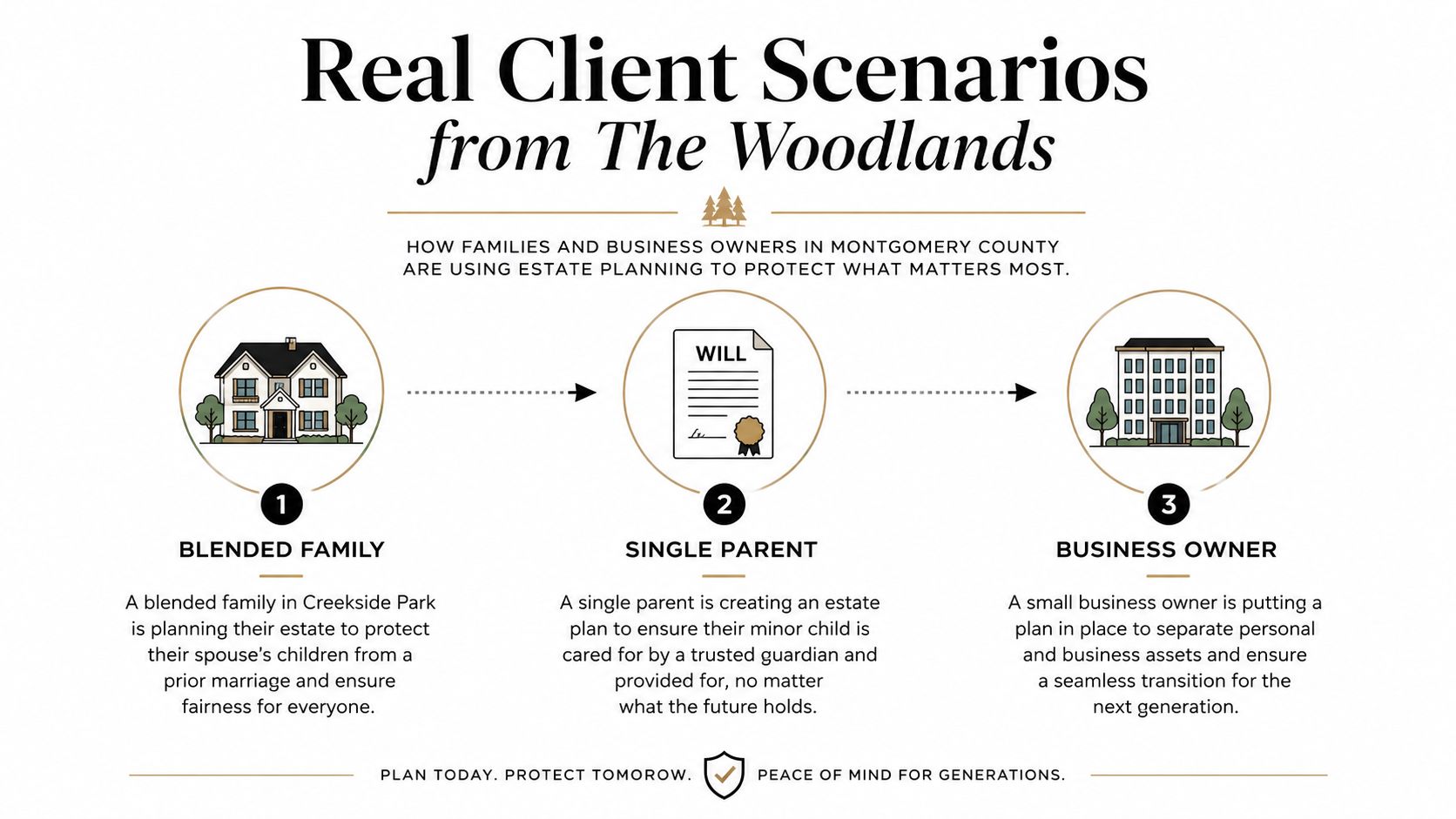
The same analysis applies to a single parent who needs a guardian nomination, and to a business owner who needs personal and business assets coordinated for succession. The document must match the responsibility that needs to be handled.
Choosing the Right Option for Your Family
My recommendation is direct. Use a will when Texas's simplified probate tools solve the problem. Use a funded revocable trust when privacy, control, incapacity planning, blended-family protection, or out-of-state property justifies the additional work.
A will paired with a durable financial power of attorney and healthcare directive often fits a family with one Woodlands home, current retirement beneficiaries, and an estate likely to qualify for independent administration or muniment of title. Texas Estates Code Chapter 401 can make independent administration comparatively manageable, and local filing costs may be around $360 for common probate filings, as noted earlier.
A trust is stronger when a blended family needs controlled distributions, a beneficiary needs special handling, real estate exists outside Texas, or the family wants a successor trustee to manage assets privately after incapacity or death. The trust only delivers that advantage for assets placed into it.
| Your Situation | Recommended Plan | Controlling Authority | Why It Wins Locally |
|---|---|---|---|
| One home, current beneficiaries, no complex debts | Will with related incapacity documents | Texas Estates Code Chapter 401 | Streamlined probate may be sufficient |
| Blended family or controlled inheritances | Funded revocable trust plus pour-over will | Trust terms and Texas Estates Code | Keeps trust assets private and separates beneficiary interests |
| Minor children | Will plus coordinated trust planning | Texas Estates Code Section 1104.053 | The will nominates a guardian |
| Out-of-state real estate | Trust-centered plan | Applicable state and Texas law | May reduce multiple probate proceedings |
| Assets not yet funded | Will as a safety net, then complete funding | Texas Estates Code probate rules | Prevents overlooked property from defeating the plan |
Don't select a trust because it sounds more impressive. Select it because its additional structure solves a specific family problem.
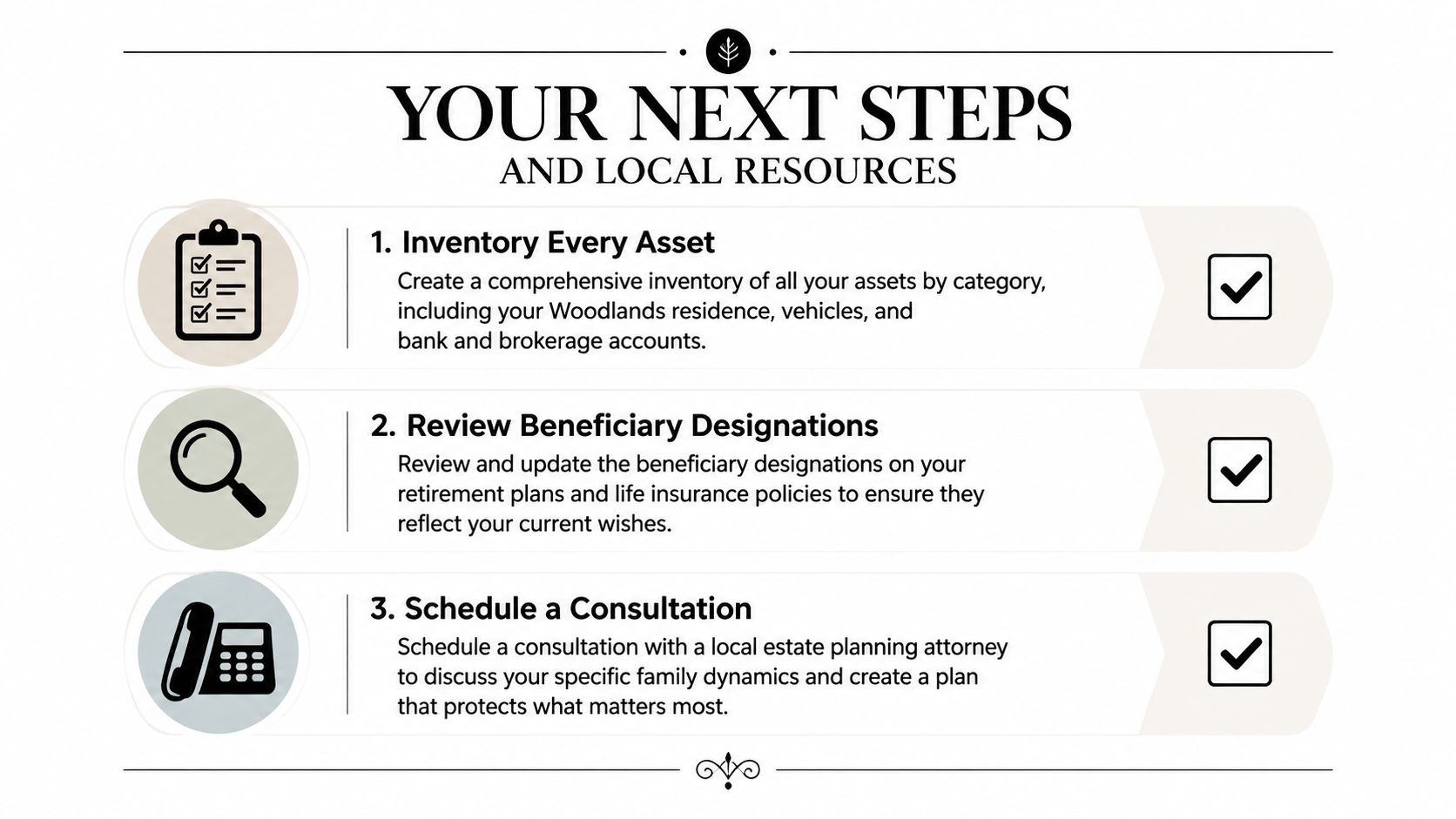
Your Next Steps and Local Resources
Start with an inventory, not a document template. List the Woodlands residence, vehicles, Woodforest and brokerage accounts, retirement plans and IRAs, life insurance, business interests, digital accounts, and jointly owned property.
Then check every beneficiary designation. Retirement and life insurance instructions can control those assets, so a will or trust shouldn't be treated as a substitute for reviewing the forms held by each institution.
Use this checklist:
- Inventory every asset: Record the owner, title, account type, approximate value, and location.
- Review beneficiaries: Confirm the primary and contingent beneficiaries on every retirement and life insurance policy.
- Address minor children: Decide whether a will should nominate a guardian under Texas Estates Code Section 254.002.
- Gather records: Collect two years of statements, deeds, account records, insurance information, business documents, and prior estate-planning papers.
- Review the funding plan: Ask which assets should be retitled, which should remain outside the trust, and which need beneficiary updates.
- Schedule local counsel: Speak with a Texas-licensed Montgomery County estate planning or probate attorney before signing or transferring property.
You can review revocable trust forms as part of your preparation, but forms alone won't determine whether your assets are correctly titled. This article provides general information, not individualized legal advice, and it doesn't create an attorney-client relationship.
The Law Office of Bryan Fagan helps families in The Woodlands and Montgomery County evaluate wills, trusts, beneficiary designations, and probate options based on their actual assets and family structure. Visit The Law Office of Bryan Fagan to schedule a consultation with a local attorney serving the Woodlands and Conroe area.