
If you're sitting in The Woodlands staring at divorce papers and wondering who gets the house, you're probably not asking a legal question first. You're asking a life question. Can the kids stay in the same school? Can one income carry the mortgage? Do you need to move out now, or can you stay put until the case is over?
That matters because who gets the house in a divorce in The Woodlands, TX doesn't turn on whose name is on the deed, who wants it more, or who picked the countertops. In Texas, the first fight is usually classification. Is the house community property, separate property, or a mixed asset with reimbursement issues layered on top?
For a family in Creekside Park, Alden Bridge, Sterling Ridge, or Panther Creek, the house is often the biggest asset and the biggest monthly obligation. Texas law starts with a presumption that property owned at divorce is community property unless a spouse proves otherwise, and the court then divides the community estate in a just and right way rather than automatically splitting everything equally, as explained by Texas Law Help on dividing property and debt in divorce. That is the framework. Everything else comes after it.
What Most Woodlands Homeowners Really Want to Know About the House
You get served in The Woodlands. The first panic usually is not about deed language or abstract property rules. It is about whether the kids can stay at Tough, McCullough, or College Park, whether one paycheck can carry the note, and whether staying in the house now helps or hurts your position later.
That is the right starting point.
The house question in a Montgomery County divorce usually follows a clear sequence. First, what kind of property is this house under Texas law. Second, what is the house worth after you account for debt and sale costs. Third, if one spouse keeps it, what does that spouse give up elsewhere to make the overall division fair.
Skip that order and people make expensive mistakes. They argue about who wants the house more. They rely on the deed. They assume equity gets split down the middle and call it done. That is not how this plays out in a Texas courtroom or in a workable divorce decree.
Start with the outcome, not the emotion
A house award on paper means very little if the spouse who keeps it cannot refinance, cannot pay the taxes, or cannot buy out the other side within the deadline in the decree. That is why the better question is not just who gets the house. It is who can keep it after the divorce is final.
In Montgomery County, that practical question drives almost every smart strategy decision early in the case.
The facts that usually decide the house fight
A judge or mediator will care about a short list of facts, and you should too:
- How and when the home was acquired. Before marriage, during marriage, after a prior sale, or through a transaction that mixed separate and community funds.
- Where the down payment came from. Inheritance, gift money, premarital cash, or money that sat in a joint account long enough to create proof problems.
- What happened during the marriage. Mortgage payments, principal reduction, major repairs, and improvements often shape reimbursement or offset arguments.
- What the equity looks like right now. A house with thin equity creates a different case strategy than a house with a large buyout number.
- Whether either spouse can qualify to keep it. Monthly principal and interest are only part of the cost. Taxes, insurance, HOA dues, maintenance, and 2025 to 2026 refinance terms matter just as much.
- Whether temporary possession is necessary. Keeping the children stable during the case is different from proving long-term affordability after the decree.
Possession, title, and the mortgage are three separate problems
People mix these up constantly.
One spouse can have temporary use of the home while the divorce is pending. A different spouse can receive title in the final decree. Both spouses can still remain liable on the mortgage until a refinance, payoff, or sale happens. If you do not separate those issues, you can sign a decree that sounds fine and still end up tied to a house you no longer live in.
That is why Texas house-division advice that stops at community versus separate property is incomplete. A Woodlands homeowner needs the full decision path. Classification. Valuation. A just-and-right division. Then the mechanics that make the result work in real life, including temporary possession, refinance deadlines, and in some cases relief available through local court procedures described on the Montgomery County Courts self-help page.
Practical rule: Do not fight only about who stays in the house this month. Fight about whether the final decree gives one spouse a house they can actually keep, or a problem they will be forced to sell later.
How Texas Courts Decide Who Gets the Marital Home
A Montgomery County judge does not start with "Who wants the house?" The judge starts with a harder question. What result is just and right across the entire estate under Texas Family Code Section 7.001?
For the house, that means four decisions usually happen in order. Is the home community or separate property. What is the house worth after debt and selling costs are considered. Which spouse, if either, can realistically carry it after divorce. What trade gives the overall property division a fair result under Texas law. The Texas Judicial Branch family law resources give the procedural framework, but the fight in The Woodlands is usually over proof and practicality.
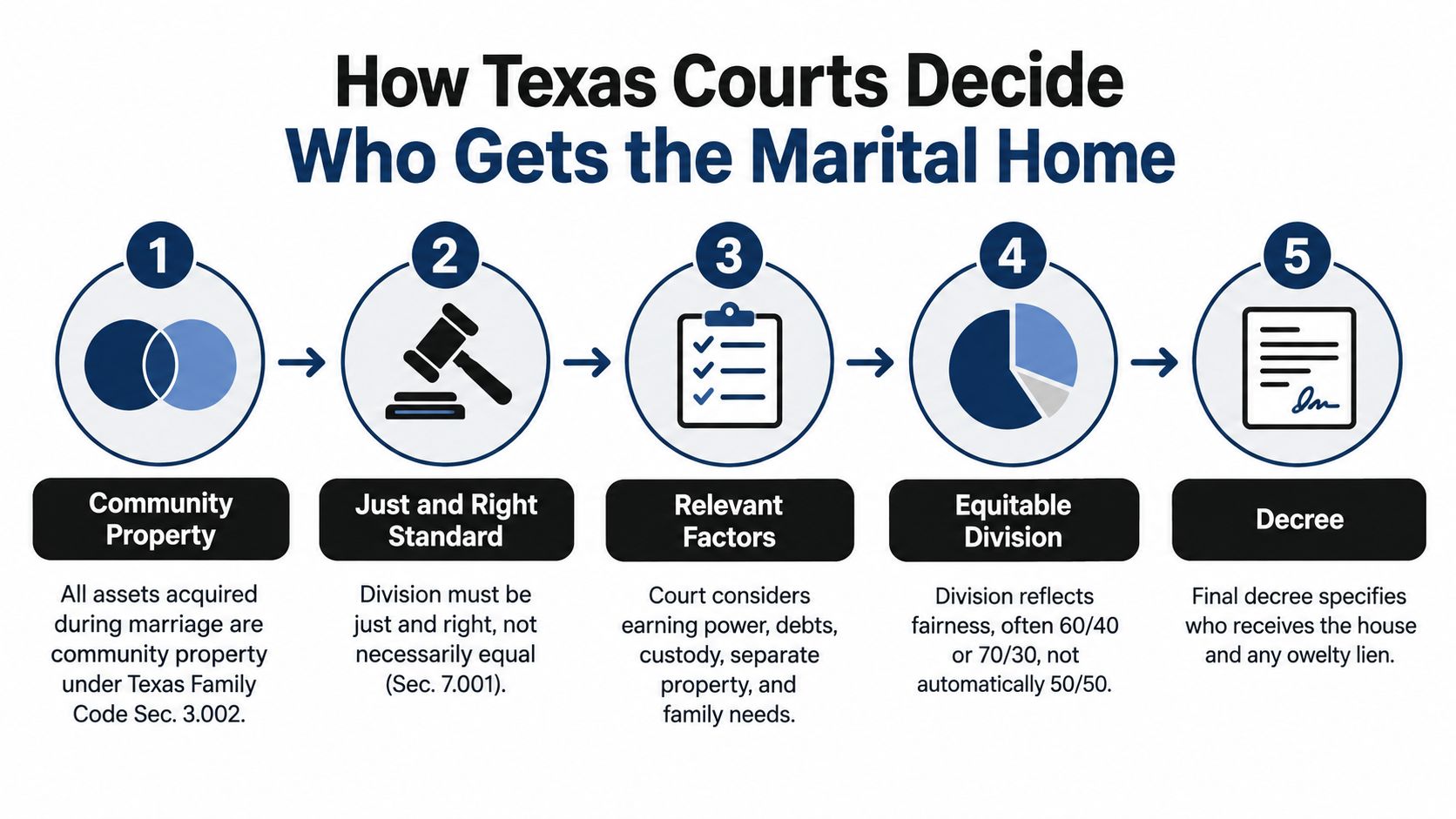
The 50 50 myth causes expensive mistakes
Plenty of spouses walk into mediation expecting half the equity because they heard Texas is a community property state. That shortcut causes bad deals. Community property does not guarantee an equal split, and the house is never decided in a vacuum.
If one spouse keeps the home, the court can offset that award with retirement funds, brokerage accounts, vehicles, business interests, or debt. If keeping the home would leave one spouse house rich and cash poor, a judge can favor a sale instead. If a separate property claim is proven, the discussion changes again because the court may be dividing reimbursement claims, equity growth, or debt responsibility instead of the house itself.
For a closer look at local issues that shape these outcomes, see this guide to property division in a Woodlands divorce.
What a Montgomery County judge usually cares about
Judges care about whether the order will work after the ink dries. Sentimental attachment carries far less weight than people think.
- Ability to pay: The spouse asking to keep the home needs credible numbers. Mortgage, taxes, insurance, HOA dues, and repairs all count.
- Children's stability: School continuity can matter, especially if a short-term possession arrangement protects the children during the case. It does not automatically justify long-term ownership.
- Size of the rest of the estate: A spouse may keep the house only because other assets can offset the equity fairly.
- Fault and financial misconduct: Waste, fraud on the community, hiding money, or running up avoidable debt can affect the division.
- Health, earning history, and family role: A court can weigh a spouse's future earning capacity against the other spouse's homemaker contribution and financial need.
The practical point is simple. A spouse who cannot refinance, maintain the home, or buy out the other side is asking for a decree that may collapse later.
The court's real job is bigger than deciding title
Title is only one piece. The court is trying to divide the full marital estate in a way that can be carried out without a second fight six months later.
That is why judges and experienced lawyers focus on net equity, deadlines, and enforceable terms. Who pays while the case is pending. How the equity is calculated. When a refinance must happen. What happens if it does not. Whether a sale is automatic after a missed deadline. Those details decide whether "you get the house" means ownership you can keep or a delayed sale you cannot avoid.
Three outcomes show up again and again
Most Woodlands divorce cases involving a house end in one of three places.
- One spouse keeps the house and buys out the other. This works only if the spouse keeping the home can qualify for the refinance or has another clear way to remove the other spouse from the debt.
- The house is sold and the proceeds are divided. This is often the cleanest result when neither spouse can comfortably carry the property alone.
- One spouse receives the house and the other receives offsetting assets. This can work well in higher-asset cases, but only if the numbers are real and the decree spells out the mechanics.
Good strategy starts with all three options on the table. If you argue only about who stays in the house, you are already behind.
Proving the House Is Separate Property in Montgomery County
If you claim the house is separate property, you need proof. Not a story. Not a spreadsheet you made the night before mediation. Proof.
In Texas, the spouse making the separate property claim carries the burden. Montgomery County judges want tracing that is orderly, document-backed, and easy to follow.
Four ways a house can qualify as separate property
A house may be separate property if it falls into one of these categories:
- Bought before marriage: The inception of title matters. If the legal right to acquire the home started before marriage, that can support a separate property claim.
- Received by gift or inheritance from a third party: A house gifted by a parent or inherited from family may be separate property.
- Covered by a valid marital agreement: A premarital or partition agreement can change the normal community property analysis. If that issue is in play, review the agreement carefully and compare it against guidance on a Texas community property agreement.
- Mixed ownership with reimbursement issues: Even if the house itself isn't fully separate, one spouse may have reimbursement claims tied to separate funds.
The records that usually matter
Montgomery County courts don't want a loose pile of bank statements. They want a clean tracing package.
| Tracing Separate Property: Evidence That Works in Montgomery County | Evidence Required | Common Pitfall |
|---|---|---|
| Pre-marriage purchase | Closing documents, original deed, loan records, proof of purchase date | Assuming later mortgage payments don't matter |
| Gift from third party | Gift letter, transfer records, title documents | Confusing a spouse-to-spouse transfer with a third-party gift |
| Inheritance | Probate papers, distribution records, deposit trail into the purchase | Letting inherited funds flow through mixed accounts without records |
| Marital agreement | Signed agreement, supporting deed or partition documents | Relying on an incomplete or poorly drafted agreement |
Commingling is where good claims go bad
If mortgage payments, improvements, or down payment funds ran through joint accounts after marriage, the argument gets harder. You may still have a valid claim, but you'll need careful tracing to overcome the presumption that property at divorce is community.
That is why organized exhibits matter. Closing statements, canceled checks, deposit records, and the original loan history carry more weight than broad testimony. A Divorce Lawyer in The Woodlands, TX handles divorce representation for clients in The Woodlands and Montgomery County, and this kind of record-building is exactly where legal help can change the outcome.
Bring paper that tells the story in order. Judges believe documents before they believe conclusions.
Your Three Main Options for the Family Home
Once the house is classified and valued, the next step is blunt. Decide whether keeping it is smart, not just emotionally appealing.
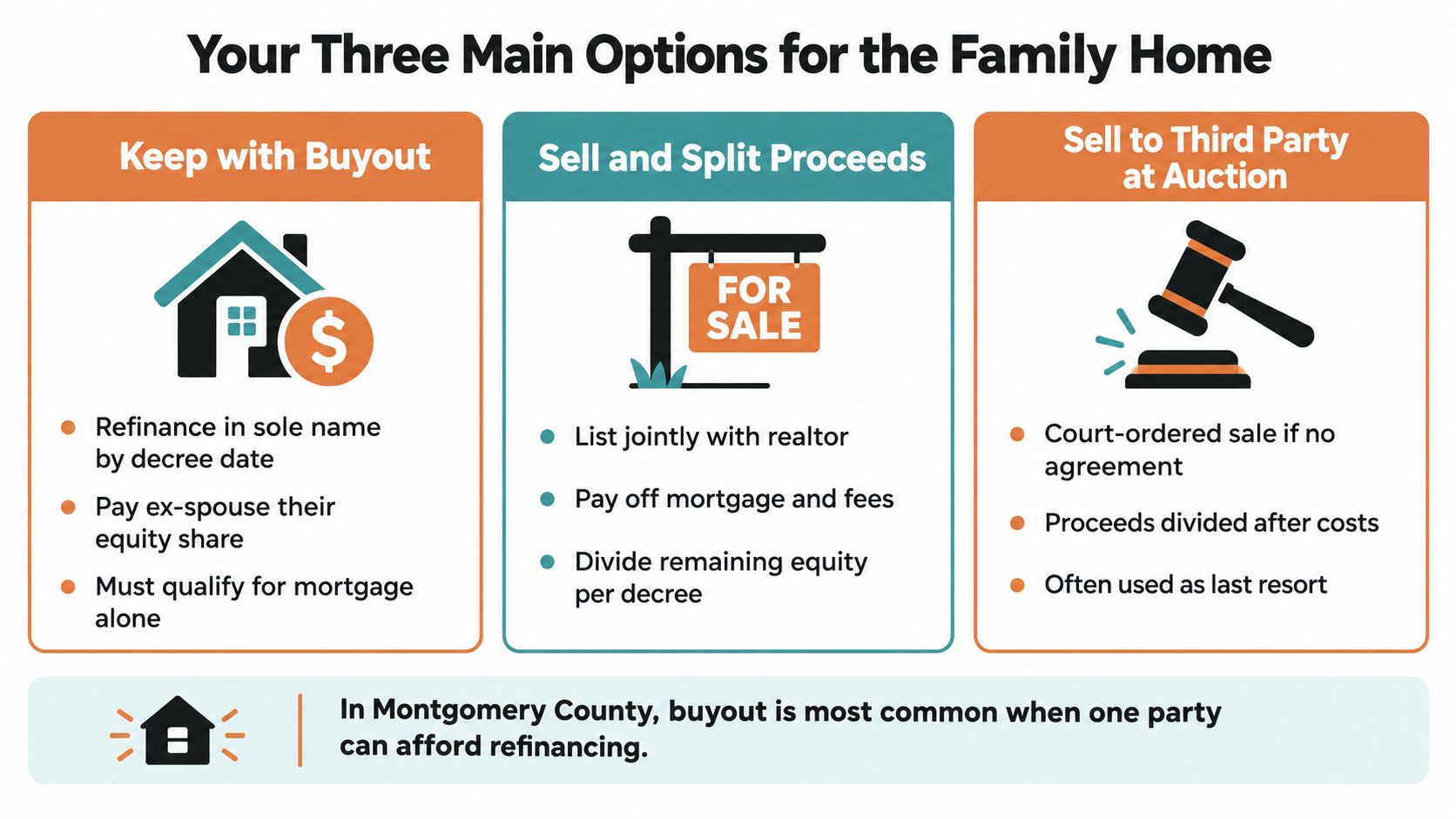
Option one keeps the house with a buyout
This is the option asked for first. One spouse keeps the house, refinances into their sole name, and compensates the other for their equity share.
It sounds clean. It often isn't. The spouse keeping the house has to qualify alone, carry the monthly payment alone, and meet the decree deadline. In practice, the “winner” of the house can end up with the hardest post-divorce financial position.
Option two sells the house and splits what is left
Sometimes selling is the adult answer. That is especially true when neither spouse can refinance comfortably, the equity needs to be converted into cash, or the house would drag both parties into months of post-divorce conflict.
This route also ends the shared housing problem. No delayed refinance. No waiting for missed payments. No fights over repairs after the decree.
Option three awards the house and offsets the rest
This is often the most strategic option in higher-asset Woodlands divorces. One spouse takes the residence. The other takes more retirement funds, brokerage assets, or another major asset to balance the division.
That approach can preserve school stability for children while avoiding a forced immediate buyout. It can also reduce the cash crunch that comes from trying to refinance and pay equity at the same time.
My recommendation in most contested cases
Run all three options on paper before you sign anything. Don't negotiate the house by itself.
Use a side-by-side decision list:
- Monthly affordability: Can one income handle the full carrying cost?
- Exit risk: What happens if refinance fails?
- Children's routine: Will a move disrupt school or custody exchanges?
- Asset tradeoffs: Are you giving up retirement or cash to keep walls and a roof?
- Conflict level: Will co-owning the sale process create more damage than it's worth?
A buyout is often the most emotionally attractive option. It is rarely the cheapest.
Mortgages, Refinancing, and Tax Consequences in 2026
A divorce decree can give you the house and still leave your ex tied to the loan, or leave you tied to a house you no longer live in. Those are two different problems. People mix them up all the time, and it causes bad settlements.
Texas guidance on divorce and real estate explains the basic rule: title and mortgage liability are separate issues, and the lender is not bound by your divorce decree in the way divorcing spouses expect under Texas guidance on divorce and real estate. If your name stays on the note, your credit is still exposed. If your ex keeps the house and misses payments, the decree does not stop the bank from reporting against you.
The 2025 to 2026 rate market makes this worse. A spouse may be able to afford the old payment but fail to qualify for a refinance at current terms. I tell clients the same thing in Montgomery County cases: do not award the house based on hope. Get the loan officer involved before mediation or before you sign a decree.
If the house is being kept, set a refinance deadline, a sale backup plan, and a clear consequence for failure. Anything less is sloppy drafting.
A lender also cares about debt-to-income ratio, cash reserves, credit score, and sometimes support income documentation after divorce. The Consumer Financial Protection Bureau warns divorcing homeowners to address who remains responsible for the mortgage, how payments will be handled during and after the case, and what happens if one spouse cannot remove the other from the loan under CFPB guidance for homeowners dealing with divorce. That is the underwriting trap. One spouse says, "I can make the payment." The lender says, "You do not qualify."
The tax side is usually handled too casually
The transfer of the house between spouses is one issue. A later sale is another. Do not treat them as the same event.
If you may sell near the divorce, ask a CPA to review capital gains exposure, basis, exclusion rules, and timing before you finalize the property division. The IRS rules on sale of a principal residence control whether a homeowner can exclude some gain from taxable income under IRS Publication 523 on selling your home. In plain English, the date of sale, who remains on title, and who lived there can all matter.
Then look at the smaller costs that wreck monthly budgets after divorce:
| 2026 Cost Snapshot: Keeping vs. Selling the Woodlands Marital Home | Buyout (Refinance) | Sell and Split |
|---|---|---|
| Mortgage liability | May continue until refinance or payoff | Ends at closing if loan is paid off |
| Cash pressure | High if one spouse must buy out equity | Lower immediate carry cost after sale |
| Timing risk | Refinance delays can derail the decree | Listing and market timing can delay resolution |
| School stability | Better if children stay in place | Harder if sale forces a move |
| Ongoing maintenance | One spouse carries it | Shared sale prep until closing |
Property tax exemptions need attention. Escrow can change. Private mortgage insurance can appear or reappear. Insurance premiums can increase when one income is carrying the house. None of that shows up in a quick equity calculation.
My recommendation is blunt. If refinance approval is uncertain, do not build your divorce decree around the house being kept. Structure the decree around what will happen in Montgomery County after the ink dries. A paper award is worthless if the spouse keeping the home cannot refinance, cannot carry the payment, and cannot close out the other spouse's risk.
Temporary Orders, Emergency Relief, and Owelty Liens
While the divorce is pending, somebody still has to live in the house, pay for it, and stop the other spouse from making a mess of title or debt. This stage gets ignored in a lot of articles. It shouldn't.
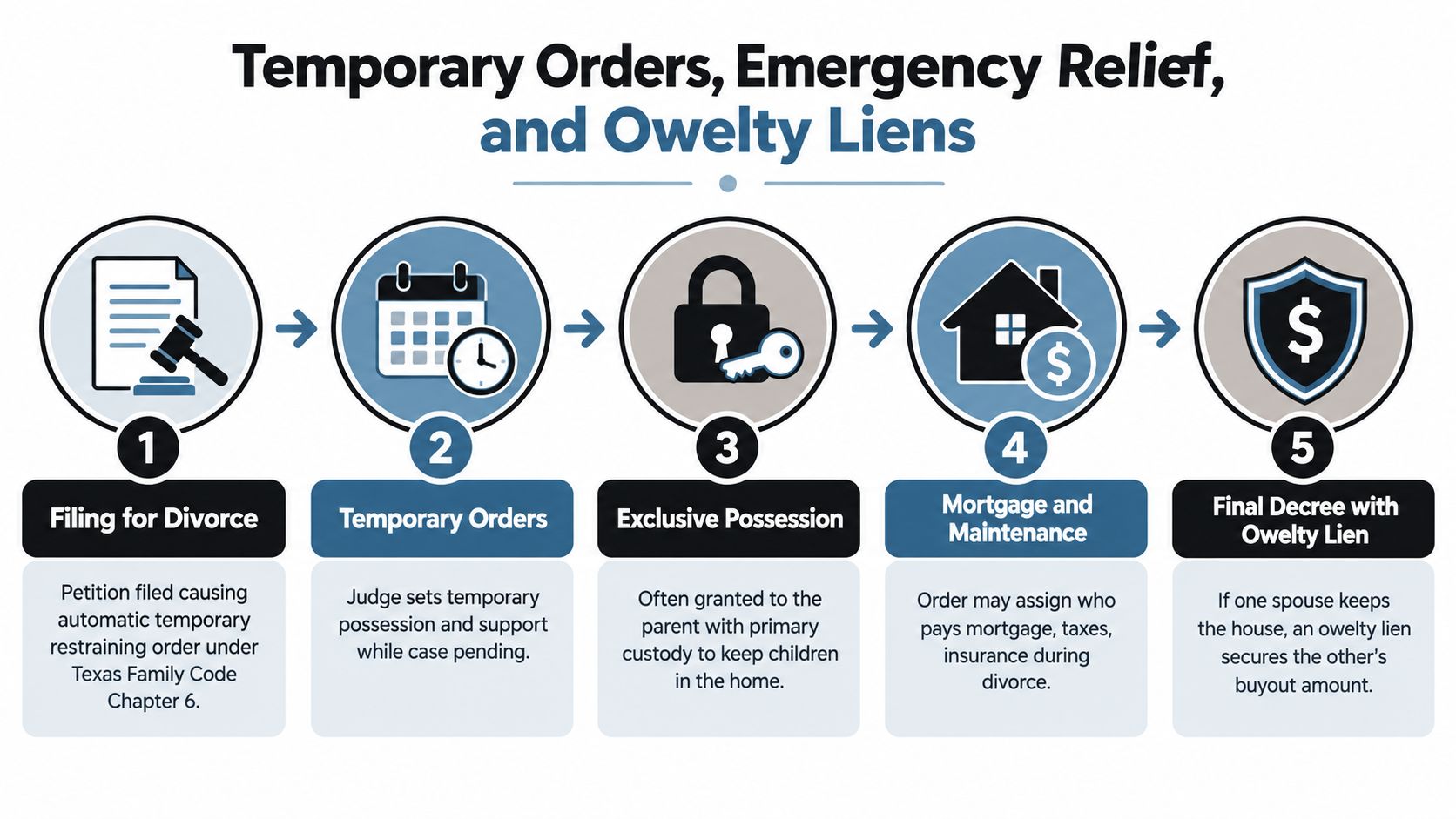
Temporary possession is not final ownership
One spouse may get exclusive temporary use of the home while the case is active. That often happens when children need stability. But temporary possession does not answer final title, final debt, or final equity allocation.
Texas homestead rules also matter here. State constitutional materials recognize strong protection for the homestead, and family-law divisions can later use an owelty structure to equalize equity rather than forcing an immediate sale, as discussed in Texas homestead law materials.
If you're fighting about who stays in the house during the case, review local procedure for a temporary orders hearing in Montgomery County divorce.
Owelty liens solve a real problem
An owelty lien is one of the most useful tools in Texas house division. It lets one spouse keep the home while securing the other spouse's equity claim for later payment.
Texas Estates Code Chapter 102 recognizes a spouse-to-spouse debt created by dividing or awarding the family homestead in divorce as an owelty of partition, and it specifically allows refinance of a lien against the homestead as part of that framework under Texas Estates Code Chapter 102.
A related Texas banking and homestead explanation also notes that the lien needs to be created in the decree or a written partition agreement, and that ownership transfer and equity settlement can happen on different timelines under Texas homestead and owelty guidance.
What I want in the temporary stage
I want the paperwork to answer these questions clearly:
- Who has temporary possession
- Who pays the mortgage, taxes, insurance, and routine upkeep
- Whether either spouse is blocked from refinancing, borrowing against, or damaging the property
- How reimbursement claims will be preserved if one spouse pays more during the case
- Whether a deferred buyout needs lien language built into the final decree
If nobody addresses the house until final mediation, both spouses usually lose their ability to negotiate. Good planning saves bad outcomes.
A Woodlands Scenario and Your Practical Next Steps
Take a Sterling Ridge couple with children in local schools. They own a house together, both names are on the mortgage, and one spouse wants to stay so the kids don't move during the school year. The other spouse wants equity out and doesn't want their credit tied to the loan any longer.
The first smart move is valuation. They order an independent appraisal from someone who knows The Woodlands subdivisions, not a generic online estimate. Then they gather the mortgage statements, tax records, deed history, and closing file to figure out whether there is any serious separate-property argument or whether this is a community asset that needs a practical exit plan.
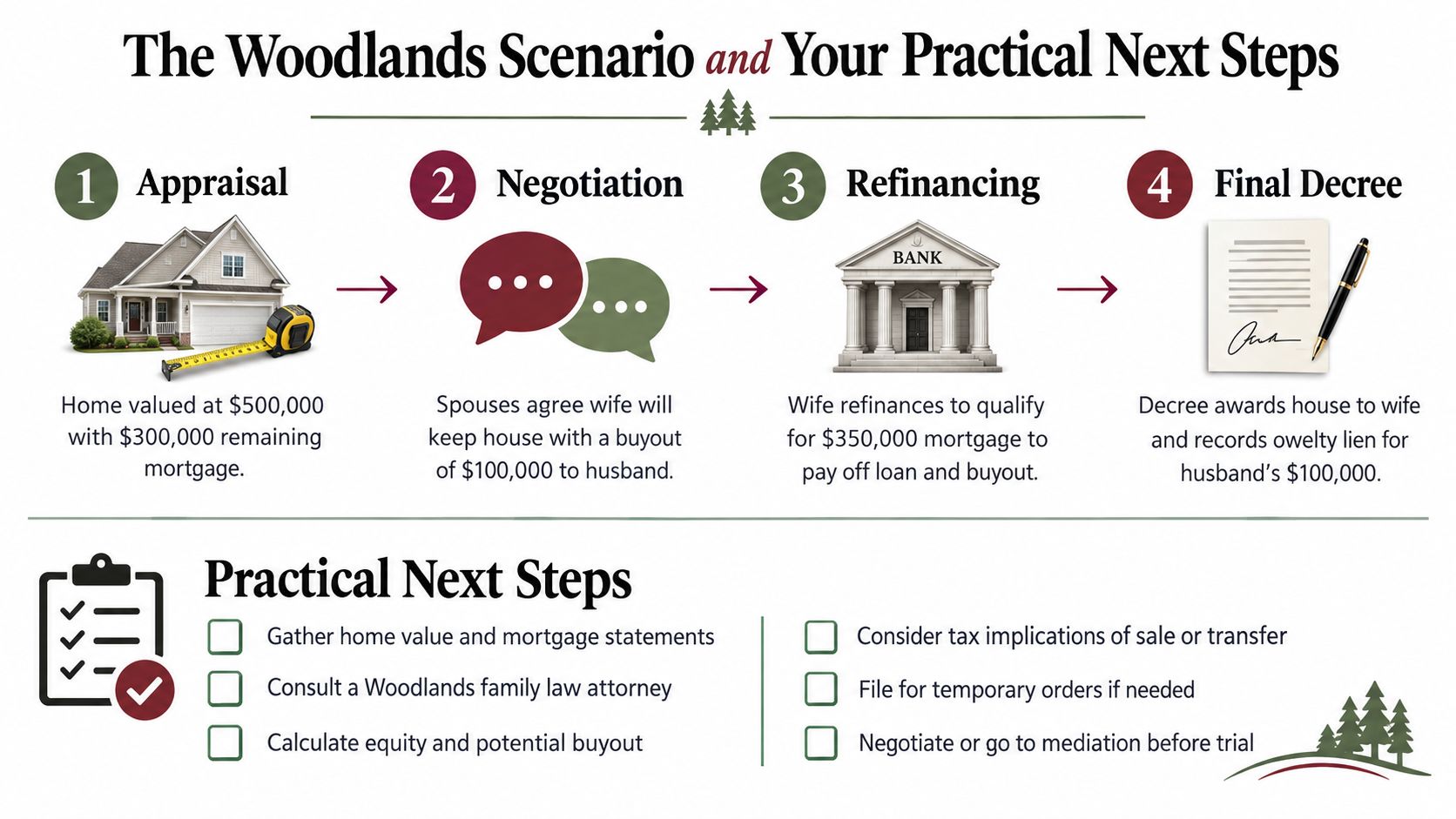
How this usually plays out in real life
The spouse who wants to keep the home asks for temporary possession. That may make sense if the children are primarily with that parent and the parties can cover the bills short term.
Then the hard question arrives. Can that spouse refinance alone? If the answer is yes, the decree can award the house, set a refinance deadline, and include deed documents plus any lien terms needed to protect the departing spouse. If the answer is no, delaying reality only creates a second crisis after the divorce.
Sometimes the better result is a staged solution. One spouse remains in the home temporarily, an owelty lien secures the other spouse's equity claim, and the decree includes a clear future trigger for refinance or sale. Other times, selling now is cleaner and cheaper than pretending one household can support a home that really required two incomes.
The right house outcome is the one you can actually perform after the ink dries.
What to do next
Use this checklist if you're dealing with the marital home in The Woodlands or elsewhere in Montgomery County:
- Order a real valuation: Get an independent appraisal from someone familiar with local neighborhoods such as Sterling Ridge, Alden Bridge, Creekside Park, or Panther Creek.
- Pull the full paper trail: Gather at least the recent mortgage statements, property tax records, deed, closing documents, and any records showing inheritance, gift funds, or premarital contributions.
- Check the refinance question early: Talk to a lender before mediation if keeping the house is even on the table.
- Ask for temporary protections fast: If exclusive possession is disputed, or if you're worried a spouse may sell, refinance, or draw against the property, get temporary relief in front of the court quickly.
- Review the decree line by line: If one spouse keeps the house, the final paperwork should address the deed transfer, any owelty of partition lien, and a written refinance or sale deadline.
- Protect school stability where possible: If children are enrolled in local schools, build the housing plan around a realistic school-year transition instead of making rushed moves.
- Talk to a lawyer before you answer casually: Offhand agreements about the house often turn into the most expensive mistakes in the divorce.
This article is not legal advice. Texas divorce outcomes depend on your documents, your debt structure, your children, and the specific facts in your case. If the house is a major issue in your divorce, get advice based on your situation before you move out, sign a deed, or agree to a refinance deadline you may not be able to meet.
For who gets the house in a divorce in The Woodlands, TX, the honest answer is this: the spouse who can prove the right property claim, support the right financial plan, and present the court with a workable decree usually has the stronger position.
The Law Office of Bryan Fagan helps families in The Woodlands and Montgomery County handle divorce disputes involving the marital home, temporary orders, property division, and the decree language needed to turn a paper award into a workable result. If you're trying to decide whether to keep, sell, or structure a buyout of the house, you can visit The Law Office of Bryan Fagan to schedule a consultation and discuss your options.