 Skip to content
You may be searching “divorce timeline The Woodlands TX” because you need a practical answer, not another explanation that stops at the 60-day waiting period. Perhaps you're considering filing at the Montgomery County Courthouse on Martin Luther King Jr. Place, trying to understand whether your spouse will cooperate, or wondering how children, a home, and retirement accounts will affect the schedule.
The honest answer is that the 60-day minimum is only the starting point. A clean, fully agreed case may be ready soon after that period expires. A case involving disputed custody, difficult service, complex property, or a trial setting can remain active for many months. This guide explains what controls the timeline in The Woodlands and throughout Montgomery County, including what you can do to keep avoidable delays from taking over.
What the Divorce Timeline Looks Like in The Woodlands
A Woodlands couple may file an Original Petition for Divorce with the Montgomery County District Clerk expecting the case to end in two months. That can happen when both spouses resolve every issue and prepare the final paperwork correctly. Disagreement over parenting, support, the home, or financial records changes the timetable immediately. The filing starts the case, but it does not resolve those disputes.
Texas Family Code § 6.702 sets a statutory floor. A court generally cannot grant the divorce before the 60th day after the Original Petition is filed. The waiting period runs from the filing date, not from service on the other spouse. Even a fully agreed case therefore generally reaches its earliest possible completion on day 61. See the Texas statute governing the waiting period.
The practical timeline after filing
A clean uncontested case may be ready for finalization shortly after the waiting period, sometimes around 75 days. That timing depends on accurate pleadings, completed required steps, an agreed decree, and an available procedure for presenting the matter to the court. A missing signature or defective document can postpone an otherwise settled case.
Contested divorces often take four to nine months. A case that needs a trial setting can continue for 12 to 18 months or longer. These ranges describe practical case management, not legal deadlines. Texas Law Help notes that an uncontested divorce may resolve after the waiting period, while disputes involving children, property, hearings, and docket availability can take longer. The Texas Law Help overview of filing a divorce without children offers general procedural context.
Four factors usually decide whether a Woodlands case finishes soon after the waiting period or remains active for months:
- Agreement level: Each unresolved issue can require more negotiation, discovery, or court involvement.
- Children: Custody, possession, support, and decision-making require workable parenting terms, not only a property settlement.
- Asset complexity: A home, business, retirement plan, or separate-property claim may require records, tracing, and valuation.
- Service and procedure: The case cannot proceed normally until the respondent is properly notified, and rescheduled hearings add delay.
A Divorce Lawyer in The Woodlands, TX can help address these issues in The Woodlands and Montgomery County, but no lawyer can remove the statutory waiting period or guarantee a specific court date.
Practical rule: The shortest timeline usually comes from complete financial disclosure, agreement on every material issue, and accurate final paperwork submitted without avoidable delay.
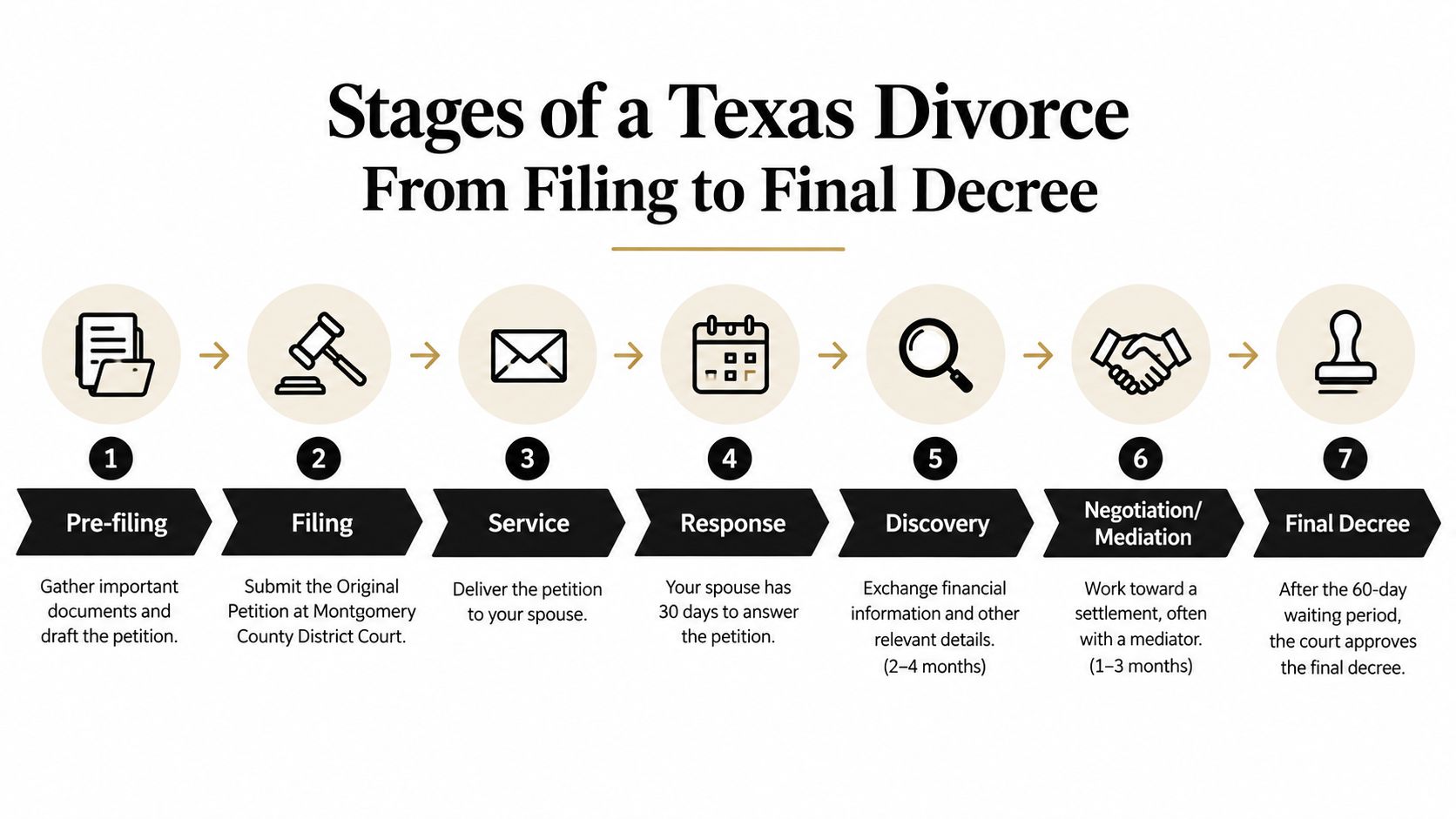
Stages of a Texas Divorce From Filing to Final Decree
A Woodlands divorce can look straightforward on filing day and still take months to finish. The petition starts the case, but service, temporary issues, information exchange, settlement, and the Montgomery County court's schedule determine what happens afterward.
Filing starts the legal clock
Stage one is preparation and filing. Before filing, identify the spouses, children, property, debts, and relief requested. The Original Petition is filed with the Montgomery County District Clerk. That filing opens the case and starts the statutory waiting-period clock.
Stage two is service or waiver. The respondent may sign a waiver acknowledging receipt, or the petitioner may arrange personal service through a sheriff, constable, or private process server. An incorrect address, an evasive respondent, or an out-of-state respondent can delay the case before substantive issues are addressed. Confirming service details early prevents avoidable resets.
Stage three is temporary relief. Either party may request temporary orders if the household cannot function while the case is pending. The court may address possession of the home, temporary support, access to children, payment of bills, and use of property. A temporary-orders hearing may occur early, but the date depends on the dispute and available docket.
Information exchange and resolution
Stage four is discovery. Discovery may include interrogatories, requests for production, depositions, and subpoenas. Financial institutions, employers, business partners, and plan administrators may hold records needed to identify or value property. The process takes longer when one spouse controls the records or produces them incompletely.
Stage five is mediation. Mediation may occur before or after filing, and the court may order it after the case begins. Texas Law Help provides Texas divorce and mediation guidance. Mediation does not remove the waiting period, but it can resolve disputed issues without requiring the judge to decide each one.
Stage six is settlement or trial preparation. After an agreement, counsel prepares the agreed documents for court approval. Without an agreement, the parties must organize evidence, witnesses, exhibits, and legal arguments for a final hearing. A trial setting can come well after one party believes the case is ready, particularly when the court's calendar is full.
Stage seven is entry of the Final Decree of Divorce. The judge signs the decree after the legal requirements are satisfied and the proposed terms are acceptable. A case may finish at the first lawful opportunity after the waiting period, or continue well beyond a year when children, property, service, or contested evidence remain unresolved.
The practical objective is orderly completion, not merely quick filing. Complete information, accurate proposed orders, and timely responses reduce the chance that a missing term or procedural error sends the parties back for correction or another hearing. The difference between a case resolved soon after the waiting period and one lasting many months often appears in these post-filing steps.
What Speeds Up or Slows Down Your Case
The timeline usually turns on the dispute, not the street address of the parties. The Woodlands and Montgomery County location matters because filings, hearings, mediation, and trial settings move through local court procedures, but the substance of the case determines how much work is required.
A fully agreed case can be ready soon after the statutory floor. One unresolved issue can change the character of the case because the parties may need negotiation, discovery, mediation, or a contested hearing.
| Case Factor | Best Case | Worst Case |
|---|---|---|
| Agreement level | The parties exchange information, agree on all terms, and prepare final documents promptly | A disputed issue requires repeated negotiation, mediation, or litigation |
| Children | Parents agree on conservatorship, possession, support, and decision-making | Custody, relocation, safety, or support disputes require hearings and additional evaluation |
| Asset complexity | The parties have clear records and agree on values and division | A home, retirement account, business, or separate-property claim requires valuation and tracing |
| Service and procedural issues | The respondent signs a valid waiver or is served without difficulty | Evasion, address problems, emergency requests, or resets interrupt the schedule |
Agreement level
Agreement saves time only when it's informed and complete. A short document that overlooks retirement division, tax consequences, insurance, personal property, or enforcement language may create a later dispute instead of a real resolution.
Before describing a case as uncontested, make a written list of every unresolved issue. If the list contains only drafting questions, the matter may move efficiently. If it includes the house, children, support, or hidden accounts, the case needs more preparation.
Children and parenting issues
A divorce involving children often requires more than inserting a standard schedule into a decree. Parents may need to address school transportation, holidays, healthcare, extracurricular activities, communication, and changes in residence. If the parents disagree, temporary orders and mediation may be necessary before a final parenting plan can be approved.
The practical step is to create a proposed schedule that reflects the children's actual school and childcare routine. A schedule that ignores Conroe ISD or Tomball ISD transportation, work shifts, or childcare exchanges will be harder to accept and harder to follow.
Property and financial complexity
A home near Sterling Ridge, a Magnolia property, retirement accounts, a closely held business, or stock-based compensation can require records and valuation. Don't agree to a division before understanding ownership, debt, tax treatment, and the mechanics of transferring the asset.
Organizing statements early makes formal discovery more focused. The divorce discovery process in Texas explains why financial information often becomes central when spouses disagree about property.
Service and procedure
Service is not a formality to ignore. If the respondent can't be located or refuses to cooperate, the petitioner may need different service steps or court assistance. Temporary emergency requests and continuances can also change the schedule.
A useful question for counsel is not “Can this be filed today?” but “What could prevent this case from being ready after the waiting period?”
A Realistic Woodlands Divorce Scenario
Consider a composite example involving a Shenandoah-area couple with two children and a jointly owned home near Sterling Ridge. One spouse files an agreed petition on a Monday. Both spouses expect to finish shortly after the statutory waiting period because they've already discussed parenting and property.

The initial plan is workable. The parents outline a parenting schedule, agree on how ordinary expenses will be handled, and identify the home as the principal property issue. They attend mediation with a Conroe alternative-dispute-resolution provider and reach agreement on parenting and most of the property division within five months.
Then one issue remains. The spouses disagree about the valuation date for the marital home. One believes the relevant value should be tied to an earlier point, while the other relies on a more recent value. That disagreement affects equity, the proposed buyout, and the division of other assets.
How one issue changes the schedule
The parties exchange another round of discovery. They request valuation-related records, compare an appraisal with other evidence, and prepare for a contested hearing in Montgomery County. The case is no longer a simple agreed divorce, even though parenting and most financial terms are settled.
A resolution that might have been completed in about four months now moves toward a trial-ready setting around twelve months after filing. The delay isn't caused by the couple living in Shenandoah or owning a home near Sterling Ridge. It results from one unresolved valuation question, the need for reliable evidence, and the court's available settings.
The scenario also shows why rushing can be dangerous. Accepting an uncertain home value merely to obtain a faster decree may produce a division neither spouse understands. A focused appraisal exchange and targeted discovery may take longer, but they give both parties a clearer basis for settlement.
The practical lesson is to separate true drafting disagreements from issues that require proof. If the disagreement changes the economic result, treat it as a substantive dispute and prepare accordingly.
Here's a short video that may help visualize the consultation and preparation process:
Documents and Evidence to Prepare Early
Good preparation begins before filing. Documents help identify what exists, show how property was acquired, and reveal which issues may require discovery. Keep the originals secure, provide copies for working files, and scan everything to a reliable cloud backup because the same records may be requested repeatedly.
Financial records
Use this checklist as a starting point:
- Marriage records: Locate the original marriage certificate and any prenuptial or postnuptial agreement.
- Tax information: Gather three years of tax returns, including schedules, attachments, and K-1s.
- Banking records: Collect twelve months of bank and brokerage statements for each account.
- Employment records: Save pay stubs from Woodlands-area employers and records showing bonuses, commissions, or equity compensation.
- Real estate files: Gather deeds, mortgage statements, home-equity records, and recent appraisals for property in The Woodlands, Magnolia, or nearby communities.
- Vehicles and personal property: Locate vehicle titles, loan records, and documentation for valuable items.
- Retirement information: Obtain 401(k), pension, and IRA statements, along with plan administrator contact information.
- Business records: Preserve formation documents, operating agreements, financial statements, ownership records, and K-1s for any business interest.
- Insurance details: Record health insurance and life insurance policy information, beneficiaries, and coverage terms.
A financial disclosure form for a Texas divorce can help organize the information needed to discuss income, expenses, assets, and debts.
Records involving children
Save school records from Conroe ISD or Tomball ISD, childcare schedules, activity calendars, medical information, and existing communications about parenting. Keep messages in their original form when possible. A chronological file is more useful than a folder filled with screenshots that lack dates or context.
Don't alter messages or delete social-media content after a dispute begins. Make a backup, preserve the surrounding conversation, and tell counsel how the record was created.
Preparation has two benefits: It can shorten routine information exchange, and it can reveal a serious issue before you sign an agreement that can't easily be undone.
Montgomery County Court Procedure Tips
Out-of-area divorce guides often describe Texas procedure without explaining how local practice affects the working schedule. Montgomery County cases may be assigned to the 410th, 418th, or 419th District Courts, and parties should review the applicable court requirements rather than assume every courtroom handles filings and hearings identically.
A standing order concerning children may issue when the case is filed. Read it immediately. It can govern conduct, communication, possession, and financial responsibilities while the case is pending. Parties should also be prepared to exchange financial information before the first hearing when the court's procedures require it.
Preparing for local hearings
Montgomery County courts commonly expect parties to attempt mediation through an approved alternative-dispute-resolution provider before asking for a final trial. Mediation can narrow the issues even when it doesn't resolve the entire case.
Hearings may be set at the Montgomery County Courthouse on Thompson Road, including morning settings. Confirm the exact notice, courtroom, appearance instructions, and exhibit requirements for your case. There isn't a separate family-court filing window that replaces the district clerk's process, so filing and service logistics should be handled through the appropriate clerk procedures.
Texas e-filing is used for pleadings, and remote appearance requests should be made through the district clerk's process and any applicable court instructions. Service options can include a constable or certified mail where legally appropriate, but the proper method depends on the case and the respondent's location. Don't choose a cheaper or easier method without confirming that it will support the relief you're requesting.
A temporary orders hearing in a Montgomery County divorce requires focused preparation. Bring organized evidence, not loose stacks of paper. Judges and court staff can work more efficiently when exhibits are clearly labeled, indexed, and tied to a specific request.
Courtroom organization matters
Prepare a hearing folder with the pleadings, orders, financial information, relevant messages, photographs, and proposed relief. Keep a separate witness and exhibit list. If a fact matters, make sure you know which document proves it and which witness can explain it.
Local scheduling can affect even a prepared case. A party may be ready to settle, but the decree still must be submitted and signed through the court's process. That's why completing documents early and monitoring the docket is more effective than waiting until the last possible day.
Your Next Steps and When to Get Legal Help
Start by reducing uncertainty. You can't control every court setting, but you can control whether your records are complete, whether your position is organized, and whether you make decisions based on verified information.
What to do next
- Gather documents: Collect marriage, tax, banking, property, retirement, business, insurance, and vehicle records.
- Create a dedicated email: Use a private account for case communications and protect access with a strong password.
- Separate finances carefully: Ask for legal guidance before transferring, hiding, closing, or spending marital funds. Opening an account for personal budgeting is different from removing community property.
- Preserve communications: Save texts, emails, voicemails, and social-media content that relates to finances, safety, or parenting.
- Avoid major purchases: Don't take on new debt or make significant purchases without understanding how the transaction may appear in the property division.
- Keep a parenting journal: If children are involved, record exchanges, missed visits, school issues, medical events, and important communications in a factual format.
- Build support: Identify trusted family, childcare help, counseling resources, and practical assistance for the months ahead.
Contact a Woodlands family law attorney promptly if there's domestic violence, a risk of child abduction, suspected hidden assets, or a spouse who has already hired counsel. Those circumstances can require immediate protective, financial, or procedural decisions. A contested custody case, business ownership, or complicated property division also deserves early review.
Limited-scope representation or mediation may be appropriate when both spouses are informed, cooperative, and dealing with a relatively straightforward case. Mediation alone isn't a substitute for independent legal advice when you don't understand the value of an asset, the effect of a parenting provision, or the consequences of signing a decree.

This article is not legal advice. Texas divorce deadlines, service requirements, standing orders, parenting provisions, and property issues depend on the facts of the case, and you should consult a qualified Texas family law attorney about your situation.
The Law Office of Bryan Fagan helps families in The Woodlands and surrounding Montgomery County communities understand the steps, documents, and local court procedures that shape a divorce timeline. Visit The Law Office of Bryan Fagan to learn more or schedule a consultation about your case.
