 Skip to content
You check the bank account and the balance is gone. Or your spouse says they're taking the kids to stay with family and refuses to tell you where. Or the argument at home crossed a line and you don't feel safe going back tonight.
That is when a standard divorce stops being a paperwork problem and becomes a protection problem.
In need of an emergency divorce lawyer the woodlands tx, you probably don't need a lecture on how divorce works in theory. You need to know whether this is a true legal emergency, what can be done fast in Montgomery County, and what you should do before the situation gets worse.
Most local family law pages mention emergencies without defining them. That leaves people in crisis without a usable framework, even though emergency relief like temporary orders is time-sensitive and procedurally different from a basic divorce filing, as noted by Cordell & Cordell's The Woodlands family law office page.
When Your Divorce Becomes an Emergency
A lot of divorces are painful. Not all of them are emergencies.
If your spouse is rude, stalling, or making the process miserable, that's serious. But it usually doesn't require immediate court intervention by itself. A true emergency exists when waiting creates a real risk to safety, children, housing, or property.
A crisis usually looks concrete
In The Woodlands, emergency divorce situations often start with one event that changes the stakes overnight:
- A parent disappears with the children
- A joint account is suddenly drained
- A spouse threatens violence or has already become violent
- Important records, passports, or keys vanish
- The house is being locked down or sold out from under you
Those aren't just signs of a bad marriage. They are warning signs that you may need immediate legal action.
Practical rule: If the problem can't safely wait for normal scheduling, you need to treat it like an emergency now, not after another argument, another transfer, or another missed pickup.
One short scenario
A parent in The Woodlands learns on a Thursday night that the other spouse has emptied a joint account, taken the children's passports, and says they are leaving by the weekend. That's not the time to debate whether things might calm down. That's the time to preserve proof, protect the children, and get a lawyer moving on emergency relief.
Panic is normal. Delay is dangerous.
An emergency divorce case is rarely about getting instantly divorced. It's about getting control back fast enough to stop the immediate damage. In Montgomery County, that usually means shifting from general divorce talk to immediate steps focused on evidence, safety, and court orders.
Defining a True Family Law Emergency in Texas
Some situations need urgent court action. Others need a strong divorce filing and a good strategy, but not emergency relief. If you mislabel the situation, you waste time. If you underreact, you can lose advantage, access to your children, or critical evidence.
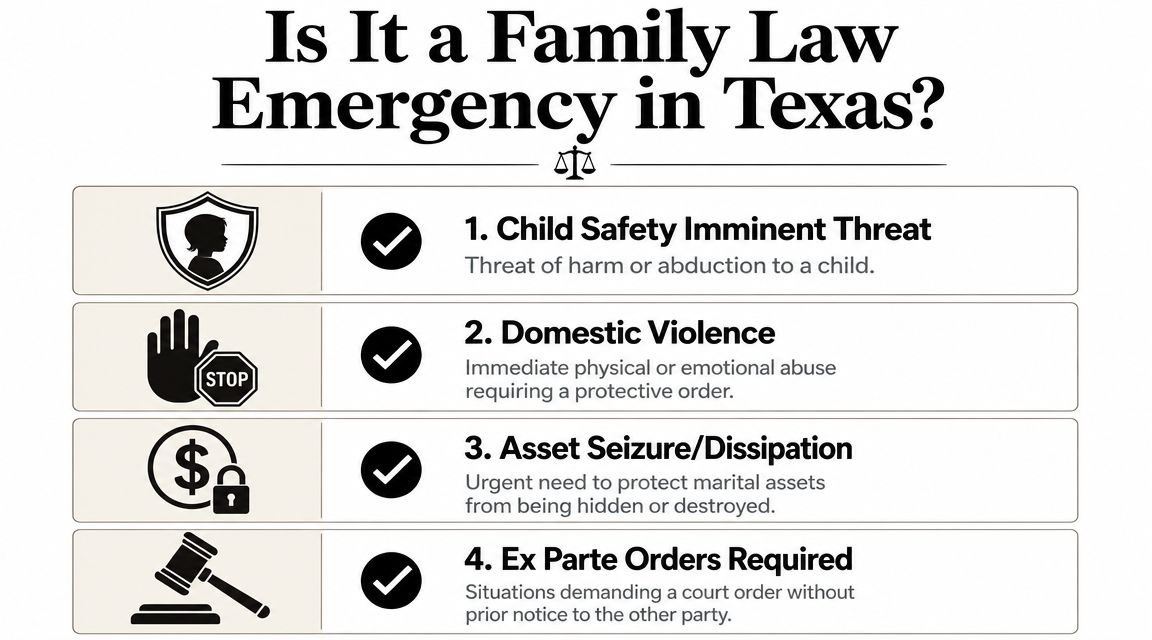
What usually qualifies as an emergency
Use this as your triage test.
Threats to child safety
Your spouse threatens to take the child, hide the child, keep the child from you, or expose the child to immediate danger.Family violence or credible fear of violence
If there has been assault, threats, stalking, intimidation, or conduct that makes you fear imminent harm, that can trigger the need for a protective order under the Texas Family Code.Asset dissipation
Money is being moved, accounts are being emptied, property is being sold, or records are being destroyed.Need for ex parte relief
Some facts are so urgent that asking the other side to wait for a normal response defeats the purpose. Those are the cases where immediate court action may be necessary before full notice and hearing.
What is urgent, but not always an emergency
These issues still matter. They just usually don't justify emergency relief by themselves.
- Your spouse is verbally hostile
- You believe divorce is coming soon
- You disagree about who should keep the house
- Your spouse is dating someone else
- You want the divorce done quickly
Those facts may support filing now. They usually don't mean the court will treat your case as an emergency unless they connect to immediate harm, child risk, or property loss.
If your spouse is difficult, that's litigation. If your spouse is dangerous, hiding children, or moving assets, that's emergency territory.
Don't force a low-conflict method onto a high-conflict case
Collaborative divorce can work when both spouses are cooperative and every issue can be resolved out of court. It is often the wrong tool when there is high conflict or a history of domestic violence, and one unresolved issue can derail the process, as described by Matt Horak's discussion of collaborative divorce in Texas.
My view is simple. If someone is threatening your access to your kids or your financial stability, stop trying to save the process. Start protecting your position.
Your First 72 Hours Protecting Yourself and Your Children
The first three days matter because facts disappear quickly. Texts get deleted. Money moves. Stories change. If you act calmly and document well, you give your lawyer something the court can use.

Start with safety and proof
Do these first.
Get yourself and your children to a safe place
If you're dealing with violence or a threat of violence, safety comes first. Call law enforcement if needed. Courts can address custody and property. They cannot undo a preventable injury.Preserve digital evidence
Screenshot texts, emails, banking activity, social media messages, call logs, and location-sharing records. Save them in more than one place.Collect critical documents
Gather IDs, birth certificates, passports, insurance cards, recent account statements, tax records, deeds, lease papers, loan records, school records, and medical information.Secure your personal accounts
Change passwords on your email, cloud storage, phone backup, and any account used only by you. Use strong, unique passwords.
Be careful with money and communication
You need discipline here.
- Don't clean out accounts in revenge
- Don't send threats back
- Don't sign anything under pressure
- Don't agree to a custody arrangement just to keep the peace if it puts you at a disadvantage
Keep your communication short and factual. If a message would look bad in front of a judge, don't send it.
What helps most in court: dates, screenshots, bank records, school information, and specific conduct. Vague claims don't carry emergency hearings.
A real-world example
A parent in Montgomery County noticed the other spouse's behavior had become erratic. Instead of arguing over text, the parent kept a dated log, saved threatening messages, preserved missed pickup records, and documented sudden school-related disruptions. That kind of organized record can become the backbone of a request for emergency relief involving children.
If child possession is the immediate problem, read about how an emergency custody order in The Woodlands may fit into your next step.
Watch this before you make your next move
Securing Emergency Orders in Montgomery County Courts
When people say they need an emergency divorce lawyer, what they usually mean is this: they need a court order that changes the situation now.
In Texas family law, the main tools are temporary restraining orders, temporary orders, and protective orders. They serve different purposes. If you ask for the wrong one, you lose time.
What each order is designed to do
A temporary restraining order, often called a TRO, is used to stop immediate harmful conduct. In a divorce context, that can include acts involving children, property, records, or access to the home. Think of it as the fast brake pedal.
A temporary order creates rules while the case is pending. It can address possession of the children, use of the home, payment of bills, temporary support, and who controls certain property or accounts. In practice, this is what stabilizes day-to-day life.
A protective order is about safety. If family violence is part of the facts, this is often the most important order on the table. The Texas Family Code governs protective orders and related family-violence relief.
Comparing Emergency Orders in Texas Family Law
| Order Type | Primary Purpose | Typical Duration |
|---|---|---|
| Temporary Restraining Order | Stop immediate harmful acts involving children, property, or access | Short-term emergency relief pending further court action |
| Temporary Orders | Set interim rules for custody, support, housing, and finances during the divorce | Remain in effect during the pending case unless changed |
| Protective Order | Protect a person or child from family violence and related threats | Lasts according to the court's order |
Why strategy matters more than labels
Some clients come in saying they want an uncontested divorce because they want this over fast. That's understandable. It's also often a mistake in a high-conflict case.
Collaborative and uncontested methods can be efficient only when both spouses are cooperative. In emergency cases involving threats, hidden assets, or child risk, trying to force a low-conflict model can cost you the chance to secure immediate protection. That's why a focused request for an emergency family court order in Montgomery County is often more useful than arguing over final terms too early.
The first win in an emergency divorce case is usually not the final decree. It's a court order that stops the bleeding.
The statutory backbone
Texas law gives courts authority to enter temporary relief in family cases. The Texas Family Code provisions on temporary orders and injunctions are where much of this authority starts in divorce matters. If probate or incapacity issues overlap with your family crisis, the Texas Estates Code can matter too, especially if control over documents, property, or decision-making is in dispute.
The Timeline for an Emergency Divorce Case
You filed because something is happening right now. Your spouse emptied an account, kept the children, showed up drunk, or started making threats. You need to know what the court can do this week, what has to wait, and how long the full case will take.
Start with the hard truth. An emergency divorce case can move fast at the beginning, but Texas still requires a waiting period before the divorce itself can be finalized. The emergency part is about getting control early. It is about stopping harmful conduct, setting temporary rules, and protecting your children, home, and money while the larger case moves forward.
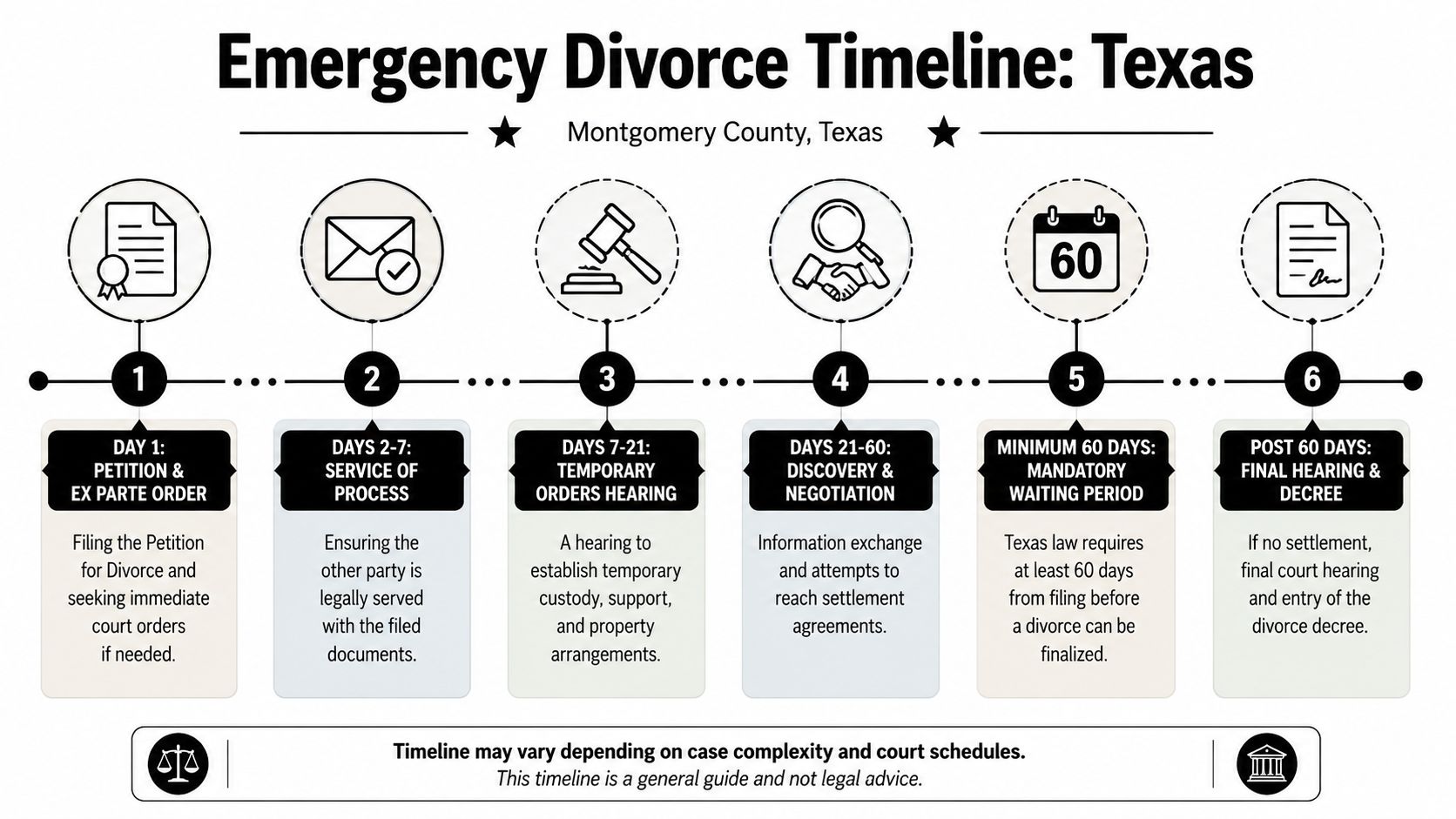
What usually happens first
In a true emergency, the first phase is measured in days, not months. Your lawyer files the divorce, requests temporary relief that fits the facts, and pushes the court to address the immediate risk first. Service on the other spouse still matters. Due process still matters. But the court does not need to wait until every property or custody issue is ready for final trial before stepping in.
Early hearings usually focus on four practical questions:
- Who has possession of the children right now
- Who stays in the house
- What money or property must be frozen or protected
- What behavior has to stop immediately
That first hearing often shapes the rest of the case. A weak start puts you on defense. A strong start gives you stability and a record the court can build on.
A realistic timeline
Day 1 through Day 3 usually centers on filing, gathering proof, and asking for immediate court action if the facts justify it. Day 3 through Day 14 often involves service, a short hearing setting, and temporary restrictions or other early relief. After that, the case shifts into a standard contested divorce track, which can include temporary orders, discovery, negotiation, and, if necessary, trial.
The key point is simple. Emergency relief is front-loaded. Final divorce terms are not.
If you are still choosing counsel, read this guide on how to choose a divorce lawyer in The Woodlands for a high-conflict case. In an emergency, you need a lawyer who can prepare evidence fast, ask for the right orders, and get in front of a Montgomery County judge without wasting time.
What delays cases
The divorce does not slow down because the emergency was not real. It slows down because final orders require more work. Child-related disputes may need records, witnesses, school evidence, or a custody evaluation. Property disputes may require account tracing, business records, appraisals, or subpoenas. If your spouse hides information or ignores court orders, expect more hearings and more time.
That is why your first week matters so much. The documents you collect now can decide how the next several months go. Use a simple system and start immediately. The Superdocu client document collection is a practical example of how to organize records before your lawyer asks for them twice.
The practical expectation
Expect fast action on the issue that cannot wait. Expect a longer process for everything else.
Clients get into trouble when they treat an emergency case like ordinary divorce paperwork. It is not. The early goal is to secure breathing room, stop financial or personal damage, and create a stable temporary structure the court can enforce. Once that is in place, you can fight the final issues from a safer position.
What to Do Next A Checklist for Action
The worst move in an emergency divorce is waiting for things to become clearer. In most crisis cases, they become worse, not clearer.
The Woodlands has a deep legal market. Avvo lists over 60 divorce lawyers serving The Woodlands. That means you have options. It also means you need to choose carefully. In an emergency, general divorce help isn't enough. You want a lawyer who handles temporary orders, emergency hearings, and high-conflict cases in Montgomery County courts. One local option for general family-law representation is The Law Office of Bryan Fagan's guide to choosing a divorce lawyer in The Woodlands.
What to do next
Make safety the first decision
If there's violence, threats, or fear of harm, get to safety and call law enforcement if needed.Lock down your evidence
Save screenshots, account activity, and records today. Not tomorrow.Gather your core documents
If you need help organizing what to collect before a legal consult, this overview of Superdocu client document collection is a practical starting point.Say less to your spouse
Keep communication brief, factual, and child-focused. Don't negotiate major terms under pressure.Don't rely on verbal promises
If someone has already hidden money, threatened to take the kids, or become violent, informal agreements won't protect you.Book a confidential consultation quickly
Bring a timeline, your evidence, and a short list of immediate concerns. Good emergency planning starts with a clean factual record.
This article is for informational purposes only. It is not legal advice, and reading it does not create an attorney-client relationship.
If you need practical guidance on an urgent family law situation in Montgomery County, you can schedule a confidential consultation with The Law Office of Bryan Fagan. A focused review of the facts can help you decide whether you need immediate court action, a standard divorce filing, or a custody-specific response.
