 Skip to content
Yes, in most cases, you can stop a divorce in Texas after filing. The exact path depends on how far the case has progressed and whether your spouse agrees.
If you're in The Woodlands or elsewhere in Montgomery County, that question usually comes up after the first wave of emotion has passed. You filed. The papers are real now. Maybe you and your spouse had a calm conversation for the first time in months. Maybe you're thinking about counseling. Maybe you're worried you moved too fast.
Texas procedure does give you a way to stop the case, but timing matters. If your spouse hasn't responded yet, stopping it is usually more straightforward. If your spouse has already appeared in the case, the decision may no longer be yours alone.
The Moment of Doubt After Filing for Divorce
A common local scenario goes like this. Someone in Alden Bridge or Panther Creek files for divorce after a bad stretch at home. A few days later, the house is quieter, the children are asking questions, and both spouses start wondering whether they should slow down instead of pushing the case forward.
That second-guessing is normal.

In Montgomery County, I see this most often when the filing happened during a crisis. One spouse wanted to create space. One wanted to get the court involved before money moved or parenting conflict got worse. Then the urgency fades, at least for the moment, and the question changes from "How do I get divorced?" to "can i stop a divorce in texas after filing?"
There are usually two practical paths:
- You dismiss your own case before the other side has asked the court for relief.
- Both spouses agree to dismiss after the case has already become active on both sides.
A third option sometimes makes more sense. Instead of ending the case, you ask the court to pause it while you try reconciliation, counseling, or mediation.
Practical reality: Stopping a divorce is often less about legal theory and more about case posture. Who filed what, and when, controls your options.
If you're trying to stabilize emotions before making another major decision, outside support can help. Some people also benefit from reading about recovering after divorce, even if they're not sure the divorce will proceed, because the grief and uncertainty often start before a final decree.
If you're still early in the process, it also helps to understand how the filing itself works in this county. This overview of filing for divorce in The Woodlands gives useful background on where your case sits procedurally.
This article is for general education, not legal advice. Your facts matter, especially if there are children, temporary orders, property access issues, or safety concerns.
Your Primary Option The Voluntary Nonsuit
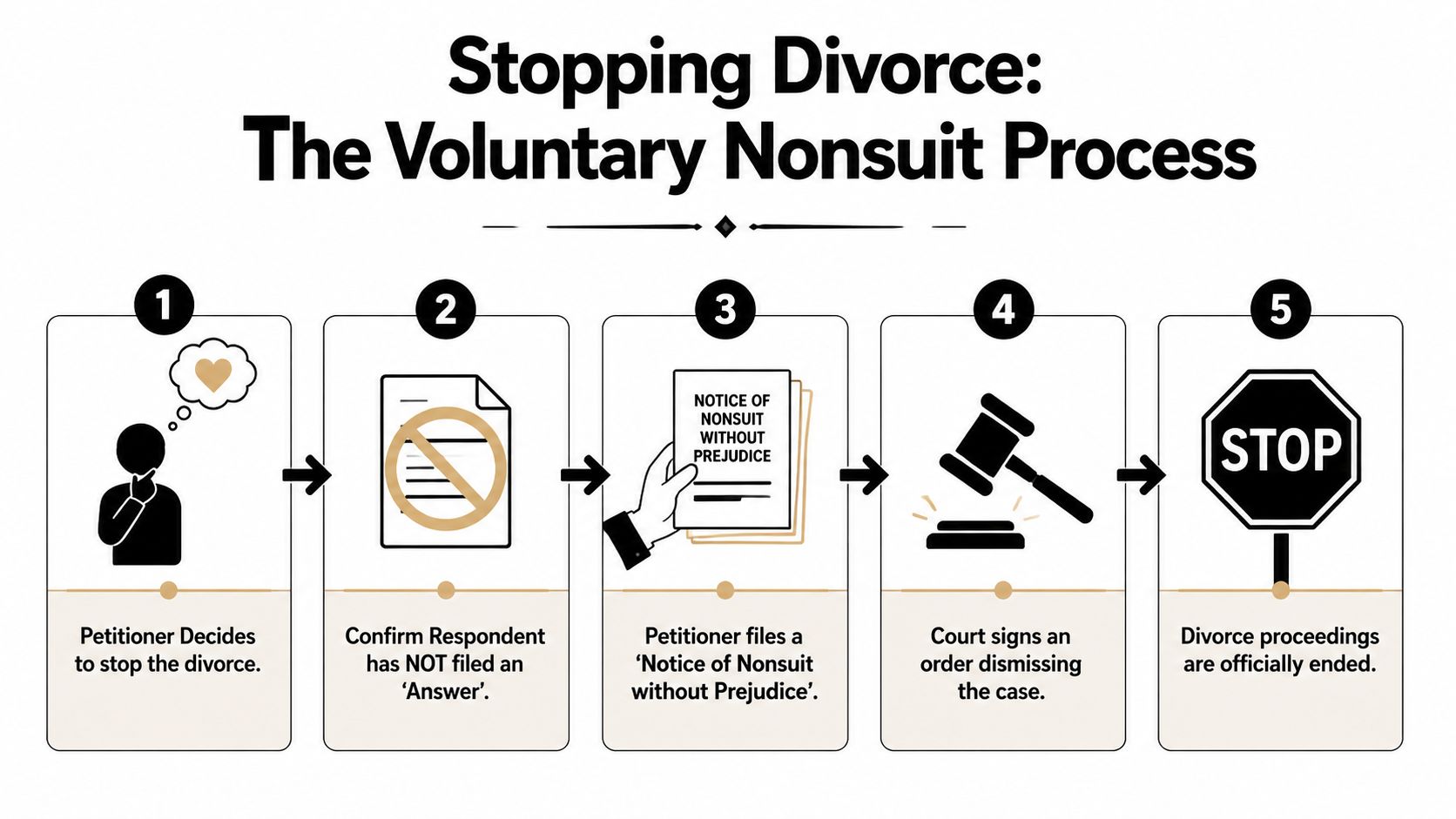
If you filed the divorce, your cleanest option is often a voluntary nonsuit. In plain English, that means you tell the court you're withdrawing your own case.
This is usually the most efficient route when the case is still young and your spouse hasn't filed a pleading asking the court for relief. In practice, that often means the respondent hasn't filed an Answer or a counterpetition.
When a nonsuit works best
A simple example. A husband in Sterling Ridge files for divorce after a major argument. Before his wife is served, they reconcile and decide to start marriage counseling. In that situation, he can usually file a Notice of Nonsuit without Prejudice and ask the court to dismiss the case.
"Without prejudice" matters. It generally means you're not forever barred from filing again later if reconciliation doesn't hold.
The practical steps in Montgomery County
If you're handling this in Montgomery County, the process usually looks like this:
- Confirm the docket status. Check whether your spouse has filed anything. Don't guess.
- Prepare the nonsuit filing. The title usually makes clear that you're nonsuiting your petition.
- E-file it correctly. Montgomery County uses electronic filing, so the document has to be submitted through the proper system and into the correct cause number.
- Request a dismissal order if needed. Filing the nonsuit is important, but you also want the court record to reflect that the case is dismissed.
- Verify the case is closed. Never assume the filing alone ended everything.
A lot of people make the same mistake here. They decide privately that the divorce is off, stop paying attention to the case, and never file the proper dismissal paperwork. That's how avoidable court settings get missed.
A private reconciliation does not automatically close a court case. The file stays alive until the court dismisses it.
Later in the process, many people find it helpful to hear a plain-language explanation before they file anything. This video gives a basic overview of stopping a divorce case:
What works and what doesn't
The following usually works:
- Acting quickly: If you've changed your mind, file before the case grows legs.
- Checking for a response first: This is the difference between a routine dismissal and a more complicated problem.
- Using the right wording: The court clerk can't give legal advice, so your filing needs to be legally sufficient when submitted.
What usually doesn't work:
- Texting your spouse "never mind." That doesn't dismiss anything.
- Ignoring service issues. Even if your spouse was never served, the case still exists if you filed it.
- Assuming the clerk will fix mistakes. The clerk processes filings. The clerk doesn't strategize your dismissal.
Texas lawyers often discuss this under Rule 162 of the Texas Rules of Civil Procedure, which covers nonsuits. The practical point is simple. If the other side hasn't stepped into the case asking for their own relief, you usually have much more control over ending it.
What Happens When Your Spouse Has Already Responded
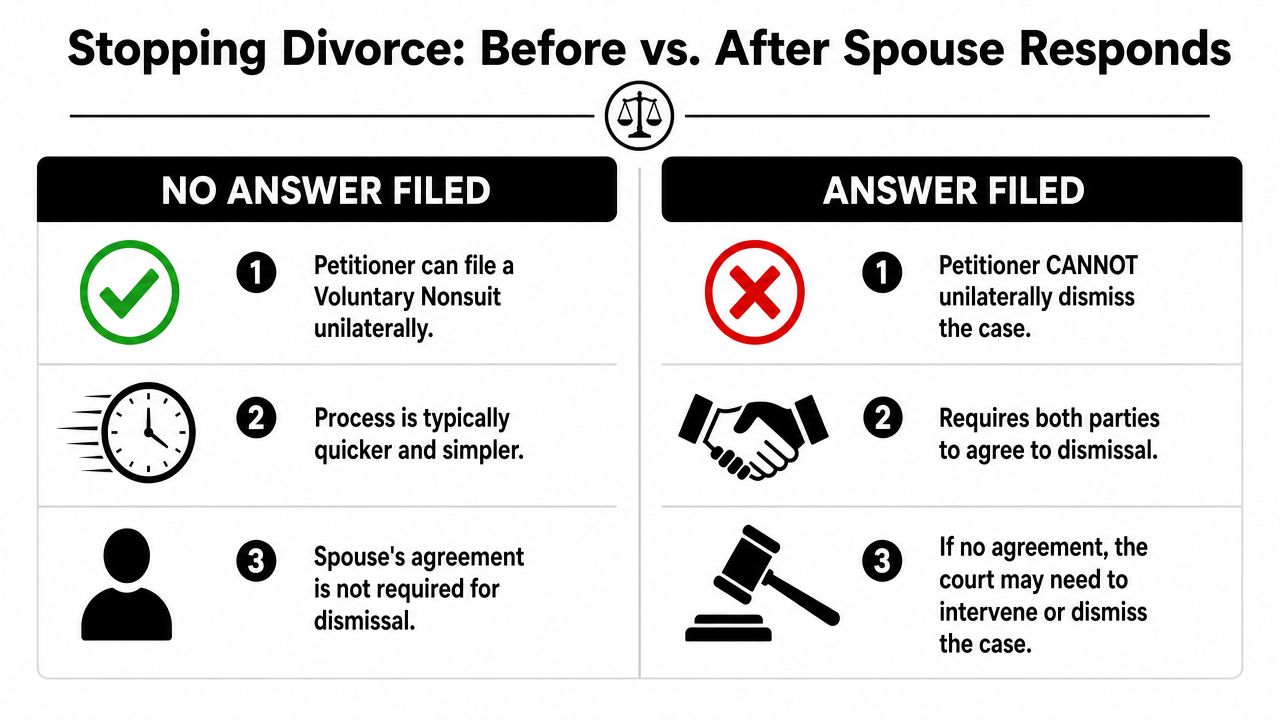
Once your spouse files a response, the ground shifts. At that point, you usually can't just pull the plug on the entire case by yourself, because the court also has to account for your spouse's position and any relief they want.
That's where many online answers become too simplistic. They tell you that you can dismiss your case, but they leave out the part that matters most after an Answer is on file.
The cooperative path
If both of you want to stop the divorce, the usual solution is an Agreed Motion to Dismiss or an Agreed Order of Dismissal. Both spouses sign, the paperwork is filed, and the court can dismiss the case based on agreement.
That is often the best route in Montgomery County when the case has already become active on both sides.
If your spouse was recently served and responded, this article on what to do after being served divorce papers in The Woodlands helps explain why their response changes the posture of the case.
If only one of you wants to stop
The trade-offs present considerable challenges. If you want to reconcile but your spouse wants the divorce to continue, your change of heart may not end the matter.
A court isn't in the business of forcing reconciliation. If the respondent has filed responsive pleadings and wants to move forward, the case may continue despite your hesitation.
| Factor | Voluntary Nonsuit | Agreed Dismissal |
|---|---|---|
| Who controls it | Usually the filing spouse, if the other side hasn't sought relief | Both spouses together |
| Need for cooperation | Not usually | Yes |
| Best timing | Early in the case | After both sides have appeared |
| Risk of delay | Lower | Higher if signatures or terms stall |
| Common local issue | Filing too late | One spouse agrees verbally but won't sign |
Local court reality: Judges and coordinators in Montgomery County want active cases to move. If you're trying to pause or dismiss, do it clearly and through proper filings, not informal promises.
Sometimes a pause is smarter than a dismissal
If reconciliation feels possible but fragile, a motion to abate or a request to stay the case may be the more practical option. That doesn't erase the divorce. It puts the litigation on hold so you can see whether the marriage can be repaired.
That choice often makes sense when:
- Counseling has just started
- Trust is still shaky
- One spouse wants a safety net
- Children are doing better with structure and you don't want to reset everything too quickly
A pause is not the same as peace. It preserves the court file while both of you test whether stopping the divorce is wise.
The Impact of Dismissal on Custody and Support Orders
This is the part people often overlook. Stopping the divorce can also remove court protections that are keeping the household stable right now.
If your Montgomery County judge has signed temporary orders about the children, support, possession of the house, use of vehicles, or who pays which bills, those orders are tied to the pending suit. Under Texas Family Code Chapter 105 on temporary orders, those orders are meant to stabilize the family only while the case is pending. If the underlying divorce suit is dismissed, those temporary orders become unenforceable.
Why that matters in real life
Take a common Creekside Park example. A wife files for divorce and obtains temporary orders giving her exclusive use of the marital home while the case is pending. A month later, both spouses say they want to try again and dismiss the case.
Once the case is dismissed, that court-ordered exclusive use protection is gone.
The same concern can apply to temporary parenting schedules and temporary support arrangements. If one parent has been relying on a signed order to keep exchanges predictable, dismissal can drop the family back into an informal arrangement overnight.
If a temporary order is the only thing keeping daily life workable, don't dismiss the case until you understand what protection you are giving up.
The trade-offs you need to weigh
Before dismissing, ask yourself these questions:
- Housing: Are you living in the home because of a temporary order, or because your spouse is cooperating for now?
- Children: Is there a written temporary schedule preventing arguments, or are things only calm this week?
- Money: Are bills being paid under an enforceable order, or just by informal agreement?
- Communication: If conflict returns, will you have any immediate court structure left?
Those aren't abstract questions. They affect where you sleep, how school drop-off works, and whether support continues.
What tends to work better
In some situations, a short pause is safer than a full dismissal. That is especially true when reconciliation is uncertain or one spouse has a history of changing course quickly.
A practical approach often looks like this:
- Review every active temporary order
- Identify what protection each order gives you
- Decide whether you can live without that protection right now
- Choose dismissal only if the answer is yes
If there are children involved, I usually tell clients to think in routines, not hopes. Hope matters. But school pickup, bedtime, access to funds, and possession schedules matter too.
Can You Refile Later and Should You
If your case is dismissed without prejudice, you can generally file for divorce again later. That preserves your ability to come back if the reconciliation effort fails.
But the better question is often not "Can I refile?" It's "Should I dismiss right now, or should I pause?"
Dismissal versus breathing room
A full dismissal makes sense when both spouses are committed to stopping the litigation and rebuilding outside court. It also makes sense when there are no temporary orders you need to preserve and no immediate concern that one spouse will restart the conflict as soon as the case disappears.
A pause may be smarter when the marriage is unsettled and the legal structure still serves a purpose.
Here is a useful way to approach this concept:
- Dismiss if you both want the case over and you're comfortable losing the court framework.
- Pause if you need time to test whether the reconciliation is durable.
- Proceed if your spouse wants out and the case needs to move, even if you're having doubts.
A hard truth many people need to hear
Stopping the divorce doesn't fix the reasons the divorce was filed.
Sometimes filing is a wake-up call and the marriage improves. Sometimes filing interrupts a bad pattern for a few weeks. If you dismiss too early, you may end up starting over with the same issues and more frustration.
This is one area where getting case-specific guidance matters. One option available to local families is working with a Montgomery County firm such as The Law Office of Bryan Fagan, which handles divorce and related family court matters in The Woodlands and nearby communities. The value isn't magic wording. It's knowing which procedural move fits your exact posture.
Your Next Steps A Checklist and Disclaimer
If you're asking can i stop a divorce in texas after filing, don't make the decision by emotion alone. Check the file first. Then look at what legal protections are in place, and only then decide whether dismissal, agreement, or abatement makes sense.
What to do next
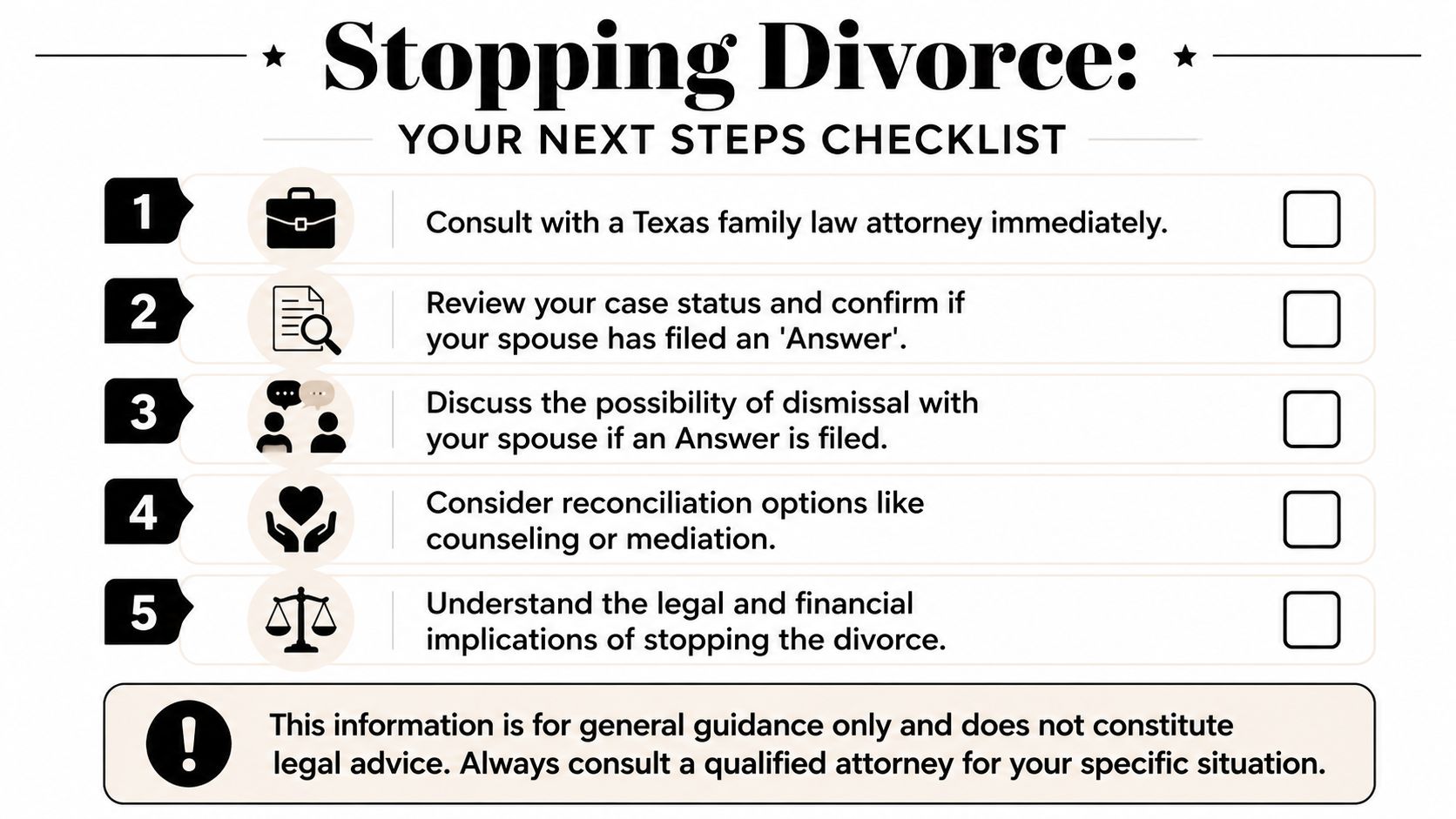
- Check your case status: Look at the Montgomery County court file and confirm whether your spouse has filed an Answer or any counter-request.
- Review all temporary orders: If the court has entered temporary custody, support, or property-use orders, identify exactly what you would lose by dismissing.
- Talk to your spouse if it's safe: If they have already responded, ask whether they will sign an agreed dismissal. Verbal agreement is not enough.
- Consider whether you need a pause instead: Counseling, mediation, or a temporary abatement may fit better than ending the case outright.
- Get legal help before filing: If you need a clearer sense of process, this article on whether you need a lawyer for divorce in The Woodlands, Texas is a useful starting point.
This information is for general guidance only and does not constitute legal advice. Reading this article does not create an attorney-client relationship.
If you want an example of broader website legal notice language, you can also review our full disclaimer. But for your divorce case, the more important point is simple. Your filing status, your spouse's response, and any temporary orders change the answer.
The safest next step is a short consultation focused on your court file, not a generic internet answer. That is especially true in The Woodlands, Conroe, Magnolia, Montgomery, and other parts of Montgomery County where practical court handling matters as much as the underlying law.
If you need help deciding whether to dismiss, pause, or continue your case, you can schedule a consultation with The Law Office of Bryan Fagan. A focused review of your Montgomery County divorce file can tell you what options are available right now.
