
No, a stepparent is not automatically a legal guardian in Texas, and marriage or living in the home doesn't create guardianship or custody. Legal authority can come through three routes: a parent's written authorization, a court order, or adoption, although each gives a different level of authority.
That distinction can surprise families in The Woodlands. A stepparent may handle school pickups, appointments, and bedtime every day without having independent authority to approve treatment or change schools. The practical question isn't just whether you care for the child. It's what document allows you to make the particular decision in front of you.
No, Marriage Alone Does Not Make a Stepparent a Guardian
A wedding changes the relationship between spouses. It doesn't automatically change who holds legal rights over a child.
Those rights normally remain with the child's biological or adoptive parents, subject to existing court orders. A stepparent who handles school runs and doctor visits is like a trusted driver who has the keys but not the title. The responsibility is real, but it isn't the same as ownership of the legal role.
Identify where your authority comes from
For a stepparent, the practical routes are:
- Written parental authorization: A legal parent delegates specified tasks that the parent is legally allowed to delegate.
- A court order: A judge grants particular rights or appoints a guardian, with limits stated in the order.
- Completed adoption: The stepparent becomes a legal parent rather than an authorized caregiver.
The Texas Family Code's adoption-filing provisions expressly allow a stepparent to bring an adoption action, including a request addressing termination of an existing parent-child relationship. That formal process matters: legal parenthood comes from the completed proceeding, not the marriage certificate.
Texas law also ties parental duties to the legal parent-child relationship and court-allocated responsibility, rather than to a household role alone. Being listed as an emergency contact doesn't necessarily give you medical consent authority, and permission to collect a child doesn't necessarily let you enroll that child elsewhere.
Practical rule: Before signing, identify the document that authorizes this particular decision. Don't assume permission for one task covers every other task.
Guardianship, Custody and Adoption Side by Side
Stepparent legal routes compared
| Route | What the stepparent gets | How long it lasts | Other parent's rights | Texas governing law |
|---|---|---|---|---|
| Parental authorization (power of attorney) | Authority the parent chooses and is permitted to delegate | Set by the document; revocable by the parent | Unchanged | Texas Family Code provisions governing caregiver authorization |
| Court-appointed guardianship of a minor | Court-created authority over the child's person and/or estate | Usually ends at adulthood or when the court terminates it | Not automatically ended | Texas Estates Code §1022 and Chapter 1105 |
| Custody or possession order | Conservatorship or possession rights set by a family court | Until modified, expired, or otherwise ended under law | Limited by the order's terms | Texas Family Code Title 5 |
| Stepparent adoption | Full legal parent status | Permanent | The replaced parent's rights end when statutory requirements are met | Texas Family Code Chapter 162 |
This visual offers another way to compare the routes.
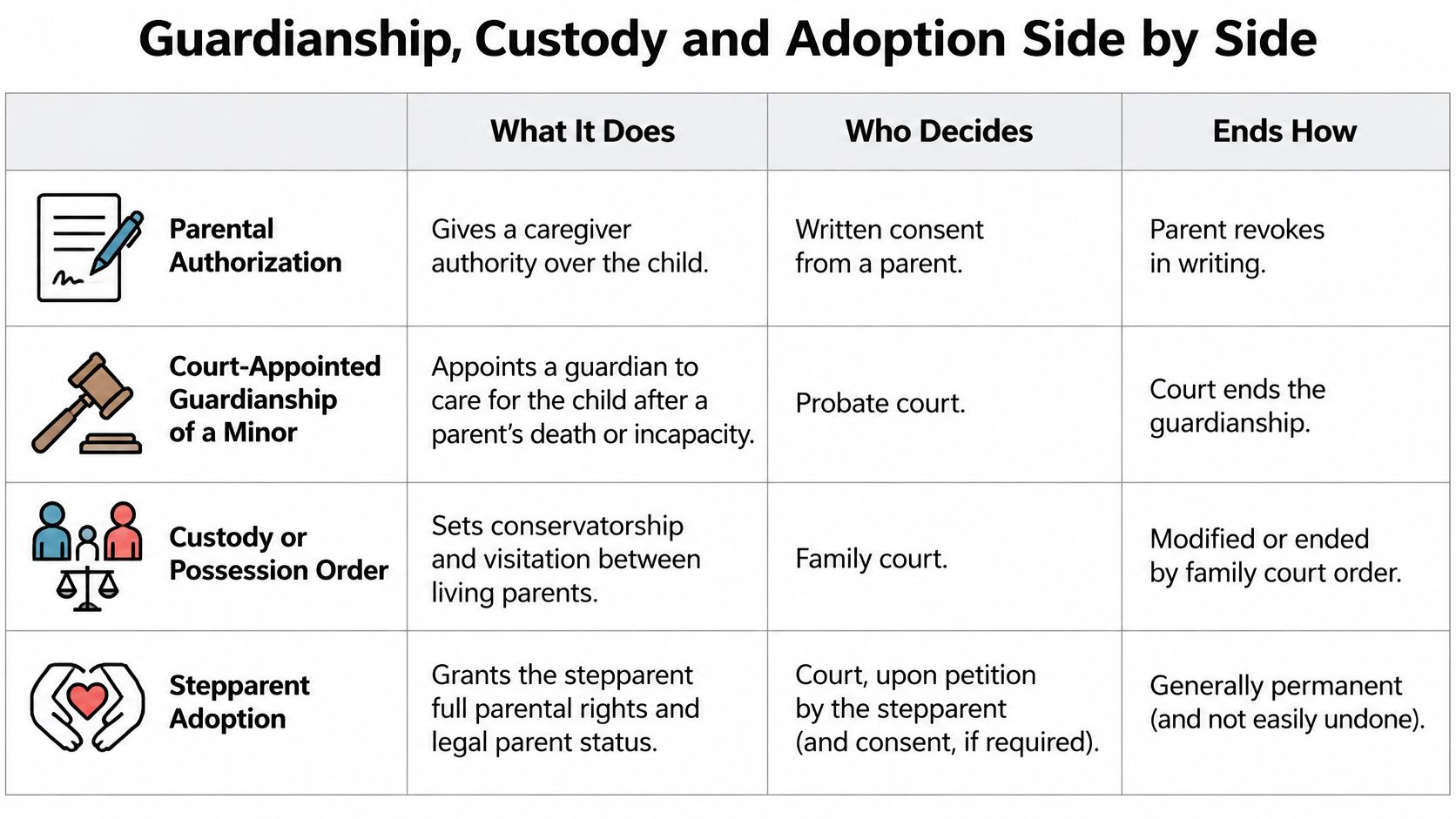
Think about permission, responsibility, and permanence
Using the car analogy, parental authorization is like lending the car. The parent permits particular uses but retains the underlying authority.
Guardianship is closer to appointing a court-approved driver. The guardian has genuine responsibilities, but the appointment doesn't automatically remove the parents from the legal picture. Guardianship of the person concerns care and personal decisions; guardianship of the estate concerns property and finances.
Adoption resembles transferring the title. The Child Welfare Information Gateway's adoption guidance distinguishes permanent adoptive parenthood from guardianship and explains that adoption can end the replaced parent's rights and responsibilities, including future child-support obligations. Don't assume an adoption erases previously unpaid support.
The American Bar Association's stepparent guidance explains that minor guardianship typically ends when the child turns 18, while adoption establishes a permanent parent-child relationship.
Guardianship generally proceeds through a court exercising probate jurisdiction under the Estates Code. Custody and adoption generally proceed through family-law cases under the Family Code. A stepparent must also qualify to bring the particular case; caregiving alone doesn't guarantee access to every remedy.
Choose the goal before choosing the paperwork: temporary permission, court-defined caregiving rights, or permanent parentage.
What a Stepparent Can Decide Today and What Needs a Court Order
Decisions a stepparent can usually make without a court order
| Decision | Usually possible without an order? | What closes the gap |
|---|---|---|
| Routine doctor and dental visits | Often, with valid written parental authorization | Signed authorization accepted by the provider |
| Emergency treatment | You can seek help; marriage alone doesn't authorize consent | Medical authorization or court authority when consent is needed |
| School enrollment and pickup | Pickup may be authorized; enrollment requires separate review | District-approved authorization and any custody order |
| Surgery or ongoing specialist care | Not independently merely because you're a stepparent | Legal parent's consent or appropriate delegated or court-issued authority |
| Access to school or medical records | Only when applicable access rules permit it | Accepted records release or other recognized authority |
| Passport or international travel | Not independently based on stepparent status | Required parental consents or qualifying court documents |
| Moving the child out of the area | Not on the stepparent's authority alone | Compliance with the custody order and any required court approval |
| Insurance or benefit claims for the child | Only when the plan recognizes the claimant's authority | Plan requirements and proof of eligibility or authorization |
A legal parent's permission is the starting point, but schools, clinics, hospitals, and insurers also have documentation requirements. Ask for the actual form they accept rather than relying on a general handwritten note.
Bringing a child isn't the same as consenting
You may be able to accompany a child to an appointment without being authorized to approve a procedure. Likewise, a school pickup designation may allow collection at dismissal without allowing access to every record or authority to change enrollment.
Texas Family Code §151.001 identifies parental rights involving possession, residence, care, control, protection, and discipline, and ties a stepparent's reasonable-discipline authority to having the duty of control and reasonable discipline. Marriage alone isn't the source of that duty.
Surgery, travel, and relocation deserve particular attention. A travel permission letter isn't a passport application, and an agreement to move may still require the court to modify an existing geographic restriction.
A parent can't delegate authority that a custody order withholds from that parent.
Review the signed order before relying on any authorization. In an emergency, seek medical help promptly and tell staff exactly what authority you have; don't delay care while trying to resolve guardianship paperwork.
How to Pursue Guardianship or Custody in Montgomery County
Years of pickups, homework help, and doctor visits still leave the same threshold question: which court has authority to hear your case. Guardianship following a parent's death or incapacity generally raises probate issues, while disputes about custody between living parents generally belong in family court. The right proceeding turns on the child's circumstances and any case already on file, so confirm the correct court before you prepare a single form.
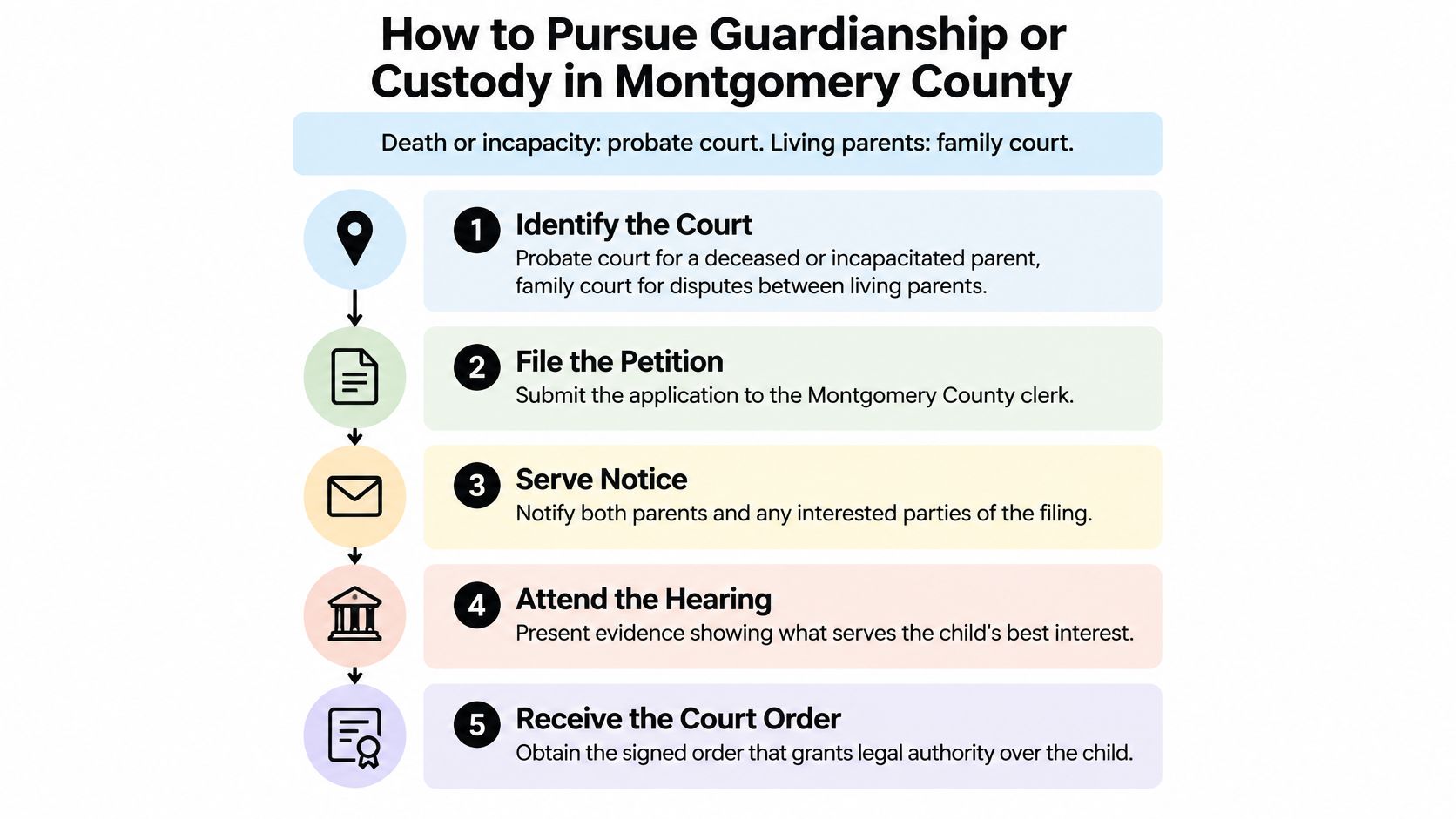
Prepare before filing
Confirm the goal. Decide whether you need temporary permission, custody rights, guardianship, or adoption. Each sits in a different legal category, so ask an attorney whether you're legally eligible to bring that proceeding.
Identify the court and county. Under Texas Estates Code §1023, guardianship venue can turn on where parents or managing conservators reside, or where the last surviving custodial parent lived. Confirm the Montgomery County court assignment with the appropriate clerk rather than assuming any local court can hear it.
Gather supporting documents. Collect the birth certificate, marriage certificate, existing orders, and relevant school and medical records. Separate evidence of daily caregiving from documents that already grant legal authority: a folder of permission slips shows involvement, while a signed order shows standing.
Prepare the application and qualification paperwork. The Estates Code places guardianship proceedings in probate jurisdiction and requires compliance with applicable qualification and bond requirements. Ask counsel which application, supporting records, and proposed orders the assigned court requires.
Arrange legally sufficient notice. Parents and other interested persons may need formal notice. A text message explaining your intentions isn't a substitute for required service.
Prepare for the hearing. Organize evidence about the child's needs, the parents' circumstances, and your ability to serve. The judge must address the applicable legal requirements, not merely whether you've been helpful. That gap surprises many stepparents: daily caregiving supports the case, but it isn't the legal test.
Complete appointment requirements before acting. Follow the signed order, obtain the required letters, and complete any oath and bond requirements. Filing an application starts the case; the court's appointment is what creates the authority.
Track continuing duties. Keep records and calendar required reports. Confirm local filing procedures and scheduling with the court because paperwork and hearing arrangements can differ.
For a family-court route, the firm's guide to filing for custody can help you organize initial questions before you meet with an attorney.
Temporary and Emergency Options While a Case Is Pending
A court case can take months, but a child's needs don't wait. The signature for this week's appointment, a safe place to sleep tonight, an enforceable answer about who decides. Temporary tools exist for exactly this gap, and each one fits a different kind of problem. Picking the wrong one wastes time you may not have.
Match the tool to the immediate need
- Written caregiver authorization: Texas Family Code Chapter 34 addresses authorization agreements for nonparent caregivers. Use one when a cooperative parent is temporarily unavailable and the task is routine, such as a medical appointment or school-related consent. Eligibility, notice, duration, and revocation rules still apply.
- Temporary family-court orders: Texas Family Code §105.001 addresses temporary orders in child-related proceedings. Use this route when a case is already open and a judge needs to allocate care and decision-making while it proceeds.
- Emergency court relief: When a child faces immediate danger, an attorney can assess whether sworn facts support urgent relief. A disagreement about parenting preferences isn't automatically an emergency.
- Temporary probate guardianship: When a parent has died or cannot act, a probate court can grant a temporary guardianship that spells out the authority given and how long it lasts.
An authorization agreement depends on cooperation. It can't override another parent who holds conflicting rights and objects, so a dispute calls for a court order instead.
During a divorce, temporary orders often address the child's schedule and who handles decisions. A stepparent gains authority from those orders only when the order grants it explicitly.
Keep the limits visible: Save the document's expiration terms, permitted decisions, and revocation provisions alongside the signature page.
For a plain-language breakdown of what counts as urgent, see these reasons for emergency custody. The court with jurisdiction must address any emergency request.
Temporary orders don't all last until a judge changes them. Some expire by their own terms or under governing law, so confirm both the end date and what happens next.
When Stepparent Adoption Makes More Sense
Say Dana and Luis live in Panther Creek, and Luis has raised Dana's son since he was four. The boy's father lives in Houston, pays nothing, and hasn't been involved for years.
Luis wants more than permission to sign school forms. He wants a permanent legal relationship with the child. Guardianship would leave the father's underlying rights intact unless separately changed, while adoption could make Luis the legal parent if the statutory requirements are met.
The family relationship may already feel settled, but the legal process still matters.

The other parent's status must be resolved
Under Texas Family Code Chapter 162, the spouse who is already the child's parent must join the stepparent adoption petition, and the other parent's legal relationship must be addressed as required by law. The route may involve that parent's legally sufficient voluntary relinquishment and court-ordered termination, or proof of a termination ground under Texas Family Code Chapter 161.
Consent alone isn't the final court order. Absence and nonpayment also don't automatically terminate parental rights.
For Dana and Luis, an attorney would examine the father's legal status, involvement, support history, and required notice. The court would need the required proof, not just agreement that Luis has acted like a parent.
- Adoption may fit: The home is stable, the adults share a permanent parenting goal, and the legal requirements concerning the other parent can be satisfied.
- Adoption may be harder: Parentage is contested, an involved parent objects, or the evidence doesn't support termination.
- The child's interests remain central: Consider emotional ties, family identity, and the responsibilities the stepparent will accept permanently.
A stepparent adoption consultation in The Woodlands can help distinguish a workable adoption case from a situation better served by limited authorization or another court remedy.
Confirm Your Next Step Before You Sign Anything
Start with the paper in front of you. A permission slip, an enrollment packet, a medical consent form, or a benefits screen each asks for one signature from one adult, and that smaller question tells you more than the broad label “legal guardian.”
When families ask, “Are step parents legal guardians?” the practical answer usually sits in the task ahead: the upcoming procedure, enrollment decision, trip, or caregiving change. Match each task to the adult who can sign today, the order that would expand that authority, and the places where the other parent's rights still control the outcome.
What to do next
- List every signature line: Write down the school forms, provider consents, travel documents, and benefits questions due this year.
- Mark each deadline: Note the appointment date, enrollment cutoff, departure day, or move-in date attached to each item.
- Sort today from later: Label what a current authorization already covers and what would need temporary authority, custody, guardianship, or adoption.
- Test each signature once: Ask the school, provider, or benefits administrator whose signature it requires and which document it accepts.
- Track the other parent's role: Record contact information, current involvement, and any unresolved disagreement before a form depends on it.
- Create a usable packet: Keep accepted authorizations where caregivers can reach them and confirm receipt before the day they are needed.
Families in The Woodlands, including Panther Creek, Alden Bridge, Sterling Ridge, and Creekside, and nearby Conroe and Spring should check county boundaries and existing court jurisdiction. A close address can still fall outside Montgomery County, and an earlier case can affect where a new request belongs.
This article provides general information, not legal advice. Every family's facts differ, and existing orders can change the available options.
The Law Office of Bryan Fagan assists families with custody and probate matters in The Woodlands and surrounding Montgomery County communities. To discuss which route fits your caregiving responsibilities and the child's needs, visit The Law Office of Bryan Fagan to schedule a consultation before signing or filing documents.