 Skip to content
You're standing in a parking lot in The Woodlands at the exchange time listed in your order. Your child isn't there. Your phone lights up with a vague text, or nothing at all. Maybe this has happened once. Maybe it's becoming a pattern.
That's when most parents ask the same question in plain English: what happens if my ex violates custody order in Texas?
The short answer is this. A custody order is a court order, not a suggestion. If your ex keeps denying visits, returning your child late, or ignoring decision-making terms, Texas law gives you a way to ask the court to step in. But enforcement cases are won with precision, not outrage. In Montgomery County, that distinction matters.
A Broken Promise and Your Parental Rights
A missed exchange hits hard because it affects more than your schedule. It disrupts your child's routine, creates uncertainty, and puts you in the position of explaining adult conflict to a child who didn't cause it.
In The Woodlands, that often looks ordinary from the outside. A parent waits at a school pickup line, a restaurant parking lot, or a neighborhood clubhouse. The other parent doesn't show. Or shows hours late. Or sends a message at the last minute claiming the child “doesn't want to go.”

Your order is legally binding
Texas family courts issue possession and conservatorship orders to create stability for children. When a parent ignores those terms, the problem is no longer just disrespectful behavior between co-parents. It becomes a legal enforcement issue.
That matters because it changes your role. You're not asking the court to settle hurt feelings. You're asking the court to enforce its own order.
Practical rule: The parent who stays calm, follows the order, and documents the violation usually stands in a much stronger position than the parent who reacts emotionally.
Helpless isn't the right frame
Parents often think they have only two choices. Put up with it, or blow up. Neither is a good strategy.
There is a third option. Build a clean record, follow the order on your side, and use the enforcement tools Texas law already provides. That approach is less satisfying in the moment, but it works far better in court.
A Montgomery County judge usually wants to see a parent who is focused on the child, respectful of the order, and able to prove exactly what happened. That's the shift. The law grants you influence, but only if you exercise it in a disciplined way.
Understanding What Counts as a Violation
A custody case in Montgomery County often turns on one basic question. Did the other parent violate a clear command in the order, or did they do something frustrating that the order does not forbid?
That distinction decides whether a judge can enforce the problem or whether you are really dealing with a communication failure, a future modification issue, or conduct that needs to be documented until a pattern develops.
The obvious violations
Some violations are straightforward and usually easy to identify:
- Denied possession when the other parent refuses to release the child during your court-ordered time.
- Failure to return the child at the end of a possession period.
- Missed exchanges when the other parent does not show up at the designated time and place.
In Montgomery County courts, these cases are often the cleanest to present because they usually tie to one specific provision, one date, one exchange location, and one clear failure to comply.
The less obvious violations
Other problems fall into a gray area at first, but they can still support enforcement if the order is specific enough.
A parent who repeatedly returns a child late, especially before a school day, may be violating the possession schedule. A parent who makes unilateral medical, educational, or counseling decisions may be violating a joint conservatorship provision. A parent who relocates the child in violation of a geographic restriction may be setting up a serious enforcement problem. The same is true when an order requires a parent to handle a specific duty and that duty is ignored.
The practical test is simple. Can you point to the exact language in the order and match it to a specific act or failure to act? If you can, the issue may be enforceable. If you cannot, the conduct may still be bad for the child, but enforcement becomes harder.
What judges tend to take seriously
Judges in The Woodlands and Conroe usually look for material noncompliance, not ordinary co-parenting irritation.
One late pickup may draw a warning. A repeated pattern of late returns, denied weekends, blocked holiday possession, or disregard for joint decision-making gets more attention. Local courts want specificity. They also want to see whether the conduct interfered with the child's stability, school routine, medical care, or relationship with the other parent.
One late return may be a conflict. Repeated late returns may become evidence that the parent is choosing not to follow the order.
That is the trade-off many parents miss. Filing too early on a weak set of facts can waste time and money. Waiting too long on a clear pattern can make the problem look tolerated.
Best interest still guides the court
Texas family law focuses on the child's best interest, but enforcement still depends on the wording of the order. Courts do not punish every unfair act between parents. They act on conduct that violates a definite term, disrupts the child's routine, undercuts the other parent's court-ordered rights, or shows open disregard for the structure already in place.
Start with the signed order. Read the exact language carefully. In my experience, many worried parents have a real problem, but the winning strategy depends on whether the order gives the court something precise to enforce.
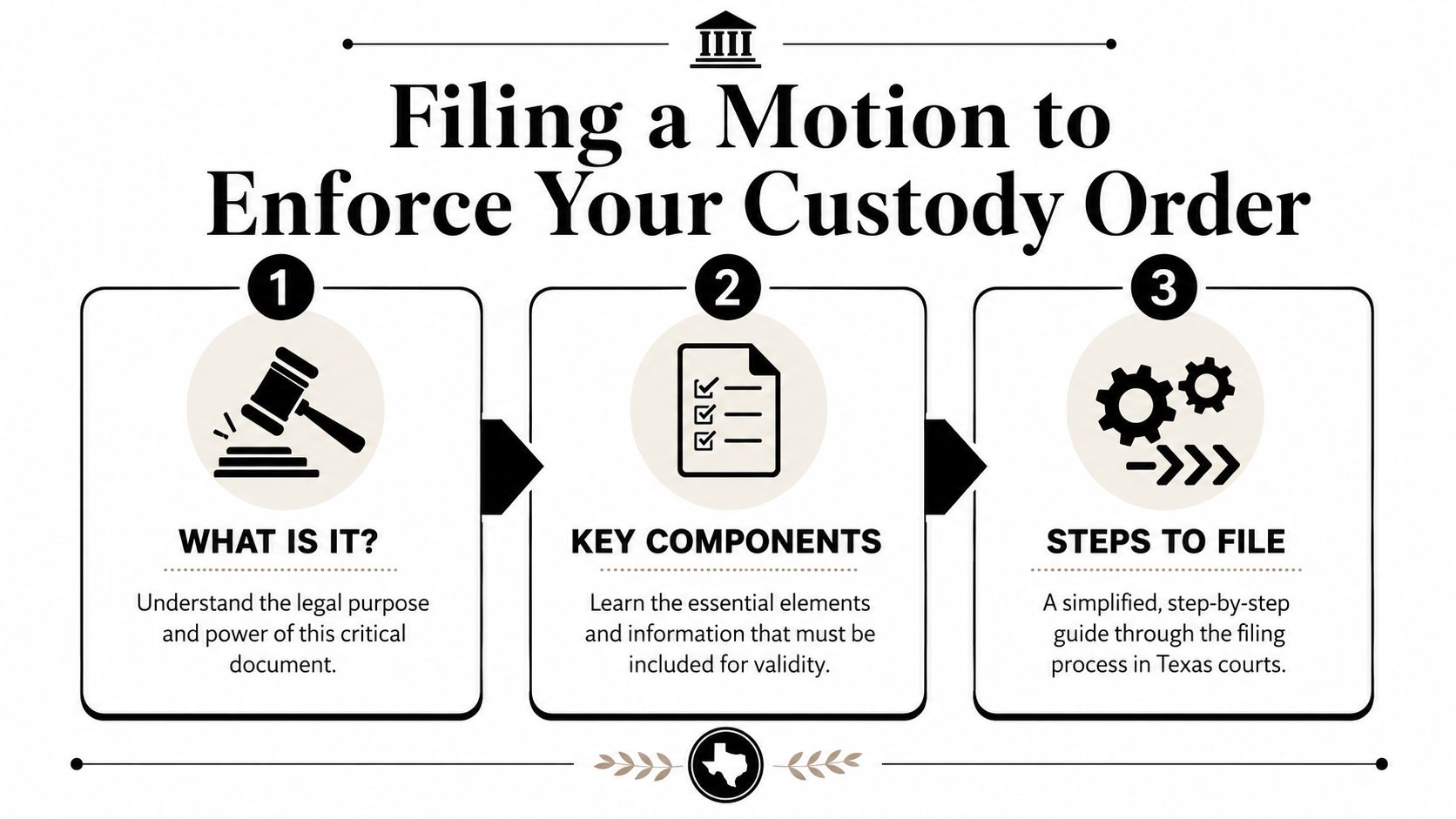
Filing a Motion to Enforce Your Custody Order
When informal efforts fail, the main legal tool is a motion to enforce. At this point, many parents make a costly mistake. They think filing means telling the judge their ex has been unreasonable.
That's not enough.
This is a pleading, not a complaint letter
Under Texas Family Code Section 157.002 as summarized by Texas Law Help, the motion must identify the specific order provision being enforced, describe the alleged noncompliance, and state the relief requested. For each alleged violation, it must state the date, place, and, if applicable, time of the missed or denied exchange.
That requirement changes everything. Enforcement is a detail-driven process. If your filing is vague, you can lose ground before the judge ever reaches the merits.
A strong motion usually ties each allegation to exact language in the order. Then it ties that language to a specific event.
What a workable enforcement record looks like
A useful record often includes:
- The exact clause from the possession or conservatorship order
- The exact exchange details such as the date, location, and scheduled time
- Your compliance with the order
- Any supporting materials that help show what happened
Texas guidance also notes that if you're seeking contempt, the parent asking for enforcement must show they complied exactly with the order and were physically present at the correct exchange location on the correct date and time. That's why “I was supposed to get my child that weekend” is much weaker than “I arrived at the designated exchange location at the scheduled time and waited.”
This short video gives a useful overview of how enforcement cases are approached in practice.
What works and what usually doesn't
Here's the blunt version.
| Approach | How it usually plays in court |
|---|---|
| Showing up exactly as ordered | Strong |
| Keeping a dated log | Strong |
| Matching each violation to the order | Strong |
| Vague claims about “always” or “never” | Weak |
| Emotional text exchanges | Weak |
| Assuming screenshots alone will carry the case | Risky |
The strongest enforcement cases turn chaos into chronology. Judges can act on specifics. They can't do much with general frustration.
Potential Penalties for Violating the Order
Once a Montgomery County judge decides the other parent violated a clear custody order, the court has several tools. The right result depends on what happened, how often it happened, and whether the judge sees a scheduling problem or a parent openly refusing to follow the order.
In practice, judges in Conroe and The Woodlands often start by fixing the missed time and reinforcing the order. If the violations keep happening, the consequences usually get sharper.
Corrective remedies often come first
The first goal is often to repair the loss to the child and the parent who was denied time. A court can order make-up possession, require the violating parent to pay attorney's fees and court costs, and assess fines in the right case.
That approach is common when the judge believes the order can still work if the court forces compliance.
A parent who misses one exchange because of confusion or poor communication creates a different case than a parent who repeatedly withholds the child, ignores deadlines, or treats the possession schedule like a suggestion. Montgomery County courts notice that difference quickly.
Contempt can carry real consequences
If the violation was willful and the order is specific enough to enforce, the court can hold the parent in contempt. That can mean fines, attorney's fees, and in more serious cases, jail time.
For a closer look at how local family courts handle these cases, see this explanation of contempt of court in The Woodlands divorce and family cases.
Judges do not hand out jail lightly. They reserve it for stronger records, clearer violations, and conduct that shows open disregard for the court's authority.
Repeated violations change the case
One missed weekend usually stays an enforcement issue. A pattern of interference can become something bigger.
If a parent repeatedly returns the child late, refuses exchanges, blocks communication, or undermines the schedule enough to disrupt school and routine, the court may start asking whether the current order still protects the child's stability. That does not mean every enforcement case should become a modification case. It means repeated violations can support both strategies, depending on the facts.
That is an important judgment call in Montgomery County. Filing too little can invite more violations. Filing too much, too soon, can dilute a strong enforcement case.
What local judges often focus on
Montgomery County judges usually want clear answers to practical questions:
- Was the order specific enough to enforce
- Did the parent violate that specific language
- Was the conduct isolated or repeated
- Did the violation affect the child's routine, school schedule, or stability
- Does the record show deliberate noncompliance rather than a one-time dispute
A minor first violation may draw a warning and a corrective order. A documented pattern can lead to contempt findings, fee awards, make-up time, and much tougher scrutiny the next time that parent comes to court.
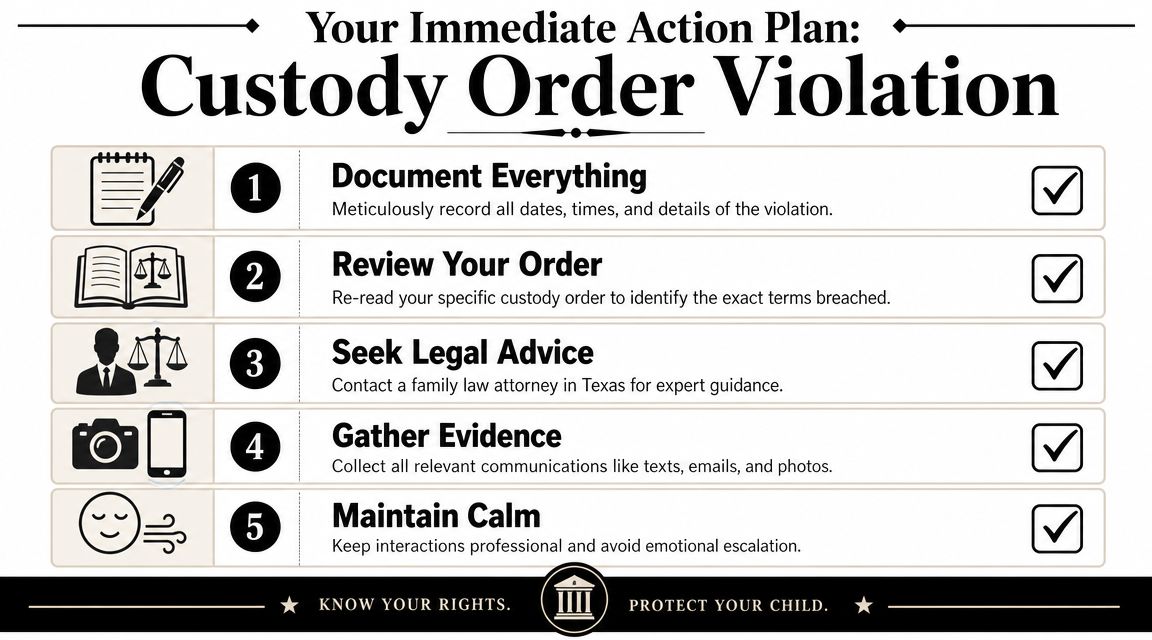
Your Immediate Action Plan a Practical Checklist
When a violation happens, your first move shouldn't be a long angry text. It should be evidence preservation.
A common local example involves a parent in The Woodlands who keeps getting their child back hours late on school nights. At first, it feels too small to take to court. Then it happens again. Then again. The child is tired, homework is late, and the other parent starts acting like the order is optional.
That's when a simple checklist matters.
What to do next
- Show up anyway. If the order says be at a certain place and time, be there. Texas guidance emphasizes that strong evidence includes being physically present at the correct location and time.
- Keep a written log. Record the date, the scheduled exchange terms, what occurred, and how long you waited.
- Save digital communications. Keep texts, emails, and app messages. They help, but they usually shouldn't be your only proof.
- Collect corroboration. Receipts, photos, and witness information can matter because Texas guidance warns that texts alone are often not enough to prove a violation in court, as noted by Texas Access on enforcing visitation.
- Read your order again. Focus on exact language for possession, exchange location, and decision-making rights.
- Respond briefly and calmly. Written communication is useful when it stays factual.
- Don't retaliate. Don't keep the child next time “to make it even.” That usually creates a second problem.
- Talk with counsel early. If the issue is repeating, strategy matters more than outrage.
What good communication looks like
A productive message is short. It sticks to the order.
You might say that you were present at the exchange location at the scheduled time, that the exchange did not occur, and that you want to know when the child will be made available. That creates a record without giving the other parent fresh ammunition.
A bad message includes insults, threats, or long arguments about past grievances.
Keep your messages short enough that a judge could read them quickly and see you were being reasonable.
Strong proof is usually layered proof
Parents often ask if screenshots are enough. Sometimes they help. Usually they need support.
The strongest proof tends to be time-stamped behavior, not just conversation. A gas receipt near the exchange location, a photo showing you there, a witness who came with you, or a clean calendar entry can support your account. That's often more persuasive than a text chain full of accusations.
If you need help organizing that material before filing, a Montgomery County custody attorney can help sort usable evidence from noise.
Navigating Enforcement in Montgomery County Courts
Texas law provides the framework. Local practice shapes how the case feels.
In Montgomery County, judges generally expect parents to treat custody orders seriously and to arrive prepared. That means clean pleadings, specific evidence, and a child-focused presentation. Broad claims and emotional narratives usually don't carry much weight if the details are missing.

Local reality matters
Parents in The Woodlands, Conroe, Magnolia, and nearby parts of Montgomery County often assume a judge will “understand what's really happening” from the big picture. Sometimes the judge may understand it. But enforcement still depends on what you can prove.
That's why local preparation matters. A lawyer who regularly handles custody order enforcement in The Woodlands will usually focus early on the exact order language, the exchange details, and whether your evidence fits an enforcement claim or points instead toward modification.
Strategy is not always the same as punishment
Sometimes the right move is filing for enforcement quickly. Sometimes the better move is pausing long enough to improve your evidence. Sometimes the facts suggest that repeated enforcement filings won't solve the underlying problem and that modification should be on the table.
That's where practical judgment comes in. Court is a tool, not a reflex.
The bottom line
If your ex is violating a custody order in Texas, you do have options. But the process is stricter than many parents expect. Montgomery County courts want specifics. They want proof. And they want to see that you followed the order too.
This article is for informational purposes only and is not legal advice. Reading it does not create an attorney-client relationship. Your facts, your court, and your order matter.
If your parenting order is being ignored in The Woodlands or elsewhere in Montgomery County, a consultation can help you decide whether enforcement, modification, or a different approach makes the most sense. You can schedule a conversation with The Law Office of Bryan Fagan to review the order, assess your evidence, and discuss next steps.
