 Skip to content
Yes, you can lose custody for not following court orders in Texas, and a judge can also impose up to six months in county jail for each violation in serious contempt cases. But custody loss usually isn't automatic. In Montgomery County, the court will look closely at whether this was a one-time problem or a pattern of willful non-compliance that affects the child's stability and best interests.
If you're in The Woodlands, Conroe, Magnolia, or another part of Montgomery County, this question usually comes up at a breaking point. A parent is frustrated, an exchange went badly, the other side is acting unreasonable, and someone starts thinking, “I'm just not going to follow this order anymore.”
That's the moment to slow down.
Texas family courts treat custody orders as binding court orders, not suggestions. If you want to know whether the answer to “Can I lose custody for not following court orders Texas” is real and practical, it is. The bigger issue is what kind of violation happened, how often it happened, and what proof exists.
The High Stakes of Ignoring a Texas Custody Order
A possession order can feel unfair when real life gets messy. Work changes. Kids get sick. One parent starts pushing boundaries. Sometimes a parent in The Woodlands tells themselves that skipping one exchange or keeping the child a little longer is justified.
That thinking creates risk fast.
Under Texas guidance on the best interest of the child, custody and visitation orders are legally enforceable under Texas Family Code Chapter 153, and the child's best interest is the court's primary consideration. In Montgomery County, that standard drives everything from enforcement to modification.

What judges care about most
Judges usually don't focus on who feels more offended. They focus on stability, safety, follow-through, and whether a parent is helping or harming the child's relationship with the other parent.
That means two things can be true at once:
- A single problem may not destroy your case
- A repeated pattern can seriously damage your position
Practical rule: If a parent disagrees with the order, the solution is to ask the court to change it. The solution is not self-help.
The local reality in Montgomery County
In practice, local courts tend to care less about dramatic accusations and more about specifics. What date was the exchange? What time? What did the order say? What message was sent? Was the child returned?
Those details matter because they show whether the issue was a misunderstanding or deliberate disobedience.
If you've missed exchanges, denied visits, refused communication, or kept the child outside the ordered period, the court may start viewing that conduct through the lens of the child's best interest. Once that happens, the legal conversation changes. It stops being about irritation between co-parents and becomes about whether one parent can be trusted to follow court orders.
What a Texas Custody Order Legally Requires
Many parents use the phrase “custody order” as if it only means a pickup and dropoff schedule. It's broader than that.
In Texas, the controlling document is often an order in a Suit Affecting the Parent-Child Relationship, sometimes called a SAPCR. The order is enforceable because it comes from the court, and the court's authority in these cases comes from the Texas Family Code, including Chapter 153 for conservatorship, possession, and access.
It covers more than visitation
A typical order may address several separate duties:
- Possession and access. This is the schedule for weekends, holidays, summer periods, and exchange times.
- Rights and duties. This can include who makes educational, medical, and other important decisions.
- Support obligations. Child support and medical support may be part of the same overall case, even if they're enforced differently.
A parent can violate the order in more than one way. Refusing to turn over the child at the start of possession is one example. Refusing to return the child on time is another. Blocking ordered communication can also matter. So can ignoring decision-making terms.
Why the exact wording matters
Texas courts enforce the order that was signed, not the version one parent thought was fair.
That's why small wording differences become major issues. “Pickup at 6:00 p.m.” is different from “after school.” “At the child's school” is different from “at the residence.” “Mutual agreement” language creates different proof issues than a fixed Standard Possession Order schedule.
A lot of parents get in trouble because they're reacting to the co-parent's behavior instead of following the signed order in front of them.
Common mistakes parents make
Some violations are obvious. Others happen because a parent assumes the court will understand.
Here are common examples:
- Trading weekends informally, then fighting about what was agreed
- Keeping a child longer because the child wants to stay
- Refusing the exchange until support is paid
- Canceling visitation because the co-parent was rude or late before
- Making medical or school decisions without following the allocation in the order
The court usually won't treat those as harmless if the order says otherwise. If you need a different arrangement, the safer move is to document the issue, communicate in writing, and ask for formal relief instead of rewriting the order on your own.
Enforcement Actions a Montgomery County Judge Can Take
When a parent files a motion to enforce, the case stops being an argument about parenting style and becomes a question of whether a court order was violated.
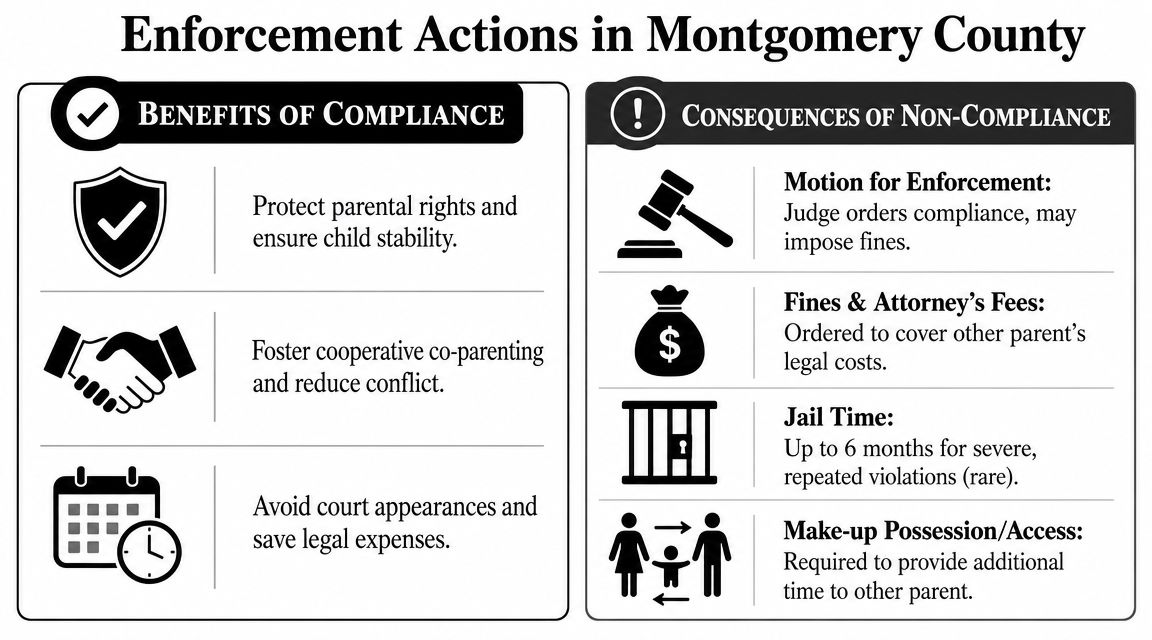
Under Texas State Law Library guidance on enforcing a SAPCR, consequences can include contempt findings, monetary fines, make-up possession, and up to six months in county jail for each violation. That same guidance explains why repeated noncompliance can become evidence of instability.
What counts as a serious violation
Judges usually look for proof that the violation was specific, repeated, and willful.
A parent who wants enforcement should usually be ready with dates, times, the exact order language, and supporting records such as texts, emails, call logs, or exchange notes. If you're dealing with allegations of contempt in family court, this overview of contempt of court in The Woodlands divorce cases gives useful context on how these proceedings are approached.
Minor issue versus pattern of non-compliance
| Situation | How a judge may view it | Likely response |
|---|---|---|
| Parent is briefly late because of traffic and communicates clearly | More likely seen as an isolated scheduling problem | Warning, stern instruction, or no major sanction if it isn't repeated |
| Parent misses one exchange but promptly explains and cooperates on a makeup plan | Often treated less harshly if the conduct wasn't willful | Possible makeup time, focus on future compliance |
| Parent repeatedly denies possession without court approval | Seen as intentional interference | Enforcement remedies, attorney's fees, contempt risk |
| Parent keeps the child beyond the ordered return time | Viewed as serious because it disrupts possession and stability | Make-up possession, contempt, stronger court restrictions |
| Parent ignores the order after prior complaints or warnings | Suggests willful disobedience | Greater risk of fines, jail exposure, and future modification evidence |
A short real-world scenario
A parent in Conroe gets upset because the other parent brought the child home late twice. In response, that parent refuses the next two weekend exchanges and says the other side has to “learn a lesson.”
That usually backfires.
The court is unlikely to view that as reasonable self-help. The judge may see the late returns as one issue and the denied weekends as a separate, provable violation of the order. The parent who thought they were taking control may end up defending an enforcement action instead.
Good facts are wasted when a parent responds to a problem by violating the order too.
How Disobeying Orders Can Lead to Custody Modification
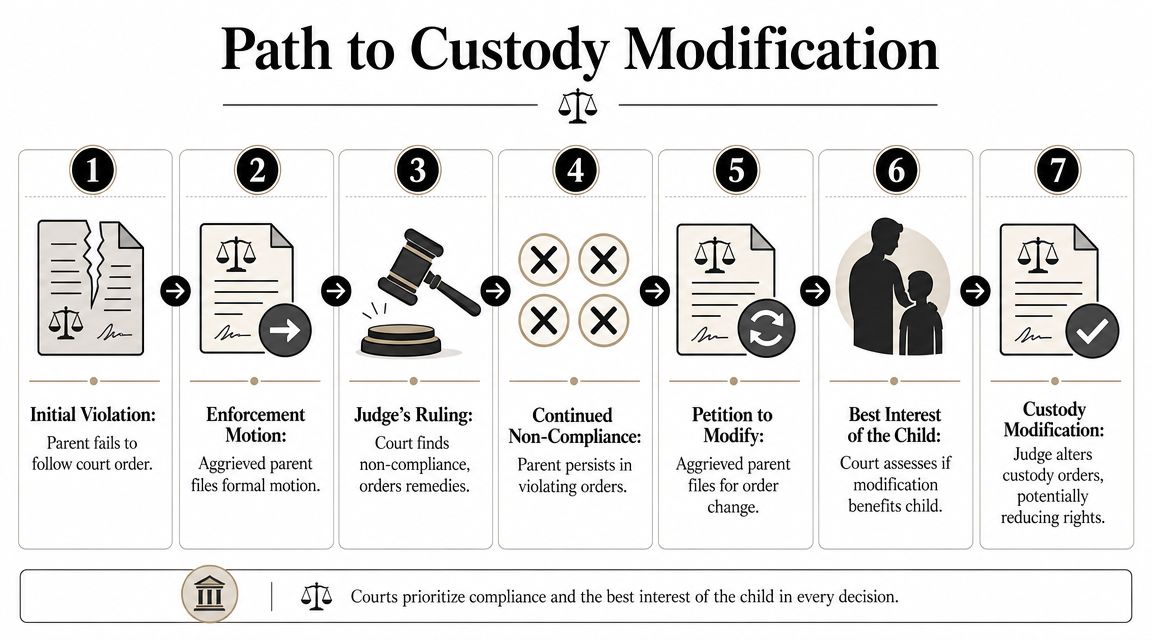
The path from violation to custody loss usually isn't one dramatic hearing. It's a record that builds.
A parent violates the order. The other parent documents it. An enforcement case gets filed. The judge addresses the violation. If the conduct continues, the same facts can later support a request to change custody.
When the issue becomes bigger than enforcement
According to Texas family law guidance on refusal to follow a custody order, enforcement violations can support a later custody modification request if the court concludes the parent's conduct is harming the child's best interests. That guidance also notes that a single missed exchange rarely changes custody, but a pattern of willful non-compliance can lead to restricted possession or a change in the primary conservator.
That distinction matters.
A judge in Montgomery County may not be interested in relitigating every petty disagreement between adults. But if one parent keeps showing that they won't respect the child's schedule, won't support the child's relationship with the other parent, or keeps pulling the child into conflict, the court may decide the current arrangement no longer works.
What judges tend to look for
Modification requests often gain traction when the facts show a pattern such as:
- Repeated denial of visitation
- Interference with calls or communication
- Keeping the child outside the ordered period
- Using the child to manipulate adult disputes
- Ignoring prior court warnings or enforcement orders
Those facts can suggest poor co-parenting judgment. They can also suggest that the parent is creating instability around school, routines, and emotional security.
A broader primer on Florida family law contempt of court can also be useful for understanding the general logic behind contempt proceedings, even though Texas courts apply Texas statutes and local procedure.
Later in the case, parents often benefit from reviewing how a custody modification in The Woodlands, Texas is actually requested and what kinds of evidence tend to matter most.
Here's a short video that helps frame how these disputes develop in practice.
A practical scenario from a high-conflict case
A parent in The Woodlands doesn't just miss one exchange. Over time, that parent starts canceling visits, claiming the child doesn't want to go, and refusing makeup time. School events are used to create conflict. Phone access gets limited. Messages become hostile.
At first, the other parent files for enforcement.
If the behavior continues, the court may stop seeing the case as a scheduling dispute. The judge may conclude that one parent is undermining the other parent's court-ordered role and creating instability for the child. At that point, the request may shift from “make them comply” to “change the order so this keeps happening less.”
That's where people effectively “lose custody” in Texas. It may not be a complete loss of parental rights. More often, it looks like restricted possession, supervised visitation, tighter exchange terms, or a change in who has the primary right to determine the child's residence.
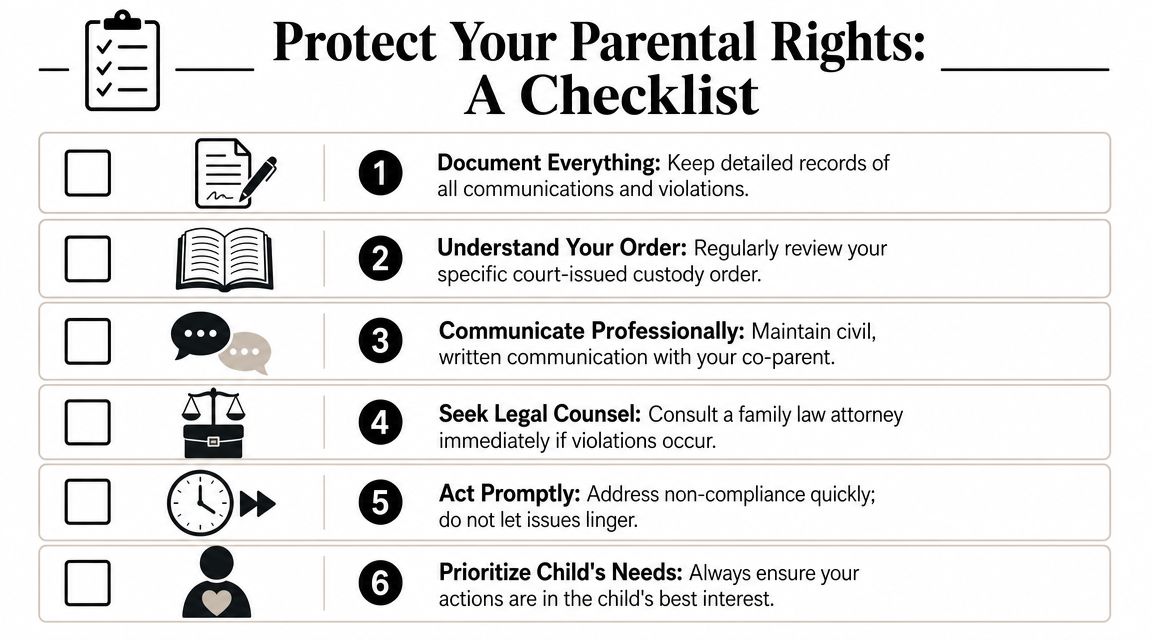
What to Do Next A Checklist to Protect Your Rights
When emotions are high, parents often make the wrong move because they want immediate relief. The better move is usually the one that creates a clear record and keeps you on the right side of the order.
If you need a practical starting point, use this checklist.
If you think the other parent is violating the order
Read the signed order closely
Don't rely on memory. Check the exact language for dates, times, holidays, and exchange locations.Document each incident in real time
Keep a journal with the date, time, what the order required, what happened, and any witnesses. Save texts, emails, screenshots, and call logs.Communicate in writing and stay calm
Short, factual messages help. Avoid insults, threats, and editorial comments that distract from the violation.Ask for compliance, not revenge
A message like “The order requires return at 6:00 p.m. Please confirm return now” is much better than an angry argument.Move quickly if the problem repeats
Delay hurts. Patterns are easier to prove when your records are organized and current.
One available option is to speak with a lawyer who handles local enforcement matters, such as enforcing a custody order in The Woodlands, to evaluate whether a motion to enforce fits your facts.
If you are the parent accused of not following the order
Start complying immediately
Even if you think the other parent is difficult, stopping the bad pattern matters.Don't justify self-help with fairness arguments
“They did it first” usually doesn't solve your problem in court.Preserve evidence that explains what happened
If there was a genuine emergency, document it clearly. If there was confusion, gather messages that show it.Fix avoidable problems
Use calendar reminders, exchange logs, and written confirmations. Parents lose credibility over details they should have controlled.
The parent who looks organized, calm, and child-focused usually stands on stronger ground than the parent who looks reactive.
Enforcement versus emergency retrieval
Not every violation calls for the same legal tool.
Under TexasLawHelp guidance on when a parent refuses to return a child, a Motion for Enforcement is common when a parent violates the order. But if a parent is illegally withholding a child, a Petition for Writ of Habeas Corpus may be necessary to secure an immediate return order.
That difference matters because filing the wrong thing can waste time when time matters most.
A simple way to think about it:
- Ordinary enforcement fits many repeated possession violations.
- Urgent retrieval remedies may be necessary when the child is being unlawfully kept and immediate return is the priority.
For parents comparing approaches in different parts of Texas, this San Antonio legal guidance may be a useful additional reference point on family-law representation options and dispute handling.
What works and what doesn't
What tends to work
- Written communication
- Precise documentation
- Following the current order while pursuing a legal change
- Filing for modification when the order no longer fits reality
What usually hurts your case
- Using the child to gain an advantage
- Refusing exchanges to prove a point
- Making side deals that can't be proven later
- Posting about the dispute online
- Waiting too long to address a growing pattern
The Law Office of Bryan Fagan is one option for parents in Montgomery County who need help with enforcement filings, modification requests, or emergency custody-related issues.
Navigating Custody Disputes in Montgomery County
Parents usually don't lose custody because of one bad day. They lose ground because a judge sees a pattern. The pattern shows unreliability, poor judgment, or a refusal to put the child's need for stability ahead of adult conflict.
That's the practical answer to the question, “Can I lose custody for not following court orders Texas?” Yes, you can. But the closer question in real cases is whether your conduct looks like a temporary problem that can be corrected or a continuing pattern the court has to stop.
Keep the court focused on your strongest facts
In Montgomery County, credibility matters. Parents who keep clean records, follow the order, and ask for formal relief usually present better than parents who improvise and then try to explain it later.
That also applies outside the courtroom. In high-conflict family cases, online behavior can add fuel to the dispute. If public posts, reviews, or search results are becoming part of the conflict, this article on managing online reputation during divorce offers practical guidance on handling that issue carefully.
One final caution
This article is for informational purposes only. It is not legal advice, does not create an attorney-client relationship, and should not replace advice based on the facts of your specific case.
If you're dealing with denied visitation, repeated violations, a motion for enforcement, or a possible custody modification in The Woodlands, Conroe, Magnolia, or elsewhere in Montgomery County, get advice before you make the next move. A single decision made out of frustration can create a court record that follows your case for a long time.
If you're facing a custody-order problem and need practical guidance specific to Montgomery County courts, you can schedule a consultation with The Law Office of Bryan Fagan to discuss your situation and the options available under Texas law.
