 Skip to content
If you live in The Woodlands and your child's other parent still lives near the court that issued your custody order, it's easy to assume the case now belongs in Montgomery County. The child may attend school here, see doctors here, and spend nearly all of their time here. But current residence alone doesn't automatically move a Texas custody case.
The first question is usually not, “Where should I file?” It's, “Which Texas court has continuing, exclusive jurisdiction?” That answer controls the filing sequence, the transfer motion, and the moment Montgomery County can take authority over the case. This guide explains how to transfer a custody case to Montgomery County when continuing, exclusive jurisdiction is involved, including the procedural traps that cause otherwise qualifying transfers to stall.
Why Finding the Correct Custody Court Comes First
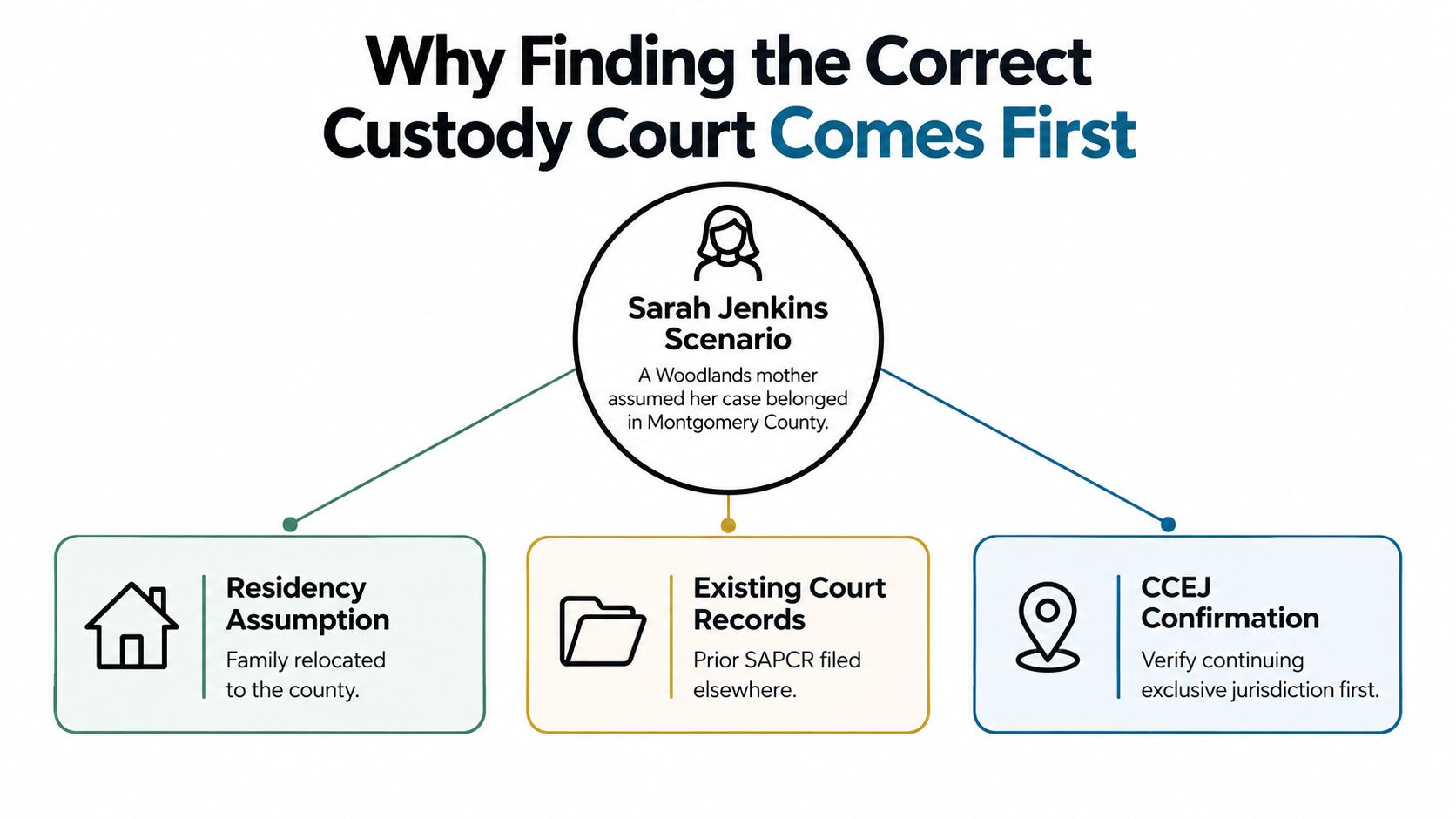
Sarah Jenkins, a hypothetical Woodlands mother, believed her custody case automatically moved with her family. She and her child had relocated to Montgomery County, the child attended school locally, and the other parent had begun communicating about the case through a nearby court. Sarah filed in Montgomery County without first confirming which court had continuing, exclusive jurisdiction.
The opposing parent objected. The problem wasn't necessarily that Montgomery County lacked a connection to the child. Sarah had started with the wrong court and the wrong assumption. She spent months addressing objections and procedural delays that could have been avoided by reviewing the prior SAPCR order and the state records before filing.
CEJ follows the existing final order
Texas establishes continuing, exclusive jurisdiction, often called CEJ or CCEJ, in the court that renders the final order in a suit affecting the parent-child relationship. That court generally retains authority over later custody, possession, access, conservatorship, support, modification, and enforcement proceedings.
The child's move to The Woodlands doesn't, by itself, replace that court. Another Texas court generally can't modify or enforce the existing order until the case is transferred under Chapter 155 of the Texas Family Code. The Texas Family Code Chapter 155 transfer provisions are more specific than ordinary venue rules.
Practical rule: Confirm the court connected to the final SAPCR order before preparing a Montgomery County petition or motion.
The state's Uniform Support/Vital Statistics records and the prior SAPCR orders are important starting points. Check the cause number, the court designation, the final order, and any later modification or enforcement orders. If records conflict, treat that conflict as a jurisdiction issue, not a clerical detail.
Signing and docketing are different events
A transfer order signed by the original court doesn't complete the jurisdictional shift. Docketing in the Montgomery County receiving court marks the critical milestone. Until the case is docketed there, the original CEJ court retains authority during the transfer process and may issue temporary orders.
Once Montgomery County dockets the transferred case, authority moves to that court. Montgomery County becomes the new CEJ court, and the proceeding continues as though it had originally been filed there. For a local explanation of how venue and court location can differ, review which family court venue applies in The Woodlands and Conroe.
The Procedural Steps to Transfer Your Custody Case
A transfer usually works best when the filings follow the statutory sequence. Skipping a step can give the other parent a procedural objection even when the child has lived in Montgomery County for the required period.

Start with the existing CEJ court
First, identify the court of continuing, exclusive jurisdiction through the state records and the prior SAPCR orders. Don't rely only on the child's address, the location of the current school, or where either parent now works.
Next, file the appropriate modification or enforcement proceeding in the CEJ court. A transfer motion generally belongs within that proceeding. Filing a new case directly in Montgomery County before the original court transfers the matter can leave the new court unable to exercise authority over the existing custody order.
The sequence is generally:
- Confirm the court: Locate the final SAPCR order and verify the current CEJ court.
- File the proceeding: File the modification or enforcement action in that court.
- Serve the parties: Properly serve the opposing parent and other required parties.
- Move for transfer: File a timely motion under Texas Family Code §§155.201 through 155.204.
- Prove residence: Show that the child has lived in Montgomery County for at least six months when relying on the mandatory residence-based route.
- Obtain the order: Secure a signed transfer order from the CEJ court.
- Confirm docketing: Verify that the Montgomery County court has docketed the case before treating the transfer as complete.
The Montgomery County family court filing forms guide for The Woodlands can help you identify filing components, but forms don't replace jurisdiction analysis.
Treat the response deadline as part of the transfer
The respondent generally has 20 days after service, or the first Monday after the expiration of 20 days, to respond to a transfer motion, as described in Texas Family Code Chapter 155 and the state litigation materials. The court must also act within the statutory period after the motion is properly presented.
That timing makes service and presentation important. A motion that sits unserved, is presented incorrectly, or is filed without the underlying proceeding can create avoidable disputes about whether the request was timely.
When the statutory residence conditions are met and the motion is procedurally proper, the transfer is ordinarily mandatory rather than a matter of general judicial preference. The receiving court then handles the case going forward. The Texas litigation essentials guide discussing Chapter 155 transfers describes the practical sequence and the importance of identifying the existing CEJ court first.
Mandatory Versus Discretionary Transfer Paths Explained
Texas law provides more than one possible route to Montgomery County. The mandatory residence-based path and the discretionary convenience-based path serve different situations, and confusing them can weaken the motion.
The mandatory residence-based route
A court with CEJ must transfer a modification or enforcement proceeding to another Texas county when the child has resided there for at least six months or longer, provided the statutory conditions and timing requirements are satisfied. For a child living in The Woodlands, that means the residence evidence must connect the child to Montgomery County for the full statutory period.
This route is more predictable because the transferring court generally has a mandatory duty when the requirements are established. The judge isn't merely weighing whether Montgomery County seems more convenient. The court must first determine whether the motion is the correct type of proceeding, whether it was timely, whether the proper court has CEJ, and whether the residence requirement has been proven.
Residence proof may include:
- School records: Enrollment, attendance, registration, and address records.
- Medical records: Records identifying the child's provider and Montgomery County treatment location.
- Housing records: A lease, utility records, or other documents connecting the child's household to the county.
- Care records: Childcare or activity records showing the child's regular local presence.
- Sworn testimony: A parent's sworn residence statement supported by documents rather than presented alone.
The discretionary convenience route
Texas Family Code §155.202(b) allows a court to order a discretionary transfer for the convenience of the parties and witnesses and in the interest of justice. This route may matter when the six-month residence requirement is disputed or hasn't been established, but the family's practical connections strongly favor Montgomery County.
For example, both parents may live in or near Montgomery County, the child's school and healthcare providers may be located there, and most relevant witnesses may work or reside there. Those facts can support a request, but they don't guarantee one.
| Transfer route | Main showing | Court's role |
|---|---|---|
| Residence-based | Child has lived in Montgomery County for at least six months and statutory requirements are met | Generally mandatory |
| Convenience-based | Parties, witnesses, and the interests of justice favor Montgomery County | Discretionary |
The Texas Family Law Practice transfer discussion addresses the discretionary convenience framework. A strong motion should identify the witnesses and explain why Montgomery County is materially better suited to handle the proceeding, rather than merely stating that the child now lives there.
Evidence and Motion Requirements for Montgomery County Transfers
A residence-based transfer depends on proof, not just a parent's statement. Before filing, assemble documents that cover the child's residence continuously throughout the claimed period. Gaps can give the opposing parent an opening to argue that the statutory requirement hasn't been established.
Build a document record that tells one consistent story
Useful evidence can include:
- School documents: Enrollment confirmations, attendance histories, registration forms, and school correspondence.
- Medical documents: Pediatric, dental, counseling, or specialist records showing the child's local care.
- Childcare documents: Provider records, invoices, attendance information, or enrollment paperwork.
- Housing documents: Lease agreements, renewal documents, or other residence records.
- Utility documents: Bills or service records tied to the child's household.
- Sworn residence evidence: An affidavit or declaration identifying where the child lived and the relevant dates.
- Prior court documents: The final SAPCR order, later orders, cause information, and docket records.
- Witness information: Names and contact details for people who can verify residence or local connections.
The documents should agree about the child's address and dates. A lease in a parent's name may help, but it doesn't alone prove where the child lived. School and medical records can be more persuasive when they identify the child directly and cover the relevant period. More guidance on assembling records appears in this Texas child custody evidence checklist.
Draft the motion around the statutory elements
A motion under Texas Family Code §§155.201 through 155.204 should identify the existing CEJ court, the underlying SAPCR proceeding, the requested modification or enforcement action, and the factual basis for transfer. It should also state the child's Montgomery County residence and identify the supporting records.
Sample language might read:
Requested relief: Movant asks the Court to transfer this modification or enforcement proceeding to the appropriate court in Montgomery County under Texas Family Code Chapter 155 because the child has resided in Montgomery County for at least six months and the statutory requirements for transfer have been met.
That language is only a starting point. The filing should identify the specific orders and attach or reference admissible evidence. It should also address service and the timing requirements under §155.204.
Common drafting failures
A motion may face resistance when it:
- Names the wrong court: The filing doesn't establish which court has CEJ.
- Uses an incomplete residence period: The evidence covers only part of the claimed time.
- Files the wrong proceeding: The request doesn't clearly qualify as a modification or enforcement action.
- Omits service information: The record doesn't show proper notice to the respondent.
- Files directly in Montgomery County: The parent assumes current residence gives the receiving court immediate authority.
- Treats consent as essential: The other parent's refusal doesn't necessarily defeat a qualifying mandatory transfer, but the motion still must satisfy the statute.
The court needs a complete procedural record. A persuasive argument can't cure an absent transfer order, defective service, or missing residence proof.
Jurisdictional Consequences After Transfer to Montgomery County
The transfer changes more than the courtroom address. It changes which Texas court has authority over the child and the existing order.
Before docketing, the original CEJ court retains authority during the transfer process. That court can issue temporary orders while the transfer is pending. A parent should therefore avoid assuming that a Montgomery County filing, hearing request, or signed transfer order has already shifted jurisdiction.

What changes after Montgomery County dockets the case
Once the case is docketed in the Montgomery County receiving court:
- Montgomery County becomes the new CEJ court.
- The proceeding continues as though it began there.
- The transferred order keeps the same legal effect.
- The receiving court enforces the order as though it entered it.
- The original court loses jurisdiction over the child.
The original court no longer retains authority to enforce violations occurring before or after the transfer. That doesn't erase the existing order or make past conduct irrelevant. It means enforcement authority follows the case to Montgomery County after docketing.
CEJ is not identical to ordinary venue
Texas Family Code Chapter 103 provides venue mechanics for an original suit filed in the wrong county when no other court has CEJ. When parties or children are located in different counties, the statute gives priority to the court with CEJ and then, when applicable, the child's county of residence.
That distinction matters in Montgomery County. A parent may have a strong venue argument based on The Woodlands residence, but venue doesn't automatically displace an existing CEJ court. Review the Texas Family Code Chapter 103 venue rules before treating a new Montgomery County filing as a substitute for transfer.
Timelines, Fees, and Common Defenses in Montgomery County Practice
Families often want a firm answer about how long a transfer will take or what the filing fee will be. No universal processing timeline or filing-fee amount is established in the verified Chapter 155 materials for every Montgomery County transfer. The clerk's office and the applicable local procedures should be checked for current administrative requirements.
The statutory response period still matters, even though the overall schedule can vary. Service, presentation of the motion, objections, hearings, and the receiving court's docketing process can all affect when the case moves.
Defenses that commonly change the course of a transfer
The other parent may argue that:
- The motion was untimely: The response or presentation deadlines weren't followed.
- Residence wasn't proven: The records don't establish the child's residence for the required period.
- The wrong court was identified: A different court may hold CEJ based on the final order.
- The proceeding doesn't qualify: The filing may not be a modification or enforcement action under Chapter 155.
- Convenience is insufficient: A discretionary request may not show why the transfer serves the parties, witnesses, and interests of justice.
- Another jurisdiction is involved: Interstate facts may require a separate UCCJEA analysis.
A parent shouldn't respond to these objections by filing a second case in Montgomery County. That can create competing filings instead of fixing the original jurisdiction problem.
Enforcement during the transition
Before docketing, the original court remains the court with authority during the transfer process. After docketing, Montgomery County becomes the court handling enforcement. Keep copies of the existing order, communications, missed exchanges, and other relevant records, and seek advice before taking self-help action.
A Child Custody Lawyer in The Woodlands, TX may provide custody and conservatorship representation for The Woodlands families. Whether you consult counsel, a clerk, or another qualified resource, ask specifically how the transfer status affects the next filing.
Your Immediate Next Steps and FAQ Guidance
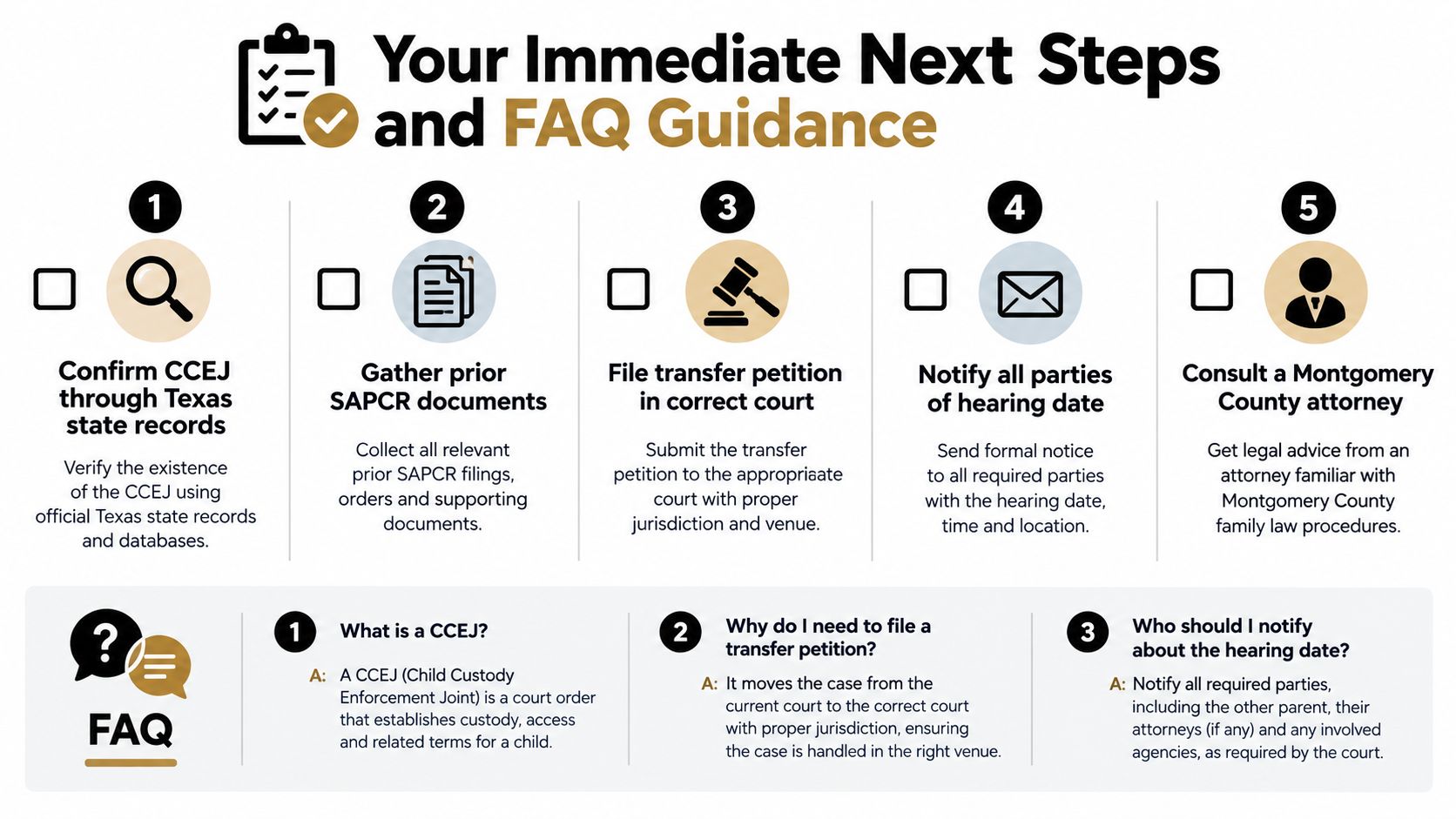
A transfer request becomes easier to evaluate when you separate jurisdiction, residence, procedure, and proof. Use this checklist before filing anything in Montgomery County.
What to do next
- Confirm the current CEJ: Review the final SAPCR order and Texas state records.
- Gather residence evidence: Collect school, medical, childcare, lease, utility, and sworn-residence records covering the child's time in Montgomery County.
- Consult Montgomery County counsel: Ask an attorney to evaluate the court, proceeding type, service, timing, and evidence.
- File in the correct court: Begin the modification or enforcement case in the CEJ court and file the transfer motion there when appropriate.
- Prepare for defenses: Organize proof addressing timeliness, residence, competing court authority, and any convenience argument.
Frequently asked questions
Does interstate jurisdiction prevent a Montgomery County transfer?
It can affect the analysis. Texas may retain CEJ under the Uniform Child Custody Jurisdiction and Enforcement Act unless the required Texas connections and evidence have ended or the relevant people no longer reside in Texas. A parent should identify any out-of-state orders, residences, or pending cases before filing.
Can an emergency custody request bypass the transfer process?
An emergency may require immediate legal attention, but emergency authority and a permanent or ongoing transfer are separate questions. Don't assume an emergency filing automatically changes CEJ. Tell counsel about the specific safety concern, the existing order, and the location of the child and parents.
What if the other parent refuses to consent?
Consent isn't the only path. A qualifying residence-based transfer can be mandatory when the statutory requirements and timely procedure are satisfied. The other parent can still challenge the evidence, timing, court identification, or legal basis, so refusal should be answered with a properly supported motion rather than an informal agreement or a direct filing in Montgomery County.
This article is not legal advice. Texas jurisdiction and transfer rules can turn on the exact final order, the filing type, service history, residence evidence, and facts involving other states or counties. Parents in The Woodlands, Conroe, and nearby Montgomery County communities should obtain advice about their own records before acting.
The Law Office of Bryan Fagan helps families address custody, conservatorship, modification, and enforcement matters involving Montgomery County and The Woodlands. To discuss whether your case should be transferred and what must happen before filing, visit The Law Office of Bryan Fagan to schedule a consultation.
