 Skip to content

The Woodlands Township is a special-purpose district created under Texas law, not an incorporated city, so its powers come only from state law and its governing documents. It's governed by a seven-member Board of Directors elected at large to two-year staggered terms, and that board still doesn't run a municipality.
So when a drainage ditch backs up behind your fence, or you need a protective order enforced at two in the morning, which government do you call? Most residents answer "The Woodlands," and that's the gap. A Woodlands mailing address tells the post office where you live. It doesn't tell you who holds legal authority over your problem.
That distinction sounds academic until you're filing something. Then it decides which clerk takes your petition, which agency writes the report, and which office holds the record you need. Understanding The Woodlands Township is not a city, and what that means legally, is mostly a routing exercise: match the subject matter to the body that has power over it.
What The Woodlands Township Is and Is Not
Think of a contractor holding a permit for electrical work only. That contractor can do real, licensed work, but the permit lists the activities, and anything outside the list is off limits. A city holds something closer to a general license. The Township holds the itemized permit.
The community itself was founded in 1974, and the current governmental structure began on January 1, 2010, when three community associations and the Town Center Improvement District consolidated into one public organization, according to the Township's governance history. The Texas Legislature had created that improvement district in 1993 to promote economic development in a 1,000-acre business and commerce district.
How the Township is governed
Residents elect a seven-member Board of Directors at large, with two-year staggered terms, and the Board acts as the legislative body, sets policy and approves the budget, as described on the Township's About page. For financial reporting, the Township is treated as an independent political subdivision because it has a separate elected governing body, is legally separate and is fiscally independent of other governments.
That's a real government with real money. It just isn't a city, and The Woodlands remains unincorporated within Montgomery County.
Township and incorporated city powers compared
| Legal feature | The Woodlands Township | Incorporated Texas city |
|---|---|---|
| Legal status | Special-purpose district created by state law | Municipality incorporated under Texas law |
| Source of authority | Only powers granted by state statute and governing documents | General municipal powers, with home-rule authority where adopted |
| Governing body | Seven-member elected Board of Directors, two-year staggered terms | Elected council or commission with a mayor |
| Ordinance-making power | Limited to statutory and governing-document powers, mainly rules on property the Township owns | Citywide ordinances on local matters within state law |
| Municipal court | Cannot create a municipal court | Can establish a municipal court |
| Police | Financially supplements county law enforcement, cannot hire officers directly | Typically operates its own police department |
| Zoning | No citywide zoning ordinance, land-use limits come mainly from county rules and deed restrictions | Citywide zoning under municipal ordinance |
| Taxing | Property, sales and hotel taxes as authorized by statute | Property, sales and other taxes under municipal authority |
| Annexation | Cannot annex land | Can annex adjacent land under state procedures |
| Eminent domain | Only as granted by the enabling statute | Broad power for public purposes, subject to state limits |
Two rows surprise people most. No municipal court means there's no "Woodlands city court" to hear a local violation. No annexation power means the Township can't absorb your neighborhood, so any annexation pressure comes from a neighboring city instead.
Practical rule: if your issue involves a citywide ordinance, a city court or a city police officer, the responsible body is usually a county or state agency, not the Township.
The table describes general Texas rules. To test any specific authority claim, find the enabling statute, read the Township's governance pages, then check recent Board minutes and the adopted budget for what the Township does today.
Who Handles Police, Roads, Utilities and Protective Orders
Law enforcement here is a county responsibility. The Township doesn't run an independent police department. It financially supplements services supplied by the Montgomery County Sheriff's Office and the Harris County Constable's Office, Precinct 4, and a Texas Ethics Commission analysis cited on the Township's law enforcement page describes the Township as having limited authority, unable to create a municipal court, and prohibited from directly hiring law-enforcement personnel or creating a police department.
An incident inside The Woodlands still belongs to the county agency serving that address. Calling "the Township police" gets you nowhere, because no such department exists.
Who handles each common issue
| Issue | Responsible body | Where to start |
|---|---|---|
| Police report or criminal investigation | Montgomery County Sheriff's Office, or Harris County Constable Precinct 4 for Harris County addresses | Agency serving the address |
| Protective order | Texas Family Code matter, court clerk for the county covering the address | Confirm filing route with the county office |
| Road maintenance and traffic enforcement | County and state transportation authorities | County road office or state agency |
| Water, wastewater and stormwater | Municipal utility district serving the property | Name printed on the water bill |
| Parks and Township-owned amenities | Woodlands Township | Township office and public Board records |
| Deed restrictions and association rules | Private associations, then the courts | Association covenants and governing documents |
| Building permits | County office covering the parcel, plus association covenant review | Confirm requirements with that county office before starting work |
| Township Board election | Township Board of Directors seats filled at large by resident vote | Confirm with the county elections office |
| Probate filing | Montgomery County Clerk (confirm county of residence) | Clerk's office |
| Divorce and custody | Montgomery County district courts (confirm county) | Clerk and court filing requirements |
Protective orders run through the county
A protective order is a Texas Family Code matter, not a Township service. In Montgomery County, a protective order case is filed through the County Attorney's Office and requires attending at least one preparation appointment and one court appearance. Plan for that time before you assume the process finishes in a single visit.
If you're weighing an application, our walkthrough of the Montgomery County protective order process and the County Attorney's role for Woodlands residents explains the sequence in more detail. For enforcement of an order already issued, call the county agency serving your address, since that's who responds.
Two habits save days of frustration. First, keep the water bill handy, because the municipal utility district named on it is your drainage and sewer contact. Second, when someone tells you "that's a Township rule," ask which document says so, and whether it applies to Township-owned property or to your lot.
Taxes, Annexation and Eminent Domain Explained
Not being a city doesn't mean the Township lacks taxing power. Township planning materials identify authority to collect sales tax, hotel or room tax, and property tax, and the official governance history explains that the 2007 arrangement contemplated funding more services through sales taxes while maintaining a property-tax mechanism.
Rates and service responsibilities shift with each budget cycle. Pull your parcel's current tax statement and read the adopted budget published on the Township's official website before you quote any figure to a spouse, an executor or a buyer.
Annexation comes from a neighbor, not the Township
A city may annex adjacent unincorporated land only through the procedures in Texas Local Government Code, Chapter 43. The Township can't annex anything. So if you're worried about your property being absorbed into a municipality, watch the neighboring cities and their statutory steps, not the Township Board agenda.
Eminent domain depends on the enabling statute
A city's condemnation power is broad but bounded by state law. A special district can condemn only if its enabling statute grants that power. When a road, drainage or easement project touches your lot, ask the proposing entity to identify the statute it's acting under, in writing, before you sign anything.
Unpaid taxes and district assessments come out of the property's net value, whether you're dividing it in a divorce or distributing it in an estate.
That's why the tax statement belongs in your file early. Our guide to property tax proration in a Montgomery County divorce shows how those numbers get allocated between spouses.
A short owner's checklist:
- Pull the current tax statement: confirm every taxing unit listed for the parcel, including the Township and any utility district.
- Match the bill to the service: the entity charging you is usually the entity you call about that service.
- Watch the mail for project notices: road, drainage and easement letters carry deadlines that don't wait for your divorce to end.
What Incorporation Would Change and What Would Stay the Same
Residents rejected incorporation in the November 2021 election, with Township materials reporting a roughly two-to-one vote to retain the existing structure, as noted in the Township's strategic planning workshop documents. That vote didn't make The Woodlands a city, and the Township keeps operating through its elected Board on property, sales, hotel-occupancy and other authorized revenues.
The pathway stays open, though. Those same Township materials describe the Township's ability to call an incorporation election, and state that approved incorporation would dissolve the Township as the existing entity while transferring its assets, liabilities, obligations, tax authorizations and functions to a successor city. Confirm the dissolution and transfer terms in the enabling statute before relying on them for a specific transaction.
Test the claims against a drainage complaint
Say a homeowner in Panther Creek watches water pool along the back lot line after every heavy rain. Today that call goes to the municipal utility district named on the water bill, and the county handles road-side drainage.
Would a future city fix it faster? Maybe, maybe not. Township materials identify potential city responsibility for law enforcement, courts, road maintenance, public works and services then provided by municipal utility districts, which means the duty could shift, stay split, or land on the city with a transition schedule attached. Anyone promising a specific outcome is guessing at terms nobody has drafted yet.
What wouldn't change
County courts keep hearing cases. The Texas Family Code and Texas Estates Code keep supplying the rules. Deed restrictions stay enforceable through the associations and the courts. Probate still starts at the county clerk's office.
If you own high-value property or have a probate or divorce pending, track assessments, liabilities and service obligations rather than the political argument. Those line items affect what your assets are worth and who owes what, whichever structure voters choose next time.
How the Status Affects Family Law, Probate and Property Records
A couple in Alden Bridge is divorcing. One spouse wants to list the house before the case ends. The first question isn't whether The Woodlands is a city. It's which court controls the case and which records office controls the property.
Divorce, custody, child support and property division are governed by the Texas Family Code. The Township's status doesn't rewrite those rules or create a separate local family court. Probate and estate administration run under the Texas Estates Code, statewide, with no Woodlands exception.
The county line decides your clerk
Part of The Woodlands extends into Harris County, so confirm which county covers the property address before filing anything. Because the community is an unincorporated special-purpose district rather than a city, the Township's incorporation materials explain that the relevant forum in family-law, probate or property disputes is generally a Montgomery or Harris County court, not a "Woodlands city court." Venue, filing requirements and governmental records follow county and statutory jurisdiction.
Residents of The Woodlands file probate at the Montgomery County Clerk's office in Conroe, at 210 W Davis St. For civil and family matters, it also helps to know which bench hears what, and our explainer on Montgomery County court-at-law jurisdiction sorts out the difference between the district courts and the county courts at law.
Back to the Alden Bridge house
The spouse who wants to sell has three things to check, in order:
- Confirm the county covering the property address, since that sets the clerk and the recording office for the deed.
- Confirm the court and any standing order in the divorce that restricts selling, transferring or encumbering community property.
- Gather the paper before listing: tax statements, the deed, and the association's covenants and any transfer requirements.
A wrong county or a missing record can stall a case longer than any argument about the merits.
Notice what the Township never touches in that sequence. It doesn't grant the divorce, doesn't record the deed, and doesn't clear the sale. Treating it as a city hall sends you to the wrong counter, and the clock keeps running while you're redirected.
Permits, Elections and Where to Find the Rules
A citywide ordinance in a nearby municipality isn't automatically a rule in The Woodlands. Identify the source of the rule before you go looking for the answer, or you'll spend an afternoon reading requirements that don't apply to your lot.
Work through four steps, in this order:
- Name the governing body. Use the routing table to decide whether your issue belongs to the county, a utility district, an association or the Township.
- For Township authority, read the record. Check the Township governance pages for Board minutes, the adopted budget and published policies, and trace the power to the statute that grants it. Township rule-making generally reaches property the Township owns, not every yard in the community.
- For county rules, go to the county. Use the county's official website and the office named for your parcel, and ask early whether a deed restriction or association covenant applies, because private covenants often control what you can build even where public rules are quiet.
- For state law, read the code and chapter. The Texas Estates Code is the starting point for probate and estate administration questions, and the statutes site lets you read the current text rather than a summary.
Permits
Building and land-use permissions depend on the parcel. Confirm requirements with the county office covering the property and with the association before you order materials or hire a crew. A fence, a pool or an addition can trigger covenant review even when the public permitting step is simple.
Elections
Township directors are elected at large, so confirm voter eligibility, registration status and election dates with the county elections office rather than assuming a city-style election calendar.
Keep a short record of every source you rely on: the Township order or policy, its date, and the statute cited. If a dispute follows, that note shows the basis for your decision, and it's far easier to produce than a memory of a phone call.
Confirm the Jurisdiction Before You Act
Run this checklist before you file, sign or pay:
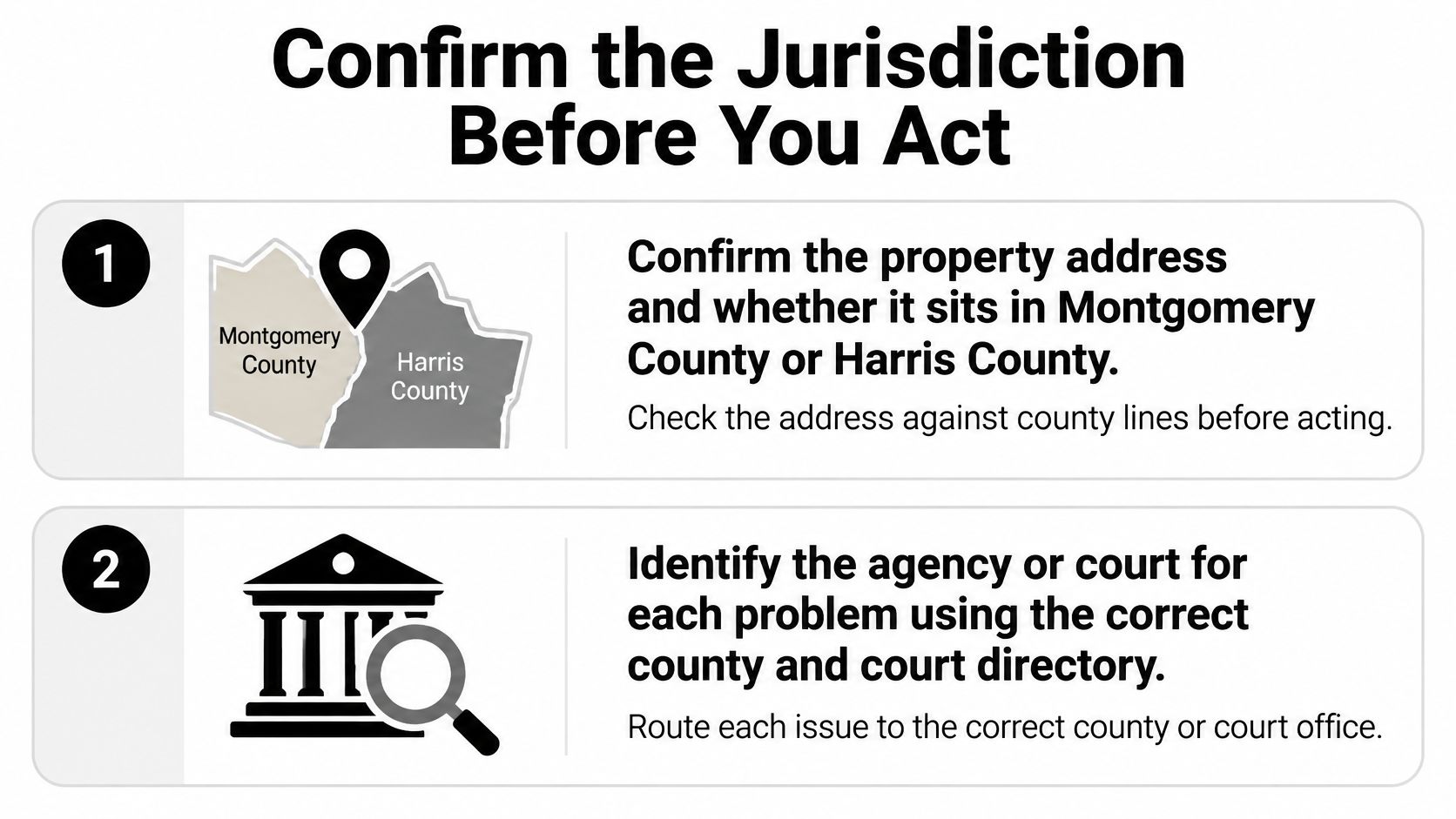
- Confirm the property address and whether it sits in Montgomery County or Harris County.
- Identify the agency or court for each problem using the routing table.
- Check Township governance pages, Board minutes and the adopted budget for any question about Township authority.
- Read the relevant statute: the Texas Family Code for family cases, the Texas Estates Code for probate and estate administration.
- Confirm deadlines with the county clerk, the sheriff's office or the utility district before acting.
The two steps that trip people up are the first two, so it's worth seeing them side by side.
When to bring in an attorney
Some situations reward a conversation early rather than after a filing mistake. Reach out if you're facing a contested divorce, a custody modification, a high-asset property division, a probate dispute, a condemnation or easement notice, or a question about how a future incorporation vote could affect a pending case.
This article is general information, not legal advice, and every case turns on its own facts. Nothing here creates an attorney-client relationship or substitutes for advice about your specific property, county and court.
If a short video walkthrough helps you picture how these routing questions come up in practice, this one is a useful companion to the checklist.
The Law Office of Bryan Fagan serves The Woodlands and Montgomery County families in divorce, custody, child support, property division and probate matters. Our office is at 25211 Grogans Mills Rd, Suite 275, The Woodlands, TX 77380, and you can reach us at 281-819-1726. When you're ready to talk through your situation, you can schedule a consultation through the website form or by stopping by the Woodlands office.
Sorting out which county, clerk or agency controls your case is the unglamorous first step in almost every Woodlands family matter, and it's the step we handle before anything gets filed. The Law Office of Bryan Fagan works with families across Panther Creek, Alden Bridge, Sterling Ridge and Creekside on divorce, custody, support, property division and probate, including the tax statements, deeds and district obligations that come with a Woodlands address. If you'd like a plain answer about where your case belongs and what to gather next, visit The Law Office of Bryan Fagan and set up a time to talk.
