 Skip to content
A slip and fall in The Woodlands usually gives you two years to file an injury lawsuit under Texas Civil Practice and Remedies Code section 16.003. The strongest claims prove both that the property owner had notice of the hazard and that the injured person wasn't more than 50% responsible for the fall.
You may be sitting at home right now with a swollen hip, a stiff back, or a growing stack of medical bills, while an insurance adjuster asks questions designed to make the incident sound like your fault. Maybe you fell at a grocery store near Lake Woodlands Drive, in an apartment common area, at a restaurant, or on a poorly lit parking lot.
The legal issue isn't whether you were hurt. A Texas premises-liability claim usually depends on the hazard, the owner's actual or constructive knowledge, the failure to fix or warn, and the percentage of fault assigned to you. This guide is a practical playbook for your first week in The Woodlands and Montgomery County.
When a Slip and Fall Happens in The Woodlands
A resident stops at a grocery store off Lake Woodlands Drive and steps onto wet tile. She lands hard on her hip. The manager points toward a caution sign and offers to throw away the mop bucket before she leaves.
Within hours, the situation may include a fractured hip, mounting medical bills, and missed time from work at an office in The Woodlands Town Center. The store may already be suggesting that the warning sign solves the problem, even though the sign's location, timing, and visibility still matter.
That is where the legal analysis begins. A slip and fall in Montgomery County is generally a premises-liability claim, not an automatic payout. The two questions driving the claim are whether the property owner knew or should have known about the dangerous condition and whether the injured person shares responsibility for the way she walked, what she could see, or where she chose to go.
The public-health stakes are serious, especially for older residents. The CDC's fall injury data reports that adults age 65 and older suffer over 14 million falls each year, roughly 1 in 4 older adults. About 37% of those falls cause an injury requiring medical treatment or restricting activity for at least one day, and the CDC estimates about 9 million fall injuries annually among older adults. The reported fall death rate for this group rose from 64.7 per 100,000 in 2018 to 78.4 per 100,000 in 2024, a 21% increase.
The evidence starts disappearing immediately
The store's report may leave out the condition of the floor. Surveillance footage may be overwritten. Employees may remember less as time passes, and the hazard may be cleaned, repaired, or moved before anyone photographs it.
Practical rule: Treat the first seven days as an evidence-preservation period, not a waiting period.
A strong claim connects the injury to a specific condition and builds a timeline showing when that condition existed. Photos, witness names, incident records, maintenance logs, and medical documentation all help answer the notice and causation questions.
What to Do Right After the Fall
Start with your health. Get evaluated at Memorial Hermann The Woodlands or an urgent care, even if the pain seems manageable. Adrenaline can mask an injury, and a gap between the fall and treatment gives an insurer an opening to argue that something else caused your symptoms.

Before leaving the scene, document what you can safely document. Take photos and short video of the exact hazard, the surrounding floor, lighting, aisle or walkway layout, warning signs, and your visible injuries. Include wide shots that show where you were walking and whether an employee could reasonably see the condition.
Follow the evidence trail
Ask a manager to create a written incident report. Request the business's claim number and insurance contact, then read the report before signing anything. Don't guess about details, accept language that blames you, or give a recorded statement to an insurer without legal advice.
Collect names and phone numbers for shoppers, employees, or anyone else who saw the fall or noticed the condition beforehand. Keep the shoes and clothing you wore in the same condition, because the defense may later question traction, footwear, or whether the clothing was damaged during the incident.
Save every receipt connected to the injury, including medical visits, prescriptions, parking, and rideshares. Those records help document out-of-pocket losses and show how the injury affected your routine.
- Get medical care: Tell the provider exactly when and where you fell.
- Preserve the scene: Photograph the hazard before it changes, if you can do so safely.
- Report the incident: Obtain a copy or identifying information for the business report.
- Protect communications: Don't provide recorded statements or sign a release before review.
- Organize records: Keep medical bills, receipts, photographs, messages, and witness contacts together.
If the fall involved a vehicle incident in the same period, keep those records separate and obtain advice from a car accident lawyer in The Woodlands. A different legal theory may apply. Separately, Child Custody Lawyer in The Woodlands, TX concerns custody and conservatorship representation for The Woodlands families, not premises liability.
How Texas Premises Liability Law Treats Your Case
Most shoppers, diners, tenants, and business visitors enter as invitees. Texas generally gives invitees the highest level of premises protection. A property owner or occupier typically must address known or discoverable hazards by correcting them or providing a reasonable warning. Texas materials describe the visitor categories as invitees, licensees, and trespassers, with the duty changing based on that status. The Texas premises-liability overview explains the framework and uses the wet grocery aisle example.
Notice comes in two forms. Actual notice means an owner, manager, or employee knew about the condition. Constructive notice means the condition existed long enough that reasonable inspection should have discovered it. A manager seeing a spill and walking past it supports actual notice. Footprints, track marks, inspection records, witness testimony, or video may help establish how long a condition remained for constructive notice.
The difficult question is often time. A nearby employee alone doesn't necessarily prove the store should have discovered the hazard. The claim needs evidence connecting the condition to a reasonable opportunity to find and correct it.
Proportionate responsibility changes the value
Texas Civil Practice and Remedies Code section 33.001 can reduce recovery according to the injured person's assigned fault and can bar recovery when that person is found more than 50% responsible. That rule damages many otherwise promising claims.
For example, if a jury finds a store 80% at fault, the award is reduced by the injured person's 20% share. The result changes sharply if the defense moves that allocation to the cutoff. A phone, footwear, poor visibility, an open-and-obvious argument, or choosing a particular route can become part of the insurer's fault case.
| Legal Element | Standard | Impact on Recovery |
|---|---|---|
| Visitor status | Invitee, licensee, or trespasser classification | Determines the property owner's duty |
| Dangerous condition | A condition created an unreasonable risk | Identifies the physical basis of the claim |
| Notice | Actual knowledge or a reasonable opportunity to discover it | Connects the owner to the hazard |
| Warning or correction | The owner failed to make the condition safe or warn | Supports breach of duty |
| Proportionate responsibility | Fault is assigned among the parties | Reduces recovery or may bar it |
| Injury and causation | Medical evidence links the fall to the harm | Establishes damages |
Montgomery County litigation can involve the 410th and 457th District Courts in Conroe, and local court procedures affect how a case moves. Local knowledge can also matter during negotiations, just as readers handling unrelated family matters may consult a guide to Montgomery County Family Courts to understand how family-law cases proceed in courts serving The Woodlands. A vehicle injury requires a different evaluation, which is why a motorcycle accident lawyer in The Woodlands may be relevant to that separate type of claim.
What Your Claim May Actually Be Worth
No attorney can responsibly price a slip-and-fall claim from the injury label alone. The property type, hazard timeline, medical proof, future impairment, available insurance, and comparative fault all affect negotiations.
A 2026 settlement analysis reported that 22% of slip-and-fall claims involved surgery, 72% resolved before a lawsuit, the median settlement was $31,500, and the average settlement was $48,700. Those figures come from the 2026 slip-and-fall settlement analysis, but they aren't a promise about any individual case.
The same caution applies to setting. A separate premises-liability settlement analysis reported incident rates per 1,000 visits of 4.1 in medical facilities, 3.2 in restaurants, 2.8 in grocery stores, and 2.1 in shopping malls. Its average settlement ranges rose from roughly $50,000 to $110,000 in restaurants to $200,000 to $450,000 in medical facilities. Commercial properties represented 63% of claims in that dataset.
| Scenario | Typical Injury | Value Range | Biggest Swing Factor |
|---|---|---|---|
| Grocery spill | Soft-tissue injury | No reliable case-specific range can be stated from the verified data | Proof of notice, treatment consistency, and fault allocation |
| Restaurant wet floor | Fracture | No reliable case-specific range can be stated from the verified data | Surgery, permanence, warning evidence, and the hazard timeline |
| Commercial parking lot trip | Head trauma | No reliable case-specific range can be stated from the verified data | Medical proof, future impairment, lighting, and responsible parties |
Be cautious of any website offering a fixed estimate based solely on the location of the fall. Even a minor injury with clear notice can be difficult to value, while a serious injury may lose impact if the claimant cannot demonstrate the owner had time to discover the condition.
If the injured person dies before the claim resolves, estate administration may affect who can pursue or receive the claim. A Probate Lawyer in The Woodlands, TX handles probate administration and estate settlement in Montgomery County, which is a separate legal process from proving premises liability.
Working With a Slip and Fall Lawyer in The Woodlands
A first consultation should focus on facts, not sales pressure. Bring the fall date, location, photographs, medical records, receipts, witness information, communications from the business, and any insurance letters. The lawyer should identify the notice problem and the comparative-fault risk early.
Many personal-injury firms use contingency agreements, but the exact terms must appear in writing. Ask how attorney fees are calculated before suit and after litigation begins, who pays investigation and filing costs, and how medical bills or liens are handled from any recovery. No ethical attorney can guarantee a particular result.
Evidence preservation comes first
A lawyer may send preservation letters to the store, property manager, security company, or maintenance contractor. The request should cover surveillance, incident reports, inspection logs, cleaning records, maintenance records, and communications about the hazard. Timing matters because video and records can disappear or change before a formal lawsuit.
The investigation may include a site inspection, witness interviews, photographs of lighting and flooring, and review of the medical timeline. The lawyer then prepares a demand package explaining liability, notice, injury, treatment, lost income, and future consequences. Negotiation may resolve the claim, but filing suit becomes necessary when the insurer won't offer a fair amount or disputes the evidence.

Ask for the net recovery: A settlement number means little until fees, case costs, medical bills, and liens are explained.
The attorney should also discuss the filing deadline. Texas personal-injury claims generally must be filed within two years under Texas Civil Practice and Remedies Code section 16.003, as summarized in this Texas premises-liability limitations reference. A claim involving public property can raise separate notice issues, so don't assume the ordinary deadline answers every question.
Watch the process overview below, then ask how its general steps would apply to your store, apartment, restaurant, or parking-lot fall.
Choosing the Right Attorney for Your Situation
Choose a lawyer who treats the case as an evidence problem, not just an injury claim. The attorney should understand how to prove when the hazard appeared, who controlled the property, what inspections occurred, and how the defense may assign fault to you.
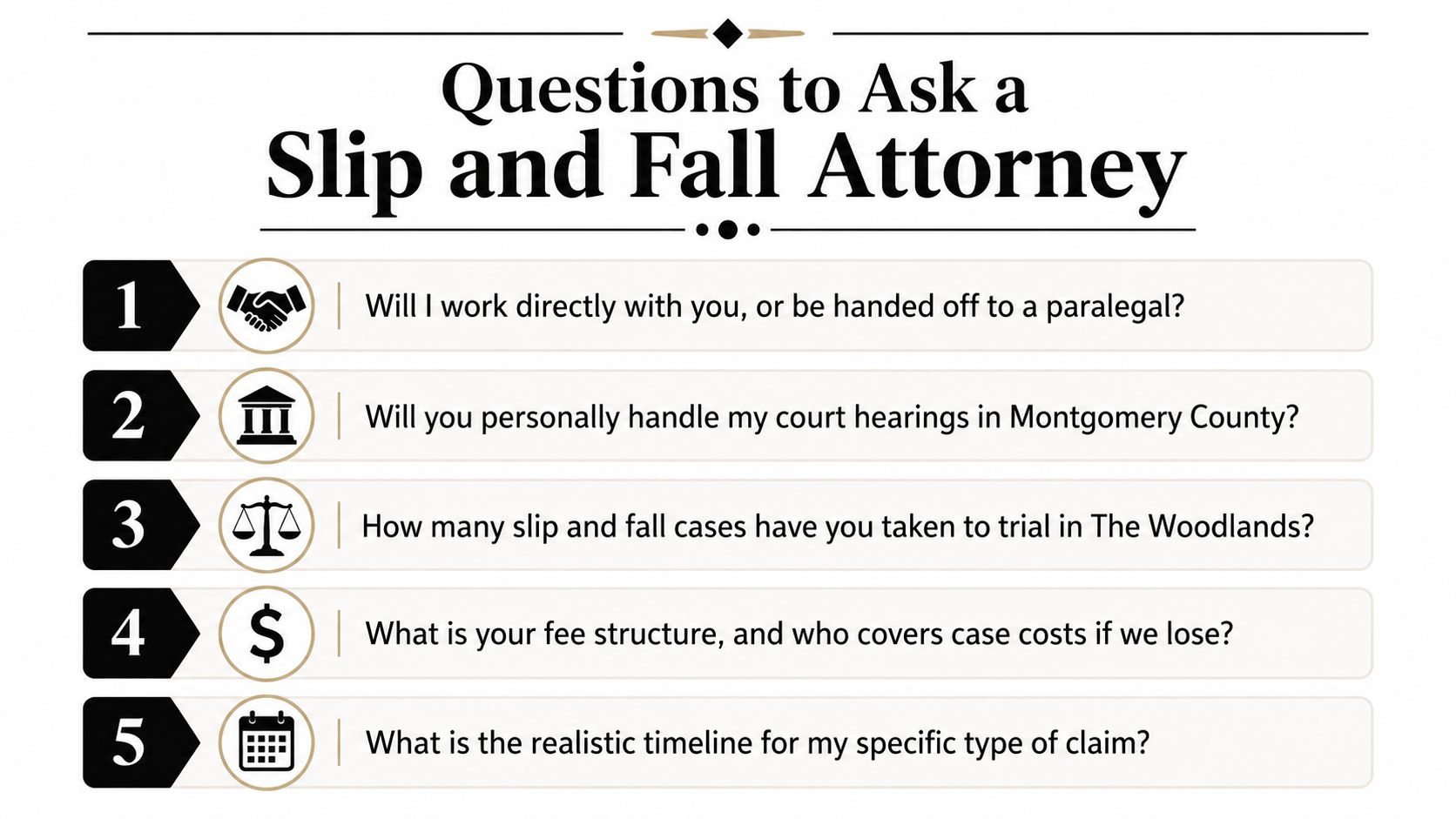
Ask direct questions before signing:
- Who handles my file? Will you speak with the attorney directly, or will every substantive question go to a paralegal?
- Who appears in court? If a hearing occurs in Conroe, will the attorney you meet personally handle it?
- What experience applies? Ask for a specific Texas premises-liability verdict or settlement discussion, without accepting vague claims about being experienced.
- Do you try cases? A firm that settles every file may have less influence when the insurer refuses to negotiate fairly.
- What are the costs? Confirm the fee structure, responsibility for case costs, medical bills, liens, and what happens if the case doesn't recover.
A lawyer's local familiarity can help with Montgomery County procedures, including the 284th District Court docket, mediation practices, and the way local claims professionals evaluate Woodlands incidents. That doesn't replace evidence. It helps the lawyer use the evidence in the right forum.
Be cautious if a lawyer pushes a quick release before treatment is complete, can't discuss a specific premises case, or advertises locally but refers files elsewhere.
Verify Texas Bar registration and review client feedback on Google and Avvo. Also ask whether the firm will seek surveillance and maintenance records before the business has an opportunity to discard or alter them.
For a broader injury evaluation, you can also review the role of a personal injury lawyer in The Woodlands, then confirm that the attorney has handled premises-liability notice and comparative-fault disputes specifically.
Your Next Steps and Local Help
Use this checklist during the week after the fall:
- Confirm treatment: Make sure medical records identify the fall, symptoms, diagnoses, and follow-up care.
- Secure evidence: Store photographs, videos, clothing, footwear, receipts, and witness contacts safely.
- Control statements: Don't give a recorded statement or sign a release for the property owner's insurer without review.
- Check the deadline: Confirm the two-year Texas limitations period under Civil Practice and Remedies Code section 16.003, and ask about any exception or public-property notice issue.
- Schedule a review: Speak with a qualified The Woodlands or Montgomery County premises-liability attorney while evidence is still available.
A local attorney may be better positioned to request incident reports from businesses such as Walmart, HEB, Kroger, and area restaurants, identify the property owner and maintenance contractor, and pursue inspection records. Local familiarity doesn't prove liability, but it can make early investigation more focused and help counsel understand Montgomery County litigation logistics.
Texas law also provides a narrow framework for exemplary damages. Under Texas Civil Practice and Remedies Code Chapter 41, exemplary damages generally cannot exceed the greater of two times economic damages plus noneconomic damages up to $750,000, or $200,000, subject to the statute's requirements and exceptions. Most slip-and-fall cases focus on compensatory damages, such as medical expenses, lost income, and pain, not punitive damages. If a claimant dies before resolution, the Texas Estates Code may affect estate administration and who can pursue or receive the claim.
This article is general information, not legal advice, and it doesn't create an attorney-client relationship. Your deadline, visitor status, evidence, medical history, and fault allocation require an individual review.
The Law Office of Bryan Fagan can review the facts surrounding a Woodlands or Montgomery County fall and discuss the evidence needed to evaluate notice, injuries, and comparative responsibility. Visit The Law Office of Bryan Fagan to request a consultation and take the next practical step.
